![]()
1
Introduction
Thirty-one propositions on changing museums: an introduction to the Glenbow case study
Michael M.Ames†1
The University of British Columbia Museum of Anthropology
Bob Janes records in detail his own experience as he and the Glenbow have attempted to grapple with some of the major issues confronting museums virtually everywhere today. For the Glenbow, the problem was exacerbated by a need to reduce its operating budget by 20 per cent, representing the loss of 31 positions and reduction of another 14 to part-time.
The Glenbow repositioning is still underway (according to Janes it will never end), so it is premature to judge its degree of success or to calculate the total cost of restructuring in money, time and people. As a case study, however, it poses pertinent questions for all organizations facing change. Janes found only modest help in the literature on organizational change because most of it was directed to the profit sector, and not-for-profits in the cultural sector belong to a different species. Ironically, Janes’s observations nevertheless have relevance for the profit and public sectors, as well as for museums.
Some general questions are posed by his account, along with a larger number applicable to the Glenbow itself. To what extent, for example, will organizational change occur according to plan, since many of the conditions institutions face – even if, as the Glenbow attempted, they anticipate them – are beyond their control? One of the great myths descending from the Enlightenment is that progress occurs through the application of reason and that planning will improve the lives of people. That may help to explain the popularity of various exercises to produce strategic plans, master plans, vision statements, etc. We think they are good for us, or are told they are good for us, so we construct them. Even more important, we cannot think of any other way to solve our problems, so we redraft our mission statements and make new plans. But how well do they work? They sometimes please governing authorities, though Janes was distinctly unimpressed by the Alberta government’s initial response to Glenbow’s five-year plan.
Planning may sometimes help to mobilize morale. This is known as the “Hawthorne effect,” one of the discoveries of a 1939 study of the Hawthorne plant in Illinois that supplied materials to the Bell Telephone Company. Investigating sociologists, F. J.Roethlisberger and William Dickson, noted that their study of workers was having an effect on their behaviour. As Schwartzman notes2: “just attempting to listen sympathetically to workers, as well as the status and attention associated with being studied, might be factors contributing to the continued increase in productivity.” This effect does not necessarily last much beyond the study itself, however. Must museums therefore perpetually plan to maintain morale or “commitment?”
Can fundamental structural or attitudinal changes be brought about through gradual and voluntary processes, or will such change require more radical measures rapidly imposed? The former process would appear to be more in tune with current popular values favouring universal participation. A clean break imposed from above may prove to be more effective, however, and also hasten the healing process. The Glenbow, for example, committed itself to a gradual process of change involving widespread employee consultation and participation. But reflecting upon the results so far, I wonder whether a more abrupt change would have been better for everyone involved. Perhaps the decisive factor here, Janes also notes, is the level of commitment of those employees who remain. Termination and reassignment processes that appear fair help to maintain a positive atmosphere in the workplace.
Janes advocates a horizontal and participatory type of organization in contrast to what he describes as the more traditional hierarchical and centralized administrative systems. This is also in keeping with the current popular values: participatory or populist democracy is good, hierarchy is bad. But which is a more effective administrative structure? History records numerous examples of the success of disciplined, high morale, and hierarchically organized military units. The same can be said for championship teams in most sports, typically characterized by strong leadership, division of labour and high levels of internal solidarity.
“The best use to be made of this account, I believe, is ...as a provocative assembly of ideas and observations about the nature of organizational change, reported from the battle lines.”
The organizational model Janes has in mind, and to which he occasionally refers, is a favourite of mine as well. It comes from our anthropological experience: the hunting band, as opposed to the urban bureaucracy. The stereotypical band is egalitarian, mobile, adaptive and responsive to individual and collective needs. Leaders emerge according to the skills required for the task at hand. It is the classic team-based organization, invented thousands of years before bureaucracies, and still surviving here and there (with remnants even in urban areas). One of the classic accounts of band organization is Geering’s study of the Cherokee and his concept of “structural poses.” A structural pose “is the way a simple human society sees itself to be appropriately organized at a particular moment for a particular purpose.”3 The Cherokee, he said, would organize differently by season and by occasion, according to the needs of the time. Leadership and the division of responsibilities would change accordingly. Large museums, of course, are complex bureaucracies, and will remain ever so. But that does not mean that they cannot be restructured in ways that take advantage of the kind of flexibility and environmental responsiveness common to band-level societies. Another useful feature of small-scale societies, according to the late British anthropologist Meyer Fortes, is a high degree of “social substitutability:” the ability of band members to substitute for one another because they are multi-skilled.4 Janes’s idea of a “jobless workplace” is an example applied to a modern bureaucracy. There are thus some things to be learned from the anthropology of organizations, of which this Glenbow case study is a particular example.
The Glenbow study invites us to consider these and other questions that are fundamental to the planning exercises in which virtually all museums must engage at one point or another. Janes demonstrates how we can learn from the examples of others, and how we need to continually question those examples as well as our own experiences. The present volume is valuable because it sets out in rare detail a set of experiments over five years or more from the perspective of the principal instigator and navigator, Executive Director Bob Janes himself. It is, accordingly, a participant’s or “insider’s” account as well as an anthropological one. Furthermore, his descriptions are interwoven with references to the literature on organizational change, which helps to locate Glenbow events within a broader context.
Adapting to the future may not always lie within museum walls. Museums must find solutions, collaborations and fresh perspectives among the many audiences they serve.
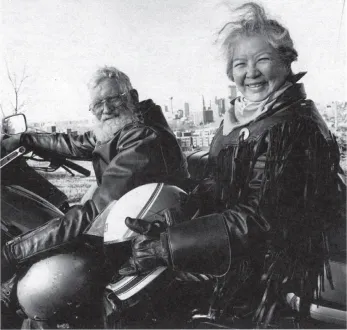
Figure 1.1 Well-known Calgary motorcyclist Walt Healy and his partner, Shirley, demonstrate the enduring role of the black leather jacket in an article for the Glenbow magazine.
The best use to be made of this account, I believe, is not just to read it as an example of one more museum struggling to survive difficult times, but also as a provocative assembly of ideas and observations about the nature of organizational change, reported from the battle lines, which we all can analyze, debate, contest, supplement, reformulate, and try out elsewhere in our own combinations of bits and pieces. What organizations need, Janes says, is “active experimentation” in a spirit of “open integrity” as they struggle “to adapt to, or outwit, the forces of change.” He would argue, I am confident, that we should apply the same methodology to the many suggestions contained in his own narrative.
To help along this process of debate I attempt below to summarize some of the more general points extracted from his narrative, restated in the form of propositions. Though I have attempted to keep as close as possible to his original wording, Janes is not responsible for the formulations as they appear here.
Five Propositions Characterize the Current Setting
- Museums cannot escape accelerating rates of change occurring in contemporary society, contributing to political and economic uncertainties.
- There is, as a result, increasing pressure on museums for results and decreasing resources to achieve them.
- All levels of government are likely to decrease financial support for the cultural sector, and at the same time increase their control over policies and operations through the imposition of various regulations and administrative procedures.
- Successful planning and accountability are seldom rewarded by government funding agencies, nor are government resources allocated, or rewards given, to those who perform well (a statement attributed to Australian Museum Director, Des Griffin).
- A corollary of Numbers 3 and 4 is that Canadian museums are likely to prosper to the extent they distance themselves from governmental influence over operational decisions, which should be the purview of their own governing authorities and staff. Governments have a continuing responsibility to provide funding, however.
Seven Propositions Describe Implications for Museums
- The future of successful museums will be one of constant repositioning to adapt to, or outwit, the forces of change.
- There are no clear, elegant solutions for how this repositioning is to be achieved, and the results are likely to be messy and difficult.
- The first problem is that museums are by nature conservative and resistant to change.
- The first and most difficult step is therefore to affirm the purpose of the organization and then decide what expertise and resources are required to achieve it.
- It follows that form should follow need, which is ever changing. “Structure must follow strategy.”
- The need (see Number 6) is for a repositioned organization that is flat, flexible, participatory, loosely structured, and decentralized.
- Most innovation occurs, not from startling discoveries, but from hundreds of small changes and ideas which may add up to enormous differences.
Other Propositions Concern the Process of Repositioning
- The key determinant in an organization’s ability to serve its community in meaningful ways is the nature of its governance and leadership.
- Organizational change cannot occur without also change in the role of the executive staff and middle managers. “It is absolutely essential that all levels of management embrace and champion the change process.”
- The most important variable in planned change is learning from experience and from the people involved.
- A changing organization must therefore be a learning organization, one in which employees are committed to learning on a continuing basis.
- Inability among staff to learn is an obstacle to change.
- Training is therefore critical for successful organizational change.
- Provide staff with opportunities to seek the training they judge useful rather than make specific types of training mandatory.
- Maximum staff participation from the beginning of the change process is essential if change is to be effective, for two reasons:
20.1 Managers no longer hold all the necessary information or skills to make all the decisions in an increasingly complex world; and
20.2 “All things equal, people will become committed to that which they help create.”
- It follows from Number 20.2 that negative reactions to change develop when people involved are not allowed and/or are unwilling to help plan the changes and implement them.
- It follows from Number 21 that difficulties in achieving change are more likely the result of individual staff attitudes than of the organizational structure.
- “Open integrity” is another key factor: full and open communication with all stake-holders and publics. “You can never communicate too much within an organization.”
- When downsizing it is preferable to “wipe the slate clean” and determine what positions will be needed, rather than to democratically strip positions from each unit.
- Abrupt termination is preferable to a gradual leaving to allow laid-off employees to achieve closure on what has happened to them. “It appears that the clean break hastens the healing process, although the immediate pain may be greater.”
- It is not downsizing itself that causes negative effects, but how it is implemented.
The Museum Organization of the Future
- Traditional hierarchical bureaucracies are non-responsive to anything but their own agendas, thus unable to serve their communities in meaningful ways.
- An adaptive and responsive organization is a paradoxical organization: one which allows maximum autonomy within each work unit while simultaneously fostering integration and collective decision-making between the units.
- This requires repositioning the centre (senior management), from standing at the top of the organization in order to “run it,” to “the middle of things” to facilitate and mediate.
- It also requires a movement away from the traditional, adversarial employee– employer relationship toward one based on trust, commitment and teamwork. “Changing union–management relationships is one of the most important, and potentially valuable, dimensions of individual and organizational learning at Glenbow.”
- Since change is continuous, a healthy organization will always exhibit a degree of chaos.
There are m...