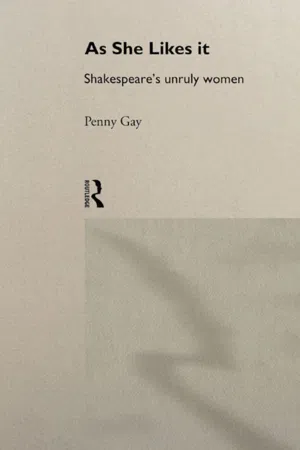
As She Likes It is the first attempt to tackle head on the enduring question of how to perform those unruly women at the centre of Shakespeare's comedies.
Unique amongst both Shakespearian and feminist studies, As She Likes It asks how gender politics affects the production to the comedies, and how gender is represented, both in the text and on the stage. Penny Gay takes a fascinating look at the way Twelfth Night, The Taming of the Shrew, Much Ado About Nothing, As You Like It and Measure for Measure have been staged over the last half a century, when perceptions of gender roles have undergone massive changes. She also interrogates, rigorously but thoughtfully, the relationship between a male theatrical establishment and a burgeoning feminist approach to performance.
As illuminating for practitioners as it will be enjoyable and useful for students, As She Likes It will be critical reading for anyone interested in women's experience of theatre.
- 224 pages
- English
- ePUB (mobile friendly)
- Available on iOS & Android
eBook - ePub
About this book
Information
1: TWELFTH NIGHT
Desire and its discontents
Twelfth Night’s alternative title is What You Will. What’s in a name? we might ask with Juliet. A parent’s impulse to play? In Will Shakespeare’s ‘romantic comedies’ will—meaning, for the Elizabethans, both the assertion of power and sexual desire1 —is the principal concern of the characters and motivator of the plot. Twelfth Night, in particular, offers multiple images of ‘the mobility of desire’2 —a theme which was taken up enthusiastically in performance in response to the ‘sexual revolution’ of the 1960s and 1970s, but was increasingly sidestepped in the more conservative atmosphere of the 1980s.
In performances of the last fifty years, the figure of Malvolio—‘ill-will’—begins as that of the traditional puritanical killjoy, denying ‘cakes and ale’ to the drunken Sir Toby, but develops into a disturbing image of the madman who cannot reconcile his sexual fantasies and the realities of his class position. Gender, in this play, becomes an ever more unstable mask: Orsino and Olivia behave increasingly ‘improperly’ as the play’s interest in the fluidity of sexuality is explored in performance. Viola always exists in the margins between genders: claiming first that she will present herself as ‘an eunuch’ to Orsino, she is called by him ‘boy’, wooed by Olivia who thinks she is male (or thinks she thinks so), and never herself changes out of her male costume once she assumes it after I.2. That she has an identical twin in the male Sebastian is of course a biological impossibility: it is a fantasy of desire undifferentiated, uncontrolled by the constraints of gender: the play ‘enables not only the fantasy that one need not choose between a homosexual and a heterosexual bond but that one need not become either male or female, that one can be both Viola and Sebastian, both maid and man.’3
The ‘play’ of desire in Twelfth Night is a game for leisured people, not for those who must work for their living (here again Viola’s position is liminal—the role she takes on is that of a page-boy who will grow up to be a leisured aristocrat). Hence the impropriety of Malvolio’s fantasies about Olivia in her day-bed, and the play’s lack of interest in the precise nature of the relation between Maria and Sir Toby. But it might be argued that as an audience we are, for the moment, the equivalent of ‘leisured gentry’, and that we watch the behaviours of Orsino, Viola, and Olivia in love with an empathetic interest. The mise-en-scène of the performance mediates our reading of their behaviour: though the actors may wear Elizabethan or Caroline costumes, they will behave more, or less, ‘historically’ according to subtle choices made by director and designer, and the audience will feel with varying force the relevance of the performance to their own lives. Twelfth Night is (with The Taming of the Shrew) particularly prone to the sort of production which induces nostalgia for ‘merry England’—its aristocracy gracious and unthreatening, its comic roisterers devoted to the cakes and ale of traditional Christmas festivity. It is easy enough for directors and even actors to avoid the questions about sexuality and gender which its narrative proposes.
1947–60
In the first post-war production (1947) of Twelfth Night at the Shakespeare Memorial Theatre, directed by Walter Hudd, who also played Malvolio, the Guardian reviewer observed a ‘most notable abatement of traditional burlesque’ in Hudd’s performance of the role: ‘he emerges, like one of Meredith’s tragic comedians, as betrayed by what is false within as well as by the machinations of Maria’ (26 April 1947). Ruth Ellis commented that he portrayed a
cranky, crotchety creature, ‘sick of self-love’ indeed, but without the inward looking eye, the sepulchral voice and the almost tragic megalomania that some actors give the part. The last exit is not a stormy curse but a creeping away of a man somewhat restored by Olivia’s petting.
(Stratford Herald, 25 April 1947)
Another (unidentified) comment in the cuttings book records,
The scene behind the grill is too painful for comedy nowadays, but that is not Mr Hudd’s fault, and he plays so well that when we arrive at his final outburst…we feel ourselves to be included in the condemnation, for did not we, too, laugh at his discomfiture in the garden?
Arguably these critics are recognising a nascent attempt to portray Malvolio as though he were part of a social context, not just the stereotypical killjoy of light comedy. The Sir Toby (John Blatchley), was also considered to be less gross than usual, and the same fresh impulse may be recognised in the casting of the 19-year-old Daphne Slater as Olivia: according to the Guardian ‘less the madonna and grand lady [of tradition] than the impulsive and warm-hearted girl, both in her eager wooing of Cesario and in her natural and unforced concern for the bemused Malvolio turned fantastic.’ Ruth Ellis thought her ‘an endearingly foolish little wench, enjoying grief, petulantly put out by Cesar io’s indifference’. These are notes that will re-emerge over a decade later,4 in Peter Hall’s first production; and it leads one to think that had artistic director Barry Jackson been encouraged to stay on at Stratford, instead of being hounded out by the local establishment, there might well have been a Royal Shakespeare Company, doing genuinely innovative work, from the beginning of the 1950s.
The most strikingly unconventional casting was that of Viola—the 44-year-old Beatrix Lehmann. Since her debut in 1924, she had made her name as an actress of modern ‘strong’ roles, those of Tennessee Williams, for instance. She became president of Actors’ Equity in 1945. Lehmann had not played Shakespeare professionally until this Stratford season, when her roles were Portia, Isabella, Viola, and the Nurse in Romeo and Juliet. She was a strongchinned, short-haired, modern-looking woman despite the Caroline costume for Cesario (photographs give the impression that she looked more ‘masculine’ than Sebastian, which opens up charming possibilities in the cross-gender comedy). The critics were surprised, but pleased:
One may say of Miss Lehmann that her Cesario is every inch a man…. If you will put by any preference for the openly wistful, Miss Lehmann seems here superlatively well cast and well spoken: here may be the nearest thing to the Violas that Shakespeare saw since the part ceased to be played by boys of flesh and blood.
(Guardian, 26 April 1947)
(‘Every inch a man’? This delightfully naive response, relying as it does on outward signs of gender, has already been deconstructed by Viola’s ‘A little thing would make me tell them how much I lack of a man’ (III.4).)
she laughs at Olivia more readily than she sighs for Orsino, and would obviously have much pleasure in trouncing Sir Andrew if the text allowed. She greets her brother with cool, sisterly affection, and the betrothal to the Duke seems a comfortable settlement rather than the realisation of the heart’s desire.
(Ruth Ellis)
This was a production not intent on foregrounding sexual confusion, but confidently presenting an image of the emotionally-independent, self-reliant, and rather interestingly ‘masculine’ woman whom the social disruptions of the Second World War had brought into being. At the same time it reasserted, through the marriages and the ultimately unthreatening Malvolio—Olivia axis, an ideal of a mutually interdependent (though still strongly hierarchical) community able to heal itself and to find a place for all types and conditions of people in the post-war world.
The famous Shakespeare Memorial Theatre production of Twelfth Night in 1955, directed by Sir John Gielgud and starring Laurence Olivier and Vivien Leigh, came after a gap of eight years in the SMT production record—the longest gap recorded between twentieth-century productions at Stratford (before or after this date). The new production was clearly intended as an indicator of a confident, newly self-indulgent society, for whom the austerity of the war was now thankfully past.
The design, by 25-year-old Malcolm Pride, was ‘particularly pretty’, according to Philip Hope-Wallace: ‘settings which suggest a Persian court as an Italian old master might have imagined it’ (Manchester Guardian, 13 April 1955). Other reviewers confirmed this impression of luxury—a world in which there is no poverty or distress, and very little social or erotic unease: ‘Always there were within the proscenium arch rich pictures of Shakespeare’s dream country, Illyria’ (Wolverhampton Express and Star, 13 April 1955). There were, as was still usual in the 1950s, two intervals, and much set-changing between scenes—to the relief of some critics, who avowed themselves bored with the ‘fetish’ of the single set, which was obviously thought of as a sign of austerity rather than an attempt (beginning in advanced theatrical practice after the First World War) to approximate the swift and uncluttered pace of Elizabethan production.
Keith Michell’s Orsino was heavily made-up, coiffed, and bejewelled—a 1950s image of the ‘Renaissance prince’—and his acting style was swaggeringly romantic. We may safely say this was an Orsino who never doubted his sexuality. Similarly, most reviewers commmented approvingly on the warm ‘femininity’ of Maxine Audley’s Olivia: no questioning her maturity or good sense. In this Gielgud and his actress were simply following tradition: Trewin and Sprague point out that Olivia ‘used to be a stately Countess. In London, earlier in the century, one reason for this was the average age of the leading actresses. It was a more mature theatre world than today’s, and Olivia could never have been allotted to the company’s ingénue’.5 Or at least, not unless it was in a company directed by the always unconventional Barry Jackson, as was the case in 1947.
Most critical attention was paid to the star couple, Laurence Olivier and Vivien Leigh, as Malvolio and Viola. Leigh had done little Shakespeare previously, and Olivier came fresh to Malvolio. Olivier showed the virtuosity that the world expected of him in the role: at one point he leapt onto a sundial; he cut capers; he ‘exchange[d] doubts, through winks and grimaces [at the audience] on the correct pronunciation of “slough”’ (Leamington Spa Courier, 15 April 1955)—he may indeed have invented this business, commonly used in more recent productions. Almost all critics remarked, beyond the virtuosity, a new interpretation of the role. It began with the costume, that of a respectable Puritan steward (contrasting the Spanish grandee look favoured by earlier actors): a realistic class perception here enters the production. Gielgud, who felt that ‘somehow the production did not work’ (‘partly because of the scenery, which was too far up-stage’), commented that ‘Olivier was set on playing Malvolio in his own particular, rather extravagant way…he played the earlier scenes like a Jewish hairdresser, with a lisp and an extraordinary accent’.6 Michael Billington remembers him as ‘a bumptious arriviste with a faintly Hebraic appearance and an insecurity over pronunciation’;7 Philip Hope-Wallace noted the ‘wonderful costive voice which exactly expresses the touchy knowingness of the character and is a most refreshing change from the usual parade of crude self-esteem’. Others saw him as far more sinned against than sinning: ‘not…a pompous bore but…a tight-lipped effeminate Shylock with an inferiority complex’ (Ronald Barker, Plays & Players, June 1955). Perhaps Olivier’s choice of a Jewish and ‘effeminate’ persona was playing subconsciously on collective guilt about England’s pre-war complacency regarding the Nazis’ brutalities; Barker goes on to remark, ‘The Merchant of Venice presented in this light would be a revaluation [sic: for “revelation”?]’.
Reinforcing this sense of vague discomfort about Malvolio, the reviewer of the Coventry Evening Telegraph (13 April 1955) found himself ‘disturbed’ by Malvolio’s last scene: ‘it may be said to stand outside the dimension of the play’. This critic is evidently working with the old assumption of uncomplicated romance and fun in the play; others were more aware of Olivier’s revolutionary effect on the role:
it remains a terrible thing to see a man stripped of the image of his dream uttering futile threats of revenge at the end. At the same time, Sir Laurence does not make the mistake of overshadowing the play. His Malvolio is not a tragic figure.
(Ruth Ellis, Stratford Herald, 14 April 1955)
Olivier’s performance, even more emphatically than Hudd’s, brought a disturbing realism to moments in the play, though his extraordinary comic inventiveness at other moments worked against this.
If Olivier’s Malvolio reflected contemporary unease about judgments based on class and race distinctions, and thereby influenced all major actors of the role up to the present day, Vivien Leigh’s Viola was of the moment only. Dressed in a 1950s interpretation of an Elizabethan boy’s suit, wasp-waisted, with the bosom clearly outlined, she looked at all times uncomplicatedly ‘feminine’. This is not to say that she acted incompetently as Cesario, but rather that she was untroubled by the ambiguity of the role: ‘She may sometimes suggest the modern miss in jeans, but she is never really out of period’ (The Stage, 14 May 1955). On the other hand, the ‘modern miss’ of the 1950s liked to get into a nice frock for formal occasions —which is what Leigh did for the curtain calls, wearing a full evening gown, with jewels and tiara, a cross between the 1950s ‘New Look’ and Queen Elizabeth I. Philip Hope-Wallace wanted Leigh’s Viola to be more old-fashioned: struck, as most critics were, by her air of cool confidence, he was surprised that ‘this Viola does not change her mood back to frightened femininity when she is alone and can drop the facade’—that is, when she could have shown the audience the ‘real woman’. The critic of the Daily Worker (15 April 1955) also found something wanting in Leigh’s restrained, beautifully-spoken performance: Viola, he said, should be ‘a bewildered, even tormented creature. Miss Leigh was about as bewildered as a practised society hostess giving a successful party’; and from the other end of the political spectrum the Spectator’s critic made the same complaint: he wanted ‘warmth, uncertainty, a capacity for being embarrassed’ (22 April 1955). ‘Embarrassment’ is an ambiguous condition, and the critics’ desire to see it in a female protagonist may reflect their own discomfort with a changing image of woman. ‘Retreats into maidenly frailty were not for her’, said the Leamington Spa Courier (15 April 1955): and a good thing too, one might reply—audiences did not need to have their most reactionary fantasies reinforced.
Gielgud’s production was followed in 1958 by the young Peter Hall’s, a reading (revived in 1960) which many found ‘definitive’. Hall, with his designer Lila de Nobili, had sought for and found the ‘dark side’ of this comedy: the visual tone was autumnal, the costumes Caroline rather than Elizabethan, the whole had a ‘faint air of overlushness’ (New Statesman and Nation, 28 May 1960). Clearly, for Hall, the 1950s dream of a brave new world had faded. Max Adrian, the Feste, an ageing Pierrot,
set the tone of the production: o...
Table of contents
- COVER PAGE
- AS SHE LIKES IT
- GENDER IN PERFORMANCE
- TITLE PAGE
- COPYRIGHT PAGE
- PREFACE
- ACKNOWLEDGEMENTS
- INTRODUCTION
- 1: TWELFTH NIGHT
- 2: AS YOU LIKE IT
- 3: THE TAMING OF THE SHREW
- 4: MEASURE FOR MEASURE
- 5: MUCH ADO ABOUT NOTHING
- CONCLUSION
- NOTES
- BIBLIOGRAPHY
Trusted by 375,005 students
Access to over 1.5 million titles for a fair monthly price.
Study more efficiently using our study tools.
Frequently asked questions
Yes, you can cancel anytime from the Subscription tab in your account settings on the Perlego website. Your subscription will stay active until the end of your current billing period. Learn how to cancel your subscription
No, books cannot be downloaded as external files, such as PDFs, for use outside of Perlego. However, you can download books within the Perlego app for offline reading on mobile or tablet. Learn how to download books offline
Perlego offers two plans: Essential and Complete
- Essential is ideal for learners and professionals who enjoy exploring a wide range of subjects. Access the Essential Library with 800,000+ trusted titles and best-sellers across business, personal growth, and the humanities. Includes unlimited reading time and Standard Read Aloud voice.
- Complete: Perfect for advanced learners and researchers needing full, unrestricted access. Unlock 1.5M+ books across hundreds of subjects, including academic and specialized titles. The Complete Plan also includes advanced features like Premium Read Aloud and Research Assistant.
We are an online textbook subscription service, where you can get access to an entire online library for less than the price of a single book per month. With over 1.5 million books across 990+ topics, we’ve got you covered! Learn about our mission
Look out for the read-aloud symbol on your next book to see if you can listen to it. The read-aloud tool reads text aloud for you, highlighting the text as it is being read. You can pause it, speed it up and slow it down. Learn more about Read Aloud
Yes! You can use the Perlego app on both iOS and Android devices to read anytime, anywhere — even offline. Perfect for commutes or when you’re on the go.
Please note we cannot support devices running on iOS 13 and Android 7 or earlier. Learn more about using the app
Please note we cannot support devices running on iOS 13 and Android 7 or earlier. Learn more about using the app
Yes, you can access As She Likes It by Penny Gay in PDF and/or ePUB format, as well as other popular books in Literature & Feminist Literary Criticism. We have over 1.5 million books available in our catalogue for you to explore.