eBook - ePub
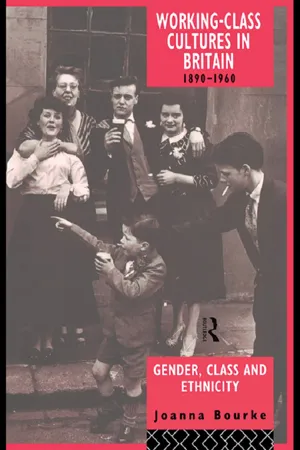
Working Class Cultures in Britain, 1890-1960
Gender, Class and Ethnicity
- 288 pages
- English
- ePUB (mobile friendly)
- Available on iOS & Android
eBook - ePub
Working Class Cultures in Britain, 1890-1960
Gender, Class and Ethnicity
About this book
Integrating a variety of historical approaches and methods, Joanna Bourke looks at the construction of class within the intimate contexts of the body, the home, the marketplace, the locality and the nation to assess how the subjective identity of the 'working class' in Britain has been maintained through seventy years of radical social, cultural and economic change. She argues that class identity is essentially a social and cultural rather than an institutional or political phenomenon and therefore cannot be understood without constant reference to gender and ethnicity. Each self contained chapter consists of an essay of historical analysis, introducing students to the ways historians use evidence to understand change, as well as useful chronologies, statistics and tables, suggested topics for discussion, and selective further reading.
1
Introduction
Class and poverty
Sex and violence have come to dominate modern historiography. It is surprising, therefore, to find that social histories of twentieth-century Britain have proven less susceptible to this allurement. In place of the body, these histories have substituted a concept: ‘class’. This is true to such an extent that discussions of the sexual practices of the ‘working class’ are frequently dealt with in the context of ‘trickle down’ theories and ‘embourgeoisement’. The intellectual fascination of British social history, is found in elegant tomes elucidating the development of working-class consciousness as experienced in the waxing and waning fortunes of trade unions, workingmen’s clubs, community pressure groups, and political parties. This book approaches the social history of the working class from a different angle: what does ‘working class’ mean when our vision focuses on the individual stripped of these institutional affiliations? The main sites of exposure are the body, the home, the marketplace, the locality, and the imagined ‘nation’. Within these sites, working-class individuals constructed and reconstructed their states of desire.
It is a truism to say that, throughout the twentieth century, the British have thought of themselves in terms of class. Shifts in the levels of poverty and wealth, world wars, and burgeoning communication industries failed to diminish the almost intuitive awareness of one’s own and other people’s class position. As late as 1950, F.M.Martin’s study of Greenwich and Hertford concluded that the ‘great majority of our subjects thought in terms of a three-class system, and most of them described these classes by the same set of names—upper, middle, working’.1 When asked to define precisely what is meant by ‘class’, there is much confusion and ambiguity. Within the space of one discussion, people may change their definition of ‘class’ a number of times, without being aware of inconsistency.2 One study revealed that almost equal portions of ‘working-class respondents’ defined ‘class’ in terms of socioeconomic characteristics, socioprofessional categories, social prestige, and property.3 Some working-class writers described ‘class’ structures in their area as ‘feudal’ with the ‘Lady of the Manor sitting on top like a cock on a farm-yard midden and the tenant cottages at the bottom of the socio-economic scale’.4 The profusion of definitions employed by historians, economists, and sociologists have further obscured the issue. Some definitions are quixotic: for instance, Jilly Cooper defines class as ‘a group of people with certain common traits: descent, education, accent, similarity of occupation, wealth, moral attitudes, friends, hobbies, accommodation, and with generally similar ideas, who meet each other on equal terms, and regard themselves as belonging to one group’.5 The weight given to the individual in such definitions precludes membership in any ‘class’ of more than one person.
More commonly, ‘classes’ are demarcated in terms of economic indicators, such as occupation, income, and a distinction between people who own the means of production and those who only own their labour power.6 A person’s class position is determined by his or her relationship to modes of production. This definition is not ideally suited to the historian’s purpose. As a static concept, implying that there is a ‘ladder’ within which people can be slotted, no criteria are provided by which we can analyse change in the structure of class. It conceals antagonisms between different social groups within a specified ‘class’. In addition, the high wages earned by some manual workers does not place that worker in the same category as university lecturers on an identical wage. Assigning people to their class positions on the basis of economic indicators alone neglects a human component: once subsistence needs have been met, the individual man or woman may be more concerned with relative incomes. ‘Objective’ definitions are problematical. Eric Hobsbawm pointed out the chief difficulty when he noted that if the ‘working class’ were defined as manual workers, the twentieth century witnessed a decline in this ‘class’ from 75 per cent of the population in 1911 to 70 per cent in 1931, and 64 per cent by 1961. If, however, ‘working class’ was defined in a more marxist sense, that is, as the proportion of the population who earned a living by selling their labour power (plus ‘dependants’), then this ‘class’ had grown. In 1911, around 7 per cent of the workforce were ‘employers and proprietors’, compared with around 4 per cent by the 1960s.7
Other definitions—less concerned with precision and ‘objectivity’—take account of shared social characteristics, such as similar life styles. In this way, the appearance and demeanour of an individual indicated class position. A stranger’s accent was immediately noted, and the refusal of a person to adapt their accent to their ‘social position’ was frowned upon.8 In a society where (at the turn of the century) 14-year-old working-class children were six inches shorter than middle-class children, visual indicators of ‘class’ were significant.9 Clothes were another indicator. Elizabeth Fanshawe, the daughter of a fireman and train driver, won a scholarship to go to High School. Although her parents did their best to buy her appropriate clothes, on Elizabeth’s first day at High School, her teacher asked her to stand in front of the class while she pointed out all the faults in her gym-slip. In Fanshawe’s words, ‘It was my first encounter with the “class” society; the types of clothing one wore was far more important than one’s academic achievement.’10 Another working-class writer, Kenneth Leech, agreed that an individual’s ‘class’ was a matter of distinctions in material culture. His ‘earliest consciousness of “class”’ was connected with clothes, indoor lavatories, telephones, and books: ‘The poor children—of whom I was one—whose parents could not afford new clothes at Whitsun, had no part in the processions.’11 This view of ‘class’ reflected a world divided into minute distinctions based on status indicators. Thus, Johnny Speight lived in the Canning Town district of London between the wars. In 1932, when he was 12 years old, the family moved four streets away:
It was almost a social upheaval. Some of the people in this new street even had aspidistras in the window. They all wore shirts. At the very top end they even wore collars and ties. The houses had bay windows. We still had an outside toilet. But now we had two rooms and a scullery downstairs and three rooms upstairs…. There were a lot of people a cut above us in the street. But we were a cut above the others.12
Although this understanding of the world was fundamentally concerned with interpersonal relationships, it must be regarded as distinct from other analysts who argued that an individual’s ‘class’ position was inseparable from their state of consciousness. While interaction remained the key to a person’s understanding of ‘class’, it required a form of political consciousness which was more than simply class awareness. In The Making of the English Working Class, E.P. Thompson argued that ‘class happens when some men, as the result of common experience (inherited or shared), feel and articulate the identity of their interests as between themselves, and as against other men whose interests are different from (and usually opposed to) theirs’.13 Thus, Louis Heren of Shadwell confessed: ‘I was possibly dim, but was unaware of the British class system until I went to Sandhurst during the Second World War as an officer cadet and temporary gentleman.’14 In this way, class was both the embodiment and expression of common traditions, experiences, and values.15
Prioritizing the political, the masculine, and the consensual in such definitions is unhelpful in analyses concerned equally with the private, the feminine, and the discordant. A more eclectic position—although offensive to theorists of both the political ‘left’ and the political ‘right’—is the standpoint taken in this book. Claims to objectivity are rejected in favour of adopting the labels individuals give themselves as the final word on that individual’s ‘class’ position. The label ‘working-class’ in this view need not imply class consciousness in the political sense—but it does imply class awareness. Realization of one’s ‘class’ position emerged from routine activities of everyday life: it was the ‘feeling of belonging’ which was ‘felt to be natural and was taken for granted’.16 It was concerned as much with symbolic expressions of power in social relationships as with material realities. In this way, ‘class’ was intrinsically tied up with awareness of difference and experience of conflict.
Stressing individual perceptions of class position has an advantage for studies such as this one. It provides one way around the thorny problem of gender and ethnicity. Employing categories such as occupation, income, or relationship to modes of production as indicators of ‘class’ is clearly unsatisfactory when focusing on women and different ethnic groups. Ethnicity may override any ‘objective’ analysis of ‘class’. Employed women may be categorized in terms of their own occupation, or that of the ‘chief breadwinner’ in the household. Women without paid employment are often allocated to the ‘class’ position of their husband or father (assuming —often wrongly—that women would be dependent on them). It is equally unsatisfactory to impute a wage to them. The advantage of allowing self-perceptions to predominate is that it allows a woman married to a manual labourer to classify herself in terms of her middle-class father’s position, should she consider this appropriate. In a society where gender and ethnic relationships are unequal, there may be an incongruity of interests between men and women or between members of different ethnic groups allegedly sharing one ‘class’ position. Adding gender and ethnicity to a description of class awareness makes the process of attaining group identification a more complex negotiation among ...
Table of contents
- Cover
- Halftitle
- Title
- Copyright
- Contents
- List of chronologies
- List of Tables
- Preface
- Acknowledgement
- 1. Introduction: Class and poverty
- 2. Body: Making love and war
- 3. Home: Domestic spaces
- 4. Marketplace: Public spheres
- 5. Locality: Retrospective communities
- 6. Nation: Britishness: illusions and disillusions
- Epilogue
- Notes
- Bibliography
- Index
Trusted by 375,005 students
Access to over 1.5 million titles for a fair monthly price.
Study more efficiently using our study tools.
Frequently asked questions
Yes, you can cancel anytime from the Subscription tab in your account settings on the Perlego website. Your subscription will stay active until the end of your current billing period. Learn how to cancel your subscription
No, books cannot be downloaded as external files, such as PDFs, for use outside of Perlego. However, you can download books within the Perlego app for offline reading on mobile or tablet. Learn how to download books offline
Perlego offers two plans: Essential and Complete
- Essential is ideal for learners and professionals who enjoy exploring a wide range of subjects. Access the Essential Library with 800,000+ trusted titles and best-sellers across business, personal growth, and the humanities. Includes unlimited reading time and Standard Read Aloud voice.
- Complete: Perfect for advanced learners and researchers needing full, unrestricted access. Unlock 1.5M+ books across hundreds of subjects, including academic and specialized titles. The Complete Plan also includes advanced features like Premium Read Aloud and Research Assistant.
We are an online textbook subscription service, where you can get access to an entire online library for less than the price of a single book per month. With over 1.5 million books across 990+ topics, we’ve got you covered! Learn about our mission
Look out for the read-aloud symbol on your next book to see if you can listen to it. The read-aloud tool reads text aloud for you, highlighting the text as it is being read. You can pause it, speed it up and slow it down. Learn more about Read Aloud
Yes! You can use the Perlego app on both iOS and Android devices to read anytime, anywhere — even offline. Perfect for commutes or when you’re on the go.
Please note we cannot support devices running on iOS 13 and Android 7 or earlier. Learn more about using the app
Please note we cannot support devices running on iOS 13 and Android 7 or earlier. Learn more about using the app
Yes, you can access Working Class Cultures in Britain, 1890-1960 by Prof Joanna Bourke,Joanna Bourke in PDF and/or ePUB format, as well as other popular books in History & Modern British History. We have over 1.5 million books available in our catalogue for you to explore.