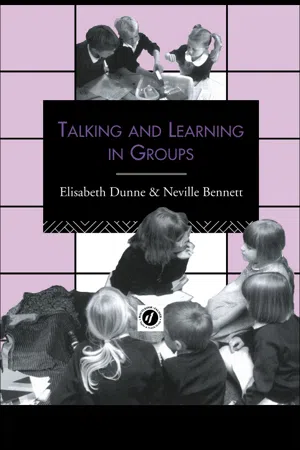
Recent research has shown that group learning is a method of classroom organisation with which many teachers feel uncomfortable. Yet well done it can produce greater independence, greater cooperation and better quality work from children of all abilities. Talking and Learning in Groups , like the rest of the Leverhulme skills series attempts to identify in general terms the competencies and strategies which are needed for this aspect of class management and to guide teachers in discovering what works for them. The modular text gives evidence of the success of cooperative learning and discusses its various forms. It them gives specific guidance on how to do it. There are individual sections on choosing groups, on groups management and training and on monitoring and assessment. The text is supported by activities, both for discussion and for use in the classroom and by transcripts of actual classroom conversations, and illustrated with ten specially comissioned black and white photos showing various aspects of cooperative learning.
The introduction of the National Curriculum has, not surprisingly, created genuine concerns in the minds of primary teachers. We know, from our own national surveys (Wragg, Bennett and Carré, 1989), that teachers are worried about their competence or confidence to teach such subjects as Science, Technology and Music, and about how they can possibly find the time for the continuous assessment and recording of each child’s performance and progress across the curriculum. In addition, there is some anxiety about how best to satisfy statements of attainment in areas that have not previously been emphasised. Competencies and skills in collaborative endeavours and in oracy are two such areas.
Can these very real difficulties be overcome? We believe that there is a form of organisation— cooperative groupwork—that can substantially overcome the above concerns whilst at the same time holding out the promise of improved learning and social skills.
The reaction of some teachers to this suggestion is that they already do groupwork. So what’s new? It is certainly true that most teachers have children seated in groups and talking in groups, but it is mistaken to think that this represents cooperative learning, as we shall see later when we consider some of the research evidence. In reality cooperative learning is something that few teachers achieve, as the delightfully named Schmuck (1985) argues:
Why have we humans been so successful as a species? We are not strong like tigers, big like elephants, protectively coloured like lizards, or swift like gazelles. We are intelligent, but an intelligent human alone in the forest would not survive for long. What has really made us such successful animals is our ability to apply our intelligence to cooperating with others to accomplish group goals. From the primitive hunting group to the corporate boardroom, it is those of us who can solve problems while working with others who succeed. In fact, in modern society, cooperation in face-to-face groups is increasingly important. A successful scientist must be able to cooperate effectively with other scientists, with technicians, and with students. An executive must cooperate with other executives, salespersons, suppliers and superiors.
Of course, each of those relationships also has competitive elements, but in all of them, if the participants cannot cooperate to achieve a common goal, all lose out. It is difficult to think of very many adult activities in which the ability to cooperate with others is not important.
Because schools socialise children to assume adult roles, and because cooperation is so much a part of adult life, one might expect that cooperative activity would be emphasised. However, this is far from true. Among the prominent institutions of our society, the schools are least characterised by cooperative activity.
Although Schmuck is talking from an American perspective, it is the ‘groupgoals’ about which he writes that will be central to our arguments. Yet how do we know that cooperative groupwork is not just another fad which will actually turn out either to increase demands on teachers, or be extremely difficult to implement in the busy primary classroom? Firstly (as we report in the next unit), there is a substantial body of theory and research to justify cooperative learning. In addition, we have been studying classroom grouping for more than eight years; and for two years we have collaborated with teachers to find out whether cooperative grouping really works and what difficulties, if any, they have had in setting it up.
For all these teachers, cooperative grouping in the form we describe through this workbook was entirely new, but without exception they have found it easier to implement than they imagined. Typical comments were ‘I was pleasantly surprised at how easy the sessions were’, and The children performed in a more business-like way than I’d expected’. Most of the teachers also commented on how much the children enjoyed such groupwork and how enthusiastic they were to continue to work in this way. One initially sceptical teacher said she ‘was agreeably surprised to find that the children were in fact able to use each other and help each other more than I realised.’
You may, by this time, be asking, ‘What does cooperative groupwork look like?’ Essentially what we are attempting is to change typical classroom practice from children working in groups, to children working as groups, in other words, to move from children working on individual tasks in a group setting to their working on cooperative tasks. By this means, the quality of children’s talk (and the underlying thought processes) should be enhanced and a corresponding improvement in the quality of their completed work should be seen.
The freeing of teacher time, which is a consequence of cooperative groupwork (as we will show in Unit 5), is also important, and here too the results have been encouraging. We know, from our own observations, that time was created in each classroom, and the teacher comments bear this out. ‘Much more time is available to teach rather than to deal with many matters which can be peer assisted.’ Another reinforced this, stating that ‘It is a management method that really frees the teacher, and would enable her to carry out the profiling, observation and testing jobs.’ So much time was freed in some classrooms that the teachers began to feel guilty at not being rushed off their feet—‘I found it very satisfying teaching in this way because the children were so involved in their work. It gave me a lot of free time… At times this made me feel that I was not doing my job.’ Although several teachers had felt anxious at first about devolving responsibility to the groups, they in fact found there had been no need to worry about the lack of control over the whole class, and as teachers they became involved in other ways.
The extent and quality of children’s involvement was commented on by all teachers who saw, for example ‘a dramatic increase in the amount of discussion, suggestion, testing, inferring and drawing informed conclusions’ and ‘rich mathematical language.’ They reported ‘work that was more thorough and presented well’ and children who were ‘thinking and reflecting their views and not a teacher’s.’ One stated of a poetry activity: ‘I was delighted that this whole assignment had developed the conditions for such high quality learning to take place.’
Low attainers particularly seemed to benefit and in some cases they ‘now often sit with higher ability children who took them under their wing. On the other hand we have evidence to show how much high attainers gain from group work. The benefits to both low and high attainers are looked at in Unit 3.
Overall, the teachers with whom we have worked in the past, and those with whom we continue to work, are positive about the benefits of the approach, seeing it as beneficial to themselves in terms of releasing teacher time, and beneficial to children in terms of greater independence, greater cooperation and better quality work from both low and high attainers.
So, before we go any further, we would like you to consider your own practice and the reasons underlying it.
ACTIVITY 1
Answer the following questions in the space provided or, if you prefer, on a separate sheet. (Student teachers should answer the questions in relation to the class that they have current or most recent knowledge of).
1 INDIVIDUALISED WORK
If you provide individualised work for the children in your class:
For what proportion of the day do children work on individual tasks?
What do you think are the main advantages and disadvantages of this as a way of managing learning?
2 GROUPWORK
If you group the children in your class
For what proportion of the day do children work in groups ie. seated together but working on individual tasks?
What proportion of the day do they work as groups ie. seated together working on tasks that require a group outcome?
How do you compose these groups; eg. what size are they? Are they based on age, sex, friendship, ability (ie. attainment) or any combination of these?
What are the reasons for your choice of group composition?
Does the group composition change for different curriculum areas, and if it does, why is this so?
continued
3 i) What are the benefits (either for you or for the pupils) of children working in groups?
ii) Are there disadvantages to this way of working?
4 CLASS TEACHING
If you use whole class teaching for any lessons:
What proportion of the day is used for class teaching?
What do you think are the main advantages and disadvantages of whole class teaching?
When you have completed your answers for questions 1 to 4, exchange them with a colleague, or colleagues, and discuss the differences which may be apparent. Can you justify your ans...
Table of contents
Cover
Half Title
Series Page
Title Page
Copyright Page
Contents
Preface
Acknowledgements
Introduction Aims and Content
Unit 1 Why should Children Work in Groups?
Unit 2 Types of Cooperative Groupwork
Unit 3 Choosing Groups
Unit 4 Managing Groups
Unit 5 Assessing Groupwork
Unit 6 Implementing Cooperative Groupwork in the Classroom
Further Reading and References
Trusted by 375,005 students
Access to over 1.5 million titles for a fair monthly price.
Study more efficiently using our study tools.
Frequently asked questions
Yes, you can cancel anytime from the Subscription tab in your account settings on the Perlego website. Your subscription will stay active until the end of your current billing period. Learn how to cancel your subscription
No, books cannot be downloaded as external files, such as PDFs, for use outside of Perlego. However, you can download books within the Perlego app for offline reading on mobile or tablet. Learn how to download books offline
Perlego offers two plans: Essential and Complete
Essential is ideal for learners and professionals who enjoy exploring a wide range of subjects. Access the Essential Library with 800,000+ trusted titles and best-sellers across business, personal growth, and the humanities. Includes unlimited reading time and Standard Read Aloud voice.
Complete: Perfect for advanced learners and researchers needing full, unrestricted access. Unlock 1.5M+ books across hundreds of subjects, including academic and specialized titles. The Complete Plan also includes advanced features like Premium Read Aloud and Research Assistant.
Both plans are available with monthly, semester, or annual billing cycles.
We are an online textbook subscription service, where you can get access to an entire online library for less than the price of a single book per month. With over 1.5 million books across 990+ topics, we’ve got you covered! Learn about our mission
Look out for the read-aloud symbol on your next book to see if you can listen to it. The read-aloud tool reads text aloud for you, highlighting the text as it is being read. You can pause it, speed it up and slow it down. Learn more about Read Aloud
Yes! You can use the Perlego app on both iOS and Android devices to read anytime, anywhere — even offline. Perfect for commutes or when you’re on the go. Please note we cannot support devices running on iOS 13 and Android 7 or earlier. Learn more about using the app
Yes, you can access Talking and Learning in Groups by Neville Bennett,Elizabeth Dunne in PDF and/or ePUB format, as well as other popular books in Education & Classroom Management. We have over 1.5 million books available in our catalogue for you to explore.