eBook - ePub
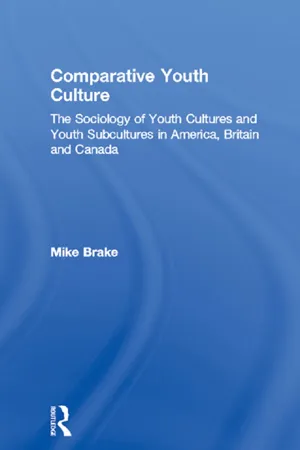
Comparative Youth Culture
The Sociology of Youth Cultures and Youth Subcultures in America, Britain and Canada
- 238 pages
- English
- ePUB (mobile friendly)
- Available on iOS & Android
eBook - ePub
Comparative Youth Culture
The Sociology of Youth Cultures and Youth Subcultures in America, Britain and Canada
About this book
Mike Brake suggests that subcultures develop in response to social problems which a group experiences collectively, and shows how individuals draw on collective identities to define themselves.
Information
Chapter 1
The use of subculture as an analytical tool in sociology
Subcultural analysis and sociology
Culture has several, often contradictory meanings and its ambiguity, conceptually, can be located in its differing uses throughout history. Williams (1961; 1973) has seen this in the context of the culture and society. Two basic, familiar definitions have arisen historically. Firstly, the classical perspective of using a cultural setting as a standard of excellence, a yardstick of sensitivity, intellect and manners developed in the bourgeois world, and this can be encapsulated in the notion of ‘high culture’. The other view which has its roots in anthropology is seen by Williams (1961, p. 57) as a
particular way of life which expressed certain meanings and values not only in art and learning, but also in institutions and ordinary behaviour. The analysis of culture, from such a definition, is the clarification of the meanings and values implicit and explicit in a particular way of life, a particular culture.
This is the conceptualisation of ‘low culture’ as a form of consciousness, of a way of life, and one which is central to the development of subculture as an analytical concept. It involves the ‘study of relationships between elements in a whole way of life’ (Williams, 1961, p. 57). In the United States, theories concerning mass society and mass communications obfuscated the point made by Swingewood that ‘consumer capitalism, rather than creating a vast, homogeneous and culturally brutalised mass, generates different levels of taste, different audiences and consumers. Culture is stratified, its consumption differential’ (Swingewood, 1977, p. 20). Culture was seen as a reified object, and its scholars tended to respond with suspicion to the synthetic culture of the mass media. Debra Clarke (1980) makes the point that there are many cultures and many cultural forms, and some of these may be appropriated by class linked groups. However, it is important to remember that if culture indicates a relation to a way of life, this is intimately bound up not with consumption in the social relations of capitalism, but in the social relations of production. Implicitly this leads the relation of culture firmly back to the set of social relations most predominant in society—class relations. Clarke criticises the simplistic assumptions of mass society and mass communication studies in the United States for three reasons. Firstly, they fail to examine the historical transformations in society which influence popular culture, in particular the artistic and cultural commodities that transform the media into a feature of class domination. Secondly, there is absent any sophisticated, or indeed often any mention of a model of social class, and thirdly, the moralism which she argues taints the analysis. This ranges from the left criticism that communication is one-sided, from elites to the masses, to the conservative argument familiar from the celebration of ‘high culture’ which romanticises the past and decries the vulgarity of synthetic popular culture.
The earliest use of subculture in sociology seems to be its application as a subdivision of a national culture (Lee, 1945; Gordon, 1947). Culture is seen here as learned behaviour emphasising the effects of socialisation within the cultural subgroups of a pluralist society. There are again anthropological influences as, for example, Tylor (1871, p. 10), who argues that culture ‘taken in its wide ethnographic sense, is that complex whole which includes knowledge, belief, art, morals, law, custom and many and any other capabilities and habits acquired by man as member of a society’. Firth (1951, p. 27) states that ‘Culture is all learned behaviour which has been socially acquired’. This emphasis on culture as a socialising influence on subgroups is useful to subculture. Kroeber and Kluckhohn (1952, p. 2) synthesise a definition of culture empirically drawn from analysing 160 definitions of culture taken from different social sciences and conclude that
Culture consists of patterns, explicit and implicit of symbols, constituting the distinctive achievements of human groups, including their embodiments in artefacts; the essential core of culture consists of traditional (i.e. historically derived and selected) ideas and especially their attached values; culture systems may, on the one hand, be considered as products of action, and on the other as conditioning elements of further action.
Ford (1942) offers the view that culture is a ‘traditional way of solving problems’, a ‘learned problem solution’, a view which was to be taken up by A.K.Cohen who saw a major determinant ofsubcultures among youth as ‘What people do depends upon the problems they contend with’ (Cohen, 1955, p. 51).
Whilst culture is a cohesive force binding social actors together, it also produces disjunctive elements. To argue that culture is merely cohesive is to take an ahistorical, idealist view. In any complex society culture is divisive merely because the presence of several subcultures indicates a struggle for the legitimacy of different subgroups’ behaviour, values and life styles against the context of the dominant culture of the dominant class. Swingewood (1977) puts this well,
Throughout the major social institutions (the family, religious, educational, political and trade union organisations), cultural values, norms and aspirations are transmitted, congealing into largely nonconscious routines, the norms and customs of everyday experience and knowledge. At the level of popular consciousness, culture is never simply that of the ‘people’ or region or family or subordinate class. Culture is not a neutral concept; it is historical, specific and ideological.
We are born into social classes, themselves complexly stratified with distinct ‘ways of life’, modified by region and neighbourhood. This local subculture into which we are first socialised is that parochial world against which we measure social relations that we meet in later life, and in which we begin to build a social identity. Our social identity is constructed from the nexus of social relations and meanings surrounding us, and from this we learn to make sense of ourselves including our relation to the dominant culture.
Culture, class and ideology
Contemporary theories of youth culture, especially in Britain, have been influenced by Marxist thought. History is not neutral, but a perpetual disclosure and working out of contradictory and conflicting class relations, which include ethnic relations where racial minorities are an underclass, and the relations between the sexes influenced by patriarchal cultures. The social production of material necessities generates sets of social relations both between and within classes. In this sense, what is called in Marxism the mode of production (a form of social organisation which links human labour to the environment and transforms raw materials into goods), creates the social relations of production, that is the various social relations of those people involved in production. Classical Marxism sees this as owners, managers and workers, but obviously the situation is more complex than this, and includesthose on the periphery of the work force, such as youth or the elderly, as well as working men and women, the latter being involved in domestic as well as occupational work. In Capital Marx argues a historical, materialist theory of ideology, distinguishing between reality as it appears in everyday life, and reality which is revealed by a more scientific analysis. We are, however, unaware of the ideological nature of social relations just because our awareness is organised by ideology itself to obscure the real relations of bourgeois society. Our response to our culture is a response to history of which Marx (1951, p. 251) reminds us:
Men make their own history, but they do not make it just as they please; they do not make it under circumstances chosen by themselves, but under circumstances directly encountered, given and transmitted from the past.
The theory of ideology in Capital reveals that the conditions for the production of mystificatory beliefs in capitalist society lie in that disjuncture between what the real relations of production are and their appearance. Marx, however, firmly grounds his theory of ideology in the arena of class struggle (1970, p. 39).
…the ideas of the ruling class in every epoch are the ruling ideas…the class which is the ruling force in society is at the same time its ruling intellectual force. The class which has the means of material production at its disposal has control at the same time over the means of mental production, so that thereby, generally speaking, the ideas of those who lack the means of mental production are subject to it….
Developing the disjuncture between the real and apparent relations of production, Althusser (1971, p. 162), influenced by the psychoanalyst Jacques Lacan, argues that ‘Ideology represents the “imaginary” relationship of individuals to their real conditions of existence’. This relationship is ‘imaginary’ just because ideology does not correspond to the real relations in society. It represents a distorted relation to those real relations, but its attraction is that it is one which is lived. Ideology in Althusser has a material existence, it is not free-floating but constitutes what he describes as ideological state apparatuses (ISAs) such as the family, mass media, the churches, education, law and politics. Ideology is for Althusser beneath consciousness; in this sense it is unconscious. It is firmly sedimented in common sense which conceals its ideological nature. Hall et al. (1978) puts this well:
It is precisely its ‘spontaneous’ quality, its transparency, its ‘naturalness’, its refusal to be made to examine the premises onwhich it is founded, its resistance to change or to correction, its effect on instant recognition, and the closed circle in which it moves which makes common sense, at one and the same time, ‘spontaneous’, ideological and unconscious. You cannot learn, through common sense, how things are; you can only discover where they fit into the existing scheme of things.
In a society such as in the United States, for example, where black workers form, by and large, a subproletariat, racist ideology is reproduced in material form at the economic level. Because they are over-represented in the lower economic incomes, because of poor educational advantages and over-representation in unemployment, they are structurally subordinate to white workers. The evidence of material structure, welfare and unemployment statistics and educational achievement records produces support for the racist assumptions that black workers take white workers’ jobs, live on welfare, do not work in school and so forth. What is concealed is the real underlying mechanisms of racism. These include the use of black workers when there is a shortage of semi-skilled labour, the structured nature of employment in modern low labour-intensive industry, the lack of funding to poor black neighbourhoods.
Gramsci (1973) has suggested that ruling social groups can exert social authority over subordinated classes by not only winning, but shaping, consent to their authority. In his division of the state into political and civil society he argues that it has a dual task: to maintain domination and to produce consent to this domination. This consent which the ruling class obtains from its subordinate classes is called ‘hegemony’ by Gramsci, and it holds in abeyance the ‘armour of consent’ or coercion by the state through force. The authority of a fraction of a dominant class is extended through to the spheres of civil society, so that an apparent universality emerges. Dominant class ideas appear as common-sense explanations. Subordinate groups may offer resistance or alternatives, but these are always negotiated within a cultural context which emerges from ruling class (or a fraction of its) ideas. The cultures and subcultures of subordinate classes are constantly accommodated, and the arena of class struggle is viewed not just over social production and profit but also over hegemony. Because the support of the dominated classes is never permanent, hegemony is conceptualised as having a ‘moving equilibrium’ and class fractions have to shift their alliances to sustain it. This opens up, as in the work of Hall and his associates (Hall and Jefferson (eds), 1976), an interesting analysis of subcultures engaged in a struggle over cultural ‘space’. Indeed, Hall argues that youth subcultures attempt to solve problems which they are only able to do in an ‘imaginary’ way,because they are never able, given the peripheral class position of youth, to tackle the fundamental problems of class access to education and occupation.
In any complex, stratified society there are several cultures which develop within the context of a dominant value system. The dominant value system is never homogeneous; instead there are constant modifications and adaptations of dominant ideas and values. The major cultural forms are class cultures, and subcultures can be conceptualised as subsets of these larger cultural configurations. Subcultures, then, share elements of larger class cultures (sometimes called the parent culture by writers), but are also distinct from it. Working-class, black subcultures, for example, share elements both of urban or rural working-class culture, but also have the distinctive elements of black culture. To be black and working-class is not the same as being white and working-class. Subcultures also have a relationship to the overall dominant culture which, because of its pervasiveness, in particular through the mass media, is unavoidable. Membership of a subculture necessarily involves membership of a class culture and the subculture may be an extension of, or in opposition to, the class culture. Parkin (1971) has suggested that what he calls ‘subordinate value systems’ reflect the ways of life and material conditions of existence of subordinate classes so that the cultures of the subordinate are not alternatives but negotiations of the dominant value systems. In this way subordinate cultures are different from dominant cultures, and form a ‘pragmatic acceptance’ of hegemony, as the result of a class struggle in ideas. For Parkin, a ‘corporate’ culture emerges as a result of a series of negotiations, qualifications and limited situational variants, either within or against the hegemonic culture. Hall et al. (1978, p. 155) put this as
The difference between ‘corporate’ and ‘hegemonic’ cultures emerges most clearly in the contrast between general ideas (which the hegemonic culture defines) and more contextualised or situated judgements (which will continue to reflect their oppositional material and social base in the life of the subordinate classes). Thus it seems perfectly ‘logical’ for some workers to agree ‘the nation is paying itself too much’ (general) but only too willing to go on strike for more wages (situated).
Groups, then, hold mixed values, generally in relation to dominant values, but they may be situated in relation to the groups’ specific class context or subgroup problems. This means that for youth subcultures, as Murdock and McCron (1976) found, many members took over styles either ‘situated’ in the family or neighbourhood or ‘mediated’ from the synthetic culture of the teenage entertainment industry. As such they were expressions and extensions of the dominant meaning system, rather than deviant from, or in opposition to it. Most youth subcultures, unless they have an articulated political element, are not in any simple sense oppositional. They may be rebellious; they may celebrate and dramatise specific styles and values, but their rebellion seldom reaches an articulated opposition. Even where it does, as it did with the counterculture of the 1960s (more accurately the period between 1964 and 1972), or in black and Hispanic youth cultures, it becomes accommodated and contained, although in the latter case the exploitation is less easily accommodated.
Downes (1966, p. 9) has suggested that one must distinguish between subcultures which emerge in positive response to the demands of social and cultural ‘structures, e.g. occupational subcultures, and those which emerge in response to these structures as in the delinquent subcultures. He also argues that those subcultures originating from within a society can be differentiated from those that originate from without, such as with immigrant groups or traditions. This particularly holds true for ethnic or minority cultures. Membership of a subculture necessarily involves membership of a class culture, and the subculture may be an extension of, or in opposition to, this. It may form a miniature subworld of its own, or it may merge with the dominant class culture. There may be a clear subculture with distinct ‘focal concerns’. These are described by Miller, W.B. (1958, p. 6) as ‘areas and issues which command widespread and persistent attention and a high degree of personal involvement’. This introduces the important aspect of different values, and these may significantly deviate from middle-class norms. If we use these criteria, then we can begin to distinguish some form of analysis of subcultures which are distinguished by age and generation, as well as by class, and which consequently generate specific focal concerns. Miller suggests that working-class youth is concerned with toughness, trouble, smartness, excitement, fate and autonomy, arguing that between 40 and 60 per cent of the United States’ total population are significantly influenced by the major outlines of the working-class cultural system. These are further mediated, as Cohen, P. (1972) suggests, by family, the neighbourhood and the local economy. By the use of these variables we can develop a concept of youth or youthful subcultures which has been popularly subsumed under the term ‘youth culture’. This has often been loosely applied to some sort of structural monolith of all those under thirty, regardless of class, age group, ethnicity or even gender. There is, as we shall see, a complex kaleidoscope of several adolescent and youthful subcultures appealingto different age groups from different classes, involving different life styles. These subcultures appeal to different self-images, values and behaviour and they bear a close relation to their parent class culture. There is a symbiotic relationship between myth and reality in these subcultures.
Culture, then, may be seen as containing a source of signs or potential meaning structures which actors inherit and respond to. Subcultures, by their very existence, suggest that there are alternative forms of cultural expression refle...
Table of contents
- Cover
- Half Title
- Full Title
- Copyright
- Contents
- Preface
- 1 The use of subculture as an analytical tool in sociology
- 2 Street-wise. The delinquent subculture in sociological theory in the United States
- 3 Just another brick in the wall. British studies of working-class youth cultures
- 4 The trippers and the trashers—bohemian and radical traditions of youth
- 5 Hustling, breaking and rapping—black and brown youth
- 6 ‘Take off eh!’—Youth culture in Canada
- 7 The invisible girl—the culture of femininity versus masculinism
- 8 No future? Subcultures, manufactured cultures and the economy
- Bibliography
- Index
Trusted by 375,005 students
Access to over 1.5 million titles for a fair monthly price.
Study more efficiently using our study tools.
Frequently asked questions
Yes, you can cancel anytime from the Subscription tab in your account settings on the Perlego website. Your subscription will stay active until the end of your current billing period. Learn how to cancel your subscription
No, books cannot be downloaded as external files, such as PDFs, for use outside of Perlego. However, you can download books within the Perlego app for offline reading on mobile or tablet. Learn how to download books offline
Perlego offers two plans: Essential and Complete
- Essential is ideal for learners and professionals who enjoy exploring a wide range of subjects. Access the Essential Library with 800,000+ trusted titles and best-sellers across business, personal growth, and the humanities. Includes unlimited reading time and Standard Read Aloud voice.
- Complete: Perfect for advanced learners and researchers needing full, unrestricted access. Unlock 1.5M+ books across hundreds of subjects, including academic and specialized titles. The Complete Plan also includes advanced features like Premium Read Aloud and Research Assistant.
We are an online textbook subscription service, where you can get access to an entire online library for less than the price of a single book per month. With over 1.5 million books across 990+ topics, we’ve got you covered! Learn about our mission
Look out for the read-aloud symbol on your next book to see if you can listen to it. The read-aloud tool reads text aloud for you, highlighting the text as it is being read. You can pause it, speed it up and slow it down. Learn more about Read Aloud
Yes! You can use the Perlego app on both iOS and Android devices to read anytime, anywhere — even offline. Perfect for commutes or when you’re on the go.
Please note we cannot support devices running on iOS 13 and Android 7 or earlier. Learn more about using the app
Please note we cannot support devices running on iOS 13 and Android 7 or earlier. Learn more about using the app
Yes, you can access Comparative Youth Culture by Mike Brake in PDF and/or ePUB format, as well as other popular books in Social Sciences & Popular Culture. We have over 1.5 million books available in our catalogue for you to explore.