While films such as Rambo, Thelma and Louise and Basic Instinct have operated as major points of cultural reference in recent years, popular action cinema remains neglected within contemporary film criticism.
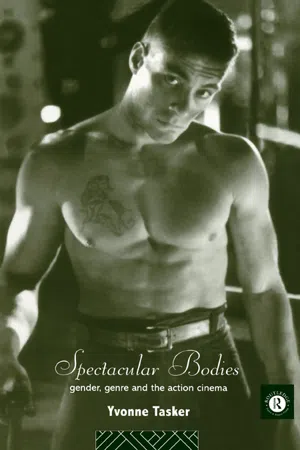
Spectacular Bodies unravels the complexities and pleasures of a genre often dismissed as `obvious' in both its pleasure and its politics, arguing that these controversial films should be analysed and understood within a cinematic as well as a political context.
Yvonne Tasker argues that today's action cinema not only responds to the shifts in gendered, sexual and racial identities which took place during the 1980s, but reflects the influences of other media such as the new video culture. Her detailed discussion of the homoeroticism surrounding the muscleman hero, the symbolic centrality of blackness within the crime narrative, and the changing status of women within the genre, addresses the constitution of these identities through the shifting categories of gender, class, race, sex, sexuality and nation. Spectacular Bodies also examines the ambivalence of supposedly secure categories of popular cinema, questioning the existing terms of film criticism in this area and addressing the complex pleasures of this neglected form.
- 220 pages
- English
- ePUB (mobile friendly)
- Available on iOS & Android
eBook - ePub
About this book
Information
1
Women Warriors
Gender, Sexuality and Hollywood’s Fighting Heroines
Pictured alongside Sylvester Stallone, whose box-office success in the roles of Rocky and Rambo represented a particular and very visible inflection of masculine identity in the cinema of the 1980s, was found, for a time, the larger-than-life image of the star’s then wife, Brigitte Nielson.1 Shortly after her arrival in America, Nielson had played the part of a comic-book swordswoman, alongside Arnold Schwarzenegger, in the mythological epic Red Sonja (1985). Nielson also played the wife of Rocky’s opponent in Rocky IV (1985) and had roles in Cobra (1986) and Beverly Hills Cop II (1987). Though she was associated with the action genre through such roles, it was her marriage to Stallone that gave Nielson extensive media visibility. A six-foot, muscular blonde, Nielson’s androgynous image combines ‘masculine’ characteristics, such as her height, muscular physique and boyish short hair, with an exaggerated female sexuality. Nielson embodies the big-breasted sexualised fantasy woman of comic-book traditions, whilst emphasising the more ‘masculine’ elements that are an important part of this figure. The stories circulated through magazine gossip and Hollywood hype are indicative of the rather unsettling aspects of this image, in that they often centre on sexuality and on Nielson’s location in relation to traditional discourses of womanhood. Along with persistent rumours of both lesbian and heterosexual affairs, questions about her ‘fitness’ as a mother undermine Nielson’s ‘femininity’, whilst rumours of cosmetic surgery similarly emphasise her constructedness as against some ‘natural’ notion of womanhood. A regular ‘comic’ interview question concerns whether men are afraid of her, a formulation which is indicative of the uncertainties generated by her image.
Nielson embodies then a contradictory set of images of female desirability, a sexualised female image which emphasises physical strength and stature. Like the figure of the muscular male hero, Nielson’s version of the woman warrior borrows on comic-strip traditions which deal in parodic, exaggerated characterisations of gendered identity. Indeed, the increased visibility of male and female action stars within American movie culture are related phenomena. What then is the significance of the emergence of the action heroine within Hollywood cinema? How has the Hollywood cinema represented the action heroine and how has this changed in relation to the shifting persona of the muscular action hero? At one level the action heroine represents a response of some kind to feminism, emerging from a changing political context in which images of gendered identity have been increasingly called into question through popular cultural forms such as music video. Equally the persona of the action heroine borrows on well-established images such as that of the tomboy, so that the heroine who is cast as the hero’s sidekick can be read as a girl who has not accepted the responsibilities of adult womanhood. The heroine of Hollywood action pictures has more commonly been figured as romantic interest for the hero. The female fighter as centre of the action, whilst only emerging relatively recently in American film, has for some time been an important figure in Hong Kong action traditions. It was in Hong Kong that American martial-arts star Cynthia Rothrock, who is considered in more detail below, made her first films.
Ripley, played by Sigourney Weaver in Alien (1979) and Aliens (1986), represents one of Hollywood’s most visible action heroines of recent years.2 The characterisation of Ripley in Ridley Scott’s original film represented a significant development in the portrayal of action heroines, combining icons of the action narrative with borrowings from the horror film. The climactic action sequences of the film, in which Ripley undresses before her final confrontation with the alien, has generated a good deal of debate concerning the limits and possibilities of the cinematic representation of the action heroine.3 Weaver reputedly dubbed her role in the second film as ‘Rambolina’, acknowledging the film’s rather self-conscious allusions to the Rambo narrative and persona. Aliens has Ripley, having been betrayed by the ‘company’, decked out in weaponry to do battle with the mother alien. Director James Cameron had co-written the screenplay for Rambo as well as directing another key muscleman movie of the 1980s, The Terminator. The Alien sequence of films is discussed further in Chapter 7, alongside the figure of the muscular heroine. The figure of Ripley raises interesting questions of symbolic transgression, of the extent to which the positioning of a woman at the centre of the action narrative generates problems for the genre at the level of connotation. The figure of Ripley also provides an interesting instance of the ways in which image-makers have dealt with the ‘problem’ of the action heroine, mobilising configurations of motherhood, for example.
By way of contrast to a figure like Ripley, roles such as that played by Patsy Kensit as Rika in Lethal Weapon 2, to cite just one example amongst many, provide little for the actress to do but confirm the hero’s heterosexuality. If the male body is to be a point of security, the hero a figure who can be relied on, then bodily integrity and heterosexuality in particular, need to be maintained within the action narrative. The figure of the woman as romantic interest performs, in this respect, a key narrative function. She both offers a point of differentiation from the hero and deflects attention from the homoeroticism surrounding male buddy relationships. In these terms the figure of the woman provides a space onto which a variety of desires and anxieties are displaced. In Death Warrant (1990) Jean-Claude Van Damme plays Burke, an undercover cop in a maximum security jail. Cynthia Gibb plays Amanda Beckett, a lawyer who, posing as Burke’s wife, provides a contact to the outside. The film enacts a complex male psycho-drama in which the prison narrative is framed by Burke’s encounter with the ghostly figure of ‘The Sandman’. Rape is held up as a threat to Burke, who resists both the sexual violence of his cell-mate and the more seductive temptations of Jersy, a transsexual who lives in the prison’s basement. At the same time, the narrative and cinematography insistently sexualises and commodifies the male body. Gay desire is primarily displaced onto a pathologised construction of blackness within the film, but seemingly to further allay the anxieties attendant on the male prison narrative the film includes a scene in which Amanda inexplicably visits Burke in a private trailer for an intimate love scene, which then fades out at the first kiss. This love scene follows an indicative set of sequences in which we cut from Burke being beaten up by the prison guards to a scene in which Amanda arrives at the prison and is sexually harassed by the same guards. In this case the woman functions as a figure where a displaced story of sexual desire – represented in terms of violence – can be voiced. In an earlier visit to the prison, Burke rebukes Amanda for not looking the part, indicating perhaps the extent to which she is out of place in this film.4
Whilst the woman in the action narrative may operate as some kind of symbolic guarantee, a place for the fixing of difference and heterosexual desire, she is simultaneously rendered increasingly marginal. Unlike the active/passive division of labour discussed by Laura Mulvey in relation to the classic Hollywood film, in which the male figure advances the narrative whilst ‘woman’ functions as spectacle, the male figure in the contemporary action picture often functions in both capacities. He controls the action at the same time as he is offered up to the audience as a sexual spectacle.5 Given the additional importance that images of same-sex friendship have as a source of visual and narrative pleasure within the action narrative, the woman as love interest is in many senses an unwelcome figure. An hysterical figure who needs to be rescued or protected, the heroine is often played for comedy. Sometimes she is simply written out of the more intense action narrative altogether, as in First Blood. More often female characters are either raped or killed, or both, in order to provide a motivation for the hero’s revenge. It is almost a cliché of the detective narrative that the cop hero has lost his wife or lover either before the film commences, as in Dirty Harry or Lethal Weapon, or fairly soon after her appearance as love interest, as in Lethal Weapon 2.
In films like Rocky 111 (1982) and Kickboxer (1989) the figure of the woman mediates the sexual threat that the black or Asian villain represents to the white hero. Mr T plays Clubber Lang, a vicious challenger to Rocky’s title in Rocky 111. Lang challenges Rocky’s virility, making sexual suggestions to his wife Adrian and taking his title from him before the film’s final confrontation, from which Rocky emerges triumphant once more. In the final fight from Kickboxer the Thai kickboxing champion, Tong Po, taunts Jean-Claude Van Damme with both having raped his girl Mylee and holding his paralysed brother Eric captive. Such roles for female characters are very much in line with traditional, even archaic, understandings of women’s role within society. The action movie often operates as an almost exclusively male space, in which issues to do with sexuality and gendered identity can be worked out over the male body. It is perhaps no surprise then that the heroines of the Hollywood action cinema have not tended to be action heroines. They tend to be fought over rather than fighting, avenged rather than avenging. In the role of threatened object they are significant, if passive, narrative figures. This role is sometimes also played by a ‘weak’ male character, a figure who is similarly in need of the hero’s protection. This kind of narrative dynamic operates, for example, in Lock Up, a film in which the status of threatened object is initially played by the young male convict that Stallone/Leone has befriended in the prison. His nickname, ‘First Base’, indicates something of the sexualised power relations structuring this friendship, implications not lost on the rest of the inmates at Gateway. Once First Base has been killed, it is Leone’s girlfriend on the outside, Melissa, who once more assumes the role of the one who needs to be protected, as the narrative moves to its conclusion.
This much, in terms of the sexual organisation of narrative, is familiar, summarised in the mythological image which Laura Mulvey invokes, of Andromeda tied to a rock awaiting rescue from Perseus.6 If women are erased from the action, if not the mise-en-scène, of the action narrative, where does this leave female performers? I certainly do not want to argue that this results in an unproblematic erasure of female audiences. One of the pleasures of the cinema is precisely that it offers a space in which the ambiguities of identities and desires are played out. This blurring of categories is crucial to understanding the play of femininity and masculinity over the bodies of male and female characters, a process that has been inflected significantly in the action cinema of recent years in which the body is brought so much to the fore. Weakness, vulnerability is expressed through the mobilisation of traits associated with femininity, most particularly a softness or lack of definition which might allow the body to be fatally penetrated. It is in these terms that the scars and wounds which mark the body of the suffering male hero are significant. The muscular male body functions as a sort of armour – it is sculpted and worked on – which is repeatedly breached, an understanding expressed in the image of Achilles’ heel, a body with one point of physical vulnerability which betrays the otherwise invincible warrior, and which itself becomes intensely vulnerable.7 Such images can be interpreted in relation to images of castration within the framework of psychoanalysis, as a dramatising of the pleasures of empowerment and the fear of powerlessness. The narrative dynamic that operates in relationship to the female body in the action cinema is constructed within a similar set of terms. Considered within a psychoanalytic framework women, of course, have less to lose. Whilst there is a symbolic transgression enacted through the feminisation and penetration of the male body, a symbolic transgression enacted over the woman’s body emphasises the ways in which her body is rendered impenetrable. It is the play of such qualities in Alien that elaborates a distinction between the two female crew members – Ripley, who survives, and Lambert, who does not.
As the construction of the action heroine with reference to images of physical hardness makes clear, the connotations of the term ‘heroine’ in the Hollywood action cinema have been sharply shifted in recent years. By the beginning of the 1990s a range of images of active heroines had begun to emerge, figures such as Susan Sarandon and Geena Davies in Ridley Scott’s Thelma and Louise, Linda Hamilton in a muscular reprise of her role as Sarah Connor in Terminator 2 and Jodie Foster as aspiring FBI agent Clarice Starling in The Silence of the Lambs. These roles began to sketch out a different set of roles and new narrative possibilities for women in the Hollywood action cinema so that ‘heroine’ no longer necessarily signifies passivity. The success of these films, and the sheer visibility of images of their female stars, represents a significant inflection of the action cinema’s articulation of gender. Nonetheless these images do emerge from existing traditions of representation, a history that is briefly traced below in an attempt to offer a context for the very public emergence of these action heroines.
The ‘Independent Heroine’ as Stereotype
During the 1970s Hollywood, always eager to cash in on the emergence of new markets, sought to respond to the women’s movement in a variety of ways. Films such as Klute and Julia, which both starred Jane Fonda (an important actress of the period) attempted to redefine existing types and traditions of representation, in order to include the figure of the ‘independent heroine’.8 Such films centred around the stories of women who are independent of men, who are sexually free and who, to an extent, determine their own lives. Forming a recognisable sub-genre these films are also primarily concerned with detailing the problems faced by the independent woman in achieving her independence. Thus the problematic aspects of the ‘independent woman’s’ narrative is repeatedly foregrounded. These fictions can be seen to respond to feminist demands for less stereotypical roles for women, since they offer more developed character parts, even if retrospectively they can be seen to have contributed to a recognisable stereotype. These fictions offer, that is, a new, or at least revised stereotype. During the same period, and forming an allied development in some respects, American television produced such successful series as Charlie’s Angels, Policewoman and Wonderwoman. These television series all placed women at the centre of the action narrative, though signalling in a variety of ways uncertainties about such a shift. Thus the three investigators who are ‘Charlie’s Angels’ were oddly positioned as both fashion plates and action heroines, but also as in the service of the central male figure ‘Charlie’. Whilst Angie Dickinson, the star of Policewoman and a well-established performer, played what was a more sober or ‘dramatic’ role, these series often emphasised the glamorous sexuality of the heroines, an emphasis which sat uneasily with the need to include action sequences.
What was implicit in a series like Charlie’s Angels, that these characters were drawn from a stylised cartoon or comic-strip tradition, was made explicit in the televising of Wonderwoman with ex-Miss World Lynda Carter in the title role. The cult British television series of the 1960s, The Avengers, had mobilised such fantasy traditions, out of pop art, in the leather-clad, tough, fighting heroines played by Honor Blackman and Diana Rigg. In the cinema, films like Barbarella (1968) provide antecedents for these 1970s superheroines and for more recent epics such as Red Sonja and Conan the Destroyer, discussed below, which conjure up a mythological world in which to place the woman warrior, whilst also drawing on camp comedy to undermine the earnest poses of the performers. In crude terms, if images of men have often needed to compensate for the sexual presentation of the hero’s body through emphasising his activity, then images of women seem to need to compensate for the figure of the active heroine by emphasising her sexuality, her availability within traditional feminine terms. Hence the rather conventional coding of glamour around characters such as ‘Charlie’s Angels’. This anxiety also allows us to think about the complex problems of coding posed by the more recent emergence of the muscular action heroine, a figure who is discussed later in the book.
In responding to feminism, image-makers sought to present women as active and as powerful, mobilising already-existing types and conventions, images that were an established part of popular culture, such as the leather-clad dominatrix. That producers reached for such conventions convinced many hostile critics that these representations were exploitative, and were directed at male rather than female audiences. The complex relationship between feminist criticism and images of the action heroine is taken up further in Chapter 7. Here we can note that the combination of supposedly masculine and feminine elements in the gendered images of the 1970s posed all sorts of iconographie problems for television producers and film-makers. Producers often sought to allay, if not resolve, the uncertainties posed by the action heroine through either the sexualisation of her persona or the use of comedy, or both. The production history of a television series like Cagney and Lacey is a case in point. Whilst this series became a rallying point of ‘quality’ television for many feminist critics and audiences of the 1980s, it was initially conceived as something quite different, during the 1970s. Barbara Avedon and Barbara Corday created the characters as a response to the arguments presented in Molly Haskell’s book From Reverence to Rape, first published in 1974. Haskell had argued that women had been excluded from Hollywood in the 1970s in favour of the ‘immature’ and unthreatening relationships seen in male buddy movies. The producers got the idea of producing a female buddy movie, with the initial plot functioning as a spoof that had Cagney and Lacey investigating a ‘Godmother’ figure who runs a joke scam involving male prostitutes and female clients.9
The kind of comic role reversal operating here is reminiscent of the polarised ‘battle of the sexes’ rhetoric through which gender relations were popularly represented during the 1970s. The militancy ascribed to the women’s movement can be seen as, in some senses, an extension of such rhetoric. This rhetoric and the images to which it gave rise are part and parcel of an attempt to insist on the retention of a binary understanding of gendered identity - a battle between two sides - which finds its contemporary manifestation in the popular understanding of human nature as made up of feminine and masculine ‘sid...
Table of contents
- Cover
- Half Title
- Title Page
- Copyright
- Contents
- List of plates
- Acknowledgements
- Introduction: Gender and the action cinema
- 1. Women Warriors: Gender, sexuality and Hollywood’s fighting heroines
- 2. Black Buddies and White Heroes: Racial discourse in the action cinema
- 3. New Hollywood, Genre and the Action Cinema
- 4. Tough Guys and Wise-Guys: Masculinities and star images in the action cinema
- 5. Masculinity, Politics and National Identity
- 6. The Body in Crisis or the Body Triumphant?
- 7. Action Heroines in the 1980s: The limits of ‘musculinity’
- 8. The Cinema as Experience: Kathryn Bigelow and the cinema of spectacle
- Notes
- Filmography
- Bibliography
- Index
Trusted by 375,005 students
Access to over 1.5 million titles for a fair monthly price.
Study more efficiently using our study tools.
Frequently asked questions
Yes, you can cancel anytime from the Subscription tab in your account settings on the Perlego website. Your subscription will stay active until the end of your current billing period. Learn how to cancel your subscription
No, books cannot be downloaded as external files, such as PDFs, for use outside of Perlego. However, you can download books within the Perlego app for offline reading on mobile or tablet. Learn how to download books offline
We are an online textbook subscription service, where you can get access to an entire online library for less than the price of a single book per month. With over 1.5 million books across 990+ topics, we’ve got you covered! Learn about our mission
Look out for the read-aloud symbol on your next book to see if you can listen to it. The read-aloud tool reads text aloud for you, highlighting the text as it is being read. You can pause it, speed it up and slow it down. Learn more about Read Aloud
Yes! You can use the Perlego app on both iOS and Android devices to read anytime, anywhere — even offline. Perfect for commutes or when you’re on the go.
Please note we cannot support devices running on iOS 13 and Android 7 or earlier. Learn more about using the app
Please note we cannot support devices running on iOS 13 and Android 7 or earlier. Learn more about using the app
Yes, you can access Spectacular Bodies by Yvonne Tasker in PDF and/or ePUB format, as well as other popular books in Media & Performing Arts & Film History & Criticism. We have over 1.5 million books available in our catalogue for you to explore.