- 224 pages
- English
- ePUB (mobile friendly)
- Available on iOS & Android
eBook - ePub
About this book
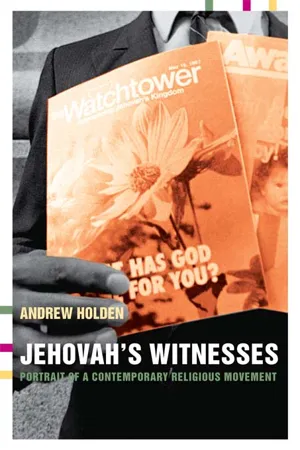
This is the first major study of the enigmatic religious society. By examining the Jehovah's Witnesses' dramatic recent expansion, Andrew Holden reveals the dependency of their quasi-totalitarian movement on the physical and cultural resources have brought about the privatization of religion, the erosion of community, and the separation of 'fact' from faith.
1 The end is nigh
There could be no period more appropriate than the beginning of a new millennium in which to consider the activities of those who hold beliefs about the end of the world. In 1872, a Pittsburgh draper named Charles Taze Russell founded what later became known as the Watch Tower Bible and Tract Society – the official name for the organisation of Jehovah's Witnesses. Russell had a fascination for biblical eschatology – a fascination which would play a huge part in the expansion of what is now a huge international corporation with over six million members. The Witnesses are members of a world-renouncing puritanical movement that claims to monopolise truth, and for this reason they refuse all ecumenical relations with other religious denominations. In a modern age in which people are free to construct their own aesthetic identities, the Witnesses stand out as authoritarian, calculating and aloof, and this makes their organisation distinctive from other social movements. The Witnesses are now active all over the world. Their worldwide membership increased from a mere 44,080 in 1928 to an extraordinary 6,035,564 in 2000, making a total international net growth of more than 5 per cent a year. Although these are the movement's own figures, there is no reason to doubt them. For one thing, they are consistent with government estimates as well as those of independent scholars and, for another, the Society publishes losses as well as gains.1 Indeed, the Witnesses are loath to include anyone other than active evangelists over the age of sixteen in their annual statistics. Even the most conservative estimates indicate that, by the year 2020, there will be 12,475,115 members worldwide (Stark and Iannaccone 1997: 153–4).2
The Watch Tower Society has had a chequered evolution. Almost from the moment of its foundation, devotees have lived in anticipation of a new Messianic Kingdom in which all earthly wickedness would be destroyed and paradise be inaugurated. The years of 1874, 1914, 1918, 1925 and 1975 were all earmarked, to a greater or lesser extent, as times for the Second Coming of Christ, yet all brought bitter disappointment. Despite this persistent prophecy failure, the Witnesses have managed to recruit and expand with remarkable success and have now (paradoxically) been on the scene for almost 130 years. This book is about their continued appeal and status at the beginning of the twenty-first century. It is about life inside the Society from the point of conversion and how the Witnesses manage their relations with the outside world. I also consider what causes some of these Witnesses to defect. Those who are expecting answers to questions concerning philosophical or theological truth should read no further. I write as a sociologist, and am thus concerned with the effects of supernatural beliefs rather than their validity. My aim is to highlight some of the challenges that the modern world presents to the movement, and to consider the ways in which devotees manage their religious identity in an age of cultural fluidity.
It is astonishing to find that there is a dearth of academic literature on the Witnesses, given the remarkable success of their evangelistic mission. Beckford (1975a, 1975b, 1976), Wilson (1974, 1978, 1990) and Dobbelaere and Wilson (1980) have carried out the most extensive empirical research, although these studies are now quite dated. Moreover, the Witnesses are not given anything other than a brief mention in most of the key textbooks on the sociology of religion. There is, as one might expect, a slightly larger number of published articles on the Watch Tower movement in Social Compass, Sociological Analysis, The Journal of Modern African Studies and The British Journal of Sociology, but not nearly as many as those devoted to obscure (and relatively unsuccessful) new religious movements. By far the best known study of the Witnesses is James Beckford's The Trumpet of Prophecy (1975a). The first three chapters of Beckford's book are devoted to the historical development of the Watch Tower Society. In them, Beckford makes use of the few earlier sociological studies on the Witnesses as well as the organisation's own published literature. These chapters tell us about the movement's social composition and its postwar expansion in Britain and the USA. Beckford's work contains important quantitative and qualitative data collected from ten congregations representing the geographical divisions of England, Wales and the Scottish Lowlands. Although the book is largely empirical, Beckford offers some theoretical analysis of conversion and affiliation to the organisation that aids our understanding of the Witnesses’ worldview.3 Beckford's discussion of the factors that influence membership and the internal forces that maximise long-term commitment informs some of my analysis in Chapters 3 and 4. Whatever strengths Beckford's work might have, however, the fact remains that it is now more than twenty years old. My aim, therefore, is to produce not only a current monograph on the Witnesses but one that is unlike anything that has been published to date. My hope is that this will help to redress the neglect I have described as well as some of the more general shortfalls in the academic literature on religion identified by sociologist Robert Wuthnow (1997):
One feature that most clearly distinguishes contemporary scholarship from, say, the 1950s or 1960s is its rejection of … ‘linear narratives of disembodied trends’. Recent studies not only dispute the claims of theories that emphasize, for instance, secularization and modernization; they also reject the value of such theories, preferring instead to talk about gender differences, multiple vocabularies, local cultures, contradictory impulses, negotiation, and the construction of meaning.
(248)
Mindful of Wuthnow's warning that idiosyncratic details of religious organisations can hinder cumulative (theoretical) knowledge, I have used sociological theory to inform my ethnographic description of the Witnesses’ system of beliefs. There is, I believe, a current shortage of empirical studies of religious movements that make anything other than brief reference to the wider issues of modernity. What follows is an attempt to chart some of this territory.
Research perspective and method
Before embarking on a discussion of the movement's beliefs, I want to explain how I became interested in the Watch Tower community and to describe the kind of sociology in which I have been engaged for the last ten or so years. There were two main reasons for my initial interest in the Witnesses. First, my childhood memories of their periodic visits to our home and my mother's impatience with their tireless efforts to recruit us aroused my curiosity. Why did these people persist in knocking on our door when my parents had made it patently clear that we were a Catholic family who had no intention of converting to another faith? What did the Witnesses want to say to us? And why were my parents so dismissive of their message without even hearing it? After all, people were not usually turned away from our house with such short shrift. Second, a chance encounter with some Witnesses at a local fitness club several years later led to some interesting discussions about creation, evolution, the meaning of life and what happens to us when we die. I discovered that the Witnesses held exclusive and absolutist beliefs – beliefs that seem strange to the outside world. I had to find out what kind of people converted to the Watch Tower organisation and why they did it. Though I found their theology unconvincing, I could see that they were convinced. In the early 1990s, I decided to let the Witnesses tell their story and used what they told me to write my doctoral thesis. I now want to share some of what I learned with a wider audience. This monograph contains fieldwork data collected in my home town of Blackburn between 1991 and 1996, but I have added some new material that will also be of interest to the sociologist of religion.
Carrying out an empirical investigation among fervent evangelists like the Witnesses is far from easy. Although in principle anyone is welcome to attend Watch Tower meetings, dealing first hand with devotees themselves requires a certain amount of sensitivity. When I first entered the field, I was thankful for the support of key individuals, including congregational elders, but I was ever wary of doing or saying anything that could appear antagonistic.4 Though I had read widely on the evolution of the Society and familiarised myself with its doctrines, I was still aware that, as an outsider, I was different from the rest of the congregation, and I had made it clear that I was not a prospective recruit. Since the Witnesses were under no obligation to help me, I became increasingly aware that the quality of my data would depend on the relationships I formed with people who were willing to answer my questions and talk to me about their lives. I cannot tell a lie. I found some of the members difficult to work with, and my status as a sociologist did nothing to allay the suspicion with which they approach outsiders. Nevertheless, I was hungry for information about this movement and it was going to take more than a group of suspicious devotees to stop me from finding out more.
As an ethnographer, I was interested to learn about the Witnesses’ version of reality as they perceived it, and this meant giving them a voice. Though I am well aware of the methodological problems involved in ‘going native’, one of the reasons I believe millenarians are poorly understood is that they are seldom given the opportunity to explain their view of the cosmos. Though it was not (and still is not) my intention to rehabilitate the Witnesses from public misrepresentation, I wanted to know why they renounced the world in the way they did and to see how they operated in their own place of worship. The information contained in this book has been culled from participant and non-participant observation, transcripts from unstructured interviews (pseudonyms have been used in order to protect the identity of all interviewees), extracts from the Watch Tower Society's own published literature and extensive analysis of the writings of former members.
Although there are numerous texts and journal articles offering guidance to researchers about the styles and strategies that can be employed in the collection and presentation of ethnographic data, there is still a great deal of mystery surrounding the way in which researchers engage in data analysis. This owes something to the complexity of interpreting the lives of others and presenting qualitative data. No matter how much care ethnographic researchers take in collecting and handling data, their interpretations will always be subjective. Ethnography is no less flawed (or no more for that matter) than any other method in the social sciences, and even the poorest ethnographer knows better than to claim otherwise. We would do well to heed the words of anthropologist Clifford Geertz: ‘The culture of a people is an ensemble of texts, themselves ensembles, which the anthropologist strains to read over the shoulders of those to whom they properly belong’ (Geertz 1973: 452).
What Geertz is suggesting here is that human societies are analogous to texts that can be read in different ways. The essence of a text (a collective text in the case of culture) is that its meaning is freed from the author's position. According to this view, everyone is entitled to a reading, but there are still issues of interpretation to consider. Texts, for example, can be read and written in ways that detract from the intentions of participants. This book is no exception. I have drawn on the subjective experiences of the Jehovah's Witnesses to help illuminate a social phenomenon, but in so doing I am mindful of my own sociological perspective. My decision to examine the social interactions of the Witnesses in the context of a rapidly changing world that cannot easily accommodate their beliefs indicates that I have chosen to view their relationship with modern forces as something that is characterised by tension. Although few people (including devotees themselves) would argue that this was an unreasonable claim, I could be charged with making the assumption that the values of secular society are, for most non-sectarians, unproblematic. Moreover, my decision to allow the Witnesses to speak through my text involved judgements about which issues were worthy of attention and how best to tell the story.
There are dozens of monographs in which researchers explain how they combined hard data and thick description, but, in the last analysis, the primary role of the ethnographer is to present the experiences of those with whom they are working to an academic community. Geertz distinguishes between the world of the native and the knowledge or interpretations of the researcher, and he refers to these two perspectives as experience near and experience distant (Geertz 1983). The skill of the ethnographer lies in his or her ability to move to and fro between them. In my own study, the vocabulary of the Witnesses contrasts sharply with that of the academic. Watch Tower concepts such as ‘truth’, ‘love’, ‘brother’ and ‘sister’ could be regarded as experience near concepts and tell us something about the Witnesses’ way of thinking. Experience distant concepts, on the other hand, belong to the specialist vocabulary of the academic who would replace a concept such as ‘truth’ with one such as Weltanschauung. In his passion for understanding the world of others, Geertz argues that the local knowledge of participants should be combined with that of the social scientist:
so as to produce an interpretation of the way a people lives which is neither imprisoned within their mental horizons, an ethnography of a witchcraft as written by a witch, nor systematically deaf to the distinctive tonalities of their existence, an ethnography of a witchcraft as written by a geometer.
(1973: 57)
It is only by understanding the natives’ worldview that ethnographers are able to make sense of an individual act, but these interpretations can only be partial and must be subjected to continual revision. The spatial and temporal gap between author and interpretation is brought together by tradition and by what Geertz calls ‘a fusion of horizons’, but such a gap can never be fully bridged. Reading the lives of others is, in the final analysis, only a reading; and there is no irrefutably correct interpretation. With this in mind, I have tried to examine Watch Tower culture in terms of how the devotees themselves experience it. Though I neither disdain nor applaud the way the Witnesses choose to live, their lifestyle can be understood only by a methodology that allows them to explain their religious perspective. But epistemological claims are themselves everything but impartial. Sociologist Eileen Barker (1987) sums up some of the difficulties of ethnography in her analogy of the observer as an actor in a live theatrical performance:
Professional stage actors, like participant observers, have to learn to recognise within themselves the emotions that they share with the rest of humanity, but which will have been developed to different degrees and will have taken different forms in each one of us. They have to learn the form and the strength of such ingredients as compassion, jealousy, idealism, ambition and fear, and they have to understand how these operate in the situations in which the characters they play find themselves. But, at the same time, although they will be drawing on their own emotions, and can have very genuine tears flowing from their eyes, they must still make sure that their choked words can be heard from the back of the gallery, and that they wait for the audience's laughter to subside before taking up a cue. And if the properties-man has forgotten to set the dagger with which the abandoned mistress is about to kill herself, the actress has to be sufficiently distanced to notice this and rapidly work out what the hell to do next.
(142–3)
As I became a more familiar figure at the Kingdom Hall (the official name for the Witnesses’ place of worship), I realised that I was both subjectively involved on the inside and dispassionately collecting data from the outside. This was my first real insight into a reflexive ethnography.5 Like an actor, I felt that I was performing and, at the same time, I was aware that the activities in which I partook were being carefully constructed by those with whom I had little in common. Needless to say, my relationships with individuals in the congregation were all different. To some, I was a polite but sceptical academic with nothing other than a quasi-professional interest in their way of life. To the elders, I was an enthusiastic young man of apparently agnostic disposition who needed help in collecting what was to them rather futile information. To others still, I was a friendly acquaintance (rather than a friend) who, unlike most other outsiders, had a comprehensive knowledge of their mission and with whom they could hold an intelligent conversation.
Throughout my study, I interviewed many Witnesses who told me that their religious conversion had brought them happiness and well-being – a declaration that flies in the face of the generally negative profile which religious movements have been given over the years by the popular press. The mass media thrive on stories of families being torn apart by the loss of their loved ones allegedly enticed by religious maniacs demanding total compliance. Sensationalism of this kind tends to portray all heterodox religious devotees as brainwashed extremists, and this makes their zeal difficult to comprehend. While I too find these movements unappealing, I respect the rights of others to join them. Such rights are, I believe, part and parcel of the democracy which few would wish to jeopardise. My ethnography gave me a better understanding of something I had always treated with caution. In the end, I recognised that the confusion and conflict that derive from religious conversion are often the result of people's inability (and sometimes their unwillingness), to understand a different way of life from their own. Throughout the whole period of my research, I met hundreds of Jehovah's Witnesses; some were warm and friendly, others were aloof and cynical. I watched, I listened and I collected some interesting data. I chatted to the Witnesses at meetings and visited them in their own homes. I asked some naive questions and made some embarrassing mistakes. I experienced fascination, humour, sadness and frustration. I felt anger, tension, disappointment and bewilderment. I made friends and I made enemies. But most importantly, I learned what it was like to enter an unfamiliar world and to listen intently to those who inhabited it. It was a journey that forced me to confront my own prejudices and to challenge the prejudices of others. I wouldn't have missed it for the world.
The millenarian option
Since the foundation of their movement around 130 years ago, the Witnesses have maintained that we are living on the precipice of the end of time. Their eschatology is based on the texts of the New Testament and almost all of their literature makes reference to the annihilation of evil at Armageddon; hence, they see their mission as having to proselytise to as many prospective converts as possible. It is no coincidence that their belief in the imminence of a New Kingdom corresponds with the evidence they present in their publications that they are one of the fastest-growing religious movements in the world. The Watch Tower Society teaches that the end will come only when Jehovah's true word has been ministered to the ends of the earth. Millenarian tenets are, by their nature, potentially disruptive since they challenge other systems of belief and patterns of behaviour, religious and secular. Where societies allow people space in which to establish their own lifestyles, millenarian communities can prosper by presenting themselves as exclusive organisations that make clear distinctions between members and non-members. Since many such movements are critical of mainstream religion, their appeal lies in their alternative way of life. Historically, millenarian movements were usually formed by dissidents who rejected the authority of the church and its pontiff and were regarded as a form of religious deviation or protest. Worse still, some of these movements advanced new doctrines which met the wrath of mainstream Christianity; hence, most millenarians have a history of tension with the wider society.
There are two main approaches in the academic literature to the analysis of millenarian beliefs – the first sees millenarianism as a reaction to, and the second as a manifestation of, secular forces. In the former case, it could be argued that the Watch Tower community appeals to p...
Table of contents
- Front Cover
- Half Title
- Title Page
- Copyright
- Dedication
- Contents
- Preface
- Acknowledgements
- 1 The end is nigh
- 2 The Jehovah’s Witnesses in the modern world
- 3 Finding a home
- 4 Rational means to rational ends
- 5 Returning to Eden
- 6 Inside, outside
- 7 Honour thy father and thy mother
- 8 The fear of freedom
- 9 Conclusion
- Notes
- Glossary
- Bibliography
- Index
Trusted by 375,005 students
Access to over 1.5 million titles for a fair monthly price.
Study more efficiently using our study tools.
Frequently asked questions
Yes, you can cancel anytime from the Subscription tab in your account settings on the Perlego website. Your subscription will stay active until the end of your current billing period. Learn how to cancel your subscription
No, books cannot be downloaded as external files, such as PDFs, for use outside of Perlego. However, you can download books within the Perlego app for offline reading on mobile or tablet. Learn how to download books offline
Perlego offers two plans: Essential and Complete
- Essential is ideal for learners and professionals who enjoy exploring a wide range of subjects. Access the Essential Library with 800,000+ trusted titles and best-sellers across business, personal growth, and the humanities. Includes unlimited reading time and Standard Read Aloud voice.
- Complete: Perfect for advanced learners and researchers needing full, unrestricted access. Unlock 1.5M+ books across hundreds of subjects, including academic and specialized titles. The Complete Plan also includes advanced features like Premium Read Aloud and Research Assistant.
We are an online textbook subscription service, where you can get access to an entire online library for less than the price of a single book per month. With over 1.5 million books across 990+ topics, we’ve got you covered! Learn about our mission
Look out for the read-aloud symbol on your next book to see if you can listen to it. The read-aloud tool reads text aloud for you, highlighting the text as it is being read. You can pause it, speed it up and slow it down. Learn more about Read Aloud
Yes! You can use the Perlego app on both iOS and Android devices to read anytime, anywhere — even offline. Perfect for commutes or when you’re on the go.
Please note we cannot support devices running on iOS 13 and Android 7 or earlier. Learn more about using the app
Please note we cannot support devices running on iOS 13 and Android 7 or earlier. Learn more about using the app
Yes, you can access Jehovah's Witnesses by Andrew Holden in PDF and/or ePUB format, as well as other popular books in Theology & Religion & Marketing. We have over 1.5 million books available in our catalogue for you to explore.