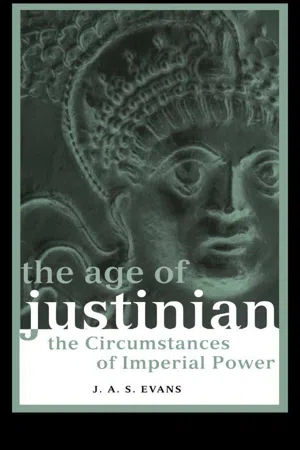
The Age of Justinian examines the reign of the great emperor Justinian (527-565) and his wife Theodora, who advanced from the theatre to the throne. The origins of the irrevocable split between East and West, between the Byzantine and the Persian Empire are chronicled, which continue up to the present day. The book looks at the social structure of sixth century Byzantium, and the neighbours that surrounded the empire. It also deals with Justinian's wars, which restored Italy, Africa and a part of Spain to the empire.
- 360 pages
- English
- ePUB (mobile friendly)
- Available on iOS & Android
eBook - ePub
1
THE IMPERIAL ENVIRONMENT
THE EMPIRE WHICH ANASASTIUS LEFT
BEHIND
During the night of 9 or 10 July, 518, the emperor Anastasius died in Constantinople. A violent thunderstorm was raging, and a lightning bolt struck the imperial palace, which may have hastened the death of the aged and heretical emperor.1 Thus ended a remarkable reign which had begun unexpectedly twenty-seven years earlier. The emperor Zeno the Isaurian had died; the people gathered in the Hippodrome and waited restively for word of his successor, and the senate, respecting the hereditary principle, resolved to invite Zeno’s widow, Ariadne, daughter of the emperor Leo I, to make the choice. She passed over Zeno’s brother and the whole coterie of Isaurians who had supported Zeno, and chose Anastasius, a decurion of the court ushers with senatorial rank known as silentiaries. He was 61 years old, and had a reputation for Monophysite leanings, but he was an old friend of Ariadne’s. The next day, 11 April, 491, Anastasius gave the patriarch of Constantinople, Euphemius, a written pledge to make no religious innovations, and the diadem was placed on his head. The following month he married Ariadne.
But in 518 Ariadne had been dead for two years, and there was no obvious successor. Anastasius had three nephews, and the most likely of them, Hypatius, was Master of the Soldiers in the East when the old emperor died. Distance ruled him out, for he was probably at his headquarters in Antioch. The silentiaries reported the emperor’s death to Celer, the Master of Offices, and Justin, Count of the Excubitors. Both these men had soldiers under their command, Celer more than Justin, but Celer’s candidati and regiments of the Scholae (Scholares) were largely ornamental, whereas Justin’s Excubitors were the palace guard and could fight if need be. When morning came, Celer summoned the senate, the patriarch and high officials to the palace, while the people gathered in the Hippodrome next door and waited impatiently. Celer urged a quick decision: if the senators failed to act promptly, he warned, others would make the choice for them.
Yet no quick decision was forthcoming. The Constantinople senate had never chosen an emperor before. The Excubitors put forward a nominee, but the Blues2 in the Hippodrome would not have him. The Scholares put forward another, but the Excubitors would have killed him but for the intervention of Justin’s nephew, Justinian. The Excubitors then tried to put forward Justinian himself, but he declined. The situation was in danger of getting out of hand. Finally all the senators, who were by now a little frightened, agreed upon Justin. Some Scholares objected, and in the ensuing scuffle, the future emperor got a split lip. But the army and people backed Justin, and the chamberlains sent him the imperial robes. So Justin, after the conventional show of reluctance, accepted. He entered the imperial box at the Hippodrome, and there, before the people, he was raised upon a shield; an officer of the Lancers put a gold chain on his head, and while the Excubitors screened him with their shields, he put on the purple robe and red shoes of a Byzantine emperor. Then the patriarch John crowned him, and the new emperor was exhibited to the people, who shouted in unison, ‘Justinus Augustus, tu vincas! (may you be victorious)’. Justin then spoke, promising good government and a donative to the troops, and the ceremony ended with a solemn procession to the church of Hagia Sophia, and a banquet in the palace.3
That, at least, is the story according to the official account, which derives from the contemporary historian, Peter the Patrician, and except for the insinuation that the future emperor Justinian was himself a possible candidate in 518 for the imperial office, it is credible enough. But we have more information from John Malalas, who was familiar with contemporary traditions. The imperial chamberlain Amantius (praepositus sacri cubiculi) had ambitions of his own, and since he could not himself aspire to the throne, for he was a eunuch, he schemed to put forward his domestic, the count Theocritus. He entrusted Justin with money to make the necessary bribes, and Justin distributed it. ‘The army and the people’ took the money, reported Malalas, but they did not choose Theocritus. Instead, ‘by the will of God’ they made Justin himself emperor, who began his reign by putting Amantius and his clique to death.4
Justin, who now at the age of about 65 became emperor, had been a Thracian peasant who migrated to Constantinople, and rose through the army ranks until he became Count of the Excubitors, well positioned to succeed the childless Anastasius. The dynasty he founded was to end the series of remarkable emperors from Illyricum that began in 268 with Claudius Gothicus, who took over a Roman Empire at the point of collapse and began the restoration. They were also the last emperors whose native tongue was Latin, and perhaps the last who genuinely felt the resonance of Rome’s departed grandeur. The reign of Justinian, for which Justin’s was the preface, was a period of transition, when the classical Graeco-Roman world finally died, and the Byzantine world began. Not that the sixth century itself recognized the watershed: the inhabitants of the empire called their empire Romania and themselves Romaioi, and the term ‘Byzantine’ which we use to describe the period is something of an anachronism, for it became common usage only in the Renaissance. The shift was probably not one that Justinian consciously willed. He saw his innovations as restoration and reform rather than a break with the past, but he accelerated change nonetheless. The regime of Justinian and his empress Theodora marked the summit of Late Antiquity. It concluded the chapter that we can entitle the protobyzantine period, and opened a new one on the Byzantine world.
Claudius Gothicus died of plague in 270, but the recovery of the empire was already under way. Under his predecessor, Gallienus, a horde of Goths and Heruls had swept into Greece; Athens was sacked in 267, and the invaders got as far south as Sparta. But two years later, Claudius defeated a fresh invasion of Goths, and in the fifteen years after his death, the empire reemerged with its boundaries almost, but not quite, intact, for Dacia, which the emperor Trajan had added at the start of the second century, had to be evacuated. Yet the old sense of security was gone. Nothing marks its passing so visibly as the walls of Rome, which are still standing and were last put to use during the Risorgimento in 1870. For three centuries, no one had thought Rome needed walls, but now it seemed otherwise. The emperor Aurelian began their construction in 271.
Aurelian died at the hands of his officers after a five-year reign; the 75-year-old Tacitus, whom the senate nominated as his successor at the army’s request, lasted only six months, and after him, Probus fell victim to a mutiny within six years. His successor Carus died in turn some ten months later on an expedition to Persia. His assassin was probably his praetorian prefect, Aper, who also disposed of Carus’ younger son, Numerian, or at least suspicion pointed towards him. But Aper did not succeed to the throne, for upon discovering Numerian’s death, the army acclaimed Diocles, who took the name of Diocletian and, as his first imperial act, slew Aper with his own hands.
That was on 20 November, 284. Next April, Diocletian eliminated Carus’ son, Carinus, whom his father had left in charge of the western part of the empire. Fifteen years after Claudius’ death, the empire found a ruler with a clear idea of how it should be reformed, and the acumen and skill to do it. He ruled for twenty-one years and abdicated of his own free will. The succession was orderly. At least, for the moment.
Diocletian’s design, that the empire should be ruled by a college of emperors, was not entirely new. Emperors as early as Galba in the aftermath of Nero’s death had tried to secure their positions by associating colleagues with them. But Diocletian’s scheme was the most elaborate and successful. In 285, he created his old friend Maximian Caesar, and next year made him Augustus, his equal but junior partner. In early 293, deciding that two emperors were not enough, he created two Caesars, Galerius in the East, and in the West, Constantius Chlorus. When Diocletian abdicated, Maximian did likewise, though less willingly, and Galerius and Constantius Chlorus succeeded as Augusti along with two new Caesars, their appointments intentionally disregarding hereditary right which the army rank and file were always disposed to recognize. Maximian’s son, Maxentius, and the son of Constantius, Constantine, were both passed over.
The plan failed in the outcome. When Constantius died, his army proclaimed Constantine as his successor, and in Italy, Maxentius led a revolt which Galerius and his Caesar, Severus, failed to suppress, for their soldiers would not follow them against Maximian’s natural heir. Galerius died in 311, and his portion of the empire was divided between his fellow Augustus, Licinius, and his erstwhile Caesar, Maximin Daia. The following year, Constantine destroyed Maxentius at the Milvian Bridge outside Rome: an easy victory but one which actually did change the course of history, for Constantine chose that moment to acknowledge his Christian faith. Licinius and Constantine met the next year in Milan and patched together an alliance: the Christians, whom Galerius had persecuted savagely until just before his death, were to receive toleration and their confiscated property returned. To seal the pact, Licinius married Constantine’s sister.
But as the two Augusti conferred at Milan, news came that Maximin Daia had invaded Europe, and Licinius left hurriedly to deal with him. Daia was defeated near Adrianople and pulled back into Asia Minor, but there was no hope for him: at Tarsus, he ended the contest by taking his own life. Licinius and Constantine were left to share the empire between them.
It was an uneasy accord: a Cold War between an emperor in the West whose indulgence towards the Christian church became increasingly clear, and an eastern counterpart whose suspicion of the Christians mounted in tandem. In 324, the peace broke down. Constantine attacked. His troops carried into battle the Labarum, his imperial standard bearing the Christian Chi–Rho emblem, whereas Licinius’ troops fought under the signs of the pagan gods. It was a Christian battle against the unbeliever,5 and on 8 November, 324, Licinius was defeated off Scutari on the Asian side of the Bosporus. He surrendered with the understanding that his life would be spared, but Constantine soon found a reason to put him to death.
Yet something lasted of what Diocletian’s Tetrarchy achieved. Diocletian had put his stamp upon both the administrative structures of Late Antiquity and the emperor’s persona. One aspect of his reform, however, had a result he would not have approved. Diocletian had divided the imperial administration between two Augusti, but he did not intend to split the empire itself. Yet the fracture took on a life of its own. Constantine, who united the empire at the cost of much toil and bloodshed, divided it at his death among his heirs. But by that time, it had undergone a change which pointed forward to Justinian’s empire.
In some respects, Constantine’s administrative reforms merely completed what Diocletian had begun, but two of his decisions changed the course of imperial history. First, he became a Christian. It is irrelevant to ask how profound his comprehension of the Christian faith was, though we must judge him as good a Christian as Henry VIII of England, who actually founded a church. Later tradition fostered by Constantine himself had it that his conversion resulted from a vision before the battle of the Milvian Bridge, but probably the process was less precipitate, though decisive just the same. Christianity now enjoyed official favour, and a spate of church building began which reached full flood under Justinian. But along with his new religion, Constantine inherited its theological disputes. Henceforth, finding an acceptable definition of orthodoxy would be a major concern of all emperors who sought to maintain the unity of the empire.
Second, he founded Constantinople where the city of Byzantium stood at the entrance to the Black Sea. Rome on the Tiber had long since lost its strategic importance. Diocletian had made Nicomedia his capital and Galerius Thessaloniki, but in fact, the working capitals of the late imperial period were wherever the hard-driven emperors happened to be campaigning at the time. That state of affairs would not change immediately, but by the end of the fourth century, emperors had ceased to lead their armies in person, and Constantinople had become the capital city of the eastern empire, the residence of the eastern emperors. After 476, when the last emperor in the West was deposed, it was Constantine’s new Rome that survived and continued as the imperial capital and the heart of Romania. For fifty years Justinian never stirred more than a few kilometres from its boundaries except for a pilgrimage to a shrine near Ankara at the end of his life.
THE CONSTRUCTION OF A NEW CAPITAL
Tradition had it that Byzantium was founded in 659 BC by the Greek city-state of Megara.6 The date is probably too early, but at any rate, by 600 BC there was a Greek settlement on the west shore of the Bosporus, with its acropolis where Hagia Sophia and Topkapi palace stand now. In the civil war which brought the emperor Septimius Severus to the throne, Byzantium supported Severus’ rival, Gaius Pescennius Niger, and fell to Severus only after a siege of nearly three years. Severus sacked the city, but once peace returned, he refounded it as a Roman colony named ‘Antoniniana’, gave it an amphitheatre and a theatre,7 and began the construction of the Hippodrome and perhaps the palace as well. Thus when Constantine came to Byzantium, he found a Greek city already there, with three temples on its acropolis dedicated to Aphrodite, Artemis and the sun god Helios. They were to last until the very Christian emperor Theodosius I turned them to secular uses: the Artemision became the ‘Temple’ casino, and Aphrodite’s sanctuary was turned into the praetorian prefect’s carriage house, though a reminiscence of the dispossessed goddess remained in the free housing provided nearby for indigent whores.8 West and south of the acropolis were two open commons, the Strategion close by the two old harbours on the Golden Horn, and the Tetrastoon, a plaza surrounded by a colonnade. ...
Table of contents
- COVER PAGE
- TITLE PAGE
- COPYRIGHT PAGE
- PREFACE
- INTRODUCTION
- 1. THE IMPERIAL ENVIRONMENT
- 2. THE NEW DYNASTS: THEIR EARLY YEARS OF POWER
- 3. THE RESTORATION OF THE EMPIRE: THE WARS OF JUSTINIAN
- 4. THE HOME FRONT: DOMESTIC PROBLEMS
- 5. THE FINAL YEARS
- NOTES
- SOURCES
- BIBLIOGRAPHY
Trusted by 375,005 students
Access to over 1.5 million titles for a fair monthly price.
Study more efficiently using our study tools.
Frequently asked questions
Yes, you can cancel anytime from the Subscription tab in your account settings on the Perlego website. Your subscription will stay active until the end of your current billing period. Learn how to cancel your subscription
No, books cannot be downloaded as external files, such as PDFs, for use outside of Perlego. However, you can download books within the Perlego app for offline reading on mobile or tablet. Learn how to download books offline
Perlego offers two plans: Essential and Complete
- Essential is ideal for learners and professionals who enjoy exploring a wide range of subjects. Access the Essential Library with 800,000+ trusted titles and best-sellers across business, personal growth, and the humanities. Includes unlimited reading time and Standard Read Aloud voice.
- Complete: Perfect for advanced learners and researchers needing full, unrestricted access. Unlock 1.5M+ books across hundreds of subjects, including academic and specialized titles. The Complete Plan also includes advanced features like Premium Read Aloud and Research Assistant.
We are an online textbook subscription service, where you can get access to an entire online library for less than the price of a single book per month. With over 1.5 million books across 990+ topics, we’ve got you covered! Learn about our mission
Look out for the read-aloud symbol on your next book to see if you can listen to it. The read-aloud tool reads text aloud for you, highlighting the text as it is being read. You can pause it, speed it up and slow it down. Learn more about Read Aloud
Yes! You can use the Perlego app on both iOS and Android devices to read anytime, anywhere — even offline. Perfect for commutes or when you’re on the go.
Please note we cannot support devices running on iOS 13 and Android 7 or earlier. Learn more about using the app
Please note we cannot support devices running on iOS 13 and Android 7 or earlier. Learn more about using the app
Yes, you can access The Age of Justinian by J. A. S. Evans in PDF and/or ePUB format, as well as other popular books in History & Ancient History. We have over 1.5 million books available in our catalogue for you to explore.