eBook - ePub
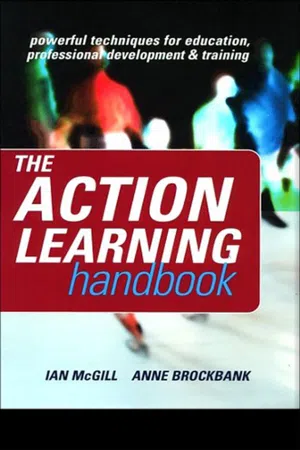
The Action Learning Handbook
Powerful Techniques for Education, Professional Development and Training
- 296 pages
- English
- ePUB (mobile friendly)
- Available on iOS & Android
eBook - ePub
The Action Learning Handbook
Powerful Techniques for Education, Professional Development and Training
About this book
Action learning is a continued process of learning and reflection with the support of a group of colleagues, working on real issues. The action learning method is increasingly used to bring innovation to many different fields of work. The principles of action learning can achieve improvement and transformation in a wide range of applications and disciplines, including professional training and educational contexts.
This book is a comprehensive guide to action learning which maintains an accessible, practical focus throughout. It is packed with useful resources, including case studies and ideas for workshop sessions.
Key topics covered include:
* action learning in professional and educational settings
* setting up, facilitating and evaluating an action learning programme
* the roles and skills required to practice successfully
* use of action learning in relation to the individual, the group and the organization
* the role of reflection; and action learning theory.
Newcomers to the area of action learning will find this an essential introduction which can be put to use straight away, while more experienced practitioners seeking a deeper understanding will value the thorough analysis of action learning theory.
Information
PART I
Starting
Action Learning
Chapter 1
Introducing action learning
Action learning is a continuous process of learning and reflection that happens with the support of a group or ‘set’ of colleagues, working on real issues, with the intention of getting things done. The voluntary participants in the group or ‘set’ learn with and from each other and take forward an important issue with the support of the other members of the set.
The collaborative process, which recognizes set members’ social context, helps people to take an active stance towards life, overcome the tendency to be passive towards the pressures of life and work, and aims to benefit both the organization and the individual.
As definitions don’t always give a clear picture, we explore here the answer to the question What is action learning?, a regular question in introductory workshops and sessions.
Personal and management development
Action learning was initially developed by Reg Revans in post-Second World War Britain and he worked intrepidly, ploughing a very innovative path compared to the prevailing norms of training and development. He was very much at the frontier. Advances made in the USA, emanating from the west coast and found in such excellent works as Pfeiffer and Jones (1977), enabled people engaging in personal and management development to work in ways that involved them – that is, their whole person – in activities that at least they could relate to their own direct experience. In the UK, learner-centred development was slower to develop. In higher education lecturing to students was the norm, and case studies of past events used as material for qualifications like the MBA, modelled on the Harvard one, where the expertise lay mainly with the lecturer leading the case, represented the mainstream. The main alternative in the development field lay with the emphasis on ‘up front’ training.
In both the above examples, authority and expertise lay firmly with the lecturer or trainer. This simply reflected the tendency to authoritarian ways of inculcating learning, even though it ignored much of the research, which suggested that in adult learning the significance of personal experience is crucial. Relatively advanced programmes in the development field at least used simulations that emphasized key issues such as the need for planning, strategy and task/process. In these programmes the participant was actually involved in undertaking a task, albeit using Lego or film. It is perhaps unfair from this vantage point to be critical of the latter methods – for they are still useful as part of the overall development of individuals both within and outside organizations. Outdoor activities that promote personal and group understanding and team development, for example, come to mind. However, all the above come under the critical gaze when attention is paid to the life experience of the individual and the utilization of that experience by the individual. That experience was usually overtly left at the door to the training or development event.
It is here that action learning becomes increasingly relevant for it does just the opposite – bringing life experience to the fore as the single most important resource in enabling the individual to move and learn and develop with the support of others. Moreover, action learning is increasingly in line with the resistance to what are in effect authoritarian methods to induce learning. By its nature there is, in action learning, a fundamental respect for where people are coming from, their values and their right to learn at their own pace in a democratic environment.
Action learning also reflects the growing recognition that learning and development can be, and is, supported by a social context in which learning is shared as a social activity. This again is in contrast to the notion that learning is best conducted in isolation and in competition with others. There is a tension here in that much of the contemporary life of work is competitive. Again that is part of the appeal of action learning. It creates the conditions for collaboration amid that competitive environment that are also needed for a sane life.
Further, while capitalism is the current order, it nevertheless has enormous downsides, and developing alternative collaborative ways of working and living may be pointers to the future.
In the 1980s, one of us, for our research leading to a PhD, investigated the organization of work and the advocacy of industrial democracy by those primarily on the left of politics – including the British Labour Party. A key feature was the advocacy of collaborative ways of working, a facet of industrial democracy. The espousal of that appeal to democratic ways of working was almost always defeated in the lack of realization of that appeal. While there were often ‘real politik’ reasons why it was not feasible, even where the conditions were possible, it did not work for the simple reason that the actors did not know how to work collaboratively.
What is the connection here with action learning? It is this: to work effectively, action learning requires in the participants a value criterion that promotes collaborative approaches to the task in hand. This includes sets where there is a facilitator. The facilitator is, in the early stages, creating the conditions within the voluntary framework for collaborative work and learn- ing. While the facilitator may lead the process, once set members become aware of and familiar with it, the set can move to more collaborative modes, sharing responsibility and gradually moving into autonomous mode without the facilitator.
Moreover, members of sets collectively share their concerns, issues and proposed actions, which itself may be novel. Just as important is the process by which the learning set works through a set member’s issues. The process is a shared, collective one where the learning about how to work on issues collectively is made explicit. Thus set members gain practice in a way of working that is designed to be collective as well as reflecting upon that practice. This reflection on practice ensures that the learning is made explicit – the practice is sensed, articulated, and incorporated into the set member’s repertoire of behaviour. This enhanced and ‘different’ repertoire is then applicable in other contexts outside the action learning set, in work as well as in other social contexts. The repertoire of behaviour is different in that the aim is to learn, develop, and engage in tasks in a collaborative way, typified by the term ‘win–win’ rather than ‘win–lose’ strategies. The approach is not adversarial.
Another facet of our experience in working with a wide range of people employed in organizations is the tremendous pressure, often oppressive, from which it is very difficult to disentangle oneself without total withdrawal through voluntary or involuntary retirement or burn-out. It is quite clear that some enthusiastic participants are attracted to action learning because the set is a haven of sanity and reflection. Working conditions commonly provide little time for shared reflection. Asked if time is feasible in the day, week, month or year for reflection (and the necessary conditions for learning and development), the answer is usually raised eyebrows and laughter. Yet we are asking organizations to make that leap to engage in organizational learning without providing the means for it, often for their most senior staff, let alone the seedbed staff of the future.
What is action learning?
Action learning builds on the relationship between reflection and action. Learning by experience involves reflection, ie reconsidering past events, making sense of our actions, and possibly finding new ways of behaving at future events. We believe that reflection is a necessary precursor to effective action and that learning from experience can be enhanced by deliberate attention to this relationship. The theoretical basis for reflection is discussed at length in Chapter 6.
Taking part in an action learning set provides the time and space to attend to the relationship, ie the link between reflection and learning. Set members enable their colleagues to understand, explore and judge their situation as well as helping them to realize underlying feelings which influence behaviour. The action learning process is supportive and challenging, while recognizing the subjective world of set members and the social context of their work and lives.
Action learning is often assumed to be an everyday activity – ‘Oh yes, that’s learning by doing’ or ‘I use action learning all the time but I’ve never been in a set’ (Pedler, 1997: 263).
Why is a set necessary for action learning?
Casual conversations in groups or one-to-one or even just talking through ideas with colleagues may be seen as reflective – why use a special name for it?
The answer lies in the deliberate and intentional provision of time and space for set members to engage in reflective learning. Action learning multiplies the kind of support which a trusted friend or colleague would offer, listening without judgement and, without giving advice, helping the individual concerned to discover his or her own solution. Not one but several people focus on supporting one person, with the knowledge that this will be reciprocated later in the session or at a later session.
Action learning sets formalize reflective learning and legitimize the allocation of time and space to it, with consistent voluntary group membership over an extended period of time.
How is action learning different from ordinary groups?
Action learning is unlike other kinds of group such as:
- formal meetings;
- seminars;
- teams;
- support or self-development groups;
- counselling or therapy groups.
Formal meetings have a chairperson, an agenda, open discussion, minutes and sometimes a vote. An action learning set focuses on the presenter’s issue and set minutes are simply action points, not a record of the meeting.
A seminar is a presentation of prepared material for discussion by the group. The material is based on factual knowledge in the public domain. The rules are rarely helpful to the presenter, being adversarial in style, and no consequent action is expected. Action learning sets are wholly focused on assisting the presenter to reflect on action and move towards action.
A team is a group with a well-defined group task. Members may support each other but the objective is primarily completion of the task. Action learning sets work for the benefit of individual set members, not an externally imposed task. If set members share a task or project, they become a team, and the action learning process would have to be created in addition to team/task-focused meetings.
Support or self-development groups are often focused more on support than challenge. See Chapter 11 for challenge vs. support in action learning sets. The aim in action learning is to enable the individual to take responsibility, decide on action, and move on.
Action learning is not a counselling or therapy group. The presenter will be listened to and will be offered empathic support – aimed at helping. Counselling will not be offered in an action learning set. When personal problems arise, set members should seek counselling or therapy elsewhere.
So if it’s not a team, support group or seminar, what issues can set members bring to a set? For action learning to be effective, the presenter’s issue should be:
- important to her;
- something where she has authority to act (or is concerned about her lack of it);
- not trivial;
- owned – not about someone else.
The ‘authority to act’ issue may well look different after the set discussion and the presenter may use the set to work with feelings related to her perceived lack of power. We look now at what the provision of time and space means in action learning.
Time and space
How long should the action learning set meet for? How often should the set meet? How much time should the set and each person have?
How long?
A typical set cycle is likely to be over one calendar year, but set cycles vary from six months to two years depending on the nature of the set. Sets may re-contract at the end of cycle review stage and start a second or even third cycle. What is important is the need for a clear commitment to an agreed number of meetings, which include a review, an ending and an evaluation. We discuss endings in Chapter 15 and evaluation in Chapter 14.
How often?
The frequency of set meetings is negotiated and agreed at the start of the cycle, and set meeting dates are decided and diaried in advance. This is particularly important with independent sets (described in Chapter 2) where set members are coming from different organizations and different geographical locations. An interval of one month or six weeks between set meetings is usual; any longer affects the momentum and work of the set.
How much time?
The total time for each set meeting will also be agreed at the start. The set members may not b...
Table of contents
- Cover Page
- Title Page
- Copyright Page
- Acknowledgements
- Introduction
- Part I: Starting Action Learning
- Part II: Understanding Action Learning
- Part III: Facilitating Action Learning
- Part IV: Evaluating Action Learning
- Conclusion
- Appendix: Group Action Learning
- References
Trusted by 375,005 students
Access to over 1.5 million titles for a fair monthly price.
Study more efficiently using our study tools.
Frequently asked questions
Yes, you can cancel anytime from the Subscription tab in your account settings on the Perlego website. Your subscription will stay active until the end of your current billing period. Learn how to cancel your subscription
No, books cannot be downloaded as external files, such as PDFs, for use outside of Perlego. However, you can download books within the Perlego app for offline reading on mobile or tablet. Learn how to download books offline
Perlego offers two plans: Essential and Complete
- Essential is ideal for learners and professionals who enjoy exploring a wide range of subjects. Access the Essential Library with 800,000+ trusted titles and best-sellers across business, personal growth, and the humanities. Includes unlimited reading time and Standard Read Aloud voice.
- Complete: Perfect for advanced learners and researchers needing full, unrestricted access. Unlock 1.5M+ books across hundreds of subjects, including academic and specialized titles. The Complete Plan also includes advanced features like Premium Read Aloud and Research Assistant.
We are an online textbook subscription service, where you can get access to an entire online library for less than the price of a single book per month. With over 1.5 million books across 990+ topics, we’ve got you covered! Learn about our mission
Look out for the read-aloud symbol on your next book to see if you can listen to it. The read-aloud tool reads text aloud for you, highlighting the text as it is being read. You can pause it, speed it up and slow it down. Learn more about Read Aloud
Yes! You can use the Perlego app on both iOS and Android devices to read anytime, anywhere — even offline. Perfect for commutes or when you’re on the go.
Please note we cannot support devices running on iOS 13 and Android 7 or earlier. Learn more about using the app
Please note we cannot support devices running on iOS 13 and Android 7 or earlier. Learn more about using the app
Yes, you can access The Action Learning Handbook by Anne Brockbank,Ian McGill in PDF and/or ePUB format, as well as other popular books in Education & Education General. We have over 1.5 million books available in our catalogue for you to explore.