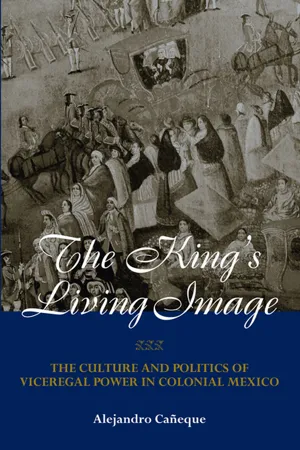
To rule their vast new American territories, the Spanish monarchs appointed viceroys in an attempt to reproduce the monarchical system of government prevailing at the time in Europe. But despite the political significance of the figure of the viceroy, little is known about the mechanisms of viceregal power and its relation to ideas of kingship. Examining this figure, The King's LivingImage challenges long-held perspectives on the political nature of Spanish colonialism, recovering, at the same time, the complexity of the political discourses and practices of Spanish rule. It does so by studying the viceregal political culture that developed in New Spain in the sixteenth and seventeenth centuries and the mechanisms, both formal and informal, of viceregal rule. In so doing, The King's Living Image questions the very existence of a "colonial state" and contends that imperial power was constituted in ritual ceremonies. It also emphasizes the viceroys' significance in carrying out the civilizing mission of the Spanish monarchy with regard to the indigenous population. The King's LivingImage will redefine the ways in which scholars have traditionally looked at the viceregal administration in colonial Mexico.
eBook - ePub
The King's Living Image
The Culture and Politics of Viceregal Power in Colonial Mexico
- 416 pages
- English
- ePUB (mobile friendly)
- Available on iOS & Android
eBook - ePub
The King's Living Image
The Culture and Politics of Viceregal Power in Colonial Mexico
1
Imagining the Viceroy
Speaking of the figure of the viceroy in his magnum opus on the government of the Indies, Juan de Solórzano Pereira, one of the most eminent of seventeenth-century Spanish legal writers, asserted that the "highly honored and preeminent" office of viceroy had been created "so that those vassals who live and reside in such remote provinces need not go seek their king, who is so far away, having his vicar nearby to ask for and get all those things they could expect and get from their king." For this reason, added Solórzano, the viceroys had to be obeyed and respected as persons who stood in place of the king, even when they committed some wrongdoing or exceeded their powers and instructions (even though the king might punish them afterwards), and this was so because it always had to be presumed that anything done by the viceroys had to be judged as done by the king who appointed them.1 These words by Solórzano sum up perfectly the way in which the Spanish Crown conceived of the rule of its remote American possessions and the privileged position that viceroys occupied in the power structure of a political formation of an imperial nature such as the Monarquía Hispánica, as the Spanish empire was known by contemporaries.2
More specifically, and according to the laws of the realm and the royal titles issued to them, the viceroys appointed to rule New Spain were to be the "governors" of the provinces entrusted to them. In this capacity, they were allowed to grant the favors and rewards that they considered appropriate. Also, they could distribute those government and judicial offices that were customarily assigned to them and not under any specific prohibition. In addition to their titles of viceroys and governors, those chosen for these positions received two other separate appointments as capitanes generates (commanders in chief) and presidents of the audiencia of Mexico.3 In the sixteenth century, the viceroys were appointed for an indeterminate number of years, according to the monarch's will (the first two viceroys ruled for 15 years each, although the average term of office was 5 or 6 years). After 1629, viceroys would be appointed for only 3 years, usually with an extension of their term for another 3 years.4 The viceroys were entrusted with several missions. First of all, they were to procure the expansion of religion. Second, they were to keep those provinces in "peace, tranquility, and calm." Third, the viceroys were to take any necessary steps to ensure the administration of justice. Fourth, they were in charge of the defense of the viceroyalty. Fifth, they were responsible for rewarding the descendants of the conquerors and first settlers. Sixth, they had to be especially careful in ensuring the "good treatment, conservation, and augmentation" of the Indians. Finally, the viceroys were in charge of protecting the interests of the Royal Treasury.5
In his Política Indiana, Juan de Solórzano devoted an entire chapter to the things the viceroys of the Indies could and could not do.6 Solórzano contended that the viceroys could do in their provinces everything the king who appointed them could do if he were present in those provinces. Solórzano goes on to enumerate the things that the viceroys "can do." They can order anything necessary to ensure the security, tranquility, and good government of the provinces under their charge, especially anything related to the conversion and well-being of the Indians. They can give Indians in encomienda (only in Peru). They can allocate Indians to work in the mines, ranches, and haciendas. In the case of New Spain, they can directly administer justice to the Indians or call upon the help of an oidor (civil judge) or asesor letrado (legal advisor). They appoint all the offices and benefices of their districts, except those specifically reserved to be provided by the king. In the case of a vacancy in any of the offices provided by the king, they can appoint someone temporarily — except in the offices of oidores, alcaldes del crimen (criminal judges), and cathedral prebendaries. They can also confirm city ordinances. Finally, they are in charge of the royal treasury and the defense of the viceroyalty.7 Solórzano observed that the viceroys had been awarded all these powers as a sign of respect for their great authority; however, he warned that the viceroys had no absolute power, as they were subject to the king's orders and laws. In his opinion, the most they could do was suspend the execution of some royal decree, "replying again and again," if they truly believed that serious harm to the republic or the king himself would occur by executing that decree. Solórzano contended that in such cases the viceroys were not committing a crime nor could they be accused of disobedience. They were just complying with the royal will, "which is always presumed to wish only that which is appropriate."8
But, one could ask, to what extent did all this power and authority vested upon the American viceroys turn them into the despots of popular — and not so popular — images? When trying to answer this question, historians have usually ignored the fact that, when royal councilors and officials wrote all those laws and royal decrees dealing with the viceregal figure, and on which the understanding of viceregal power has traditionally been based, they did not have the need to overtly state many assumptions of the political culture of the time, assumptions that they took for granted and for which the meaning and significance may be lost to modern readers. In this regard, it is then necessary to examine the political vocabulary of the period in a systematic way: the concepts, the images, and the metaphors used in both Spain and Mexico to refer to and deal with the figure and power of the viceroy, a vocabulary that does not necessarily show up in laws and decrees. In doing this, we must situate the works dealing with this matter in its general ideological context — the context of inherited assumptions.
An ideology, according to Quentin Skinner, is " language of politics defined by its conventions and employed by a number of writers."9 Thus, my aim here is to examine the shared vocabulary, the principles, and the assumptions uniting a number of texts, in order to identify "the constitutive and regulative conventions" of the reigning ideology. This, in turn, will allow us to understand the function of language in the theory and practice of viceregal power. In this approach, political ideas and principles are given a central role in shaping political behavior, because "in recovering the terms of the normative vocabulary available to any given agent for the descriptions of his political behavior," Skinner has argued, "we are at the same time indicating one of the constraints upon his behavior itself." In other words, we cannot expect a political agent "to have meant or done something which he could never be brought to accept as a correct description of what he had meant or done."10 Therefore, the aim of this chapter will be to examine how a viceroy was imagined by his contemporaries and to determine the nature and the reach of viceregal power through the examination of its ideological foundations.
The Rule of One
On the evening of July 21, 1668, a very unusual occurrence took place on the Island of Sardinia, one of the kingdoms under the rule of the Spanish monarch. On his way back to the viceregal palace after paying a visit to a church, the marquis of Camarasa, viceroy of Sardinia, was murdered by several Sardinians who fired three gunshots at him.11 This "atrocity," in which not even "the virtue and dignity" of the viceroy could halt the "sacrilegious hands" of the aggressors, prompted Rafael de Vilosa, a member of the Council of Aragon, to write a treatise on whether murdering a viceroy was a crime of lesa majestad. He was stunned to hear some Sardinians argue that, although the crime of killing a viceroy was a serious offense, it could not be considered one of lese majesty.12 One of the arguments Vilosa utilizes to show the enormity of the crime of killing a viceroy is that the king and the ministros superiores constitute one and the same person, as the latter are considered to be members of the body of the prince and the prince's majesty and royal splendor are communicated to them. The viceroy, then, is part of the prince's body and, as someone who serves the king in a position of the highest rank, is considered to be his relative colateral).13 The ruler and the realm together constituting one body, the greatness of the prince's ministers can be recognized, Vilosa contends, in that "being so immediate to the person of the prince, they are considered to be his limbs," and therefore "they cannot be offended without affronting the one with whom they are united." For Vilosa, it was an established principle in all confederacies that the offense made to one confederate is also made to the other members of the confederacy. Vilosa then goes on to argue:
Thus if confederates who form a mystical body establish that one member of the body cannot be offended without the whole body being injured, since the prince is the head of the mystical body which is composed of him and his ministers and since the viceroy is united to the royal person with a closer link than the one uniting the confederates themselves, two inevitable consequences will follow. ...The first is that, being the link of the representation with which the persons of the prince and his lieutenant general are united closer than that of the confederates, the offense done to the latter will be considered to be the same as that done to the former. The second one is that, being the viceroy such a superior minister, whether we wish to consider him as head of that magistracy in which the person of the king is represented, or we wish to consider him as a limb of that universal body of the monarchy whose head is the prince, it cannot be comprehended that it could be wounded without injuring the head.14
The notion of "mystical body" used by Vilosa to describe the kind of relation that exists between the king and his ministros superiores is fundamental to understanding the nature of viceregal power. The idea of a political community endowed with a "mystical" character had its origins in medieval thought and was common to all European countries. It had originally been articulated by the Church, although it was not part of the biblical tradition. Corpus mysticum originally designated the Sacrament of the Altar (that is, Christ's body), but after the twelfth century it served to describe the body politic or corpus iuridicum of the Church — the Church as a supernatural (mystical) body of which Christ was its head. This notion then was used by the jurists to describe the secular commonwealth, in an attempt to transfer to it some of the transcendental values usually possessed by the Church. It came into being in the twelfth century, at that moment when the doctrines of corporate and organic structure of society began to pervade political theory. Society or, to be more precise, the commonwealth was conceived of as a living organism and thus systematically compared with the human body. This organic metaphor was similarly applied to both the Church and the secular body politic. On the other hand, the attribution to each part of the community of the role of a specific part of the organic totality contributed to create a sense of community among all its members, high and low.15
This organic notion of the body politic had one fundamental implication, still prevalent in seventeenth-century Spanish political thought. In this conception, no separation existed between the king and the "state," as an entity in its own right. The "state" was the collective body of the prince, as the Church was the collective body of Christ. This "bodification" of the "state" helps, therefore, to explain the absence of any conception of the "state" as an abstract personification beyond its members. The "state" was an organic whole. It did not exist apart from its members nor was the "state" some superior being beyond its head and members or beyond moral values and the law. As Ernest Kantorowicz has argued, "This organic oneness of head and limbs in the body politic should prevent us from rashly replacing it by the abstraction of the impersonal state."16 Images such as those of the "mystical body" or the "body politic" are not simply metaphors used to describe the state; they are images that provide a sense of a political community conceived in terms essentially different from that of the state. They suggest that individuals are neither solitary nor distinct but exist only as members of a body and that the hierarchical organization of the political community is as natural and well ordered as that of a human body, which, in turn, is a reflection of the perfect ordering and harmony of the celestial bodies. In short, they constitute a symbolic system that sets limits to thought, supporting certain ideas and making others almost inconceivable.17
This mystical body would, of course, be incomplete without a head, the king. Thus, this organic unity of head and limbs in the political community is always used as the main argument to justify the advantages of monarchical rule or, in other words, the rule of one. The rationale already appears in the Partidas, the legal code compiled by Alfonso X in the thirteenth century. In the Thomist variant of scholastic political theory that dominated medieval and early modern Spanish political thought, the king is not only the "head" of the realm but also the "soul." This is a consequence of the fact that this philosophical system was erected on the twin foundations of classical and Christian thought. According to the Partidas, the "prophets and saints" had said that kings were vicars of God on earth who ruled over the people to keep them in justice. In the same way as the soul resides in the heart and gives life and unity to the whole body, justice, which is what keeps the people alive, resides in the king, who, being one, forms a whole or unity with the inhabitants of the realm. That is why they called the king "heart and soul of the people." On the other hand, the "learned men" said that the king was the head of the realm, because, in the same way as the senses, which are found in the head, are the ones which command all the limbs, the king's commands must be obeyed by all, as the king is "lord and head of everyone in the realm."18
These are the same ideas expressed by Thomas Aquinas in his treatise on the rule of princes. Quoting Aristotle, Aquinas maintains that "political happiness" consists of the "perfect rule of the republic," and a commonwealth is perfect when each one occupies the appropriate place so as to avoid any "repugnance" among the members of the community. When this happens, a harmony is created in the commonwealth that is similar to the harmony of the celestial bodies, which, due to their orderly and perfect movements, produce a cer...
Table of contents
- Cover
- Title
- Copyright
- Acknowledgements
- List of Illustrations
- Contents
- Introduction: Rethinking the Spanish Empire in America
- 1 Imagining the Viceroy
- 2 The Pillars of Government
- 3 In the Service of Two Majesties
- 4 Performing Power
- 5 The Economy of Favor
- 6 The Political Culture of Colonialism
- 7 Colonial Rhetoric and Indian Rebellion
- Conclusion: The Power of the King's Image
- Appendix
- Glossary of Spanish Terms
- List of Abbreviations
- Endnotes
- Bibliography
- Index
Trusted by 375,005 students
Access to over 1.5 million titles for a fair monthly price.
Study more efficiently using our study tools.
Frequently asked questions
Yes, you can cancel anytime from the Subscription tab in your account settings on the Perlego website. Your subscription will stay active until the end of your current billing period. Learn how to cancel your subscription
No, books cannot be downloaded as external files, such as PDFs, for use outside of Perlego. However, you can download books within the Perlego app for offline reading on mobile or tablet. Learn how to download books offline
Perlego offers two plans: Essential and Complete
- Essential is ideal for learners and professionals who enjoy exploring a wide range of subjects. Access the Essential Library with 800,000+ trusted titles and best-sellers across business, personal growth, and the humanities. Includes unlimited reading time and Standard Read Aloud voice.
- Complete: Perfect for advanced learners and researchers needing full, unrestricted access. Unlock 1.5M+ books across hundreds of subjects, including academic and specialized titles. The Complete Plan also includes advanced features like Premium Read Aloud and Research Assistant.
We are an online textbook subscription service, where you can get access to an entire online library for less than the price of a single book per month. With over 1.5 million books across 990+ topics, we’ve got you covered! Learn about our mission
Look out for the read-aloud symbol on your next book to see if you can listen to it. The read-aloud tool reads text aloud for you, highlighting the text as it is being read. You can pause it, speed it up and slow it down. Learn more about Read Aloud
Yes! You can use the Perlego app on both iOS and Android devices to read anytime, anywhere — even offline. Perfect for commutes or when you’re on the go.
Please note we cannot support devices running on iOS 13 and Android 7 or earlier. Learn more about using the app
Please note we cannot support devices running on iOS 13 and Android 7 or earlier. Learn more about using the app
Yes, you can access The King's Living Image by Alejandro Caneque in PDF and/or ePUB format, as well as other popular books in History & Mexican History. We have over 1.5 million books available in our catalogue for you to explore.