This collection of essays constitutes a magnificent monument to recent scholarship on the Second Republic and the Civil War. It is indispensable for a full understanding of the period.' - Raymond Carr
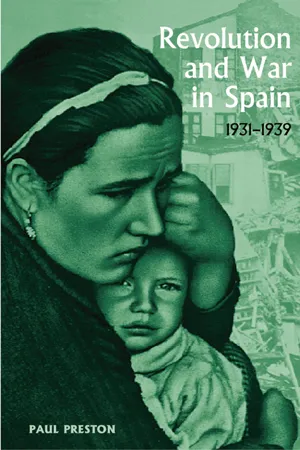
- 316 pages
- English
- ePUB (mobile friendly)
- Available on iOS & Android
eBook - ePub
Revolution and War in Spain, 1931-1939
1
The Republican ‘Take-Over’: Prelude to Inevitable Catastrophe?
In their search for an explanation to the débâcle of the Second Spanish Republic, some historians and writers of memoirs have frequently resorted to medical metaphors; others have fallen back on fatalism. The Republic, as ‘one of the most remarkable experiences of political pathology known to the contemporary world’, must have been born, some say or imply, with ‘discernible seeds of self destruction’.1 Born with obvious ‘congenital defects’, Spain’s incipient democracy was from the very outset ‘an impossible Republic’ and, due to Spanish idiosyncrasy, nothing but a skin-deep, ‘false’ political transformation.2 On a somewhat different level it is also argued that as a premature parliamentary democracy devoid of the advanced social structure necessary to sustain it, the Republic’s ultimate failure was inevitable. Rather than being the creation of a solid movement of opinion, it was the almost accidental outcome of the natural demise of the monarchy. But, ‘civically uneducated’ as they were, the Spaniards had no durable political option other than monarchy or anarchy.3
The coming of the Second Spanish Republic represented not a ‘mysterious shift of opinion’4 but the culminating point of a process of social evolution that had been gaining momentum since the Great War. In the decade of the 1920s alone, Spain’s population had increased by 10 per cent,5 and it had been, moreover, urbanized to a very great extent. Thus, for example, towns of over 10,000 inhabitants increased their population by an impressive figure of two million, and those of over 100,000 inhabitants by a not negligible one million, provincial capitals, whose population increased during the dictatorship by 30 per cent getting the lion’s share of the growth. In 1930, 42 per cent of the population of Spain lived in towns of more than 10,000 inhabitants.6 It was in such centres that the Republic was to achieve its greatest electoral gains in 1931. Primo de Rivera himself was not unaware of the socially and politically disturbing impact that the ‘frightening dimensions of the desertion of the countryside’,7 which he viewed as responding to ‘an excessive desire to satisfy earthly appetites’, could have.8 He might not have envisaged a rapid return to parliamentary democracy, but the defenders of the ‘old order’ would have been right in assuming that the flight from the countryside, or its ‘increasing depopulation’, as a leader of the National League of Farmers alarmingly put it,9 meant that, once the people were called again to the polls, the grip of electoral caciquismo would be severely loosened, and the politics of immobilism seriously challenged.
In fact, by 1923, the once almost legendary electoral omnipotence of the Ministry of the Interior had already been seriously eroded.10 The decade that preceded the Republic was likewise to witness a discernible modernization of Spain’s social structure. Thus, for example, the proportion of the working force employed in agriculture decreased from 57.3 per cent to 45.51 per cent while that employed in industry and the service sector went up from 21.9 per cent to 25.61 per cent and from 20.81 per cent to 27.98 per cent respectively. By comparison, the Portuguese Republic, brought about by a pronunciamiento rather than elections, rested on a far more archaic professional structure (57 per cent agriculture; less than 20 per cent industry; 5.5 per cent services).11 In fact, in proportional terms, the intense transformation of the social fabric in the years that preceded the Republic almost matched that which took place during the Francoist boom, and in some aspects even surpassed it. Surprisingly, the twenties witnessed an increase of 4.57 per cent in the proportion of the workforce employed in industry, that is 1.35 per cent more than during the thirteen years of the Francoist boom (1960–73). Moreover, in the twenty years that preceded the Republic, the active population engaged in agriculture decreased by 20.49 per cent, in industry went up by 10.69 per cent and in the service sector by 9.8 per cent as compared with, respectively, 18.9 per cent, 4.72 per cent and 13.08 per cent in the fifteen years that preceded the advent of post-Francoist democracy.12 Likewise, the fall in the rate of illiteracy in the 1920s was the highest of the century until the 1960s: 8.7 per cent for men and 9.15 per cent for women.13 The dictator’s expansionist economic policy had undoubtedly encouraged the upsurge of the middle classes and helped to consolidate the position of the organized proletariat.
The monarchy thus stepped down, entangled in a painfully obvious dilemma: either it democratized itself or it passed into oblivion. Primo de Rivera’s dictatorship had unleashed modernizing processes that helped to erode the non-democratic foundations of the monarchy. The monarchy was doomed by its inability to absorb the processes of modernization by adapting itself to the democratic imperatives inherent in them. The growth of wealth, technological potentialities and urbanization, as well as the steady process of de-archaization of the social structure, were simply becoming incompatible with autocracy. This is how a sharp-eyed contemporary observer saw it:
The new status of the town worker and the effect on the peasants of the building of thousands of miles of roads and railways were bound to have a great effect on the future. Roads meant motor buses, this meant more movement and freedom for the country people. It meant also that they would want a higher standard of living…. Nothing could be the same in Spain again after General Primo fell. He had launched great schemes of modernization…and there would be much political fruit in addition to economic changes.14
It was precisely this relation between socio-economic and political change which Gregorio Marañón had referred to when he wrote late in 1929, without Buckley’s advantage of hindsight, that ‘the time is ripe in Spain for the most profound transformations that the country’s social and political structure has ever undergone’.15
The republican movement was not just an anti-monarchist, negative protest.16 The significance of republicanism as it emerged after 1929 was that it reflected a determined drive to establish the politics of mobilization in place of the system of patronage and clientele.17 It was the vehicle by which the masses were to be drawn into politics; it represented a wide and heterogeneous public both in its struggle against the political immobilism of the monarchy, and in its hope of finding a remedy to particular social and economic grievances.
Republicanism was not devoid of the support of the so-called fuerzas vivas of Spanish society. One of the best-informed people in Spain, the Chief of the Security Police, General Mola, observed in dismay that
the revolutionary spirit has invaded everything, absolutely everything, from the humblest up to the highest social classes: Workers, students, civil servants, industrialists, merchants, rentiers, men of liberal professions, the military and even priests.18
It is this startling readiness of ‘vested interests’ to face ‘the unknown without apprehension’ that had been the most salient feature of republicanism in the months that preceded the Republic. To the alarmed monarchist organ ABC this phenomenon called to mind ‘the same spirit that prevailed in France on the eve of the Revolution’.19
Republicanism embraced, and gave expression to, the urban petty bourgeoisie, small entrepreneurs throughout the country threatened with the breakdown of their business under the burden of taxation and the dictatorship’s favouritism towards the big monopolistic concerns. It did the same for merchants and shopkeepers who had to reduce the scale of their businesses because of the excessively high tariffs.20 Significantly, the advocacy of free trade—to make possible cheaper food for the working class, and to help defend the smaller concerns against the protectionist priorities of big business—was standard on the platforms of most republican parties.21 Republican meetings were held and branches were opened not only in the major cities, but also in remote towns and villages and in working-class quarters. The Radical-Socialist Party, for example, was present in the working-class district of Chamartín,22 and in the most remote provincial towns.23 Appeals were made not only to dogmatic provincial intellectuals, but also to workers and small peasants whose land tenure was to be protected from both ‘red’ demagogy and the ‘appetite’ of the big landowners.24 Another republican group that was thought to be exclusively concerned with intellectuals and the professional classes, Acción Republicana, went out also to make some gains among the lower classes. Its representative in Almería spread among the local working class his party’s message: to curb rising prices by a cut in indirect taxes—of which merchants and small entrepreneurs were also highly resentful—to improve wages and to divide the big latifundia.25
Indeed, republicanism had also spread into typically rural districts. The Derecha Republicana made some gains among the vine-growers of Alicante through its campaign against the importation of French wines, which hit local agricultural interests.26 In 1926, the Catalan tenants’ association, Unió de Rabassaires, with its 14,000 members, had joined Alianza Republicana, which by then claimed a membership of 99,043 spread in 450 branches throughout the country27 (in August 1929, membership rose to 150,000).28 Alianza’s effort to strike roots in rural areas continued through a display of interest in agrarian issues by its leaders. Lerroux, Azaña and lesser figures attended meetings in support of small tenants and landowners in rural districts in Almería, Cáceres, Badajoz, Ciudad Real and Old Castile.29 Stability of tenancies, the creation of rural co-...
Table of contents
- Cover
- Half Title
- Title Page
- Copyright
- Contents
- List of contributors
- List of abbreviations
- Acknowledgements
- Map of the regions and provinces of Spain
- Introduction War of words: the Spanish Civil War and the historians
- 1. The Republican ‘take-over’: prelude to inevitable catastrophe?
- 2. The Church’s crusade against the Republic
- 3. War on two fronts: politics and society in Navarre 1931–6
- 4. Regionalism and revolution in Catalonia
- 5. The epic failure: the Asturian revolution of October 1934
- 6. Economic crisis, social conflict and the Popular Front: Madrid 1931–6
- 7. The agrarian war in the south
- 8. The Basque question 1931–7
- 9. Soldiers, politics and war
- 10. The popular experience of war and revolution 1936–9
- 11. Reflex reaction: Germany and the onset of the Spanish Civil War
- 12. The financing of the Spanish Civil War
- Index
Trusted by 375,005 students
Access to over 1.5 million titles for a fair monthly price.
Study more efficiently using our study tools.
Frequently asked questions
Yes, you can cancel anytime from the Subscription tab in your account settings on the Perlego website. Your subscription will stay active until the end of your current billing period. Learn how to cancel your subscription
No, books cannot be downloaded as external files, such as PDFs, for use outside of Perlego. However, you can download books within the Perlego app for offline reading on mobile or tablet. Learn how to download books offline
Perlego offers two plans: Essential and Complete
- Essential is ideal for learners and professionals who enjoy exploring a wide range of subjects. Access the Essential Library with 800,000+ trusted titles and best-sellers across business, personal growth, and the humanities. Includes unlimited reading time and Standard Read Aloud voice.
- Complete: Perfect for advanced learners and researchers needing full, unrestricted access. Unlock 1.5M+ books across hundreds of subjects, including academic and specialized titles. The Complete Plan also includes advanced features like Premium Read Aloud and Research Assistant.
We are an online textbook subscription service, where you can get access to an entire online library for less than the price of a single book per month. With over 1.5 million books across 990+ topics, we’ve got you covered! Learn about our mission
Look out for the read-aloud symbol on your next book to see if you can listen to it. The read-aloud tool reads text aloud for you, highlighting the text as it is being read. You can pause it, speed it up and slow it down. Learn more about Read Aloud
Yes! You can use the Perlego app on both iOS and Android devices to read anytime, anywhere — even offline. Perfect for commutes or when you’re on the go.
Please note we cannot support devices running on iOS 13 and Android 7 or earlier. Learn more about using the app
Please note we cannot support devices running on iOS 13 and Android 7 or earlier. Learn more about using the app
Yes, you can access Revolution and War in Spain, 1931-1939 by Paul Preston in PDF and/or ePUB format, as well as other popular books in History & European History. We have over 1.5 million books available in our catalogue for you to explore.