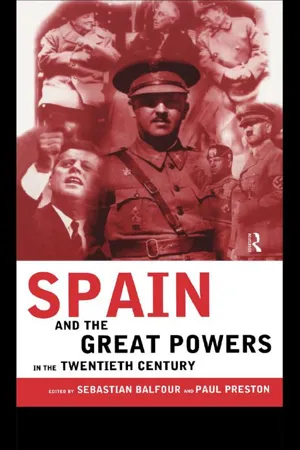
Spain and the Great Powers in the Twentieth Centuryexamines the international context to, and influences on, Spanish history and politics from 1898 to the present day. Spanish history is necessarily international, with the significance of Spain's neutrality in the First World War and the global influences on the outcome of the Spanish Civil War.
Taking the Defeat in the Spanish American war of 1898 as a starting point, the book includes surveys on: *the crisis of neutrality during the First World War *foreign policy under the dictatorship of Primo de Rivera *the allies and the Spanish Civil War *Nazi Germany and Franco's Spain *Spain and the Cold War *relations with the United States
This book traces the important topic of modern Spanish diplomacy up to the present day
eBook - ePub
Spain and the Great Powers in the Twentieth Century
- 288 pages
- English
- ePUB (mobile friendly)
- Available on iOS & Android
eBook - ePub
Spain and the Great Powers in the Twentieth Century
About this book
Information
1 Spain and the Great Powers
in the aftermath of the
Disaster of 1898
Sebastian Balfour
In 1898, Spain lost the scattered remnants of her once great empire after a disastrous war with the United States. The war gave rise in Spain to exaggerated displays of jingoist enthusiasm, and defeat plunged public opinion into excessive gloom. The so-called Disaster severely undermined the legitimacy of the political regime, the Restoration system, a parliamentary monarchy resting on a largely fictitious electoral contest between the two parties of the landowning and financial oligarchies. It also boosted social and economic movements opposed to the regime that had been emerging through the process of modernization.
Despite the sense of catastrophe that prevailed in Spain, however, the Disaster of 1898 was not an isolated event but part of a global process of colonial redistribution in a new era of expansionism which had begun in the 1870s. Japan, the United States and Germany had recently emerged as world powers and were not only encroaching on old spheres of influence but also joining the search to colonize those parts of the globe still left untouched by colonialism. As a result, the existing balance of power began to destabilize. At the same time, empires were being challenged by a wave of anti-colonial revolts, such as the struggle for independence in Cuba and the Philippines between 1895 and 1898, the revolt against the Italian occupation of Ethiopia in 1896, and the Boer rebellion in South Africa at the turn of the century. In this process, weaker powers such as Spain, Portugal and Italy were forced to cede colonies and curtail their ambitions or redirect them elsewhere. At the same time, the older Great Powers such as France, Russia and Britain found themselves jockeying for position in areas hitherto untouched by colonial expansion that were now the object of intense competition.1 While tensions also centred on the Far East, the Balkans and the Mediterranean, Africa was the most explosive of these new international flashpoints. Few of the powers, however, were indifferent to the outcome of the Spanish-American War. A Spanish cartoon of the period shows the European kings and emperors observing the 1 May 1898 naval battle between Spain and the United States, standing on the shore with their fishing-rods, ‘waiting for the weather to calm down’, as the caption reads, ‘to see if they can catch something’.
After the Disaster, Spain’s role in the emerging system of international relations was shaped by another, seemingly unconnected event that took place in the same year as she lost her empire. The competition between European powers to partition Africa which had begun in the 1870s had given rise to a series of bilateral negotiations, preceded at times by great tensions, between Britain, Germany, France, Italy and Portugal. The latter two had had to retreat in face of the dynamism of the others. Britain, for her part, was seeking to consolidate control over a north-south axis from Cairo to the Cape, while France sought to establish a west-east axis from North-West Africa to the Red Sea. In September 1898, two months after the Spanish capitulation in Cuba, forces of Britain and France confronted each other in the small village of Fashoda in the Sudan. Faced by the threat of war with Britain, France was forced to withdraw. In the negotiations that followed, leading eventually to the Entente Cordiale between the two countries, France agreed to direct her colonial interests in Africa primarily towards Algeria, Tunisia and Morocco.2 Both countries also agreed on delineating spheres of influence elsewhere in Africa. Apart from her possessions in the Gulf of Guinea, Spain had a tenuous hold on territory on the North-West African coast opposite the Canary Islands which had been recognized as her protectorate in the 1884 Treaty of Berlin. This enormous stretch of land was now subject to the scrutiny of the two powers, and Britain appeared to have little objection to the French insistence on considerably reducing the area under Spanish control.3
However, it was Morocco that became the focus of tension between the powers. This was partly because of her strategic situation, dominating the entrance to and exit from the Mediterranean, and partly because of the growing commercial rivalry in North-West Africa between France and Germany. French expansion in that corner of Africa posed a potential threat not only to the commercial interests of Britain and Germany but also to the strategic security of Britain. Above all, London would not accept French penetration as far as the Mediterranean shore of Morocco because of the risk this would pose to the safety of Gibraltar and the control of the Straits. Britain had observed a purely formal neutrality during the Spanish-American War. The real sympathies of the government had lain with the United States. Britain had supplied coal to American ships and at the same time had applied pressure on the Egyptian authorities to refuse to allow the Spanish Mediterranean fleet to refuel, with the result that it could not sail to the Far East theatre of action through the Suez Canal.4
The consequent Spanish resentment towards Britain in the aftermath of the Disaster, added to the close ties that appeared to be developing between France and Spain, fuelled British fears that France might gain some territorial advantages over Britain. In the event of a war between the two countries, France might gain control over Spain’s railway system, enabling her to transport troops directly to Gibraltar. Furthermore, because of the two Spanish enclaves on the northern Moroccan coast, Ceuta and Melilla, France might threaten British control of the Straits of Gibraltar themselves. Her Majesty’s ambassador in Spain warned the British Prime Minister in August 1898:
Spain, though fallen from her station as a Great Power and unable therefore to gratify any ambition of her own, still possesses points likely to attract the ambition of others, especially France…. The position and influence of Spain in Morocco can be utilized, while her desire for increased territory in Africa to make up for her lost colonies may render her susceptible to the overtures of her new ally. I have more than once pointed out the dangers to Her Majesty’s possessions if France obtained uncontrolled access to the Hinterland of Gibraltar.5
The Spanish regime, however, was reluctant to adopt any measure that might alienate Britain. In informal contacts between the British ambassador and Spanish ministers (including the Premier, Francisco Silvela), Britain was assured that Spain needed a close alliance with ‘the most powerful of the Maritime states’ because Spain was now ‘a Maritime Power without a fleet’.6 Britain was therefore able to take advantage of Spain’s weakness to use her as a cushion against further French expansion. It was characteristic of British foreign policy in Africa to construct a sub- imperial system of alliances, such as that with Italy in the 1880s and later Portugal in Southern Africa, to compress the territorial ambitions of Britain’s rivals in the area. After secret negotiations between France and Spain in 1902 in which the Spanish were offered a large area in northern Morocco as a sphere of influence in which they might gain considerable commercial advantages and international prestige, Spain’s leaders got cold feet and declined the offer. Paris had sought also to use Spain’s relative debility in an attempt to gain a strategic advantage over Britain in the sensitive area of North Africa and the Straits of Gibraltar,7 but the Spanish government had feared Britain would object to a purely Franco- Spanish alliance that would further French strategic interests over those of the British.8 The British government, however, was keen to encourage the assignation of a sphere of influence for Spain in northern Morocco as long as this worked to contain rather than encourage French expansion.
What helped to encourage a Franco-British consensus over North-West Africa that would incorporate Spain was Germany’s growing commercial and military ambitions. France had been anxious to demarcate official spheres of influence in North-West Africa so that Germany could not muscle in where borders were unclear. Thus she had signed a treaty with Spain in 1900 confirming Spanish ownership of the strip of territory opposite the Canary Islands, Río Muni and part of the Sahara; this represented a strategic guarantee both for the islands and for Spain’s fishing industry off the mainland coast. Concern about German expansionism also lay behind the 1904 Entente Cordiale between France and Britain. However, during the negotations leading to the treaty, France sought to reduce the Spanish sphere of influence in Morocco as much as possible while Britain, still concerned at a potential later French expansion in North Africa, insisted that France should sign a treaty with Spain allowing for Spanish presence in Morocco. Although the area subsequently conceded to Spain was much reduced in comparison to that offered to her in 1902, it was nevertheless considerable: some 22,000 square kilometres (in contrast to the 42,000 square miles of the 1902 offer), amounting to 20 per cent of Moroccan territory.9 Yet the bulk of the area in north-west Morocco was also notorious for instability owing to the rebelliousness of its mainly Berber tribes against the domination of the Sultanate.
It should be clear, therefore, that in the unstable system of international relations at the end of the nineteenth century Spain’s very weakness was seen by the European powers as potentially destabilizing. Her geographical position made Spain a strategically vital piece in the complex power game between European powers in the Mediterranean and North Africa. Spain lay astride two continents and two seas, dominating the Straits of Gibraltar from both coasts, and therefore the route towards the Far East through the Suez Canal; she also could offer coaling stations and port facilities along her north-west coast and in the Western Mediterranean.10 Her presence in northern Morocco ensured that neither France nor Britain directly controlled the Straits of Gibraltar. This suited the interests of not only both these powers but Germany as well. From being the ugly sister, politely shunned in 1898 by other members of the European family, Spain became the potential bride of one or more of the Great Powers.11
Indeed, in addition to France and Britain, Germany began to woo Spain in an effort to erode the Entente Cordiale, into which Spain was being drawn as a subordinate partner. The Pan-German press was urging the German regime to play a more aggressive role in Africa. ‘Morocco is a German concern,’ wrote the Rheinische-Westfälishe Zeitung, one month after the Entente was signed, ‘owing to our increasing population and our need of naval bases. If Germany does not peg out claims, she will retire empty- handed from the partition of the world.’12 Making use of family connections between the Spanish and Austrian monarchies and the notorious sympathy of the Spanish royal family for the German state model, the Kaiser endeavoured to present himself as the protector of the interests of Spain in the new international situation. In 1904, he made a much-commented-on visit to the young and recently crowned King, Alfonso XIII, in Vigo. However, the overly assertive style of German diplomacy did not appear to go down well with many Spanish politicians. It widened the gulf between those on the right who saw Germany as an ally to be cultivated and those in the centre and left who favoured the alliance with Britain and France.13
In the following year, Wilhelm landed in Tangiers in an effort to internationalize the Moroccan question and force the French to the negotiating table. German pressure led to the Algeciras Conference of 1906 in which the thirteen participating nations agreed that they should enjoy equal commercial status in Morocco and that the sovereignty of the Sultan should be respected. France and Spain were given responsibility for the increasing problem of law and order in the Moroccan Empire that was partly the result of foreign penetration itself. The last stage in Spain’s incorporation into the Franco-British Entente as opposed to the Triple Alliance of Germany, Austria-Hungary and Italy was completed in the Cartagena Pact of 1907. The agreement settled the tensions over Gibraltar, which had been simmering since 1898,...
Table of contents
- Cover Page
- Title Page
- Copyright Page
- List of Contributors
- Introduction: Spain and the Great Powers
- 1. Spain and the Great Powers In the Aftermath of the Disaster of 1898
- 2. Spain and the First World War
- 3. Foreign Policy Under the Dictatorship of Primo De Rivera
- 4. The Second Republic In the International Arena
- 5. The Allies and the Spanish Civil War
- 6. Nazi Germany and Francoist Spain, 1936–1945
- 7. Italy and Spain In Civil War and World War, 1936–1943
- 8. Franco and the Allies In the Second World War
- 9. Spain, Britain and the Cold War
- 10. Spain and the United States, 1945–1975
- 11. Breaking the Shackles from the Past: Spanish Foreign Policy from Franco to Felipe González
Trusted by 375,005 students
Access to over 1.5 million titles for a fair monthly price.
Study more efficiently using our study tools.
Frequently asked questions
Yes, you can cancel anytime from the Subscription tab in your account settings on the Perlego website. Your subscription will stay active until the end of your current billing period. Learn how to cancel your subscription
No, books cannot be downloaded as external files, such as PDFs, for use outside of Perlego. However, you can download books within the Perlego app for offline reading on mobile or tablet. Learn how to download books offline
Perlego offers two plans: Essential and Complete
- Essential is ideal for learners and professionals who enjoy exploring a wide range of subjects. Access the Essential Library with 800,000+ trusted titles and best-sellers across business, personal growth, and the humanities. Includes unlimited reading time and Standard Read Aloud voice.
- Complete: Perfect for advanced learners and researchers needing full, unrestricted access. Unlock 1.5M+ books across hundreds of subjects, including academic and specialized titles. The Complete Plan also includes advanced features like Premium Read Aloud and Research Assistant.
We are an online textbook subscription service, where you can get access to an entire online library for less than the price of a single book per month. With over 1.5 million books across 990+ topics, we’ve got you covered! Learn about our mission
Look out for the read-aloud symbol on your next book to see if you can listen to it. The read-aloud tool reads text aloud for you, highlighting the text as it is being read. You can pause it, speed it up and slow it down. Learn more about Read Aloud
Yes! You can use the Perlego app on both iOS and Android devices to read anytime, anywhere — even offline. Perfect for commutes or when you’re on the go.
Please note we cannot support devices running on iOS 13 and Android 7 or earlier. Learn more about using the app
Please note we cannot support devices running on iOS 13 and Android 7 or earlier. Learn more about using the app
Yes, you can access Spain and the Great Powers in the Twentieth Century by Sebastian Balfour, Paul Preston, Professor Paul Preston, Sebastian Balfour,Paul Preston,Professor Paul Preston in PDF and/or ePUB format, as well as other popular books in History & 20th Century History. We have over 1.5 million books available in our catalogue for you to explore.