- 276 pages
- English
- ePUB (mobile friendly)
- Available on iOS & Android
eBook - ePub
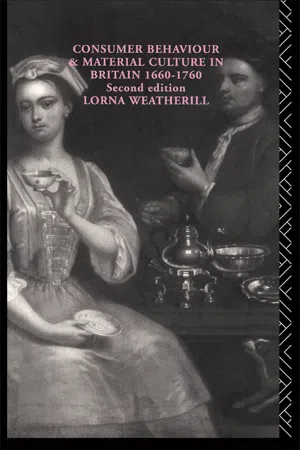
Consumer Behaviour and Material Culture in Britain, 1660-1760
About this book
This is a detailed study of the material lives of the middle classes in the pre-industrial era, a period which saw considerable growth in consumption. Lorna Weatherill has brought her highly important survey up-to-date in the light of new research. She provides a new introduction and bibliography, taking account of the latest academic writing and methodological advances, including computing, and offers further conclusions about her work and its place in current literature.
Three main types of documentation are used to construct the overall picture: diaries, household accounts, and probate inventories. In investigating these sources she interprets the social meaning of material goods; and then goes on to relate this evidence to the social structures of Britain by wealth, status and locality.
Breaking new ground in focusing on households and the use of probate inventories, Weatherill has provided a book which gives both a general account of the domestic environment of the period, and a scholarly analysis of the data on consumption patterns.
1
INTRODUCTION
the middle state…was the best state in the world, the most suited to human happiness; not exposed to the miseries and hardships, the labour and sufferings of the mechanic part of mankind and not embarrassed with the pride, luxury, ambition and envy of the upper part of mankind.
(Daniel Defoe, Robinson Crusoe, 1719)
the Middling Class of People, which Class we know are vastly, I had almost said, infinitely superior, in number to the Great.
(Josiah Wedgwood, 1772)1
This book is about consumption and consumer behaviour in the early modern period.2 It is hardly a new subject, for perceptive contemporaries puzzled over other people’s expenditure, accepting or rejecting new habits and new goods according to their preconceptions. Defoe, writing here from the viewpoint of consumers, makes the fundamental distinction between people who cannot afford to consume, those who consume too much, and those in the middle, of whom he approved. Wedgwood, from a manufacturer’s viewpoint, makes a similar distinction, but adding that those in the middle were a potentially large and attractive market. The interesting thing about these comments is that they both take it that upper, middle, and lower ranks could be distinguished on the basis of their consumption habits. Consumer behaviour does indeed imply a great deal more than whether or not some goods or services were available and used, which means that consumption cannot be discussed in isolation from other aspects of social and economic life.
Historians have also puzzled over consumption, for it has long been recognized that increasing demand for a wide range of goods and clothing was as important in industrialization as the invention of new methods of production. Yet, although the importance of the subject can be simply stated in general terms and although it is evident that consumption habits were a fundamental part of life, answers to questions about who consumed what, where they did so, and why have not been firmly established. So it is the purpose of this book to present new evidence about consumers in the early modern period and to look at this evidence in new ways. The main question, underlying the whole of it, is whether people’s material lives reflected their social position. To discuss this, and to present different viewpoints on the processes involved, the argument is divided into two main sections. Part 1 deals with consumption at national, regional, and local levels. Part 2 looks more closely at household expenditure and behaviour before discussing the role of social position directly. This introduction explains the research methods and some of the concepts used, as well as outlining some approaches taken by previous writers.
New evidence: inventories
The main framework of the book is based on new factual evidence from a comprehensive collection of probate inventories from eight parts of England.3 These listings of movable goods were made by neighbours shortly after a person’s death, and the executors or administrators of an estate were required to exhibit the inventory at the time of probate. They were commonly made throughout the seventeenth century and became rare only after the 1720s, although the precise date varies in different dioceses. In them are listed, sometimes in considerable detail, the farming, trade, and household goods of the deceased person, together with cash and debts due. They do not record debts owed or any real estate, so they do not give a complete account of the person’s wealth, although they normally give a full account of household contents. They also record other information, notably the date, the parish of residence, and the occupation or status. Each inventory contains some information about factors that may have influenced ownership, with the exception of age at death and details about the size and structure of die household. Thus it is possible to gain a considerable body of information from inventories about who exactly owned domestic goods, especially before 1725.
Many goods are listed in the documents, and it simplifies the problem of data collection and analysis to select some of them for particular study. Two criteria were used to select about twenty items for special attention: they had to be reliably and consistently listed in the documents, and they had to be representative of other goods or of people’s domestic behaviour. They range from basic furniture and utensils (tables, pewter, and cooking pots) to newly available things like china. Many of them, like knives and forks or utensils for hot drinks, point towards gradual changes in eating and drinking habits. Some, such as books and clocks, show something of a household’s cultural interests and indicate contacts with a wider world. The main omission is that textiles are poorly listed, and clothing was not valued in a reliable way. The full list of goods is discussed in appendix 1, together with other observations about the way in which the data were collected.
Ownership patterns of the selected goods can be analysed by cross-tabulating whether or not they were recorded in an inventory. There are a number of variables derived from the inventories themselves, and these form a framework for discussing the role of social status, occupation, wealth, place of residence, and change over time. That variations can be shown in all of these confirms that there were a large number of influences over ownership, and these are an important starting-point in discussing consumer behaviour.
The validity of these observations rests on the way in which the inventories examined were selected and the extent to which they are a meaningful sample. There are many problems in selecting inventories in a comprehensive way; one of these is that they were not made on behalf of everyone who died, and they give their best results for the middle ranks, from the lesser gentry down to the lesser yeomen. They are extremely rare for labourers. The sample for this book amounted to almost 3,000 inventories, taken from eight parts of England (Kent, Hampshire, Cambridgeshire, the north-east, the north-west, Staffordshire, Cumbria, and London) in the middle year of each decade from 1675 to 1725. The documents were taken unseen from the boxes, and no bias due to this simple technique has been noted in analysing the data. Scottish testaments usually contain only partial lists of goods and credits so cannot be sampled in this way.
At the same time, a sample of 300 for the same years was taken from the inventories of the Court of Orphans in the City of London, in order to include a wealthy group of consumers not covered in the main sample.4 The information from these is of particular value in enabling comparisons to be made between some very well-off merchants and tradesmen and those of modest means. For instance, the median value of the inventories of the sample from the Orphans’ Court was £2,034 (maximum £47,000), but for the probate sample it was £63 (maximum £4,132). These people more often owned all the goods listed than those in the main sample, as is demonstrated in chapter 2.
Inventories are a familiar documentary source of information for scholars working on early modern England; they have been widely used in studies of agriculture, trades, towns, and other communities. There are also a few studies that focus on living standards, as well as several printed collections with introductory sections discussing housing, furnishings, and changing expectations.5 The sample used in this book, and the selection of goods for detailed examination, approaches the problem in a different way, for the documents have been taken from eight contrasting parts of the country, rather than from one area or community or occupational group. This means that the results are meaningful for much of the country, and comparisons can be made between different regions and between town and country.6
New evidence: diaries, household papers, and illustrations
Diaries, accounts, and domestic manuals are gradually becoming more familiar to historians than formerly, especially to those interested in family life.7 They were made for many purposes and give a depth of detail not obtainable from inventories, and their range can be seen from the Bibliography. In this book I have used spiritual and personal diaries for their insight into daily routines and infrequent comments on material goods. Household accounts are much undervalued as a source for social history, although they are very rare and, for this reason, unrepresentative. They are often obscure in their meaning and time-consuming to analyse. Three full and interesting accounts have been used, especially in tracing household expenditure patterns in chapter 6. Like inventories, these sources of evidence about middle-ranking households are not unfamiliar to historians. The main problem in using them is that they originated from people’s inner needs to record experiences, feelings, or financial affairs, and the contents reflect individual idiosyncrasies as well as individual experiences. Their reasons for writing were not to tell us about domestic routines and consumption patterns, so there are many gaps and unanswerable questions. Yet they are as close as we can get to the inner lives of households, and I have drawn on them extensively for general insights as well as specific examples.
Pictures, prints, and drawings of domestic interiors, especially British ones and especially those depicting interiors of middle rank, are potentially valuable in giving coherence to descriptions from written sources. They show ‘images’ of household activities, mealtimes, and leisure, and they confirm information from inventories and elsewhere. For instance, knives and forks were not used, interiors were bare, curtains were unusual, and so on. The best pictures are by Flemish and Dutch painters who visited England. However, great care is needed in using them because artists were concerned with images and ideas as well as with description. There was, it is true, a longstanding tradition of painting graphically, but how ‘real’ the reality is impossible to tell. Their importance is that they convey atmosphere and physical presence in a way that no written record can do. The same is true of the work of David Allan in Scotland in the late eighteenth century, although he was influenced by Italian styles.8
Interpretations: household consumption
A new body of evidence about ownership patterns of household goods and the contexts in which they were bought and used is not, however, enough. It is also necessary to seek new ways of interpreting consumer behaviour in the early modern period. This can be difficult and uncertain because there are no obvious, accepted concepts that the historian (or anyone else) can readily use to analyse all aspects of the material side of people’s lives.One starting-point implicit throughout this study is that material goods were, as they still are, indicative of behaviour and attitudes. They had symbolic importance as well as physical attributes and practical uses.9 If this is taken into account, it is possible to move beyond whether or not something was recorded in a list to the meaning of ownership in social and other terms. At a simple level th...
Table of contents
- Cover Page
- Title Page
- Copyright Page
- Plates
- Tables
- Preface
- Preface to the second edition
- 1: Introduction
- Part 1: The nation
- Part 2: The household
- Appendix 1: Ways of using probate inventories
- Appendix 2: Occupations and status in inventories
- Notes
- Bibliography of contemporary sources
Trusted by 375,005 students
Access to over 1.5 million titles for a fair monthly price.
Study more efficiently using our study tools.
Frequently asked questions
Yes, you can cancel anytime from the Subscription tab in your account settings on the Perlego website. Your subscription will stay active until the end of your current billing period. Learn how to cancel your subscription
No, books cannot be downloaded as external files, such as PDFs, for use outside of Perlego. However, you can download books within the Perlego app for offline reading on mobile or tablet. Learn how to download books offline
Perlego offers two plans: Essential and Complete
- Essential is ideal for learners and professionals who enjoy exploring a wide range of subjects. Access the Essential Library with 800,000+ trusted titles and best-sellers across business, personal growth, and the humanities. Includes unlimited reading time and Standard Read Aloud voice.
- Complete: Perfect for advanced learners and researchers needing full, unrestricted access. Unlock 1.5M+ books across hundreds of subjects, including academic and specialized titles. The Complete Plan also includes advanced features like Premium Read Aloud and Research Assistant.
We are an online textbook subscription service, where you can get access to an entire online library for less than the price of a single book per month. With over 1.5 million books across 990+ topics, we’ve got you covered! Learn about our mission
Look out for the read-aloud symbol on your next book to see if you can listen to it. The read-aloud tool reads text aloud for you, highlighting the text as it is being read. You can pause it, speed it up and slow it down. Learn more about Read Aloud
Yes! You can use the Perlego app on both iOS and Android devices to read anytime, anywhere — even offline. Perfect for commutes or when you’re on the go.
Please note we cannot support devices running on iOS 13 and Android 7 or earlier. Learn more about using the app
Please note we cannot support devices running on iOS 13 and Android 7 or earlier. Learn more about using the app
Yes, you can access Consumer Behaviour and Material Culture in Britain, 1660-1760 by Lorna Weatherill in PDF and/or ePUB format, as well as other popular books in History & Economic History. We have over 1.5 million books available in our catalogue for you to explore.