The obsession with waste in eighteenth-century English literature
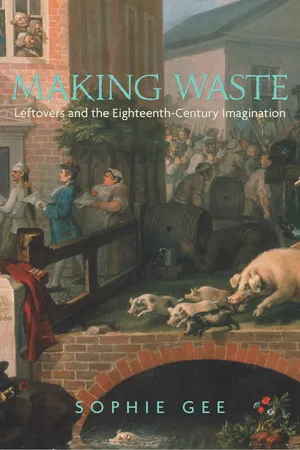
Why was eighteenth-century English culture so fascinated with the things its society discarded? Why did Restoration and Augustan writers such as Milton, Dryden, Swift, and Pope describe, catalog, and memorialize the waste matter that their social and political worlds wanted to get rid of—from the theological dregs in Paradise Lost to the excrements in "The Lady's Dressing Room" and the corpses of A Journal of the Plague Year? In Making Waste, the first book about refuse and its place in Enlightenment literature and culture, Sophie Gee examines the meaning of waste at the moment when the early modern world was turning modern.
Gee explains how English writers used contemporary theological and philosophical texts about unwanted and leftover matter to explore secular, literary relationships between waste and value. She finds that, in the eighteenth century, waste was as culturally valuable as it was practically worthless—and that waste paradoxically revealed the things that the culture cherished most.
The surprising central insight of Making Waste is that the creation of value always generates waste. Waste is therefore a sign—though a perverse one—that value and meaning have been made. Even when it appears to symbolize civic, economic, and political failure, waste is in fact restorative, a sign of cultural invigoration and imaginative abundance. Challenging the conventional association of Enlightenment culture with political and social improvement, and scientific and commercial progress, Making Waste has important insights for cultural and intellectual history as well as literary studies.
- 207 pages
- English
- PDF
- Available on iOS & Android
eBook - PDF
About this book
Information
Publisher
Princeton University PressYear
2009Print ISBN
9780691284507
9780691139845
eBook ISBN
9781400832125
Table of contents
- Cover
- CONTENTS
- ACKNOWLEDGMENTS
- Introduction: Making Waste
- 1. The Invention of the Wasteland: Civic Narrative and Dryden’s Annus Mirabilis
- 2. Wastelands, Paradise Lost, and Popular Polemic at the Restoration
- 3. Milton’s Chaos in Pope’s London: Material Philosophy and the Book Trade
- 4. The Man on the Dump: Swift, Ireland, and the Problem of Waste
- 5. Holding On to the Corpse: Fleshly Remains in A Journal of the Plague Year
- Afterword: Mr. Spectator’s Tears and Sophia Western’s Muff
- NOTES
- BIBLIOGRAPHY
- INDEX
Trusted by 375,005 students
Access to over 1.5 million titles for a fair monthly price.
Study more efficiently using our study tools.
Frequently asked questions
Yes, you can cancel anytime from the Subscription tab in your account settings on the Perlego website. Your subscription will stay active until the end of your current billing period. Learn how to cancel your subscription
No, books cannot be downloaded as external files, such as PDFs, for use outside of Perlego. However, you can download books within the Perlego app for offline reading on mobile or tablet. Learn how to download books offline
Perlego offers two plans: Essential and Complete
- Essential is ideal for learners and professionals who enjoy exploring a wide range of subjects. Access the Essential Library with 800,000+ trusted titles and best-sellers across business, personal growth, and the humanities. Includes unlimited reading time and Standard Read Aloud voice.
- Complete: Perfect for advanced learners and researchers needing full, unrestricted access. Unlock 1.5M+ books across hundreds of subjects, including academic and specialized titles. The Complete Plan also includes advanced features like Premium Read Aloud and Research Assistant.
We are an online textbook subscription service, where you can get access to an entire online library for less than the price of a single book per month. With over 1.5 million books across 990+ topics, we’ve got you covered! Learn about our mission
Look out for the read-aloud symbol on your next book to see if you can listen to it. The read-aloud tool reads text aloud for you, highlighting the text as it is being read. You can pause it, speed it up and slow it down. Learn more about Read Aloud
Yes! You can use the Perlego app on both iOS and Android devices to read anytime, anywhere — even offline. Perfect for commutes or when you’re on the go.
Please note we cannot support devices running on iOS 13 and Android 7 or earlier. Learn more about using the app
Please note we cannot support devices running on iOS 13 and Android 7 or earlier. Learn more about using the app
Yes, you can access Making Waste by Sophie Gee in PDF and/or ePUB format, as well as other popular books in Literature & Early Modern History. We have over 1.5 million books available in our catalogue for you to explore.