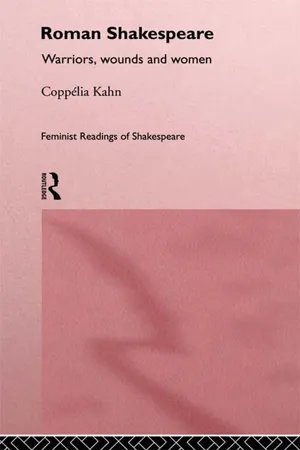
In the first full-length study of Shakespeare's Roman plays, Coppélia Kahn brings to these texts a startling, critical perspective which interrogates the gender ideologies lurking behind 'Roman virtue'.
Plays featured include:
* Titus Andronicus
* Julius Caesar
* Antony and Cleopatra
* Coriolanus
* Cymbeline
Setting the Roman works in the dual context of the popular theatre and Renaissance humanism, the author identifies new sources which she analyzes from a historicised feminist perspective.
Roman Shakespeare is written in an accessible style and will appeal to scholars and students of Shakespeare and those interested in feminist theory, as well as classicists.
- 208 pages
- English
- ePUB (mobile friendly)
- Available on iOS & Android
eBook - ePub
About this book
Information
1
ROMAN VIRTUE ON ENGLISH STAGES
His story requires Romans or kings, but he thinks only on men.
Samuel Johnson, Preface to Shakespeare
In 1765, when Samuel Johnson wrote the word “men” in the statement quoted above, he meant it in the sense of humankind, human beings— but at the same time, he meant males. The benchmark of literate, civilized humanity implied in this context rested in the possession of males. Males controlled the meaning of humanity; if the term included qualities deemed “feminine,” if women could possess humanity, it was so by permission, as it were, from males. Kings, of course, were men, and if a queen happened to rule instead of a king, she did so because the laws of succession written by men allowed it. Shakespeare's Romans were women as well as men: Lucrece, Lavinia, Portia, Calphurnia, Octavia, Volumnia are all women. But when Dr Johnson writes “Romans,” he thinks of Romanness as male. And so, I think, did Shakespeare—but with a difference. That is the central claim of this book: that Shakespeare's Roman works articulate a critique of the ideology of gender on which the Renaissance understanding of Rome was based.
In making this claim, my key premise is that gender is an ideology. At least it works like ideology, in rendering something brought about by human beings into something reified, transcendent, “natural” and inaccessible to human intervention.1 What Simone de Beauvoir said of women almost fifty years ago is also true of the opposite sex: a man is not born, but made (1989). The discursive practices of culture make bodily and other differences between human beings into a gender system that makes men as well as women.2 Once the system in is operation, it no longer seems humanly determined but rather becomes “reality”, “biology” or “common sense.” Our word for one of the world's oldest and most persistent gender systems, “patriarchy,” comes from Latin, and the male dominance that it promotes is strongly associated with Rome, though it didn't originate there. Because Rome was a patriarchal society, Romanness per se is closely linked to an ideology of masculinity. For almost four centuries, within the English-speaking world and beyond, both the scholarly community and the general public have taken Shakespeare's Roman works to represent Romanness—reading them within the terms of this ideology. Thus the degree to which that Romanness is virtually identical with an ideology of masculinity has gone unnoticed, and it has been generally assumed that Shakespeare didn't notice it either. I hope to demonstrate that, on the contrary, he dramatized precisely this linkage and, in doing so, demystified its power.
In one sense, this book continues the work I began in Man's Estate: Masculine Identity in Shakespeare (1981) of identifying a gender-specific dimension—a preoccupation with the masculine subject—in Shakespeare. In another respect, however, this book differs importantly from Man's Estate: though I make some use of psychoanalytic theory, I no longer rely on it as a hermeneutic cornerstone. Rather, I have come to see masculinity in these works less as an intra-psychic phenomenon and more as an ideology discursively maintained through the appropriation of the Latin heritage for the early modern English stage. Thus I am concerned here with the social dimensions of virtus—its interdependence with political constructions of the state and the family, and with the intertextuality of Shakespeare and the Latin authors he read.
Mungo MacCallum was the first to designate the Roman play as a Shakespearean sub-genre, in Shakespeare's Roman Plays and their Background (1910). Since then, many book-length studies of them have appeared, and several significant articles defining the category or surveying the field.3 All of them take for granted just what I want to identify and interpret: the centrality of a specifically Roman masculinity to Rome as represented in these texts. Though some pathbreaking essays over the past decade have employed gender as a category of analysis for individual Roman works, no comprehensive study of the ideological centrality of masculinity in Shakespeare's Rome exists.4
Before attending to men, however, I must attend to history. Though Rome is called “the Eternal City,” the Rome I am concerned with is a city viewed at a specific—if extended—historical moment. What did “Rome”—the city, the republic, the empire, the culture, the history, the legend, and the Latin language that mediated them all—mean to Shakespeare? Obviously, its meanings came to him from many sources— texts he could read in Latin or in translation; writings in English that mediated Roman history and culture; paintings, engravings, and tapestries; oral traditions; and generally, the humanistic culture of early modern England, for which Latin was the key to privilege and authority, and Rome the model of civilization itself.5 From the properties of Rome known to many he fashioned his versions of it. Readers have often debated how “authentic” Shakespeare's Rome is; bothered by clocks in Julius Caesar or billiards in Antony and Cleopatra, they have argued about the extent of Shakespeare's classical learning or historical consciousness: did he get the Romans “right”?6 With equal critical energy they have also justified such anachronisms on the grounds of artistic coherence— as creating a persuasive dramatic world rather than a historically “accurate” one.7
For modern readers and audiences, Rome is definitively ancient; historically and culturally distant from the modern moment, retrievable only with effort and special instruments. Moreover, it is only one of several possible origins or historical orientation points for EuroAmerican civilization, along with, say, the biblical (Judeo-Christian) past, or classical Greece. For the Renaissance as a whole, however, “Roman history was a discourse that one could not afford to ignore …one had to make use of it… The meaning of Roman history had to be articulated in and for the Renaissance present” (Burt 1991:112). Moreover, for the English Renaissance, “the Roman past was …not simply a past but the past” (Hunter 1977:95), legendarily linked to the moment in which Britain itself emerged into history.
In English chronicle histories, the founding of Britain was connected to the founding of Rome through Brutus, the grandson of Aeneas, founder of Rome. In his chronicle history of England, Richard Grafton, writing in 1569, declares: “When Brute…first entred this Island and named it Briteyne: there beginneth mine History of this Realme” (1569:31). Grafton was only following Geoffrey of Monmouth, who recorded the myth of Brutus in his History of the Kings of Britain (1136). Though Holinshed queried it, he too included the legend of Brute in the Chronicles (1577), as did William Camden in his Britannia (1610), though he also was skeptical. Other chroniclers such as Drayton (Poly-Olbion, 1613) and Stow (Annales, 1615) defended “the long traduced Brute” (MacDougall 1982:22).8 In addition, Henry VIII upheld another tradition connecting England to Rome: his descent from a half-British Emperor Constantine who“had united British kingship with Roman emperorship” (MacDougall 1982:17). And finally, there was Julius Caesar. Camden draws heavily on his account of the Roman occupation of Britain, which was part of the grammar school curriculum, and legend had it that he had built the Tower of London.9 Indeed, the old Roman wall defined the boundaries of the city of London, and Hadrian's wall in the north was a well-known landmark linking Britain's past to Rome's. Even though historians had begun to question long-accepted textual authorities, and to develop a proto-modern sense of anachronism, the Roman connection in the Brute legend persisted. Camden and Grafton both reject it, but they still feel obliged to recount it and deal with it.
In relation to Renaissance England, Rome was as much a cultural parent as a cultural other.10 Through a kind of cross-pollination that isn't simply anachronism, Englishness appears in Roman settings, and Romanness is anglicized. The well-known drawing (attributed to Henry Peacham) of characters from Titus Andronicus, the earliest known illustration of a Shakespeare play, conveys the ambiguous perception of Rome as both near and far from England that characterized popular theatrical representations of it (see Plate 1). While Titus wears Roman dress, the soldiers attending him wear Elizabethan military dress and carry halberds. At the Globe or the Fortune, Rome was not an occasion for the “humanist pathos…the sense of difference, of littleness, of exclusion, even of estrangement” from it felt by earlier Italian humanists (Greene 1982:42). Rather, to a great extent, Rome was familiarized for the English by being represented in terms of its past kinship with Britain and as a model for England's present and future. As in Golding's unabashedly exuberant and irreverent English translation of Ovid, Rome onstage is as much assimilated to an English scene and an English sensibility as it is distanced to the antique past.11 Examples abound. Chapman devotes a scene in his Caesar and Pompey (1605) to the “poor and ragged knave” Fronto, accosted by the demon Ophioneus as he prepares to hang himself. Like Autolycus, Fronto has exhausted the occupations available to an enterprising man of low birth in early seventeenth-century England; there is nothing Roman about him. In Thomas Heywood's The Rape of Lucrece (1609), Valerius, a former courtier now “Transeshapt to a meere Ballater,” punctuates many episodes with bawdy songs such as “Shall I woe the lovely Molly,” songs that seem designed specifically as English entertainments, diversions from Romanness. Similarly, Thomas Lodge's two “burghers” Poppey and Curtail, in The Wounds of Civil War (1587), talk in comic double-entendres like Dogberry and Verges; they could easily fit into an English comedy.
On the one hand, a repertory of “Roman” stage conventions signified an ancient civilization different from England, through “the same motifs, ideas, verbal images, episodes, scenes, and physical gear…repeating the names of the same gods, places, customs, and political offices and…reenacting such stock ‘Roman’ situations as the suicide, the triumph, and the sudden fight in a political forum” (Ronan 1995:32–3). On the other hand, the increasing familiarity of, for example, the senate and the capitol, tribunes and aediles, Caesar and Pompey made Rome less strange. It was becoming common knowledge and common property in early modern England; it could pop up anywhere. Public spectacles in the city of London, open to all, frequently invoked Rome and linked it to the political order of Britain. Royal entries and coronation pageants, Elizabeth's annual Accession Day pageants, celebrations of England's victory over the Armada, and the annual Lord Mayor's pageants, employed Roman motifs. For example, on November 24, 1588, to celebrate the defeat of the Armada, “‘imitating the ancient Romans’ [Elizabeth] rode in triumph in a symbolic chariot” (Strong 1977:120). James was welcomed to London in “imperial style”: triumphal arches decked with Roman gods and Latin inscriptions, coins and medallions, panegyrics and masques represented him as “England's Caesar” (Goldberg 1983:33–54).
The history of Rome, moreover, was a matter of current (even in some circles urgent) controversy, rather than a firmly contoured tradition. Rome served as a model for both “imperial ambitions and nascent republican sentiments” in England (Cantor 1976:17). Portrayed as a time of “Continuall Factions, Tumults, and Massacres” (Fulbecke 1601), the republican era was nonetheless admired for the pristine virtue of Scipio, Regulus, and Brutus. Julius Caesar was lauded as the first Roman emperor, but also denigrated as a tyrant; Octavius Caesar was viewed as Rome's savior and as a crafty politician. In schools, compositions were written on such themes as “Vituperate Julius Caesar” or “That some friend persuades Cicero that he should not accept the condition offered by Antony” (Baldwin 1944:88, 89), through which students engaged in the clash of viewpoints that shaped Roman history and its historians. Scholars have demonstrated that Shakespeare brought these ambiguities and contradictions into some of his Roman works to make dramatic meaning prismatic and indeterminate.12
Before turning to my specific interest in his representations of Roman virtue, I want to survey some of the forms in which Rome's legacy appeared to Shakespeare, and suggest how he intervened in the ongoing project of articulating its meaning for his present moment.
From among numerous scenes in the canon that evoke the ways English culture mediated Rome, let us turn to William Page's Latin grammar lesson in The Merry Wives of Windsor. Mistress Page, accompanied by Mistress Quickly, interrupts her pursuit of Falstaff to drop her son off at school. Young William, like thousands of other boys, is learning the fundamentals of Latin grammar, probably much as young William Shakespeare had. Mistress Page asks for some proof of her son's progress because, she claims, “my husband says my son profits nothing in the world at his book” (4.1.11–12).13 Sir Hugh Evans, the Welsh schoolmaster, the catechizes William on the cases of nouns and pronouns as Mistress Quickly interjects with a series of bawdy misconstructions: “polecat” (prostitute) for pulcher (beautiful); “whore” for horum (the genitive plural); “Ginny's case” (a slang reference to Ginny's sexual parts) for genitive case, and the like. The audience can see that William has merely memorized the grammar book (probably one written by William Lilly and John Colet and commanded by Edward VI to be used in all schools) without understanding the principles of grammar at all. Nonetheless, his mother is reassured: “He is a better scholar than I thought he was,” she declares fondly (4.1.69).
This modest comic scene dramatizes the state-authorized regimen that trained men, from village parsons such as Evans to princes such as Edward, to govern England. It also dramatizes the gender division built into early modern culture by means of that regimen.14 The two women, sharp-witted and articulate elsewhere in the play, are ignorant outsiders here, and the humor of the whole scene turns on Mistress Quickly's persistent but unwitting interventions into what Ong persuasively terms “a Renaissance puberty rite” for men only (1959).15 Undeterred by the schoolmaster's rebukes, she rattles on, reducing the chaste forms of correct Latin to obscenity, thus fostering the familiar association of woman with uncontrolled speech, the body in general, and sexuality in particular. But the joke is on the males as well: if William is being trained to run the state, “the state totters,” for he is a slow and reluctant learner, as uncomprehending in his way as Mistress Quickly in hers. And Sir Hugh's Welsh pronunciation and idioms, however sure his command of the genitive case, in effect mark him as not fully assimilated to the Tudor establishment. Thus the scene works to demystify the grand humanist project of making Latin the cachet to a universal, disinterested virtue.
Recently Anthony Grafton and Lisa Jardine have tried to demystify humanistic education in the Renaissance by distinguishing between the ideology of humanism itself—its claim to inculcate civic and moral virtue through the study of ancient texts—and its actual pedagogical practice. They argue that by the early sixteenth century, “an ideology of routine, order, and above all, ‘method'” prevailed in schools, its purpose being “to produce a total routineness of imaginative writing by reducing its variety to a sequence…of specified (and supposedly key) types of verbal composition.” Method and system were simply assumed to guarantee an education in virtue as well as in Latin; precise arguments for the connection were lacking (Grafton and Jardine 1986:123, 131, 135).
This reliance on method is easily documented, and its basic characteristic is disintegration: cutting the text into discrete rhetorical units for the accumulation of copia. Erasmus's treatise De Ratione Studii guided the standard curriculum of English grammar schools, specifying a certain sequence of Latin authors imitated word for word, phrase for phrase: Terence, Plautus, Virgil, Horace, Cicero, Caesar, Sallust (Baldwin 1944:8...
Table of contents
- Front Cover
- FEMINIST READINGS OF SHAKESPEARE
- ROMAN SHAKESPEARE
- Title Page
- Copyright
- Dedication
- CONTENTS
- List of plates
- Series editor’s preface
- Acknowledgements
- 1 ROMAN VIRTUE ON ENGLISH STAGES
- 2 THE SEXUAL POLITICS OF SUBJECTIVITY IN LUCRECE
- 3 THE DAUGHTER’S SEDUCTION IN TITUS ANDRONICUS, OR, WRITING IS THE BEST REVENGE
- 4 METTLE AND MELTING SPIRITS IN JULIUS CAESAR
- 5 ANTONY’S WOUND
- 6 MOTHER OF BATTLES: VOLUMNIA AND HER SON IN CORIOLANUS
- POSTSCRIPT: CYMBELINE: PAYING TRIBUTE TO ROME
- Bibliography
- Index
Trusted by 375,005 students
Access to over 1.5 million titles for a fair monthly price.
Study more efficiently using our study tools.
Frequently asked questions
Yes, you can cancel anytime from the Subscription tab in your account settings on the Perlego website. Your subscription will stay active until the end of your current billing period. Learn how to cancel your subscription
No, books cannot be downloaded as external files, such as PDFs, for use outside of Perlego. However, you can download books within the Perlego app for offline reading on mobile or tablet. Learn how to download books offline
Perlego offers two plans: Essential and Complete
- Essential is ideal for learners and professionals who enjoy exploring a wide range of subjects. Access the Essential Library with 800,000+ trusted titles and best-sellers across business, personal growth, and the humanities. Includes unlimited reading time and Standard Read Aloud voice.
- Complete: Perfect for advanced learners and researchers needing full, unrestricted access. Unlock 1.5M+ books across hundreds of subjects, including academic and specialized titles. The Complete Plan also includes advanced features like Premium Read Aloud and Research Assistant.
We are an online textbook subscription service, where you can get access to an entire online library for less than the price of a single book per month. With over 1.5 million books across 990+ topics, we’ve got you covered! Learn about our mission
Look out for the read-aloud symbol on your next book to see if you can listen to it. The read-aloud tool reads text aloud for you, highlighting the text as it is being read. You can pause it, speed it up and slow it down. Learn more about Read Aloud
Yes! You can use the Perlego app on both iOS and Android devices to read anytime, anywhere — even offline. Perfect for commutes or when you’re on the go.
Please note we cannot support devices running on iOS 13 and Android 7 or earlier. Learn more about using the app
Please note we cannot support devices running on iOS 13 and Android 7 or earlier. Learn more about using the app
Yes, you can access Roman Shakespeare by Coppélia Kahn in PDF and/or ePUB format, as well as other popular books in Literature & Feminist Literary Criticism. We have over 1.5 million books available in our catalogue for you to explore.