- 304 pages
- English
- ePUB (mobile friendly)
- Available on iOS & Android
eBook - ePub
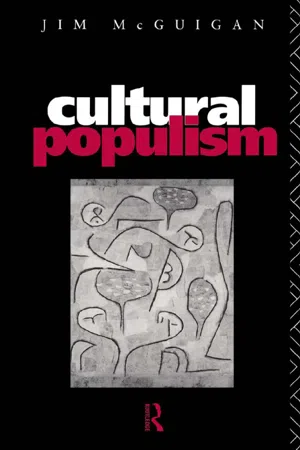
Cultural Populism
About this book
First Published in 2004. This book provides a novel understanding of current thought and enquiry in the study of popular culture and communications media. The populist sentiments and impulses underlying cultural studies and its postmodernist variants are explored and criticized sympathetically. An exclusively consumptionist trend of analysis is identified and shown to be an unsatisfactory means of accounting for the complex material conditions and mediations that shape ordinary people's pleasures and opportunities for personal and political expression. Through detailed consideration of the work of Raymond Williams, Stuart Hall and 'the Birmingham School', John Fiske, youth subcultural analysis, popular television study, and issues generally concerned with public communication (including advertising, arts and broadcasting policies, children's television, tabloid journalism, feminism and pornography, the Rushdie affair, and the collapse of communism), Jim McGuigan sets out a distinctive case for recovering critical analysis of popular culture in a rapidly changing, conflict-ridden world. The book is an accessible introduction to past and present debates for undergraduate students, and it poses some challenging theses for postgraduate students, researchers and lecturers.
Information
Part I
Theoretical politics
Chapter 1
Populism and ordinary culture
The question as to who ‘the people’ are, where they/we will be made to stand, line up and be counted, the political direction in which they/we will be made to point: these are questions which cannot be resolved abstractly; they can only be answered politically.(Bennett 1986a: 20)
To throw some light on discussions about the ‘people’ and the ‘popular’, one need only bear in mind that the ‘people’ or the ‘popular’ (‘popular art’, ‘popular religion’, ‘popular medicine’, etc.) is first of all one of those things at stake in the struggle between intellectuals.(Bourdieu 1990:150)
Tony Bennett’s statement above comes from an article which summarises a once-compelling approach to popular cultural analysis, that of neo-Gramscian hegemony theory. The statement is unintentionally ironic because the Right in Britain had recently accomplished what Bennett and similar critics believed the Left should be doing. At its height, ‘Thatcherism’ effectively mobilised ‘the people’ for authoritarian government by speaking the language of ‘setting the people free’ (Gamble 1988). From the perspective which constructed Bennett’s battle-cry, Stuart Hall drew the conclusion that the opposition had better start ‘learning from Thatcherism’ (March 1988). Later in this chapter I shall be considering what that meant for students of popular culture.
Pierre Bourdieu’s statement, quoted from a paper originally delivered at Lausanne in 1982, problematises the study of popular culture and it differs somewhat from the cultural politics of Bennett and Hall. Bourdieu’s statement is a sardonic and wicked contribution. To suggest that discoursing on ‘the popular’ is some kind of intellectual game in which participants in the cultural field, education and so on, struggle to make themselves heard and to win symbolic power in the clash of contending ideologies is not only sardonic and wicked: it is also an historical truism. After all, the whole idea of ‘popular culture’ is intellectual: ‘popular culture was not identified by the people but by others’ (Williams 1983a: 237). Who were these others? Intellectuals, of course. Who else? Johann Gottfried Herder, the German philosopher, is to blame. Towards the end of the eighteenth century, Herder and his followers made the distinction between ‘learned culture’ and ‘popular culture’. Then they set about studying the latter, no doubt to the astonishment of many of the self-consciously ‘learned’. This ‘discovery of popular culture’ (Burke 1978) in Germany around the time that industrial capitalism was being forged in Britain and modern democracy was emerging bloodied from the turmoil of the American and French Revolutions had both aesthetic and political dimensions.
In terms of aesthetics, the discovery of popular culture is related to the Romantic reaction to Classicism, the attempt to break with excessively formalistic, dry and unemotional art. To recover something of the vital impulses of ordinary people, their apparent spontaneity and disregard for propriety, their ‘naturalness’, are amongst the themes which cut both ways: back to a myth of an ‘organic’ past in contrast to a ‘mechanical’ present, or forward to a Utopian future of popular emancipation. It is no accident that the great Welsh cultural theorist Raymond Williams should most famously have opened his account of ‘culture’ with a book on English Romanticism and its conservative and radical strands: Culture and Society, published in 1958.
The discovery of popular culture was also an expressly political move, related to ideas of nationhood; thereby linked to a third constitutive feature of modernity, the formation of national identity, in addition to industrialisation and democratisation. An interest in the original ‘folk’ inflection of popular culture had greater resonance in peripheral nations, in Brittany rather than Paris and in Scotland, Wales and Ireland rather than England. The study of ‘folklore’, coined by William Thorns in 1846, has an affinity to subordinate localities, regions and aspiring nations, collecting and cataloguing fragments from a lost world of folk-song, oral story-telling, festive ritual and the rest. Such practices can function as a retreat from contemporary forms of identity, pleasure and expression, in view of which Peter Burke (1981) has named the cults of a certain apolitical conservatism with a small ‘c’: the cults of ‘primitivism’, ‘purism’ and ‘communalism’. The sentimental attachment to some pure, unsullied, primitive and originally peasant, or peasant-like, community has recurred intermittently with reference to urban as well as rural contexts: from nostalgic studies of traditional working-class neighbourhoods, best exemplified by Richard Hoggart’s founding classic of cultural studies, The Uses of Literacy (1957); to the consumption ‘tactics’ and meaningful ‘poaching’ of ordinary people generally in contemporary city locales, documented by Michel De Certeau (1984).
Now, let us return to Bourdieu’s sardonic observation concerning the symbolic ‘strategies’ deployed by students of popular culture. It offers a reflexive means of putting the relationship between populism and ordinary culture in perspective.
BOURDIEU’S PARADOX
Bourdieu draws attention to the problem of speaking about popular culture and the relation of such intellectual discourse both to the internal machinations of the academy and to the outside world. Bourdieu (1984) has written at great length on ‘distinction’ strategies whereby symbolically powerful groups, intellectuals of one kind or another, mark out their positions in society. The symbolically powerful draw the borderlines between what Mikhail Bakhtin (1984) called ‘official’ and ‘unofficial’ cultures—broadly speaking, the demarcation of Culture with a capital ‘C’, on one side, and the pastimes and pleasures of ordinary people, the nonintellectuals, on the other. These processes are complicated immensely when intellectuals, usually on the lower rungs of distinction, become interested in popular culture.
In his Lausanne paper, Bourdieu prefers to talk specifically about popular language rather than popular culture in general. The paradox of cultural populism is neatly summed up by his following questions:
When the dominated quest for distinction leads the dominated to affirm what distinguishes them, that is, that in the name of which they are dominated and constituted as vulgar, do we have to talk of resistance? In other words, if, in order to resist, I have no other resources than to lay claim to that in the name of which I am dominated, is this resistance? Second question: when, on the other hand, the dominated work at destroying what marks them out as ‘vulgar’ and at appropriating that in relation to which they appear as vulgar (for instance, in France, the Parisian language), is this submission? I think this is an insoluble contradiction: this contradiction, which is inscribed in the very logic of symbolic domination, is something those who talk about ‘popular culture’ won’t admit.(1990:155)
Bourdieu’s paradox is not only about ordinary language—the tension between ‘vulgar’ and ‘official’ discourses—but also about socially constructed actors engaged in a practice: in this case, theorising and studying popular culture. There is a sociology to be written about those who wish to speak of ‘the popular’ within the academy, a Bourdieuan, infinitely regressing project if ever there was one. This book is not such a sociology, though it has it in mind. Cultural studies, as practised in Britain, is a peculiarly congenial site of work for intellectuals of working-class origin, for women, for people of colour, in general for those from positions of social subordination and marginality, but not exclusively so. Academic cultural studies may not be a popular discourse, yet it is not strictly an official discourse either. It is, rather, a semi-official discourse mainly due to a politically impelled engagement with popular culture. Cultural studies has been perceived from above as excessively political and excessively popular in its orientations, which at least in ambition is not a misperception. The symbolic power of such a perception has kept it comparatively marginal in the academy, even now, related perhaps to its growing journalistic influence beyond the usual confines of academe. In effect, cultural studies is caught in something of a trap, caught between the power points of official academic discourse and what I would call its populist political sentiments.
As far as I can gather, Bourdieu is not unduly bothered by the ‘insoluble contradiction’, the dilemmas and traps, of his paradox, because he believes ‘resistance’ to oppressive power ‘occurs on terrains altogether different from that of culture in the strict sense of the word’ (1990:155). He means in the fields of economic and political practice, which is why his views are rather different from those of Bennett and Hall. Bourdieu’s own paradox, incidentally, has not prevented him from discoursing on the popular, with his theory of ‘the popular aesthetic’, which affirms the ‘continuity between art and life’ (1984:32) in contradistinction to the refinements of conservative high culture and also avant-garde ‘distanciation’.
POPULIST SENTIMENT
I want to argue that at the heart of British cultural studies—and also impinging upon the cognate fields of communication and media studies—there is populist sentiment, but hardly any ‘sentimentality’1 is discernible: present-day students of popular culture are too street-wise for that. Although the cultural studies approach considered here is not wholly encompassed by populism, a non-populist cultural studies is very nearly a contradiction in terms: it is an academic game which might do better calling itself something else.
To use the noun ‘sentiment’ is risky because it instantly invokes the adjective ‘sentimental’, as it does in The Oxford English Dictionary:
Sentiment…n. 1. a mental attitude produced by one’s feeling about something; a verbal expression of this; an opinion. 2. emotion as opposed to reason; sentimentality.
The next entry is ‘Sentimental…romantic or nostalgic feeling… showing or affected by emotion rather than reason’. In his invaluable Keywords Raymond Williams notes that such a delimitation of meaning is traceable back to late Romanticism, enunciated by Robert Southey during his conservative old age: ‘the sentimental classes, persons of ardent or morbid sensibility’ (quoted by Williams 1983a: 283). In Williams’s judgement ‘this confusion permanently damaged sentimental. Who knows? Perhaps ‘sentiment(al)’ can be re-articulated and used neutrally alongside the less discredited term ‘sensibility’, which has an interesting connection with ‘sense’, pace Jane Austen (1811/1989). ‘Sentimentality’, ‘sense and sensibility’ apart, using the term ‘sentiment’ enables me to avoid using Williams’s concept ‘structure of feeling’ to characterise ‘populism’ as Ken Hirschkop does, a little too loosely in my view, to characterise Williams’s own complex populism (Hirschkop 1989). To suggest that a theory or a field of intellectual enquiry is grounded in certain sentiments is hardly in itself contentious except in the most rigorously positivistic discourses of social and cultural science. That cultural studies has values and that practitioners are passionate about what they do should not alarm anyone: it would be much more alarming if cultural studies lacked such qualities.
What, then, do I mean by ‘populist sentiment’? Roughly, it is a sense of commitment to ‘the people’ and their struggles, reminiscent of Bertolt Brecht’s concept of the ‘popular’:
Our concept of what is popular refers to a people who not only play a full part in historical development but actively usurp it, force its pace, determine its direction. We have a people in mind who make history, change the world and themselves. We have in mind a fighting people and therefore an aggressive concept of what is popular.(1938:81)
This is the fighting talk of an eccentric partisan of 1930s Popular Front communism, bellicose in a manner that 1990s radical sensibility, informed by feminism and knowledgeable about the fate of ‘actually existing socialism’, would typically find problematic. Brecht’s revolutionary populism reads poignantly in the 1990s so soon after the events when the people of the now defunct German Democratic Republic rejected a nominally Marxist regime in favour of capitalism, a regime with which Brecht had evinced solidarity when he returned from the United States to make his home in the East of Germany after the Second World War.2 The recent fate of Brecht’s chosen homeland also illustrates the fact that populism is not necessarily socialist
How are we to make sense of the meaning of this slippery phenomenon, populism, which I am suggesting lies at the heart of cultural studies? As Ernesto Laclau (1977) has observed, it is ‘a concept both elusive and recurrent’ (p. 143). ‘Elusive’, difficult to define; ‘recurrent’, a label readily applied by political commentators and also, increasingly, by cultural critics. However, it is a concept more commonly used and understood in discussions of politics than of culture. For political science, the Narodnivestvo movement, emerging in the 1870s when intellectuals went to the peasantry to find a solution to the ills of czarist Russia, and the short-lived American Populist Party of the 1890s, representing farmers against monopoly capital and New York finance (Webster, D. 1988), are the paradigm cases. Other historical cases frequently mentioned include Central European peasant movements, African liberation movements, Perónism, movements with a radical rhetoric eschewing ‘class’, plus communist variants such as Maoism.3 In searching out examples, one can range back through British history to the fourteenth-century Peasant Revolt and up to the recent Anti-Poll Tax Campaign when ‘carnival turned to carnage’ in Trafalgar Square on 31 March, 1990. That conjunction, ‘carnival’/‘carnage’ (from New Statesman and Society, 6 April 1990) is an interesting one for our purposes here. That’s the problem. There are so many potential examples to be winkled out: for instance, one must not fail to mention the Paris événements of 1968 in a book on cultural studies. Nowadays, ‘populism’ is often used with reference to resurgent nationalist and ethnic movements, especially in the former Eastern bloc. Can we generalise from so many discrete cases? Is populism a movement or an ideology, or a combination of the two? Are we forever reduced to producing descriptive inventories, or can some structural principle of action and circumstance be divined? Structural functionalists have argued that ‘populism arises as a response to the problems posed by modernity and its consequences’ to do with the tension between advanced and backward regions (Stewart 1969:180). This would square, I suppose, with ‘the discovery of popular culture’ at that transitional moment between ‘tradition’ and ‘modernity’.
Laclau (1977) is not satisfied with the structural functionalist account and its formalist typology of tradition and modernity, the eruptions occurring in the interregnum telling us no more than we already know. Instead, Laclau recommends the analysis of specifiable historical conjunctures rather than a priori manipulations of ideal types. For him, populism is not inherent in the movement, nor in the ideology, but in the articulation of ‘non-class contradictions’ into political discourses originating in class contradictions. In Laclau’s subsequent theorising, with Chantal Mouffe, ‘class’ looms much less large, if at all, as a fundamental and generative grounding (Laclau and Mouffe 1985). That does not, however, substantially affect this explication. Two points are crucial here. First, ‘the people’ do not exist in any finite sense: they are an articulation of political discourse. Political discourse interpellates a subject, a subjectivity and a subjecthood (Althusser 1970/1984). This is, in a sense, a ‘culturalist’ argument: politics as the production of identity. The Weberian Donald MacRae (1969) said virtually as much, in rather different terms, in remarking that populism is ‘about personality’ (p. 160). Second, according to Laclau, politics is, furthermore, about ‘the “people”/ power bloc contradiction’ (1977:166). It never presents itself as an unmediated struggle between classes. The problem of populism, then, is both dissolved and expanded to subsume the whole terrain of politics. Whoever gets to speak on behalf of ‘the people’ against the current construction of ‘the power bloc’ is winning the game, albeit only for the time being, according to the radical democratic theorisation— see O’Shea (1984), on Thatcherite rhetoric from this perspective. That politics is thus culturally implicated in ‘the interpellation of subjects’, is what enabled Stuart Hall to say:
Popular culture is one of the sites where this struggle for and against a culture of the powerful is engaged: it is also the stake to be won or lost in that struggle. It is the arena of consent and resistance. It is partly where hegemony arises, and where it is secured.(1981:239)
Hall did, however, wish to quibble with Laclau’s formulation because he thought it depended too much on the Latin American experience of subordinate classes being articulated against the dominant classes through populist discourse. It neglected their articulation to the dominant classes in other contexts: for instance, Thatcherism in Britain. Thus, Hall wished to qualify the political range of ‘populism’ and contrast it with ‘popular-democratic’, which, by definition for him, is not available to the political Right (1988a:140). Such a view could, none the less, reasonably be considered a populism of the democratic Left, still appreciating Hall’s vital distinction between something like genuine democracy and what inadequately passes for it in the British parliamentary system. Incidentally, Hall’s complaint concerning Laclau’s Latin American particularity is somewhat peculiar when one considers the right-wing populist mobilisation of women against the socialist Allende regime in Chile during the early 1970s, which contributed to the 1973 military coup, analysed brilliantly by Michele Mattelart (1986).4 Moreover, there is a danger in Hall’s position of reducing culture entirely to politics and, more seriously, of collapsing politics into cultural politics tout court.
How does all this relate to popular cultural analysis? Throughout the course of this book I shall be exploring exactly that question, amongst others. For the moment, two examples can be sketched in before moving on to a more detailed treatment of the matters in hand: the interpretation of popular literature and the politics of carnival, both of which constitute problems in the study of popular culture in early modern Europe and the study of contemporary culture in the concluding years of the twentieth century.
When we analyse popular literature, popular television and so on, what inferences can we make about their meaning in relation to the conditions of ‘the people’? Peter Burke has posed this question with reference to the Bibliothèque Bleue, seventeenthcentury French chap-books. Folklorists have studied them as sources of popular culture without properly asking who produced them and for whom? Burke demonstrates that they were written by members of the clergy and the aristocracy, not by the French peasantry, which does not imply they were imposed simply as a deliberate policy of church and state. Their readership, in conditions of comparatively low levels of literacy, most likely consisted of ‘prosperous peasant families within a given community, the “brokers” between that community and the outside world’ (1981:220). That these texts inscribed ideologies congenial to ecclesiastical and aristocratic power should come as no surprise, nor should we infer that they necessarily represented peasant attitudes and values:
To treat the Bibliothèque Bleue as...
Table of contents
- Cover Page
- Title Page
- Copyright Page
- Acknowledgements
- Introduction
- Part I Theoretical politics
- Part II Analytical objects
- Part III Contemporary issues
- Bibliography
Trusted by 375,005 students
Access to over 1.5 million titles for a fair monthly price.
Study more efficiently using our study tools.
Frequently asked questions
Yes, you can cancel anytime from the Subscription tab in your account settings on the Perlego website. Your subscription will stay active until the end of your current billing period. Learn how to cancel your subscription
No, books cannot be downloaded as external files, such as PDFs, for use outside of Perlego. However, you can download books within the Perlego app for offline reading on mobile or tablet. Learn how to download books offline
Perlego offers two plans: Essential and Complete
- Essential is ideal for learners and professionals who enjoy exploring a wide range of subjects. Access the Essential Library with 800,000+ trusted titles and best-sellers across business, personal growth, and the humanities. Includes unlimited reading time and Standard Read Aloud voice.
- Complete: Perfect for advanced learners and researchers needing full, unrestricted access. Unlock 1.5M+ books across hundreds of subjects, including academic and specialized titles. The Complete Plan also includes advanced features like Premium Read Aloud and Research Assistant.
We are an online textbook subscription service, where you can get access to an entire online library for less than the price of a single book per month. With over 1.5 million books across 990+ topics, we’ve got you covered! Learn about our mission
Look out for the read-aloud symbol on your next book to see if you can listen to it. The read-aloud tool reads text aloud for you, highlighting the text as it is being read. You can pause it, speed it up and slow it down. Learn more about Read Aloud
Yes! You can use the Perlego app on both iOS and Android devices to read anytime, anywhere — even offline. Perfect for commutes or when you’re on the go.
Please note we cannot support devices running on iOS 13 and Android 7 or earlier. Learn more about using the app
Please note we cannot support devices running on iOS 13 and Android 7 or earlier. Learn more about using the app
Yes, you can access Cultural Populism by Jim McGuigan,Dr Jim Mcguigan in PDF and/or ePUB format, as well as other popular books in Social Sciences & Media Studies. We have over 1.5 million books available in our catalogue for you to explore.