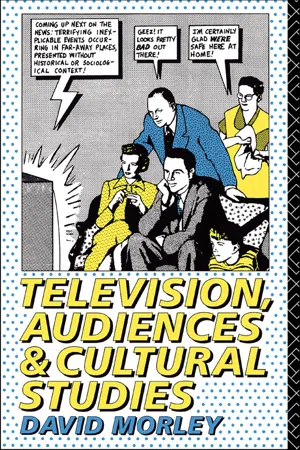
Television, Audiences and Cultural Studies presents a multi-faceted exploration of audience research, in which David Morley draws on a rich body of empirical work to examine the emergence, development and future of television audience research. In addition to providing an introductory overview from a cultural studies perspective, David Morley questions how class and cultural differences can affect how we interpret television, the significance of gender in the dynamics of domestic media consumption, how the media construct the `national family', and how small-scale ethnographic studies can help us to understand the global-local dynamics of postmodern media systems.
Morley's work reconceptualises the study of `ideology' within the broader context of domestic communications, illuminating the role of the media in articulating public and private spheres of experience and in the social organisation of space, time and community.
- 336 pages
- English
- ePUB (mobile friendly)
- Available on iOS & Android
eBook - ePub
Television, Audiences and Cultural Studies
About this book
Information
Part I
Theoretical frameworks
Chapter 1
Television audience research: a critical history
It is not my purpose to provide an exhaustive account of mainstream sociological research in mass communications. I do, however, offer a resumé of the main trends and of the different emphases within that broad research strategy, essentially for two reasons: first, because my own work has been framed by a theoretical perspective which represents, at many points, a different research paradigm from that which has dominated the field to date; second, because there are points where this approach connects with certain important ‘breaks’ in that previous body of work, or else attempts to develop, in a different theoretical framework, lines of enquiry which mainstream research opened up but did not follow through.
Mainstream research can be said to have been dominated by one basic conceptual paradigm, constructed in response to the ‘pessimistic mass society thesis’ elaborated by the Frankfurt School. That thesis reflected the breakdown of modern German society into Fascism, a breakdown which was attributed, in part, to the loosening of traditional ties and structures and seen as leaving people atomized and exposed to external influences, especially to the pressure of the mass propaganda of powerful leaders, the most effective agency of which was the mass media. This ‘pessimistic mass society thesis’ stressed the conservative and reconciliatory role of ‘mass culture’ for the audience. Mass culture suppressed ‘potentialities’ and denied awareness of contradictions in a ‘one-dimensional world’; only art, in fictional and dramatic form, could preserve the qualities of negation and transcendence.
Implicit here was a ‘hypodermic’ model of the media, which were seen as having the power to ‘inject’ a repressive ideology directly into the consciousness of the masses. Katz and Lazarsfeld, writing of this thesis, noted:
The image of the mass communication process entertained by researchers had been, firstly, one of ‘an atomistic mass’ of millions of readers, listeners and movie-goers, prepared to receive the message; and secondly…every Message [was conceived of] as a direct and powerful stimulus to action which would elicit immediate response.
(Katz and Lazarsfeld 1955: 16)
The emigration of the leading members of the Frankfurt School (Adorno, Marcuse, Horkheimer) to America during the 1930s led to the development of a specifically ‘American’ school of research in the forties and fifties. The Frankfurt School’s ‘pessimistic’ thesis, of the link between ‘mass society’ and Fascism, and the role of the media in cementing it, proved unacceptable to American researchers. The ‘pessimistic’ thesis proposed, they argued, too direct and unmediated an impact by the media on their audiences; it took too far the thesis that all intermediary social structures between leaders/media and the masses had broken down; it didn’t accurately reflect the pluralistic nature of American society; it was—to put it shortly—sociologically naive. Clearly, the media had social effects; these must be examined, researched. But, equally clearly, these effects were neither all-powerful, simple nor even direct. The nature of this complexity and indirectness too had to be demonstrated and researched. Thus, in reaction to the Frankfurt School’s predilection for critical social theory and qualitative and philosophical analysis, the American researchers developed what began as a quantitative and positivist methodology for empirical radio audience research into the ‘sociology of mass persuasion’.
It must be noted that both the ‘optimistic’ and the ‘pessimistic’ paradigms embodied a shared implicit theory of the dimensions of power and influence through which the powerful (leaders and communicators) were connected to the powerless (ordinary people, audiences). Broadly speaking, operating within this paradigm. the different styles and strategies of research may then be characterized as a series of oscillations between two different, sometimes opposed, points in this chain of communication and command: on the one hand, message-based studies, which moved from an analysis of the content of messages to their effects on audiences; and, on the other, audience-based studies, which focused on the social characteristics, environment and, subsequently, needs which audiences derived from, or brought to, the message.
Many of the most characteristic developments within this paradigm have consisted either of refinements in the way in which the message/effect link has been conceptualized and studied, or of developments in the ways in which the audience and its needs have been examined. Research following the first strategy (message/effects) has been, until recently, predominantly behaviourist in general orientation: how the behaviour of audiences reflects the influences on them of the messages they receive. When a concern with cognitive factors was introduced into the research, it modified without replacing this behavioural orientation: messages could be seen to have effects only if a change of mind was followed by a change in behaviour (e.g. advertising campaigns leading to a change in commodity choices). Research of the second type (audience-based) has been largely structural-functional in orientation, focusing on the social characteristics of different audiences, reflecting their different degrees of ‘openness’ to the messages they received. When a cognitive element was introduced here, it modified without replacing this functional perspective: differences in audience response were related to differences in individual needs and ‘uses’.
We will look in a moment at the diverse strategies through which this basic conceptual paradigm was developed in mainstream research. It is not until recently that a conceptual break with this paradigm has been mounted in the research field, one which has attempted to grasp communication in terms neither of societal functions nor of behavioural effects, but in terms of social meanings. This latter work is described here as the ‘interpretative’ as against the more dominant ‘normative’ paradigm, and it does constitute a significant break with the traditional mainstream approach. My own approach shares more with the ‘interpretative’ than with the traditional paradigm, but I wish to offer a critique, and to propose a departure from, both the ‘normative’ and the ‘interpretative’ paradigm as currently practised.
The ‘normative’ paradigm
Post-war American mass-communications research made a threedimensional critique of the pessimistic mass society thesis: refuting the arguments that informal communication played only a minor role in modern society, that the audience was a mass in the simple sense of an aggregation of socially atomized individuals, and that it was possible to equate directly content and effect.
In an early work which was conceptually highly sophisticated, Robert Merton (1946) first advanced this challenge with his case study (Mass Persuasion) of the Kate Smith war bond broadcasts in America. Though this work was occasionally referred to in later programmatic reviews of the field, the seminal leads it offered have never been fully followed through. Merton argued that research had previously been concerned almost wholly with the ‘content rather than the effects of propaganda’. Merton granted that this work had delivered much that had been of use, in so far as it had focused on the ‘appeals and rhetorical devices, the stereotypes and emotive language which made up the propaganda material’. But the ‘actual processes of persuasion’ had gone unexamined, and as a consequence the ‘effect’ of the materials studied had typically been assumed or inferred, particularly by those who were concerned with the malevolent effect of ‘violent’ content. Merton challenged this exclusive reliance on inference from content to predicted effects.
This early work of Merton is singular in several respects, not least for the attempt it made to connect together the analysis of the message with the analysis of its effects. Social psychology had pointed to ‘trigger phrases which suggest to us values we desire to realise’. But, Merton asked, ‘Which trigger phrases prove persuasive and which do not? Further, which people are persuaded and which are not? And what are the processes involved in such persuasion and in resistance to persuasive arguments?’. To answer these questions Merton correctly argued that we had to ‘analyse both the content of propaganda and the responses of the audience. The analysis of content…gives us clues to what might be effective in it.
The analysis of responses to it enables us to check those clues’. Merton thus retained the notion that the message played a determining role for the character of the responses that were recorded, but argued against the notion that this was the only determination and that it connected to response in a simple cause-and-effect relationship; indeed, he insisted that the message ‘cannot adequately be interpreted if it is severed from the cultural context in which it occurred’.
Merton’s criticisms did not lead to any widespread reforms in the way in which messages were analysed as such. Instead, by a kind of reversal, it opened the road to an almost exclusive preoccupation with receivers and reception situations. The emphasis shifted to the consideration of small groups and opinion leaders, an emphasis first developed in Merton’s own work on ‘influentials’ and ‘reference groups’, and later by Katz and Lazarsfeld. Like Merton, they rejected the notion that influence flowed directly from the media to the individual; indeed, in Personal Influence (1955) they developed the notions of a ‘two-step flow of communication’ and of the importance of ‘opinion leaders’ within the framework of implications raised by small-group research. From several studies in this area it had become obvious, according to Katz and Lazarsfeld, that ‘the influence of mass media are not only paralleled by the influence of people…[but also]…refracted by the personal environment of the ultimate consumer’.
The ‘hypodermic model’—of the straight, unmediated effect of the message—was decisively rejected in the wake of this ‘rediscovery of the primary group’ and its role in determining the individual’s response to communication. In The People’s Choice (Lazarsfeld et al. 1944) it was argued that there was little evidence of people changing their political behaviour as a result of the influence of the media: the group was seen to form a ‘protective screen’ around the individual. This was the background against which Klapper (1960) summed up: ‘persuasive communications function far more frequently as an agent of reinforcement than as an agent of change…reinforcement, or at least constancy of opinion, is typically found to be the dominant effect’.
From ‘effects’ to ‘functions’…and back again
The work outlined above, especially that of Merton, marks a watershed in the field. I have discussed it in some detail because, though there have been many subsequent initiatives in the field, they have largely neglected the possible points of development which this early work touched on.
The intervening period is, in many ways, both more dismal and less fruitful for our purposes. The analysis of content became more quantitative, in the effort to tailor the description of vast amounts of ‘message material’ for the purposes of effects analysis. The dominant conception of the message here was that of a simple ‘manifest’ message, conceived on the model of the presidential or advertising campaign, and the analysis of its content tended to be reduced, in Berelson’s (1952) memorable phrase, to the ‘quantitative description of the manifest content of communication’. The complexity of Merton’s Kate Smith study had altogether disappeared. Similarly, the study of ‘effects’ was made both more quantitative and more routine. In this climate Berelson and others predicted the end of the road for mass-communications research.
A variety of new perspectives was suggested, but the more prominent were based on the ‘social systems’ approach and its cousin, ‘functional analysis’ (Riley and Riley, 1959), concerning themselves with the general functions of the media for the society as a whole (see R.Wright’s (1960) attempt to draw up a ‘functional inventory’). A different thread of the functionalist approach was more concerned with the subjective motives and interpretations of individual users. In this connection Katz (1959) argued that the approach crucially assumed that ‘even the most potent of mass media content cannot ordinarily influence an individual who has no “use” for it in the social and psychological context in which he lives. The “uses” approach assumes that people’s values, their interests…asssociations…social roles, are pre-potent, and that people selectively fashion what they see and hear’. This strand of the research work, of course, reemerged in the work of the British ‘uses and gratifications’ approach, and was hailed, after its long submergence, as the road forward for masscommunications research.
These various functionalist approaches were promulgated as an alternative to the ‘effects’ orientation; none the less, a concern for effects remained, not least among media critics and the general public. This concern with the harmful effects or ‘dysfunctions’ of the media was developed in a spate of laboratory-based social-psychological studies which, in fact, followed this functionalist interlude. This, rather than the attempt to operationalize either of the competing functionalist models, was the approach that dominated mass-media research in the 1960s: the attempt to pin down, by way of stimulus-response, imitation and learning-theory psychology approaches, applied under laboratory conditions, the small but quantifiable effects which had survived the optimistic critique.
Bandura (1961) and Berkowitz (1962) were among the foremost exponents of this style of research, with their focus on the message as a simple, visual stimulus to imitation or ‘acting-out’, and their attention to the consequences, in terms of violent behaviour and delinquency, of the individual’s exposure to media portrayals of violence of ‘filmed aggressive role models’. Halloran’s study of television and violence in this country took its point of departure from this body of work.
During the mid- to late sixties research on the effects of television portrayals of violence was revitalized and its focus altered, in the face of the student rebellion and rioting by Blacks in the slum ghettoes of America (see National Commission on Causes and Prevention of Violence: the Surgeon-General’s Report). Many of the researchers and representatives of the state who were involved in this work, in their concluding remarks suggested that television was not a principal cause of violence but, rather, a contributing factor. They acknowledged, as did the authors of the National Commission Report, that ‘television, of course, operates in social settings and its effects are undoubtedly mitigated by other social influences’. But despite this gesture to mitigating or intervening social influences, the conviction remained that a medium saturated with violence must have some direct effects. The problem was that researchers operating within the mainstream paradigm still could not form any decisive conclusions about the impact of the media. The intense controversy following the attempt of the Surgeon-General to quantify a ‘measurable effect’ of media violence on the public indicated how controversial and inconclusive the attempt to ‘prove’ direct behavioural effect remained.
The interpretative paradigm
In the same period, a revised sociological perspective was beginning to make inroads on communications research. What had always been assumed was a shared and stable system of values among all the members of a society; this was precisely what the ‘interpretative’ paradigm put into question, by its assertion that the meaning of a particular action could not be taken for granted, but must be seen as problematic for the actors involved. Interaction was thus conceptualized as a process of interpretation and of ‘mutual typification’ by and of the actors involved in a given situation.
The advances made with the advent of this paradigm were to be found in its emphasis on the role of language and symbols, everyday communication, the interpretation of action, and an emphasis on the process of ‘making sense’ in interaction. However, the development of the interpretative paradigm in its ethno-methodological form (which turned the ‘normative’ paradigm on its head) revealed its weaknesses. Whereas the normative approach had focused individual actions exclusively as the reproduction of shared stable norms, the interpretative model, in its ethnomethodological form, conceived each interaction as the ‘production’ anew of reality. The problem here was often that although ethnomethodology could shed an interesting light on micro-processes of interpersonal communications, this was disconnected from any notion of institutional power or of structural relations of class and politics,
Aspects of the interactionist perspective were later taken over by the Centre for Mass Communications Research at Leicester University, and the terms in which its director, James Halloran, discussed the social effects of television gave some idea of its distance from the normative paradigm; he spoke of the ‘trend away from…the emphasis on the viewer as tabularasa…just waiting to soak up all that is beamed at him. Now we think in terms of interaction or exchange between the medium and audience, and it is recognised that the viewer approaches every viewing situation with a complicated piece of filtering equipment’ (Halloran 1970a: 20).
This article also underlined the need to take account of ‘subjective definitions of situations and events’, without going over fully to the ‘uses and gratifications’ position, Halloran recast the problematic of the ‘effects of television’ in terms of ‘pictures of the world, the definitions of the situation and problems, the explanations, alternative remedies and solutions which are made available to us’. The empirical work of the Leicester Centre at this time marked an important shift in research from forms of behavioural analysis to forms of cognitive analysis. Demonstrations and Communications (Halloran 1970b) attempted to develop an analysis of ‘the communication process as a whole’, studying ‘the production process, presentation and media content as well as the reactions of the viewing and reading public’. This latter aspect of the research was further developed by Elliott in his study The Making of a Television Series (1972), especially the notion of public communication as a circuit relaying messages from ‘the society as source’ to ‘the society as audience’.
Uses, gratifications and meanings
The realization within mass-media research that one cannot approach the problem of the ‘effects’ of the media on the audience as if contents impinged directly on to passive minds, that people in fact assimilate, select from and reject communications from the media, led to the development of the ‘uses and gratifications’ model. Halloran advised us: ‘We must get away from the habit of thinking in terms of what the media do to people and substitute for it the idea of what people do with the media’. This approach highlighted the important fact that different members of the mass-media audience may use and interpret any particular programme in a quite different way from how the communicator intended it, and in quite different ways from other members of the audience. Rightly, it stressed the role of the audience in the construction of meaning.
However, this ‘uses and gratifications’ model suffers from fundamental defects in at least two respects:
1 As Hall (1973a) argues, in terms of its overestimation of the ‘openness’ of the message,
Polys...
Table of contents
- Cover Page
- Title Page
- Copyright Page
- Acknowledgements
- Introduction
- Part I: Theoretical frameworks
- Part II: Class, ideology and interpretation
- Part III: Gender, domestic leisure and viewing practices
- Part IV: Methodological issues
- Part V: Television, technology and consumption
- Part VI: Between the private and the public
- Notes
- Bibliography
Trusted by 375,005 students
Access to over 1.5 million titles for a fair monthly price.
Study more efficiently using our study tools.
Frequently asked questions
Yes, you can cancel anytime from the Subscription tab in your account settings on the Perlego website. Your subscription will stay active until the end of your current billing period. Learn how to cancel your subscription
No, books cannot be downloaded as external files, such as PDFs, for use outside of Perlego. However, you can download books within the Perlego app for offline reading on mobile or tablet. Learn how to download books offline
Perlego offers two plans: Essential and Complete
- Essential is ideal for learners and professionals who enjoy exploring a wide range of subjects. Access the Essential Library with 800,000+ trusted titles and best-sellers across business, personal growth, and the humanities. Includes unlimited reading time and Standard Read Aloud voice.
- Complete: Perfect for advanced learners and researchers needing full, unrestricted access. Unlock 1.5M+ books across hundreds of subjects, including academic and specialized titles. The Complete Plan also includes advanced features like Premium Read Aloud and Research Assistant.
We are an online textbook subscription service, where you can get access to an entire online library for less than the price of a single book per month. With over 1.5 million books across 990+ topics, we’ve got you covered! Learn about our mission
Look out for the read-aloud symbol on your next book to see if you can listen to it. The read-aloud tool reads text aloud for you, highlighting the text as it is being read. You can pause it, speed it up and slow it down. Learn more about Read Aloud
Yes! You can use the Perlego app on both iOS and Android devices to read anytime, anywhere — even offline. Perfect for commutes or when you’re on the go.
Please note we cannot support devices running on iOS 13 and Android 7 or earlier. Learn more about using the app
Please note we cannot support devices running on iOS 13 and Android 7 or earlier. Learn more about using the app
Yes, you can access Television, Audiences and Cultural Studies by David Morley in PDF and/or ePUB format, as well as other popular books in Social Sciences & Gender Studies. We have over 1.5 million books available in our catalogue for you to explore.