Integrating film and cultural theory with close analysis of promotional materials, entertainment news, trade publications, and economic reports, Acland presents an array of evidence for the new understanding of movies and moviegoing that has developed within popular culture and the entertainment industry. In particular, he dissects a key development: the rise of the megaplex, characterized by large auditoriums, plentiful screens, and consumer activities other than film viewing. He traces its genesis from the re-entry of studios into the movie exhibition business in 1986 through 1998, when reports of the economic destabilization of exhibition began to surface, just as the rise of so-called e-cinema signaled another wave of change. Documenting the current tendency toward an accelerated cinema culture, one that appears to arrive simultaneously for everyone, everywhere, Screen Traffic unearths and critiques the corporate and cultural forces contributing to the "felt internationalism" of our global era.
- 351 pages
- English
- PDF
- Available on iOS & Android
eBook - PDF
About this book
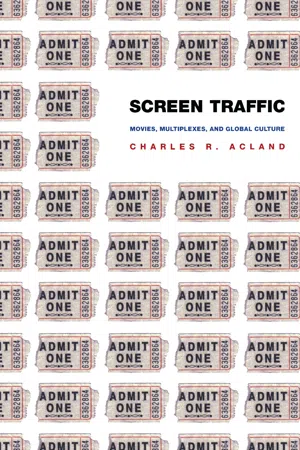
In Screen Traffic, Charles R. Acland examines how, since the mid-1980s, the U.S. commercial movie business has altered conceptions of moviegoing both within the industry and among audiences. He shows how studios, in their increasing reliance on revenues from international audiences and from the ancillary markets of television, videotape, DVD, and pay-per-view, have cultivated an understanding of their commodities as mutating global products. Consequently, the cultural practice of moviegoing has changed significantly, as has the place of the cinema in relation to other sites of leisure.
Information
Publisher
Duke University Press BooksYear
2003Print ISBN
9780822331636
9780822331759
eBook ISBN
9780822384861
Table of contents
- Contents
- List of Tables and Figures
- Acknowledgments
- I. Theorizing Contemporary Cinemagoing
- II. Structures of Cinematic Experience
- Appendices
- Notes
- Bibliography
- Index
Trusted by 375,005 students
Access to over 1.5 million titles for a fair monthly price.
Study more efficiently using our study tools.
Frequently asked questions
Yes, you can cancel anytime from the Subscription tab in your account settings on the Perlego website. Your subscription will stay active until the end of your current billing period. Learn how to cancel your subscription
No, books cannot be downloaded as external files, such as PDFs, for use outside of Perlego. However, you can download books within the Perlego app for offline reading on mobile or tablet. Learn how to download books offline
Perlego offers two plans: Essential and Complete
- Essential is ideal for learners and professionals who enjoy exploring a wide range of subjects. Access the Essential Library with 800,000+ trusted titles and best-sellers across business, personal growth, and the humanities. Includes unlimited reading time and Standard Read Aloud voice.
- Complete: Perfect for advanced learners and researchers needing full, unrestricted access. Unlock 1.5M+ books across hundreds of subjects, including academic and specialized titles. The Complete Plan also includes advanced features like Premium Read Aloud and Research Assistant.
We are an online textbook subscription service, where you can get access to an entire online library for less than the price of a single book per month. With over 1.5 million books across 990+ topics, we’ve got you covered! Learn about our mission
Look out for the read-aloud symbol on your next book to see if you can listen to it. The read-aloud tool reads text aloud for you, highlighting the text as it is being read. You can pause it, speed it up and slow it down. Learn more about Read Aloud
Yes! You can use the Perlego app on both iOS and Android devices to read anytime, anywhere — even offline. Perfect for commutes or when you’re on the go.
Please note we cannot support devices running on iOS 13 and Android 7 or earlier. Learn more about using the app
Please note we cannot support devices running on iOS 13 and Android 7 or earlier. Learn more about using the app
Yes, you can access Screen Traffic by Charles R. Acland in PDF and/or ePUB format, as well as other popular books in Social Sciences & Media Studies. We have over 1.5 million books available in our catalogue for you to explore.