- 312 pages
- English
- ePUB (mobile friendly)
- Available on iOS & Android
eBook - ePub
About this book
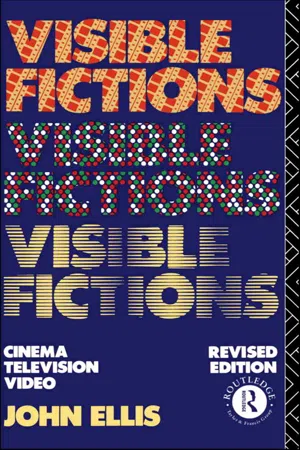
This revised edition of a standard textbook combines an examination of the cinema and television industries with a detailed analysis of their aesthetic and semiotic characteristics. John Ellis draws on his experience as an independent television producer to provide a comprehensive and challenging overview of the place of film, television and video in our daily lives and their future prospects in a changing media landscape.
Information
1 Preliminaries
Cinema and broadcast TV are often taken to be interchangeable media, in direct competition with each other. This book argues their differences from each other: differences in their social roles, their forms of institutional organisation, their general aesthetic procedures. Cinema and broadcast TV are seen as divergent and complementary, having developed distinctive aesthetic and commodity forms (the series and serial in TV; the single ‘feature’ film in cinema), and divergent forms of narration and representation of events and people. These divergent products are marketed differently and ask their spectators to treat them differently. The two media are not in direct competition with each other: broadcast TV cannot wipe out cinema any more than cinema was able to wipe out theatre. But there are vast areas of interdependence. Cinema needs TV’s money invested in film production; TV needs cinema film as a reference point for its own production work, and also as fodder for broadcasting. This mutual dependence has given cinema possibilities that it scarcely possessed before the era of broadcast TV: it can deal with more adventurous topics, and deal with them more adventurously; it can appeal to (and even work with) a wide diversity of allegedly marginal tastes. But cinema has remained within a conception of what constitutes a film (a self-sufficient, universally intelligible unit of about two hours length). It inherited this conception from its past. This conception suits the needs of broadcast TV, but does not exploit the specific characteristics of cinema as a public event to any real extent. An independent cinema in Britain has begun to explore this aspect of cinema, constructing a form of cinema that is appropriate for the age beyond that of broadcast TV: the age of domestic video. Finally, and hesitantly, then, this book peers into the video future, testing some of its arguments against the almost messianic predictions that are sometimes made.
There are some immediate remarks that must be made about this argument, which relate to the position it is made from. Broadcast TV is a notoriously difficult phenomenon to write about except in the impressionistic way that Clive James has made into a form of criticism. Broadcast TV is extensive and ever-present: it gives the impression of carrying on regardless of what anyone in its audience is doing. A critic’s attempt to catch all of broadcast TV is doomed to failure like all paranoid attempts to pin everything down, to know everything.
The same is true of commercial cinema, where the rate of releases and screenings far exceeds any one critic’s physical possibilities of viewing them, even in a cinematically deprived city like London. Yet the inheritance of many years of serious research and historical work on the cinema have made this far less of a problem than it seems to be with broadcast TV. When writing about cinema in this book, I have been very aware of the wealthof dependable reference material that stands behind the arguments made, and the possibility of easy access to a wide range of material from the history of cinema. When writing about TV, I was far more aware of searching through my own childhood memories in some cases, or being dependent on sources that seemed in some way suspect or implausible. The strategy I adopted in trying to think through general aesthetic questions in relation to broadcast TV was to trade on this unevenness of knowledge and theory (which may be my own; though I suspect it is not). The strategy was one of comparison: taking what is now a relatively tried and tested conception of cinema, developed from an initial semiotic approach to cinema in the early 1970s, and seeing how it fitted my perceptions of broadcast TV. The results are presented here, as explorations rather than definitive statements, turning a fresh attention on to broadcast TV.
The way in which some of the statements and arguments are made might seem to belie a sense of the incompleteness of this writing, and the current impossibility of going much further. The form I have adopted is able to summarise and is short (an advantage), but is one of generalisation: in this case, rather a disadvantage. The writing abounds with statements that begin ‘Television is…’.
A strategy of producing generalisations seemed to be necessary, since there are very few attempts at coherent overall descriptions of either cinema or broadcast TV as aesthetic and economic institutions. Readers are able to test generalisations against their own experiences and preconceptions; on the other hand, anecdotes and specific accounts (the most usual mode of writing about both media) are able to claim a certain authority for themselves, the authority of the eye-witness. Generalisations parade themselves, asking to be knocked down because of their own arrogance; they try to embrace everything: past, present and future. But there seemed no point in being coy about the strategy once it had been embarked upon, by qualifying each statement and surrounding it with doubts and question marks, reducing whatever clarity of perception it might have contained. Instead, it seemed better to let loose a flock of generalisations in the hope that some might return, and to take refuge instead behind some kind of statement of the position from which the arguments have been made.
This work is based on critical work carried out on the cinema because that is my own cultural background, and source of livelihood. I have been involved with a series of cinematic organisations, ranging from the Independent Film-makers’ Association to the committee of Cinema 3 in Canterbury, as well as the editorial board of Screen magazine. I approach broadcast TV from a more common position, as one of its anonymous and fragmented audience. My experiences with production for broadcast TV are limited to involvement in the production of ‘access’ programmes, and to general observation of TV’s practices informed by my experiences of cinema. Such is the nature of broadcast TV, attempting to cover everything, that each individual member of its audience sometimes confronts it as an expert. At some point, TV’s genial generalisations will cover something of which each viewer has personal experience and knowledge. At such points, broadcast TV suddenly seems rather threadbare and inadequate. In some sense, then, my limited experience of the practice of broadcast TV production, together with a far more informed conception of cinema can produce a series of ideas and criticisms of TV in exactly the same way as any TV viewer can produce ideas about TV. I am confronting TV as a member of the cinema audience; nevertheless, also as someone who can appreciate the distinctiveness of a series like Hill Street Blues
My engagement with this subject (rather than any other) comes from my enduring fascination with images, a fascination that has been enhanced rather than destroyed by analytic and critical work. My parents acquired their first TV set and their first son (me) at about the same time, so I am one of the first generation that has grown up with TV, amidst the dire predictions of the effects that the box would have on us. But my viewing experiences were interrupted rather than continued, as from the age of thirteen to eighteen I attended a boarding school whose notion of education included a savage deprivation of all electronic media. The consumption of moving images was virtually prohibited for two-thirds of the year: what had been freely available suddenly became taboo. At this point, I discovered cinema, an illicit pleasure involving avoidance of compulsory sport. University brought a new twist to this intertwining with moving images: a wide range of films, old and new; a developing sense of distaste (which still remains to some degree) with the more self-consciously artistic intentions of some TV and cinema; and contact with the growing political culture that developed amongst intellectuals in the late 1960s. One of the aims of this culture was a thorough analysis of ideology, including the audio-visual media. So my own involvement with watching moving images is closely linked with pleasure and its prohibition, and with the demands of the super-ego that such pleasures should be analysed in a socially useful way.
The position from which I write might seem to disqualify me from writing about broadcast TV. Having been much more involved with cinema than TV, I have for long periods used broadcast TV as a rather haphazardly organised film archive rather than a medium in its own right. More seriously, I have had very little experience of watching any broadcast TV other than Britain’s. In particular, I have never been to the United States, so many of the statements I have made here might need revision from the rather different perspective that US TV might provide. This really demonstrates an insuperable problem with all writing about broadcast TV: unlike cinema, which in its commercial sectors has a highly integrated international aspect, broadcast TV is an essentially national activity for the vast majority of its audience. Broadcast TV is the private life of a nation-state, defining the intimate and inconsequential sense of everyday life, forgotten quickly and incomprehensible for anyone who is outside its scope. This sense of privacy accruing to each nation state’s broadcast TV is another problem for anyone writing about TV in general. It means that any research is difficult if it is a research that aims to go beyond viewing and analysing individual programmes and series. To look at the whole phenomenon of broadcast TV in a particular country, both how its output works and how it intersects with the economic and social life of that country, it would be necessary to live there for an extended period of time. It also means that any programmes used as examples may mean nothing to some readers, especially in writing likely to be read on both sides of the Atlantic.
Sudden exposure to the often bizarre practices of broadcast TV in another country can stimulate fresh thinking about the whole phenomenon of TV. This is the case with Raymond Williams’s concept of ‘flow’ (criticised in Chapter 7) which resulted from his culture shock on seeing US TV. Seeing another country’s broadcast TV has the effect of ‘making strange’ something we normally take for granted: TV, normally habitual and bound into the private life of the nation, suddenly becomes an alien and inexplicable series of events. Even without this ‘culture shock’, something of this distance can also be gained simply from being confronted with a repugnant or ridiculous view of the world which TV’s presentation assumes to be a taken-for-granted attitude. Parts of this book are inspired by such an experience.
Several of the presuppositions of this book need to be explained. There are three general conceptions that haunt many arguments about the mass media, which are not directly confronted in the rest of the text; rather, a particular position is assumed about them. These are: first, the assumption that both cinema and TV should conform to usually unexpressed conceptions of realism; second, the assumption that technology determines the uses that society puts it to; and third, the conception that cinema and TV have certain measurable effects in modern society. It is not the aim of this book to develop arguments around these major conceptions, but the ideas that the book does develop depend to a great degree on the particular kinds of attitude that I adopt to each of them.
Realism
Notions of realism are some of the most enduring means of judgment of film and TV creations; they also form a powerful block to the development of new forms of use for the two media, as well as to perception of how they work. The word ‘realism’ is scarcely used in this book, except to denote the presence of a set of conventions of portrayal that in a certain time and place, are able to pass themselves off as realistic. Whilst there is a certain truth in this position, it may appear to some readers to do less than justice to the complexities of the notion of realism. This is indeed the case, but only because the word ‘realism’ is used to cover a whole series of ideas and expectations, some of which can conflict with each other. The question of realism is indeed a complex one, but it is complex because the word itself is being used to describe a whole series ofprinciples of artistic construction and of audience expectation alike.
‘Realism’ denotes the expectation that a particular representation should present a ‘realistic portrayal’ of character and event. Beneath this tautology can lie a series of expectations. The particular representation (film or TV programme), should have a surface accuracy; it should conform to notions of what we expect to happen; it should explain itself adequately to us as audience; it should conform to particular notions of Psycho logy and character motivation. Each of these expectations is different: there is nothing to stop more than one being demanded from a particular representation. Indeed, part of the complexity (or confusion) of the use of the term comes from the fact that when realism is demanded from a representation, it is always more than one type of realism that is demanded. So, to expand these summaries slightly further it becomes clear that the first, which is that the representation should have a surface accuracy, is not enough on its own. The kind of surface accuracy in question is an accuracy of costume, setting and props. This is often the subject of a particular ‘know-all’s’ correspondence in the Radio Times about TV historical dramas:’How could you get the buttons on the uniform wrong?’ Other notions of realism are needed to supplement this type, though they can do so in different ways. The second, that a representation should conform to what we expect to happen, is perhaps the most conservative. It represents the spectator’s desire that a representation should conform to common sense and taken-for-granted notions of events: it demands that politics is presented as a matter for powerful (male) politicians, not for popular struggle; it demands that the Second World War is shown as a conflict with the virtuous Allies pitted against satanic Germans and sub-human Japanese.
The third conception of realism is different again. It can quite cheerfully admit large-scale divergences from accepted notions, but it sets the terms on which such representations can be comprehensible to audiences as realistic representations. This criterion of realism can be regarded as quite antirealist by those who believe that ‘realism’ equals the attempt to portray things as they are or were. The demand that a representation should explain itself adequately to its audience cuts right across the desire that it should show things ‘as they were’. In practice (the practice of film- or programme-making) a compromise is always drawn between the two tendencies, a compromise that always favours the audience and explanation to that audience. The demand for explanation is a demand for adequate motivation of events in the sense that events should always be seen as having explicable causes and being related to each other within the representation, rather than coming out of the blue. On a mundane level, if a character is walking down a street, with an open umbrella, then it should be raining; on a more complex level, the fatal fall of Scarlett and Rhett’s daughter from her pony in Gone With the Wind (1939) is motivated at two levels. First, it should be prepared by Rhett coaching the child to be a good horsewoman; second, it should link to the way that Scarlett’s father met his death, also by falling from a horse. This motivation explains and prepares for the event, which nevertheless comes as a surprise to the viewer until the child announces her intention to jump the fence… The fourth version of realism is a variant on this form. Instead of demanding that all events should be soldered together into a form that explains itself to the audience through clear motivation of each action, the motivation for events is placed centrally upon the Psycho logy of individual characters, who are taken as the unifying point in a representation in which weird and ‘unrealistic’ events take place. This is what holds many films of the macabre within a realistic form; it is also what provides the unity for much comedy, whose events taken on their own would seem to be rather implausible.
Hence there is no realism, but there are realisms: a series of arguments, justifications, and procedures for the production of representations alike. The appeal to the idea of ‘realism’ to justify a particular representation will probably rest upon more than one of these arguments. But the situation is not as simple as this, since each of these conceptions is highly dependent upon changing conceptions of what is appropriate. The example from Gone With the Wind nowadays seems too obvious to most spectators, and thus is judged ‘unrealistic’. Each notion depends on particular, historically dependent judgments. They are not absolutes: they depend upon convention. As conventions ofportrayal, they tend todiversifystill further. Each conception of realism will have its older and its newer conventions, each constituting a different ‘taste’, each providing the possibility of disagreements between individual spectators, even if the particular form of justification of realism can be mutually agreed. And further, it can be argued that a work is ‘realistic’ to the extent that it breaks these conventions of portrayal in order to get to a new sense of reality. So a film that shows events as arbitrary, not explaining them in the conventional way, like Rossellini’s work, can be judged ‘realistic’ for these reasons. In not conforming to conventions of portrayal, it has found reality from behind the dead weight of representations. This is certainly the argument that André Bazin uses to explain Rossellini’s work.
Enough has been said to indicate that the notion of realism is not a simple given, not a result simply of the camera’s ability to record light and the tape’s to register vibrations in the microphone. Instead, it can be seen as a complex network of conventions of portrayal and conventions of audience expectation alike. Yet, conventions or not, the idea of realism is still a powerfulregime of reading sounds and moving images. It constitutes perhaps the basic demand that our society makes of its film and TV representations, apart from a very few licensed exceptions. The recourse to notions of realism by film-makers, by TV institutions, and by spectators alike is almost a reflex action. It ensures that film and video images continue to be treated in a particular way, as the unified image of a particular reality. The notion of realism tends to unify the diverse elements that go to make up a picture or sound track: it unifies them as the attempt to portray, according to whatever conventions of realism, a particular fragment of reality. Reality is taken as being the subject and object of the representation. This hinders various attempts to produce different uses for sound and image combinations, and different spectator attitudes. The conventions of realism (and the convention that there should be realism) prevent the realisation of Eisenstein’s wild dream of a film of Das Kapital: the realisation, that is, of the desire to use images and sounds analytically, rather than as the presentation of a self-sufficient reality.
In essence, realism is a regime of unified portrayal: every criterion of realism aims at the same objective, to combine all the elements of the representation at any one point into a harmonious whole. This prevents the reading of the image, scanning it to see its different elements and their possible conflicts or combinations, which is a central feature of modernist tendencies in the other visual arts. Film and video both have a tremendous potential to produce such combinations of elements which are meaningful as combinations of meanings rather than unified into any particular reality. With the increasing availability and flexibility of video in the home, the attempt to create such forms becomes a more urgent one. With home video equipment it is possible for people to view material more than once, view selected fragments, to skip or repeat pieces. This allows a much more analytic attitude to video representations, rather than the serial attitude that has been the only one available, in cinema or broadcast TV, to the vast majority of the population. One possible development that can now begin to take place is the development of more sophisticated reading skills, and the habit of understanding images as combinations of meanings rather than as the imprint of an external reality. The beliefs traditionally associated with realism would seem to hinder rather than to promote such an attitude.
Technology
Sophisticated new technology always seems to provoke a flurry of wild and naive speculation about its effects. It is so currently with video technology of all kinds; it was so with the introduction and spread of cinema technology. All kinds of dire prognostications can be had, according to your taste. There is the media apocalypse prediction: that home video and cable diffusion of video between them will finish off both cinema and broadcast TV. There is the surveillance paranoia nightmare, with video technology in the home to keep an eye on every action, and computer centralisation of all possible kinds of information to abolish any remaining personal freedoms that Westerners might have. There is the domestic idyll promoted by some equipment manufacturers, where it will be possible to do everything by interactive cable video (shopping, voting, socialising) so that no one need go out on to the unsafe streets or the rundown public transport any more.
All of these operate by extrapolating the technical potential of an invention into the future, without regard to any factors that might intervene. In particular, the complexities and varieties of modern culture are neglected, together with the great capacity for people to resist or ignore many of the more unsavoury aspects of technology. These predictions ignore the fact that technology is used, adapted and implemented in particular ways by the society that has called it into being. Cinema and broadcast TV provide convenient examples of this process and its complexities. First, it was once fashionable to predict the imminent demise of cinema, any form of cinema, under the impact of broadcast TV. Nowadays, it is obvious that this apocalypse has not taken place: cinema may have changed because of the impact of broadcast TV, but this is a different matter. Second, there is nothing in the technologies themselves that dictated how they were used by the societies that invented them, though there is a great deal in the form that those societies took: turn-ofthe-century America and Europe for cinema; postwar Western society for broadcast TV.
Domestic cinema is quite conceivable: easy-to-operate 16mm or 8mm projectors sol...
Table of contents
- Cover Page
- Title Page
- Copyright Page
- Illustrations
- Acknowledgments
- 1: Preliminaries
- Part I: Cinema
- Part II: Broadcast TV
- Part III: The institutions of cinema and broadcast TV
- Films and programmes cited
- Select bibliography
- Further reading
Trusted by 375,005 students
Access to over 1.5 million titles for a fair monthly price.
Study more efficiently using our study tools.
Frequently asked questions
Yes, you can cancel anytime from the Subscription tab in your account settings on the Perlego website. Your subscription will stay active until the end of your current billing period. Learn how to cancel your subscription
No, books cannot be downloaded as external files, such as PDFs, for use outside of Perlego. However, you can download books within the Perlego app for offline reading on mobile or tablet. Learn how to download books offline
Perlego offers two plans: Essential and Complete
- Essential is ideal for learners and professionals who enjoy exploring a wide range of subjects. Access the Essential Library with 800,000+ trusted titles and best-sellers across business, personal growth, and the humanities. Includes unlimited reading time and Standard Read Aloud voice.
- Complete: Perfect for advanced learners and researchers needing full, unrestricted access. Unlock 1.5M+ books across hundreds of subjects, including academic and specialized titles. The Complete Plan also includes advanced features like Premium Read Aloud and Research Assistant.
We are an online textbook subscription service, where you can get access to an entire online library for less than the price of a single book per month. With over 1.5 million books across 990+ topics, we’ve got you covered! Learn about our mission
Look out for the read-aloud symbol on your next book to see if you can listen to it. The read-aloud tool reads text aloud for you, highlighting the text as it is being read. You can pause it, speed it up and slow it down. Learn more about Read Aloud
Yes! You can use the Perlego app on both iOS and Android devices to read anytime, anywhere — even offline. Perfect for commutes or when you’re on the go.
Please note we cannot support devices running on iOS 13 and Android 7 or earlier. Learn more about using the app
Please note we cannot support devices running on iOS 13 and Android 7 or earlier. Learn more about using the app
Yes, you can access Visible Fictions by John Ellis in PDF and/or ePUB format, as well as other popular books in Sozialwissenschaften & Filmgeschichte & Filmkritik. We have over 1.5 million books available in our catalogue for you to explore.