Enlivening Secondary History: 50 Classroom Activities for Teachers and Pupils
eBook - ePub

Enlivening Secondary History: 50 Classroom Activities for Teachers and Pupils

  1. 214 pages
  2. English
  3. ePUB (mobile friendly)
  4. Available on iOS & Android
eBook - ePub

Enlivening Secondary History: 50 Classroom Activities for Teachers and Pupils

About this book

Enlivening Secondary History is the ideal handbook for busy history teachers who want to do something different in their classrooms, but have little time to plan and organise their lessons. Featuring tried-and-tested practical ideas complete with relevant exemplars and step-by-step advice, this best-selling book is a compendium of creative activities to enhance your lessons.

For the 11-19 age range, each activity includes links to important topics including the Crusades, the Reformation, the world wars, the Russian Revolution and many more. All the ideas are explained in a clear, user-friendly style, with a breakdown of the time and resources needed for each one.

Featuring a brand new expanded section about teaching history through role play, this book also covers:

  • Visuals – picturing the past
  • Numerical data – adding interest
  • Concepts – making them real
  • Primary texts – bringing them alive.

Written by practitioners for practitioners, Enlivening Secondary History helps teachers to bring history alive in an imaginative way. It will be an indispensible guide for both experienced and student teachers.
Frequently asked questions

Yes, you can cancel anytime from the Subscription tab in your account settings on the Perlego website. Your subscription will stay active until the end of your current billing period. Learn how to cancel your subscription.
No, books cannot be downloaded as external files, such as PDFs, for use outside of Perlego. However, you can download books within the Perlego app for offline reading on mobile or tablet. Learn more here.
Perlego offers two plans: Essential and Complete
  • Essential is ideal for learners and professionals who enjoy exploring a wide range of subjects. Access the Essential Library with 800,000+ trusted titles and best-sellers across business, personal growth, and the humanities. Includes unlimited reading time and Standard Read Aloud voice.
  • Complete: Perfect for advanced learners and researchers needing full, unrestricted access. Unlock 1.4M+ books across hundreds of subjects, including academic and specialized titles. The Complete Plan also includes advanced features like Premium Read Aloud and Research Assistant.
Both plans are available with monthly, semester, or annual billing cycles.
We are an online textbook subscription service, where you can get access to an entire online library for less than the price of a single book per month. With over 1 million books across 1000+ topics, we’ve got you covered! Learn more here.
Look out for the read-aloud symbol on your next book to see if you can listen to it. The read-aloud tool reads text aloud for you, highlighting the text as it is being read. You can pause it, speed it up and slow it down. Learn more here.
Yes! You can use the Perlego app on both iOS or Android devices to read anytime, anywhere — even offline. Perfect for commutes or when you’re on the go.
Please note we cannot support devices running on iOS 13 and Android 7 or earlier. Learn more about using the app.
Yes, you can access Enlivening Secondary History: 50 Classroom Activities for Teachers and Pupils by Peter Davies,Rhys Davies in PDF and/or ePUB format, as well as other popular books in Education & Education General. We have over one million books available in our catalogue for you to explore.

Information

Publisher
Routledge
Year
2012
Print ISBN
9780415678339
eBook ISBN
9781136285011
Edition
2
image

Visuals


Picturing the past

Be not afraid of growing slowly. Be afraid only of standing still.
Chinese proverb

INTRODUCTION

We live in a world where young people get most of their knowledge from screens, not pages. Thus, the use of visuals in the teaching of History has huge potential – it can help pupils make sense of the subject and ā€˜visualise’ complex ideas. Recent cognitive research also points to the fact that for some learners, a ā€˜visual–spatial’ approach to learning is not just beneficial, but vital if optimum understanding is to take place.1 In the secondary sector, the use of visual stimuli can be extremely helpful, especially for the lower-attaining pupil, for whom such terms as ā€˜socialism’, ā€˜feudalism’ and ā€˜democracy’ can be incomprehensible and alien. So, to ā€˜see’ such terms, and to ā€˜see’ how they translate into everyday life, can be of huge benefit to pupils – and teachers – in the quest to unravel the conceptual difficulties inherent in the subject. This is not to say, however, that the activities outlined in this section are not relevant to the more ā€˜academic’ or older pupil; the truth is that ā€˜visuals’ can help all individuals learn, regardless of age or ability.
Using visuals to ā€˜see’ abstract concepts and ideas is one of two general approaches considered by this section: ā€˜Draw a Concept’ (Activity 7) gives pupils the opportunity to visualise and discuss complicated abstract concepts; ā€˜Charts and Diagrams’ (Activity 3) helps individuals to visualise historical concepts such as ā€˜causation’, ā€˜consequence’, ā€˜change’ and ā€˜effect’; and ā€˜Devise a Board Game’ (Activity 9) looks at how events and political, social and economic phenomena can be charted and represented in a visual form. The other general approach to the use of visuals involves scrutinising and analysing visual images as a way of developing understanding, discussion and debate. Visual sources are invaluable for the clues they provide about the past, and historians are blessed with a deep pool of sources from which to draw. However, as teachers, how effectively do we use visual images in our teaching as a way of unlocking the past? Do we encourage our pupils to scrutinise visual sources and use them as effectively as they can? Or do cartoons, photographs, propaganda posters and portraits receive only a superficial glance and maybe a few off-the-cuff comments? In an effort to make more of sources, we present: ā€˜Freeze Frame’ (Activity 6), which allows pupils to empathise with characters in a visual via roleplay; ā€˜Introductory Images’ (Activity 4), which provokes and challenges them via graphic images; and ā€˜Annotation’ (Activity 10), which encourages young people to dissect a visual source in detail. For all the examples, it must be stressed that the quality of the artwork is incidental; visual images are produced and utilised in order to enhance discussion and learning and therefore maximise the learner’s understanding of the subject.

ACTIVITIES

  • 1 Propaganda Posters (GCSE)
  • 2 Convert a Text (Key Stage 3)
  • 3 Charts and Diagrams (Key Stage 3)
  • 4 Introductory Images (Key Stage 3)
  • 5 Class Craft (Key Stage 3, GCSE and AS/A-Level)
  • 6 Freeze Frame (GCSE)
  • 7 Draw a Concept (AS/A-Level)
  • 8 Coloured History (GCSE)
  • 9 Devise a Board Game (Key Stage 3)
  • 10 Annotation (Key Stage 3)
The most suitable level for usage is indicated in brackets. However, it should be noted that, with a little adaptation and customisation, many activity ideas contained within this section could also be employed at other levels.
image

Suitable for GCSE


PROPAGANDA POSTERS


DIY totalitarianism in action

DESCRIPTION

Setting and context

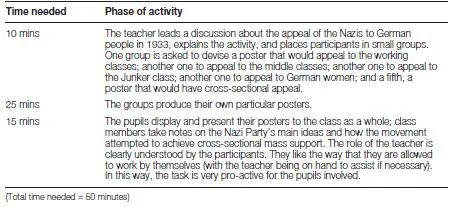
This is a particularly useful activity for analysing the doctrine of a political or social movement, or assessing the mood of a particular audience from the past. Posters can be devised after looking at a number of written sources which outline the ideas of an organisation, whether in the form of speeches, radio broadcasts or news sheets. In the example given, participants are asked to devise a Nazi propaganda poster after analysing a range of written sources dealing with the party’s programme and the movement’s appeal to the discontented elements of German society in the early 1930s. The teacher could even ā€˜model’ an example first.

Learning aims and objectives

Pupils are to convert Nazi ideas - taken from a selection of written documents - into a visual medium and so enhance their understanding of the main tenets of the party’s ideology and the appeal of the movement. The objectives of the exercise are to enable group members to: (1) analyse and discuss (in small groups) a political movement’s ideology and appeal to the people; (2) produce a visual image illustrating the appeal of the party to a certain social group - after a period of discussion and analysis of primary sources; (3) develop an empathetic awareness of what it was like (in this case) to produce propaganda in 1930s Germany; (4) present their ideas to the rest of the class and share findings.

Resources required

  • A range of written documentary evidence
  • Sugar/poster paper
  • Coloured marker pens
  • Sellotape or Blu-Tack (to display the posters)

Breakdown of method in action

image

GOOD EXEMPLARS

1 Germany 1918-1939 (see above)

The following sources can be used as stimulus material to help produce the Nazi propaganda posters:
SOURCE A A Nazi propaganda pamphlet (1932) 2
Attention! Gravediggers at work! Middle-class citizens! Retailers! Craftsmen! Tradesmen!
A new blow aimed at your ruin is being prepared and carried out in Hanover!
The present system enables the gigantic concern W...

Table of contents

  1. Front Cover
  2. ENLIVENING SECONDARY HISTORY
  3. Title
  4. Copyright
  5. Contents
  6. Acknowlegments
  7. Introduction
  8. How to Use this Book
  9. Section 1: Visuals – Picturing the past
  10. Section 2: Numerical Data – Adding interest
  11. Section 3: Concepts – Making them real
  12. Section 4: Primary Texts – Bringing them alive
  13. Section 5: Roleplay – Acting it out
  14. Summary
  15. References