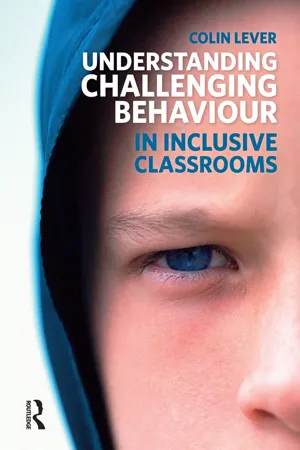
Understanding Challenging Behaviour in Inclusive Classrooms
eBook - ePub

Understanding Challenging Behaviour in Inclusive Classrooms

  1. 304 pages
  2. English
  3. ePUB (mobile friendly)
  4. Available on iOS & Android
eBook - ePub

Understanding Challenging Behaviour in Inclusive Classrooms

About this book

It is no great secret that managing disruptive behaviour in any classroom, from infants to sixth form, is one of the most stressful aspects of teaching. Rules and sanctions can be effective up to a point, but often fail to take into consideration individual differences in children and the difficulties they might be experiencing in their school or home life.

In his new book, Colin Lever uses real childrens voices to help you begin to understand why children might behave in the way that they do, offering ideas and strategies to help prevent challenging behaviour occurring in the first place.

Whether it serves as a reference manual, a useful checklist or as an aide to help you plan and prepare for your lessons, this book should be essential reading for every teacher.

Frequently asked questions

Yes, you can cancel anytime from the Subscription tab in your account settings on the Perlego website. Your subscription will stay active until the end of your current billing period. Learn how to cancel your subscription.
At the moment all of our mobile-responsive ePub books are available to download via the app. Most of our PDFs are also available to download and we're working on making the final remaining ones downloadable now. Learn more here.
Perlego offers two plans: Essential and Complete
  • Essential is ideal for learners and professionals who enjoy exploring a wide range of subjects. Access the Essential Library with 800,000+ trusted titles and best-sellers across business, personal growth, and the humanities. Includes unlimited reading time and Standard Read Aloud voice.
  • Complete: Perfect for advanced learners and researchers needing full, unrestricted access. Unlock 1.4M+ books across hundreds of subjects, including academic and specialized titles. The Complete Plan also includes advanced features like Premium Read Aloud and Research Assistant.
Both plans are available with monthly, semester, or annual billing cycles.
We are an online textbook subscription service, where you can get access to an entire online library for less than the price of a single book per month. With over 1 million books across 1000+ topics, we’ve got you covered! Learn more here.
Look out for the read-aloud symbol on your next book to see if you can listen to it. The read-aloud tool reads text aloud for you, highlighting the text as it is being read. You can pause it, speed it up and slow it down. Learn more here.
Yes! You can use the Perlego app on both iOS or Android devices to read anytime, anywhere — even offline. Perfect for commutes or when you’re on the go.
Please note we cannot support devices running on iOS 13 and Android 7 or earlier. Learn more about using the app.
Yes, you can access Understanding Challenging Behaviour in Inclusive Classrooms by Colin Lever in PDF and/or ePUB format, as well as other popular books in Education & Education General. We have over one million books available in our catalogue for you to explore.

Information

Publisher
Routledge
Year
2014
Print ISBN
9781138422711
Part 1
Creating and maintaining an inclusive classroom
Chapter 1
Readability
Case study
Anita sits at the back of the class. The teacher introduces the lesson and invites children to read the first paragraph of the worksheet that he has prepared. Few hands are raised, so he asks a boy at the front to read. The boy starts enthusiastically but gets stuck on a word. The teacher says the word, the boy repeats it and then carries on. Again he stumbles over a word and is once corrected, gently, by the teacher. Three lines into the text he is struggling with all but the simplest words. Some children in the class giggle at his predicament so the teacher picks another child to carry on reading. Anita loses concentration and starts to whisper to her friend sitting next to her. At first the teacher does not notice her, but eventually, following a loud guffaw, Anita draws attention to herself.
‘Will you carry on, from Steven?’ the teacher requests, choosing direct action to quash Anita before she becomes too disruptive. Anita pretends to look for the place where Steven got to but she is lost.
‘Can’t find it,’ comes the terse reply.
The girl sitting next to Anita shows her where to start reading from. Anita focuses on the text for a few seconds but says nothing.
‘We are waiting, Anita,’ the teacher prompts impatiently. There is a prolonged silence as Anita looks down at the sheet but refuses to comply. Tensions rise as the teacher, once more, tries to force Anita to read.
‘The word is “because”, surely you know that word.’
Anita feels threatened and embarrassed as all eyes in the class are upon her.
‘I don’t want to read,’ she shouts defiantly.
‘Anita, you could at least make an effort.’ The teacher resorts to pleading in an attempt to get her to read.
‘I’m not going to and you can’t make me.’ Anita openly challenges his authority. The situation ends in conflict, resulting in Anita being sent from the room and sanctioned. Closer inspection reveals that Anita has a reading age of 8.6 years and the piece of comprehension given to the class demands a reading age of 12 years.
‘The world may be full of fourth-rate writers but it’s also full of fourth-rate readers.’
(Stan Barstow, novelist)
Does it matter what a child reads?
Source: © Blend Images/Alamy
(!)
Do you know:
a) The reading age of the children you teach?
b) The reading level of the text material you use with the children?
Background
If a child is going to be able to access the curriculum they are going to have to be able to read the work that is placed before them. If their literacy skills are poor and they cannot do the work set, it is only a matter of time before problems will come to a head. Conversely, if a child can read, it improves their self-confidence and raises their self-esteem.
There are many reasons why a child may find it difficult to read. These include cognitive development (see p. 211), dyslexia (see p. 247), physical impairment, socioeconomic background and EAL (English As a Second Language) (see p. 203). Literacy is a major issue in schools and it is the responsibility of all subject areas to support and develop literacy – it is not just the domain of ‘English’.
England has dropped from 3rd to 19th in the International Reading league.
(Daily Mail, December 2007)
‘20 per cent of 11 year olds in England have not mastered the literacy skills needed to achieve level 4 at Key Stage 2.
26 per cent of 14 year olds fail to reach the standard expected in English, with only 67 per cent of 14 year old boys achieving target level 5 at key stage 3.’
(Sir Cyril Taylor, chairman of the SSAT (Specialist Schools and Academies Trust)
What the statistics indicate is that some children in class will have difficulty reading text material put in front of them. This is likely to lead to numerous avoidance strategies, including disruptive behaviour, as they attempt to disguise their shortcomings.
Possible signs that a child is struggling to read written material
A reluctance to offer to read in class.
A refusal to read out loud when requested.
Attempting to read but struggling with the text.
Disruptive and/or diversionary tactics when a reading task is introduced.
Children are adept at finding ways of avo...

Table of contents

  1. Cover Page
  2. Half Title page
  3. Title Page
  4. Copyright Page
  5. Dedication
  6. Contents
  7. About the author
  8. Acknowledgements
  9. Introduction
  10. Part 1 Creating and maintaining an inclusive classroom
  11. Part 2 Identifying and dealing with key social/emotional and cognitive aspects of inclusion
  12. Part 3 Whole-school management issues that affect the effectiveness of inclusion
  13. Index