This study recreates and examines a voice that sings of the dreams and interactions of women and tells of the bodies, rhythms and desires of the women of Sappho's circle.
Representations of the gods appear so frequently in Sappho’s extant songs that it has been suggested that this community of women was dedicated to a religious cult.1 Amongst invocations to the Graces, Muses, Hera and occasional references to male gods such as Hermes, one god figures most often and most significantly. Aphrodite, god of erotic love, craft and persuasion, is effectively reconstructed by Sappho’s poetry into a figure with poetic, symbolic, even visual dimensions. In this many-sided format Aphrodite or Cypris features in a larger symbolic framework intrinsic in Sappho’s poetry. This framework also centres on Aphrodisian characteristics: beauty, love and associated symbols such as the flowers that decorate her worshippers. Although it draws upon some constituents and mythic/poetic constructions of the public arena, this world and this representation of Aphrodite seem to be distinctively Sapphic and pervasively woman-centred. In Greek antiquity, hymns worshipping the gods and reports of their words and deeds were still formulated in the metres of an oral tradition. By then religious institutions were one of the few arenas in which women could act with some autonomy.
Was there a time when the status of female divinities of the Greek pantheon and their antecedents in Old Europe, Sumer and Egypt was more prestigious than it appears in later and more male-centred constructions?2 Did Aphrodite have her beginnings in such a time and evolve as a deity created, to some extent, for and by women? Some of the female gods of other, geographically and culturally contiguous regions, the Sumerian Inanna, the many Semitic Ishtars and Ishtar-type figures and the Phoenician Astarte for example, share many of the characteristics and symbols associated with Aphrodite: eroticism, fertility, astrality, golden-ness, flowers, fruits, birds and water.3 The worship of a powerful female god of love indicates/incites conspicuous differences in cultural and religious practices and attitudes; approval of female eroticism for example, or veneration of the symbols and stereotypes associated with that god and the women who dedicate themselves to her. Friedrich (1978: 103) has noted that many of the traditional, and Sapphically endowed, Aphrodisian characteristics fit perfectly, if stereotypically, into a ‘feminine’ gender scheme. I would add that, at least in a Sapphic framework, their value is paramount. Friedrich (1978: 110) also mentions the prominence of a tradition of women’s poetry that flourished in archaic Lesbos and is evidenced by Sappho’s songs. That evidence, the extant songs of Sappho, focuses on and re-creates this god suitably, beautifully, endowing her with poetic immortality, and with an accessible, erotic and powerful persona.
Sappho’s prayer to Aphrodite, her only complete extant song, features an unusual combination of traditional form and idiosyncratic treatment. Genre-wise it is irregular; Kirkwood (1974: 111) cites it as the one ‘example we have in monodic lyric of the cletic hymn’. This is only one aspect of its difference, its generic, genderic unaccountability. Sappho 1 features a woman’s voice singing songs or prayers usually heard in a public arena, using the language of rhetoric and cult, but telling of past and present erotic experience, and of her close relationship with an immortal. Kirkwood (1974: 111) considers that ‘the tone and the matter of fr. 1 are alien to worship’. In my opinion Greek religion is replete not with the dogma and creed we are accustomed to, but with mythical episodes glorifying and demonstrating the power of gods and their interactions with humankind. Sappho’s prayer fits this criterion, just as its form duplicates the traditional sequence. It is a hymn which demands, confirms religious faith, but this poetic dedication, and the artistic techniques which model it, are constructed on woman-centred lines. Certainly there are few songs from male poets which resemble this dramatic, confessional, hymnal articulation of a singular version of eros. The scenario gives an impression of a prayer from suppliant to god, and the dialogue between these apparently unequal participants, one assured, empowered, the other ostensibly humble, reinforces this illusion.
Constructed in Sapphic stanzas, a metrical pattern which falls away on the final line of each stanza and is particularly satisfying to the ear, this song uses all Sappho’s euphonic tactics. Aurally and orally it flows musically (almost sensually), into gentle patterns, into distinct and thematically appropriate sequences of sound. Were its metrical and rhythmic components chosen by Sappho from a range of traditional Lesbian genres to fit a woman-oriented occasion because they were appropriate for the representation of female experience? Or did she adapt existing patterns, reshape them into what appears to be a distinctive mode of expression? Sappho apparently chose her consonants carefully, and considered which vowels would interact best in repetitive combinations that achieve the alliterative and musical effect she desired. It is noticeable that hard consonants such as β were eschewed, while liquids and vowels incorporating α and o sounds proliferate, adding to the fluid movement, the mellifluousness of a distinctive mode of composition. Other oral features – repetition, rhyme and assonance – also contribute favourably to both the sense and sound of this erotic/cletic hymn. Whether by design or unconscious borrowing, the song also seems aurally and mythically reminiscent of Homeric verse. Another characteristic of oral poetry, a feature of its mnemonic design, is the manner in which rhythmic sequences, epithets and formulaic phrasing can be transferred from one context to another. It was customary for Greek poets to reuse these segments, along with the themes of oral verse and, in the process, to redefine them in line with contemporary trends. Arguably, Sappho 1, as a synthesis of old and new, a blend of male language and female creativity – the female appropriation and conversion of some elements of male culture – represents a remarkable illustration of this process.
The language of the first stanza, the invocation that forms the first stage of a traditional tripartite structure, is formal and elaborate, textually analogous to invocations from epics and hymns made by men.
Throned in intricate splendour, deathless Aphrodite child of Zeus, charm-fashioner, I entreat you, do not, with grief and bitterness,
4 subdue my spirit, Mistress,
Men are more likely to address their pleas to male gods, as when Achilles solicits Zeus (Iliad 16.233–48), for the purpose of immortal intervention in a human battle. Sappho is composing within the frame of lyric, not epic, conventions, but Winkler (1981: 67) feels that she is ‘articulating her own experience in traditional (male) terms’. He also suggests that ‘Sappho’s use of Homeric passages is a way of allowing us, even encouraging us, to approach her consciousness as a woman and poet reading Homer.’ It seems to me that her creation of cult-type epithets,
(1.1) and
(1.2), presents an illustration of this conjunction of male/female cultures. They are words which – in a careful reproduction of the correct phraseology – identify one particular mythological construct of Aphrodite. This divinity appeared to provide a focus for the Sapphic community. Her characteristic attributes and persona accorded with those of the author as well as relating to the singer’s present predicament. Just as Zeus was the god of thunder, an awesome symbol of male hierarchical power, Aphrodite was the female symbol or force (the male symbol more frequently represented in male poetry was Eros) who incited/controlled erotic emotion.
The epithets used to describe her in Sappho 1 are not only idiosyncratic, a departure from traditional titles, they are also slightly duplicitous or ambiguous, each weaving double images of craft, intricacy and subtlety, an example perhaps of Sappho’s many-mindedness.4 Burnett translates them as ‘blossom-clad’ and ‘snare-weaving’, Page considers that they mean ‘richly-enthroned’ and ‘weaver of wiles’, differences which are reflected in each commentator’s interpretation. Whether this Sapphic version of Aphrodite was in fact ‘a richly devious divinity’ (Burnett 1983: 249) or traditionally empowered as would be expected in an ordinary ‘imitation of that type of ritual prayer’ (Page 1955: 16) is significant. There is no doubt however, that for the singer, whose spirit is reported to have been subdued, once again, by the ‘grief and bitterness’ (1.3) of love, Aphrodite was the appropriate god to alleviate her suffering. Aphrodite was also represented as being the cause of these pangs, and the signs of distress which contribute to the persistent note of urgency that enlivens the song.
In his prayer to Zeus (Iliad 16.233–48), Achilles, as brave and proud as any epic hero, does not plead, nor does he mention his fear or torment, he merely articulates his present request. He also speaks in a solemn manner which appears typically direct and masculine, a fit tone for a procedure which Bowra (1961: 200) surmises ‘we might expect in a religion which allowed a considerable element of contract in the relations of gods and men’. Contracts between gods and women, if Sappho’s prayer can be considered an example, are clearly different, more flexible, personal negotiations, to be discussed and then resolved to the satisfaction of all parties. Surprisingly, though apparently in accordance with the adversary relationships depicted in male lyrics, where omnipotent gods such as Zeus oppress powerless humans or an unwilling beloved is subjugated by a masterful lover, Sappho uses the verb
– to tame, subdue, overpower (1.3) – to describe Aphrodite’s influence.
Although Aphrodite’s power is acknowledged, it becomes obvious that she may choose not to exercise it. Uncertainty is a vital aspect of this prayer, it is necessarily conditional: you are capable of subduing me, but if I enact a particular ritual correctly, skilfully, then perhaps, as on other similar occasions, you might aid rather than oppress me. Only faith can assure certainty in the illusory ambience that Sappho delineates. Men can be certain of the hierarchical nature of mortal/immortal interaction – a system which reproduces relations of dominance and submission, of kings/subjects, masters/slaves – and of myths constructed to explain and order the universe. Sappho, as a female myth-maker, appears deliberately to question, to subvert this order by her treatment and representation of the relationship between Aphrodite and the singer. After juxtaposing Aphrodite’s strength with the singer’s vulnerability, she then undermines not only this dichotomous structure but also a number of other conventional oppositions.
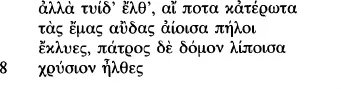
In the second stanza, after the singer asks Aphrodite to come to her, Sappho begins her version of the next stage of a cletic hymn, a persuasive delineation of the god’s past deeds and epiphanies.
But come here to me, if ever before now from far away you heard me calling and descended, leaving your father’s
8 house of gold,
Achilles, briefly (in a single line), reminds Zeus of the time he honoured him by greatly harming the Achaean army; Sappho lingers over five stanzas decoratively relating not only the assistance Aphrodite has given this lover in the past, but details of the sight and sound of her epiphanies. In this way she adds a sensual, almost tangible, dimension to an experience already touched with symbolic, ritualistic significance. Despite the economy of his depiction, Homer makes a clear distinction between Zeus’ former intervention on behalf of Achilles and this present request, taking time to nominate the prior foe, and differentiate between the distant environment of this god and Achilles’ earthly surroundings. Sappho dissolves such oppositions, conjoining this occasion with innumerable past requests, collapsing the illusion of separate instances; and bringing Aphrodite down from her father’s house to a mortal setting, to face-to-face, verbal interaction with the lover/singer. Homer’s Zeus is not described in sufficient imagistic detail to provoke a visual dimension, and he is not expected to descend to Achilles’ level to honour him, he can smite Achilles’ enemies with a thunderbolt from a heavenly realm.5 Other gods enter the thick of human combat – even Aphrodite ventures to rescue her beloved son Aeneas (Iliad 5.331–428) – and is sent wounded and shrieking back to Olympus,6 but throughout this and other epic representations, Zeus remains aloof. Despite distinctions between epic and lyric there are similarities between these two invocations. The hymnal form imposes specific restrictions upon each poet and each responds by providing the correct details, conforming to a particular sequence. The results, however, are discernibly different.
Not content with simply relating Aphrodite’s manifestation in a past epiphany, Sapp...
Table of contents
Cover
Title
Copyright
Dedication
Contents
Acknowledgements
Introduction
1 Aphrodite
2 Songs of love
3 A woman’s desire
4 ‘Virginity’
5 Gazing at beauty
6 Circles of women
7 A chain of remembrance
8 Epithalamia
9 Immortality
10 Honour
11 Symbolic realms
Notes
Bibliography
Index
Trusted by 375,005 students
Access to over 1.5 million titles for a fair monthly price.
Study more efficiently using our study tools.
Frequently asked questions
Yes, you can cancel anytime from the Subscription tab in your account settings on the Perlego website. Your subscription will stay active until the end of your current billing period. Learn how to cancel your subscription
No, books cannot be downloaded as external files, such as PDFs, for use outside of Perlego. However, you can download books within the Perlego app for offline reading on mobile or tablet. Learn how to download books offline
Perlego offers two plans: Essential and Complete
Essential is ideal for learners and professionals who enjoy exploring a wide range of subjects. Access the Essential Library with 800,000+ trusted titles and best-sellers across business, personal growth, and the humanities. Includes unlimited reading time and Standard Read Aloud voice.
Complete: Perfect for advanced learners and researchers needing full, unrestricted access. Unlock 1.5M+ books across hundreds of subjects, including academic and specialized titles. The Complete Plan also includes advanced features like Premium Read Aloud and Research Assistant.
Both plans are available with monthly, semester, or annual billing cycles.
We are an online textbook subscription service, where you can get access to an entire online library for less than the price of a single book per month. With over 1.5 million books across 990+ topics, we’ve got you covered! Learn about our mission
Look out for the read-aloud symbol on your next book to see if you can listen to it. The read-aloud tool reads text aloud for you, highlighting the text as it is being read. You can pause it, speed it up and slow it down. Learn more about Read Aloud
Yes! You can use the Perlego app on both iOS and Android devices to read anytime, anywhere — even offline. Perfect for commutes or when you’re on the go. Please note we cannot support devices running on iOS 13 and Android 7 or earlier. Learn more about using the app
Yes, you can access Sappho's Sweetbitter Songs by Lyn Hatherly Wilson in PDF and/or ePUB format, as well as other popular books in Storia & Storia antica. We have over 1.5 million books available in our catalogue for you to explore.