- 232 pages
- English
- ePUB (mobile friendly)
- Available on iOS & Android
eBook - ePub
About this book
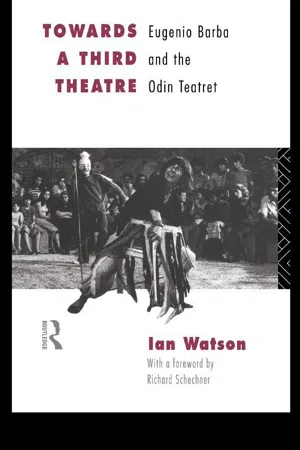
Eugenio Barba is one of Europe's leading theatre directors, at the forefront of experimental and group theatre for more than twenty years. Ian Watson provides the most comprehensive and systematic study of Barba's work, including his training methods, dramaturgy, productions and theories, as well as his work at the International School of Theatre Anthropology.
Information
1
BARBA
The early years
The Odin Teatret has provided both a source for Barba’s ideas and a laboratory where he can experiment. Those who work closest with Barba often say that he either lacks or suppresses his own originality, preferring instead to wait for his colleagues to instigate new ideas which he then uses as a point of departure for group investigation. Even though this may not be entirely true, it characterizes at least one of Barba’s methodologies, the leader as catalyst. He promotes an atmosphere in which his actors feel free to experiment physically, vocally, and/or with their improvisations. Then, when he observes something that interests him, he suggests further avenues of research in the training, or ways in which what they are doing might be used to help shape the production they are preparing.
Nevertheless, Barba is not merely a vicarious artist or thinker. He is one of those rare theatre people who is both a practical man of the theatre and an intellectual. What his colleagues take to be passivity is, in fact, a capacity for observation and analysis. It is this capacity that has produced many articles and books which together include important writings on actor training, dramaturgy, performance, and theatre sociology. Barba has also lectured and taught on both the practical and theoretical aspects of his work in Europe, North and Latin America, as well as Asia.1 He is on the International Committee of the Theatre of Nations and the advisory board of the International Association of Performing Arts Semiotics; he is a contributing editor of The Drama Review as well as an advisory editor of the New Theatre Quarterly. And, in 1988, his intellectual work was officially recognized when he was presented with an honorary doctorate from Denmark’s Aarhus University.
But foremost, Barba is a practical man of the theatre. Since 1964, when he founded the Odin, he has created almost twenty original works, ranging from intimate theatre pieces to outdoor spectacles. He has established one of Western Europe’s only government-funded theatre laboratories, the NTL— which incorporates all the activities described in the Introduction, and he formed ISTA to investigate the connections between traditional Eastern and contemporary Western performance.
HIS ROOTS
Who is this man, this southern Italian heading a group of international actors based in a small town in northern Europe who spend most of their time either closeted away in the studio working, or touring various parts of the world? He is an immigrant, a foreigner, a traveler, a man who was prompted to write, “My body is my country. The only place where I always am. No matter where I go, to Montreal or to Tokyo, to Holstebro, Bogota or New York, I am always at home, always in my country” (1988a:293). But, despite this rejection of nation and family, Barba describes his professional heritage in familial terms, seeing himself as a descendant of Stanislavksy, the “father” of modern Western theatre (1988a:292).
With all due respect, Barba’s twentieth-century theatrical lineage appears to begin with Meyerhold rather than Stanislavsky. Granted, Stanislavsky conducted the major study of the actor’s art in the early years of the century, and was followed in this by, among others, Barba’s mentor, Grotowski, who no doubt influenced him to do the same. But Barba has rejected the very basis of Stanislavsky’s system—psychological realism—embracing instead a theatre that explores a language of its own rather than one that simulates daily life on stage. He has developed a theatre in which the performance text takes precedence over a faithful interpretation of the author’s words, in which causal connections between scenes have been rejected in favor of an episodic montage, and in which the actor-audience relationship and the performance space is adjusted for each production—all ideas more often associated with Meyerhold than Stanislavsky.
Whatever his professional lineage, Barba’s childhood and youth were far removed from the theatre. He was born in the southern Italian port city of Brindisi on October 29, 1936, the son of an Italian army officer. His father was a supporter of Mussolini who fought on the side of the fascists in Spain, Abyssinia (present-day Ethiopia), and in the Second World War. During the war, Barba and his family moved to Gallipoli, a small fishing and tourist village in the bootheel of southern Italy, where some of his father’s relations lived.
When Barba was 10 years of age, in 1946, his father died of kidney failure which, combined with the financial devastation in Italy following the war, left Barba, his mother, and older brother, Ernesto, in poverty.
Because of the family’s economic situation, and familial pressures to follow in his father’s footsteps, Barba was sent to the Naples military college in 1951, at the age of 15. During his three years at the college, he had many problems with its harsh discipline, rebelling against it frequently—an ironic fact considering the legendary importance he has placed on discipline at the Odin.
It was during his freshman year at the college that Barba first went to the theatre. And, according to his own account, it made a major impact on the young man from the provinces:
I was fifteen years old when I went to the theatre for the first time. My mother took me to see Cyrano deBergerac. The hero was played by Gino Cervi, a very popular Italian actor. But it was neither he nor the other actors who impressed me, nor the story which they were telling and which I followed with interest, but without amazement. It was a horse. A real horse. It appeared pulling a carriage, according to the most reasonable rules of scenic realism. But its presence suddenly exploded all the dimensions which until then had reigned on the stage. Because of this sudden interference from another world, the uniform veil of the stage seemed torn before my eyes.
In the theatres to which I went in the following years, I searched in vain for the disorientation that had made me feel alive, that sudden dilation of my senses. No more horses appeared. Until I arrived in Opole (Poland) and Cheruthuruthy (India).
(1985:27–28)2
NORWAY
During summer vacations from the military college Barba hitchhiked around Europe. These trips culminated in a journey that took him to the north of the continent in the summer of 1954, following his graduation from college. But, this was no ordinary trip. The 18-year-old adolescent wanted to be as far away from Italy and the discipline of military college as possible. Scandinavia, with its welfare state philosophy, its reputation as a haven for personal freedoms, and its austere Lutheranism, seemed the antithesis of everything Barba disliked in Italy. His shortage of money on his arrival in Oslo, Norway, therefore provided the ideal excuse to find a job and settle, at least temporarily. Rejecting his bourgeois background, in which manual work was shunned, he took a job as a welder.
Barba’s wanderlust would not let him remain too long in one place, however, and in 1956, after a year as a welder, he joined the Norwegian merchant marine and became a sailor on ships plying the Oriental route. As with his move north, this was no casual choice. He had become intrigued with Indian religion and the merchant marine was one way for a relatively poor young man to visit the subcontinent. His travels extended beyond India, and during his two years at sea he traveled extensively in the Middle East, Africa, Lapland, and other parts of northern Scandinavia.
During the latter part of his first year in Norway, prior to going to sea, Barba enrolled at Oslo University. He continued his studies intermittently while on leave from the merchant marine, and in 1957, two years after becoming a seaman, he left the navy and, while continuing his work as a welder, devoted himself to his studies. He graduated in 1965 with a Master of Arts in French and Norwegian literature, and the history of religion.
Barba did not study theatre at university, save for several required courses in dramatic literature. Despite this lack of formal training, however, he had an interest in theatre which, combined with his developing political awareness, led him to the works of Bertolt Brecht. In Brecht he saw a model through which theatre could address politics.
POLAND
Barba decided to pursue his interest in theatre wholeheartedly. He applied for, and won, a UNESCO scholarship to study theatre in Poland. In the fall of 1960, at age of 24, he enrolled at the Warsaw theatre school.
Barba was not prepared for what he found in the Poland of the early 1960s. Certainly the theatre was rich and provocative, with world-class directors, like Konrad Swinarski and Bogdan Korzeniewski, creating works in a milieu that also included up-and-coming artists such as Andrzej Wajda and Tadeusz Kantor. Similarly, the school provided a stimulating atmosphere for learning since its staff included many of Poland’s leading theatre people (Korzeniewski was Barba’s directing teacher, for example). But the Poland Barba came to live in was not the Poland he had expected. It was a country that displayed the profound wounds of war. Much of Warsaw was still in ruins, with bulldozers clearing rubble and the skeletons of war dead being unearthed almost daily. Rebuilding was a slow process and there were chronic shortages of even the most basic food items. These harsh realities and their debilitating effect on the Polish people were not what Barba, with his leftist sympathies, had anticipated. There seemed to be an irreconcilable conflict between the quality of the theatre in Poland and the daily reality of most people’s lives. This conflict led Barba to question the theatre’s worth and his belief in its political value.
Barba’s disillusionment prompted him to leave the theatre school after only six months of study and travel in northern Poland, where he even took a job as welder in a small sugar mill. The job was short-lived, however, and he returned to his studies.
Of course, nothing had changed in Warsaw. But, rather than leave Poland— which would seem to have been the logical solution for Barba’s troubled spirit— the young theatre student traveled within the country whenever he had the opportunity. One of these trips took him to a tiny theatre in Opole, a town of 60,000 in southeast Poland some 80 miles from Wroclaw. There, in Teatr 13 Rzedow (Theatre of the Thirteen Rows) he saw the work of a then young and unknown Polish director that, though it did not capture his imagination at the time, was to have a profound influence on the rest of Barba’s professional career. He saw Jerzy Grotowski’s production of Adam Mickiewicz’s Forefather’s Eve.
Barba returned to Warsaw unimpressed by what he had seen, but several months later he met Grotowski casually in a bar in Cracow. During a lengthy conversation over drinks, the two young men discovered that they shared many interests in Asian religions, ideas, and philosophies. Grotowski’s knowledge of the East fascinated Barba, while Barba’s travels equally intrigued Grotowski. During this chance meeting, Grotowski invited Barba to come and watch the work of his company and, even though Grotowski’s ideas attracted Barba more than his theatre did at the time, he accepted the invitation.
After completing his first year at the theatre school, Barba left Warsaw and became an unofficial member of Grotowski’s company. During his three years with what was eventually to become the world-famous Polish Laboratory Theatre, Barba observed rehearsals and the actors’ performance research, was a source of ideas for the theatre, and helped promote Grotowski’s work in Poland and abroad.
For the first few months in Opole Barba was merely an observer. He watched the company’s rehearsals as well as their training experiments and discussed what he saw with Grotowski.3 In fact, at no time during his years with the company did he direct the actors or run rehearsals. But his discussions with Grotowski and the company’s literary advisor, Ludwik Flaszen, led to his working closely with them, both before and during rehearsals, on the changes made to Wyspianski’s original script for the group’s famous production of Akropolis (1962). In addition to working on the text, Barba also helped Grotowski design the sound montage—consisting of varying vocal rhythms, of scored scraping and drumming on the set’s metal pipes, and of different rhythms of marching and stamping made by the actors’ wooden-soled boots. In recognition of his contribution, Barba was credited as the assistant director of Akropolis, a role he fulfilled again on the group’s next production, an adaptation of Christopher Marlowe’s The Tragical History of Doctor Faustus (1963).
Another major contribution Barba made to Grotowski’s creative work was his introduction of kathakali training exercises to the group. With all due respect to kathakali’s eventual influence on Grotowski, there seemed little professional reason for traveling to India in 1963, since neither Grotowski nor Barba knew a great deal about Indian theatre at the time. According to Barba, he and his two companions—his future wife, Judy Jones, a cultural officer at UNESCO, whom he had met earlier in the year at the 10th International Theatre Institute (ITI) Congress in Warsaw, and a mutual friend unconnected with the theatre— went with the vague agenda of finding something of value for his colleagues in Opole, observing Indian religious rituals and sacred sites, and most of all, for the adventure of driving overland to the subcontinent (1986c). It was only when he had arrived in India that Barba heard of kathakali, through local theatre people he met in Bombay. He subsequently visited the major training academy in Kerala, the Kalamandalam at Cheruthuruthy, and was so impressed by what he saw that he wrote what was then one of the first technical descriptions of the form by a European.4 This article was eventually published in many countries including France, Italy, Scandinavia, and the USA, and, along with the observations Barba made while at the Kalamandalam, was the source of the kathakali exercises that Grotowski and his actors began experimenting with in the early through middle 1960s.
But this was not the end of kathakali for Barba. Not only were Grotowski’s adaptations of the kathakali exercises going to be incorporated into the training of his own actors during the Odin’s early years, but kathakali’s dual ethics, of intense discipline and regarding theatre as a vocation rather than merely a profession, were to be a model for Barba for many years to come.
During Barba’s first year in Opole, Grotowski worked in relative isolation with little recognition. His productions drew small houses and few people outside the group’s immediate circle of acquaintances knew of the work. What small acknowledgment there had been by authorities was mostly negative, consisting of attacks on Grotowski for mounting incomprehensible productions and distorting the Polish classics.5 Despite these attacks and lack of recognition, Barba felt strongly that what was happening in Opole had major implications for world theatre. The problems were how to reach a broader audience and how to encourage greater government support. In discussion with Grotowski, Barba devised a promotional strategy designed to attract international attention with the aim of embarrassing Polish authorities into providing greater logistical and financial assistance to the group. This plan owed much to the fact that Barba, as an Italian, was able to travel freely between Poland and Western Europe.
One of Barba’s strategies was to publish material about Grotowski’s work in the West. He and Flaszen wrote several articles which first appeared in French in 1962, following which they were translated and published in the United States by The Tulane Drama Review (Grotowski, 1964; Barba, 1965; Barba and Flaszen, 1965) .6 Barba conducted lengthy interviews with Grotowski and published them. His “Meetings with Grotowski” was published in the quarterly of the World Festival of Theatres in February 1966. And he published an entire book on the Laboratory’s work in Italian, Alla Ricerca del Teatro Perduto (Padova: Marsilio, 1965), which remained the major work on Grotowski until 1968 when Raymonde Temkine’s Grotowski and Grotowski’s own Towards a Poor Theatre, edited by Barba, were published.
Another of Barba’s strategies was to invite influential people from the West to see the company’s work. During the 1963 ITI Congress held in Warsaw from 8–15 June several performances of the Tragical History of Doctor Faustus were given in Lodz, a town only some two hours by bus from Warsaw (compared with the seven-hour train trip to Opole). Prior to the official opening of the congress, Barba persuaded Jean Julien, the head of the Theatre of Nations Festival, and the president of ITI, Jean Darcante, to see the production. As Barba hoped, they were very enthusiastic and told other delegates about it. Barba...
Table of contents
- COVER PAGE
- TITLE PAGE
- COPYRIGHT PAGE
- FIGURES
- PLATES
- FOREWORD EAST AND WEST AND EUGENIO BARBA
- PREFACE
- INTRODUCTION
- 1: BARBA THE EARLY YEARS
- 2: THEATRE THEORY SOCIOLOGY AND THE ACTOR’S TECHNIQUE
- 3: TRAINING
- 4: REHEARSALS AND DRAMATURGY
- 5: PRODUCTIONS
- 6: THE INTERNATIONAL SCHOOL OF THEATRE ANTHROPOLOGY
- A BRIEF, NECESSARY AFTERWORD
- NOTES
- SELECT BIBLIOGRAPHY
- MAJOR FILMS AND VIDEOTAPES RELEVANT TO THE WORK OF EUGENIO BARBA
Trusted by 375,005 students
Access to over 1.5 million titles for a fair monthly price.
Study more efficiently using our study tools.
Frequently asked questions
Yes, you can cancel anytime from the Subscription tab in your account settings on the Perlego website. Your subscription will stay active until the end of your current billing period. Learn how to cancel your subscription
No, books cannot be downloaded as external files, such as PDFs, for use outside of Perlego. However, you can download books within the Perlego app for offline reading on mobile or tablet. Learn how to download books offline
Perlego offers two plans: Essential and Complete
- Essential is ideal for learners and professionals who enjoy exploring a wide range of subjects. Access the Essential Library with 800,000+ trusted titles and best-sellers across business, personal growth, and the humanities. Includes unlimited reading time and Standard Read Aloud voice.
- Complete: Perfect for advanced learners and researchers needing full, unrestricted access. Unlock 1.5M+ books across hundreds of subjects, including academic and specialized titles. The Complete Plan also includes advanced features like Premium Read Aloud and Research Assistant.
We are an online textbook subscription service, where you can get access to an entire online library for less than the price of a single book per month. With over 1.5 million books across 990+ topics, we’ve got you covered! Learn about our mission
Look out for the read-aloud symbol on your next book to see if you can listen to it. The read-aloud tool reads text aloud for you, highlighting the text as it is being read. You can pause it, speed it up and slow it down. Learn more about Read Aloud
Yes! You can use the Perlego app on both iOS and Android devices to read anytime, anywhere — even offline. Perfect for commutes or when you’re on the go.
Please note we cannot support devices running on iOS 13 and Android 7 or earlier. Learn more about using the app
Please note we cannot support devices running on iOS 13 and Android 7 or earlier. Learn more about using the app
Yes, you can access Towards a Third Theatre by Ian Watson in PDF and/or ePUB format, as well as other popular books in Mezzi di comunicazione e arti performative & Teatro. We have over 1.5 million books available in our catalogue for you to explore.