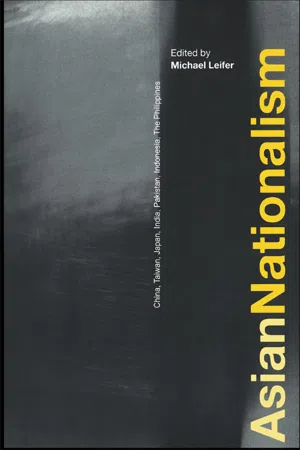
Asian Nationalism brings together internationally renowned experts in the field analysing current theories of nationalism. Featuring detailed chapter case-studies on Pakistan, China, Japan, Taiwan, India, Indonesia and the Philippines, this book provides a good balance of theoretical and empirical material.
Completely up-to-date, this book will be invaluable for scholars of both Asian Studies and Politics. Key issues covered include:
theories of nationalism
the changing faces of Chinese nationalism
Indian National Democracy
the imagined community
reflections on Asian nationalism.
- 224 pages
- English
- ePUB (mobile friendly)
- Available on iOS & Android
eBook - ePub
Asian Nationalism
About this book
Information
1 Theories of nationalism
Alternative models of nation formation
Anthony D.Smith
In pre-modern eras, human beings lived in all kinds of community and sported a variety of identities—family, gender, clan, caste, class, religion, ethnicity, citystate and empire—and no one kind of community or identity achieved political pre-eminence globally. In the modern world, things are quite different. Though human beings continue to have multiple identities, one kind of community and one type of identity has achieved a political preponderance. Today, the nation, the national state and nationalism have come to occupy the commanding heights of political allegiance and political identity. The world is divided into territorial states. These can be defined as sets of autonomous, public institutions with a legitimate monopoly of coercion and extraction in a given territory, and sovereignty in relation to those outside its borders. The contemporary world is similarly divided into nations; that is, named populations possessing an historic territory, shared myths and historical memories, a mass, public culture, a single economy and common rights and duties for all members, which are legitimised by the principles of nationalism. Nationalism itself can be defined as an ideological movement for the attainment and maintenance of autonomy, unity and identity on behalf of a population deemed by some of its members to constitute an actual or potential ‘nation’. These are, of course, only working definitions, but if they are accepted as a starting-point for subsequent analysis, it can be immediately appreciated that states, nations and nationalisms do not often coincide. And in my opinion, this is the immediate cause of so much of the conflict and turbulence that we witness throughout the world today. Here, too, we may find the proximate cause of recurrent ‘nationalisms’, since it is the aim of all nationalists to create the conditions for a greater congruence between state, nation and nationalism. In this quest, they have been only partly successful; but this serves merely to spur nationalists to greater efforts. Nevertheless, it is testimony to the power of the national ideal, and to the global appeal of nationalism today, that there is hardly a corner of the world that has not been swept by nationalist fervour and ethnic conflict.1
Perennialist theories
Why has the ‘nation’ and its ‘nationalism’ become so dominant and widespread throughout the world? Put simply, there are four kinds of answer in the literature, and they have given rise to four paradigms or grand narratives of nationalism. The first is usually termed ‘primordialism’. This theory holds that the nation is a primordial category, or one founded upon primordial attachments. These may be genetic, as socio-biologists like Pierre Van den Berghe (1995) insist, or they may be cultural, as Edward Shils (1957) and Clifford Geertz (1973) and their followers prefer. In the former case, ethnic ties and nationalisms are derived from the individual reproductive drives which find their expression in ‘nepotistic’ behaviour in order to maximise their ‘inclusive fitness’. The problem here is how far we can extrapolate from small kin groups to the much larger, and more extended, communities of the ethnie or nation; and how far these communities’ myths of presumed ancestry match actual biological ties of descent. In the latter case, the cultural ‘givens’ of kinship, language, religion, race and territory provide foci for overriding attachments, beyond the calculative nexus, and attest to a deep-seated need for emotional security and life-enhancement. Birth, territory and community are seen as bearers of life, and as such are accorded an awe and loyalty far beyond everyday considerations of interest. The problem here is that by emphasising their primordial character, there is a danger of neglecting the very considerable social and cultural changes to which such attachments are subject, and which so often transform the character of the communities which coalesce around them.2
The merit of the primordialist paradigm is that it draws our attention to the long-term significance of popular attachments, kinship and cultural bonds. The primordialist approach asks why it is that so many people are prepared to risk their lives defending ‘kith and kin’ and ‘hearth and home’. And why millions are prepared to lay down their lives for their ‘nation’. Of course, this is merely to pose the problem. That it needs to be posed is significant. The reason is that so many would-be explanations of nationalism simply ignore the issue altogether, or else treat it as a secondary matter. However, it is central to the problems posed by the ubiquity and power of nationalism. Besides, many (but not all) nationalists are organic primordialists; and we have also to recognise that many people feel that they belong to a primordial ethnie or nation, and this ‘participant’s primordialism’ is therefore a central part of the explanandum of nations and nationalism. Primordialism cannot furnish an explanation for the widespread appeal of nations and nationalism, but it does highlight the nature and size of the problem.
The second paradigm I shall term ‘perennialism’. By this I mean simply that for many scholars, as well as participants, nations are seen as immemorial and/or perennial; and therefore nationalism is simply the ideology and movement for an already existing nation. However, though some perennialists may also be primordialists, many are not; and the former position does not entail the latter. I can argue that nations have been around since the ancient Egyptians and Sumerians, but I do not have to regard them as ‘natural’, or claim that the nation either itself is, or is based upon, primordial attachments. I can be a perennialist without being a naturalist. I should add that there are two forms of perennialism. The first regards particular nations as continuous and immemorial, the kind of belief entertained by the nationalists on behalf of their own nation, though not necessarily on behalf of others. The second argues that nations are recurrent. They are one of the basic forms of human association and identity throughout recorded history. They emerge and decline, come and go, but they are to be found in every age and continent (see Hastings 1997, chapter 1).
It is a matter of definition of terms, and thereafter of empirical investigation, as to whether there were nations in pre-modern epochs. If one adopts a definition of the nation similar to the one proposed at the beginning to this chapter—one which includes a mass, public culture, a single economy and rights and duties for all members—then one is inclined to think that very few communities in antiquity and the early Middle Ages would qualify as ‘nations’. If one were to drop some of these features, then one could certainly find ‘nations’ in many areas in pre-modern epochs. The difficulty with this position is that the nations of the modern epoch appear to be quite different from those mooted in earlier epochs: they are mass nations, they form legal-political communities with a concept of citizenship, they have compact territorial borders, they legitimate themselves in terms of the ideology of nationalism, and they form part of an international system of national states. All this is relatively novel in historical terms. Though one can cite exceptions—the ancient Jews and Armenians, for example—most pre-modern nations possess none of these features. Thus, while it is important to keep an open mind, I am inclined to think that, as a general paradigm, perennialism is flawed.
Modernist theories: socio-economic developmentalism
The other two paradigms are what I call the ‘modernist’ and the ‘ethnosymbolist’, and it with these, and with the debates between them, that I shall be mainly concerned in this chapter. Undoubtedly, the current orthodoxy is ‘modernist’, where it is not ‘post-modernist’ —I treat the latter as a development of modernism, but intentionally shorn of its explanatory power, and therefore not an explanatory paradigm in itself. Modernism comes in several forms: socio-cultural, economic, political, ideological and constructionist, the labels suggesting the main explanatory thrust or focus of the approach or theory. All modernist approaches hold the following in common:
- nationalism is an explicitly modern ideology and movement, that is to say, it is both novel and relatively recent, i.e. from the eighteenth century onwards;
- as a social structure and cultural system, the nation is likewise both novel and relatively recent, again from the eighteenth century or slightly earlier;
- as a system, the international order of national states is both novel and relatively recent, dating from the nineteenth century, though with intimations going back to the Treaty of Westphalia in 1648;
- all three—nationalism, nation and the international order of national states— are the product of specifically modern conditions; namely, capitalism, bureaucracy, industrialism, urbanisation, secularism and the like. This is what makes them qualitatively distinct from any form of community or belief system in pre-modern epochs.
The most forthright and original exponent of modernism has been, of course, Ernest Gellner. His overall purpose has been to demonstrate the sociological necessity of nations and nationalism in the modern world. Nationalism, he argues, is logically contingent; it is not given in nature nor is it an intrinsic component of the human condition. But it is sociologically necessary in a given historical epoch, that of modernity; today, we must live in a modular, nationalist world. The reason is to be found in the type of society characteristic of modernity: an industrial, growth-oriented kind of society (Gellner 1964, chapter 7).
Gellner distinguishes between a pre-modern, agro-literate society and one that is modern and industrial. In the agro-literate society, there was neither room nor need for nations and nationalism. The vast mass of the population were food producers, divided into separate, self-sufficient social structures and local cultures. Above them, and exploiting their labour, the various tiny aristocratic, clerical, bureaucratic and commercial elites were largely cut off from the mass of food producers; they possessed a common aristocratic and clerical culture, but saw no need to spread it downwards or incorporate the peasantry into their way of life. Even the clergy which might have been tempted to convert the masses to their revealed truth, had neither the incentive nor the means to do so. By contrast, in modern, technologically advanced, growth-oriented societies, populations have to be mobile and literate, fluid and homogeneous. A single literate culture must come to embrace and unite elites and masses. In these circumstances, the nation and nationalism act as cement for mobile populations in industrial societies (Gellner 1983, chapter 2).
How can we explain this great transformation? The answer lies in the peculiar characteristics of modernisation. Gellner has argued that modernisation, like a great tidal wave, swept out from its Western heartlands to engulf societies across the globe; but, crucially, it has done so unevenly, sweeping over different areas of the world at different times, and with varying speed and intensity. Its effects have been twofold. On the one hand, the great wave of modernisation erodes traditional structures of family, religion and community. Villagers are driven from the countryside, their livelihoods are destroyed, their religious codes are swept aside, and they become disoriented in the anonymous cities into which they flock in search of homes, jobs and education. This means that whereas in the village local culture had reinforced social structures, in the impersonal life of the city, ‘culture replaces structure’. In the city, a new literate, linguistic culture takes the place of the traditional structure of role expectations, forcing the inhabitants to become both numerate and literate. Today ‘all men are clerks’; only a literate culture can relate and bind the great mass of immigrants to the city, and turn them into full citizens. And this can only be done through a mass, standardised, public education system under the auspices of the state and its resources. Only by being schooled in a specialist, literate ‘high culture’, sustained by a public education system, can villagers be turned into effective citizens and become a culturally homogeneous workforce (Gellner 1983, chapter 3).
That is why nations are large. But why, then, are they not as large as empires? The answer lies in a second consequence of the tidal wave of modernisation. For if modernisation erodes tradition, it also creates new kinds of conflict. The newcomers who flocked to the anonymous cities soon compete with the older inhabitants for scarce urban resources—jobs, schools, housing and welfare. If the newcomers resemble the denizens of the city in looks, language, customs and religion, or manage to learn quickly their language, there will only be social antagonism and perhaps class conflict. That was the situation in northern Italy, when southern Italians migrated north to look for jobs and housing. But if the newcomers differ in religion, pigmentation, customs and language, then ethnic antagonism is superimposed on class conflict. This is particularly likely in the later stages of industrialism, when the ‘moral chasms’ of scriptural religion and pigmentation cannot be bridged. Such an outcome is likely when the intelligentsia on both sides of the cultural divide stir up fear and resentment, and issue a summons to their respective ‘proletariats’ to secede and set up their own ‘nation-states’, creating in the process new nations seeking their own states (Gellner 1964, chapter 7; 1983, chapter 6).
Hence, for Gellner, it is not nations that engender nationalism; rather, it is nationalism that invents nations where they do not exist—though it helps to have some pre-existing cultural markers. It is nationalism that demands a culturally homogeneous nation, because the drive for a literate ‘high culture’ is a necessary component of growth-oriented industrial society. Nationalism’s huge contemporary appeal can therefore be attributed, in the final analysis, to the requirements of modern, industrial society. Today, we must all become literate citizens capable of operating the ‘industrial machine’ and enabling us to ‘swim in the sea of industria’ (Gellner 1983, chapters 5–6).
In a further development of Gellner’s theory, Tom Nairn has argued that we must look to imperialism as the basic mechanism through which the uneven development of capitalism stimulates nationalism. Nairn accepts the existence of ethnic groups and nationalities before 1800, but, like Gellner, he believes that nations and nationalism are phenomena peculiar to the modern world. They are products of the jagged and uneven spread of capitalism resulting from the activities of imperialism in the ‘periphery’ as it incorporated successive areas of the world, often with great violence, into the capitalist world-system (Nairn 1977, chapter 2).
Nairn explicates his thesis by examining the effects of the bourgeois revolutions and imperialist penetrations in the non-Western world. The result of these massive imperialist intrusions since 1800 was ...
Table of contents
- Cover Page
- Title Page
- Copyright Page
- Contributors
- Preface
- 1: Theories of nationalism
- 2: The changing faces of chinese nationalism
- 3: Ethnic nationalism in mainland china
- 4: Post-nationalist taiwan
- 5: Nationalism in japan
- 6: Communalism, secularism and the dilemma of indian nationhood
- 7: Peregrinations of pakistani nationalism
- 8: The changing temper of indonesian nationalism
- 9: Social capital and the imagined community
- 10: Nationalism and the international order
Trusted by 375,005 students
Access to over 1.5 million titles for a fair monthly price.
Study more efficiently using our study tools.
Frequently asked questions
Yes, you can cancel anytime from the Subscription tab in your account settings on the Perlego website. Your subscription will stay active until the end of your current billing period. Learn how to cancel your subscription
No, books cannot be downloaded as external files, such as PDFs, for use outside of Perlego. However, you can download books within the Perlego app for offline reading on mobile or tablet. Learn how to download books offline
Perlego offers two plans: Essential and Complete
- Essential is ideal for learners and professionals who enjoy exploring a wide range of subjects. Access the Essential Library with 800,000+ trusted titles and best-sellers across business, personal growth, and the humanities. Includes unlimited reading time and Standard Read Aloud voice.
- Complete: Perfect for advanced learners and researchers needing full, unrestricted access. Unlock 1.5M+ books across hundreds of subjects, including academic and specialized titles. The Complete Plan also includes advanced features like Premium Read Aloud and Research Assistant.
We are an online textbook subscription service, where you can get access to an entire online library for less than the price of a single book per month. With over 1.5 million books across 990+ topics, we’ve got you covered! Learn about our mission
Look out for the read-aloud symbol on your next book to see if you can listen to it. The read-aloud tool reads text aloud for you, highlighting the text as it is being read. You can pause it, speed it up and slow it down. Learn more about Read Aloud
Yes! You can use the Perlego app on both iOS and Android devices to read anytime, anywhere — even offline. Perfect for commutes or when you’re on the go.
Please note we cannot support devices running on iOS 13 and Android 7 or earlier. Learn more about using the app
Please note we cannot support devices running on iOS 13 and Android 7 or earlier. Learn more about using the app
Yes, you can access Asian Nationalism by Michael Leifer in PDF and/or ePUB format, as well as other popular books in Politics & International Relations & Asian Politics. We have over 1.5 million books available in our catalogue for you to explore.