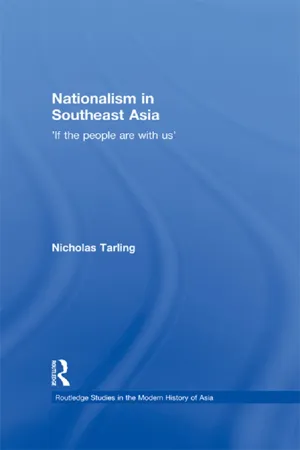
Nationalism in Southeast Asia seeks a definition of nationalism through examining its role in the history of southeast Asia, a region rarely included in general books on the topic. By developing such a definition and testing it out, Tarling hopes at the same time to make a contribution to southeast Asian historiography and to limit its 'ghettoization'.
Tarling considers the role of nationalism in the 'nation-building' of the post-colonial phase, and its relationship both with the democratic aspirations associated with the winning of independence and with the authoritarianism of the closing decades of the 20th century.
- 288 pages
- English
- ePUB (mobile friendly)
- Available on iOS & Android
eBook - ePub
About this book
Information
Part I
Definitions and chronologies
‘The political utility of the national idea is not matched by its analytical clarity.’
James Mayall
1 Definitions
Absurdly ambitious, this book has two main purposes. One is to seek an encompassing definition of ‘nationalism’. That is, of course, not a new task, though a heavy one, and there have been many attempts at it. The novelty of the present attempt lies – though Antlov and Tonnesson have tried to test the existing theory against ‘non-European uses’1 – in its focus on Southeast Asia. The study of nationalism in that region is again not new, and one of the countries in the region has stimulated, in Benedict Anderson’s Imagined Communities, a major contemporary work on the subject. Attempts to study ‘nationalism’ or ‘nationalisms’ in the region as a whole have been fewer and largely confined to general histories. Yet, as Anderson says, it offers ‘those with comparative historical interests special advantages, since it includes territories colonized by almost all the “white” imperial powers … as well as uncolonized Siam’.2 It presents a variety of experiences and, therefore, a variety of tests for definitions of ‘nationalism’. And those experiences have rather rarely been incorporated in the more general works on nationalism, which have concentrated, first of all, on the European experience, and second, so far as the colonial and postcolonial phases are concerned, on the Indian subcontinent and Africa. At least the book may avoid one of the faults Tom Nairn finds in the theorising about nationalism – ‘a tendency to treat the subject in a one-nation or one-state frame of reference’ – and perhaps the other, a related tendency ‘to take nationalist ideology far too literally and seriously’.3
Juxtaposing the possible definitions of the phenomenon with a variety of experiences in a region rarely explored in the general works that deal with it should prove a worthwhile venture, not only from an historiographical point of view, but from a still wider perspective. A world in which ‘globalisation’ has at the very least speeded up is still a world of states, and the states are conceived as nations. A clearer understanding of nationalism – and more apt applications of the term – must be of wider benefit in understanding that world, if not predicting its future.
The second purpose mirrors the first. If studying Southeast Asia may help us understand nationalism better, that may at the same time contribute to a better understanding of Southeast Asia itself. One means by which this may be achieved is by bringing the study of the region into the mainstream of historical study. The practice of treating Southeast Asia as a region had political origins, yet has proved to have historiographical value. But, as with any regional study, it runs the risk of ghettoisation, particularly perhaps when the region has never been the focus of mainstream study. ‘Area studies can very rapidly become parochial’, as Sanjay Subramanyan says.4 There can be losses as well as gains, as Vic Lieberman has argued. Are there not useful comparisons to be made, he asks, between Vietnam and Japan in the seventeenth century, or between them and France?5
At the same time, pursuing a definition of nationalism may contribute to the continued study of Southeast Asia through comparative study of its own diversity. That diversity has challenged historians who have attempted to write the history of the region. How are they to bind their work together? Some have tried to take diversity itself as a theme. Others have juxtaposed a series of narratives or picked a range of topics. A mixture of such strategies has also been attractive, based, more or less explicitly, on a comparative approach. ‘The obvious danger of comparative history is … to push comparison too far.’6 But it has been helpful in explaining the distinctive histories of the various parts of the region, the distinctive features of their societies, religions, and political structures. A useful definition of nationalism makes for a sharper use of the comparative method and thus for a better understanding of the nationalism of its component parts.
The structure of the book reflects its rationale. In the first part, the author seeks to lay the groundwork for the subsequent analysis. First of all, he reviews some of the more important definitions and usages of ‘nationalism’ – both popular and scholarly – and offers a favoured but not final definition of his own. Second, he offers, partly in order to sustain that definition, a generalised schema of the stages in the development of nationalism. Third, he supports both by some account of the spread of nationalism in Europe and beyond. Finally, he offers a brief account of the Southeast Asian region and its component parts up to the point when nationalism began to appear. In subsequent chapters he deals with the colonial states, the Japanese interregnum, the gaining of independence, the nation-states and separatist movements. A final chapter deals with the historiography of the subject.
Few who talk of nationalism or evoke it attempt to define it, and even academic writers often avoid or evade the task. Able to adopt no such strategy, the present writer looks with understanding on the latter, and turns with gratitude to those who have tried. They may not agree with what he has made of their work, but it has enabled him to reach a position that he finds useful and hopes that others will find acceptable. It should not on the one hand be regarded as ruling out other definitions. But on the other hand it should not be seen merely as a device for opening the discussion.
Can nationalism have different origins at different times or in different places? Can it serve or be put to different purposes – and yet still be the same thing? The answer to all those questions must be yes, but it might be added: only if you can find a compendious definition, or will accept a very vague one. The author hopes to find a third way, in a concept or form of words, with which it is both possible and necessary to associate a timetable and a geography. Such a concept, so sustained, may be able to cast light on the past and the present and facilitate discussion of the future.
Nations, like states, are a ‘contingency’, as Ernest Gellner tells us.7 He thus invites us to see them as a product of historical change, emerging in particular circumstances, being perhaps discarded in others. The same must be true of nationalism, whether or not you accept his definition of the way in which it is associated with the nation. In both lies one part of a definition or form of words, a sense of community, emerging or created, perhaps replacing or degrading an earlier sense of community, perhaps to be followed by yet a different one. Robert Wiebe’s suggestion is helpful, though for our purposes too limited as it stands. Nationalism, he writes, was a solution to a nineteenth century problem: ‘How could people sort themselves in societies where the traditional ways no longer worked?’8
One respect in which it is too limited is in its reference to the nineteenth century. Some, indeed, would have us discern it, well before the late eighteenth century, when J.G. Herder first used the word.9 ‘Nationalism as we understand it is not older than the second half of the eighteenth century’, wrote Hans Kohn in a classic work, further hedging his bets by adding that it had ‘roots’ deep in the past.10 K.R. Minogue found something of a gap in its history between 1650 and 1750. Then from the middle of the eighteenth century, he adds in another metaphor, ‘the story warms up, never to grow cold again’.11 More recently, Adrian Hastings has urged us to look back to fourteenth century England, to Wyclif and the gospels ‘written in Englische’.12 In The Myth of Nations, Patrick Geary suggests that ‘nation’ was a bond in medieval Europe, but not the most significant one.13 That is one line of approach. But there is some value, too, in Kohn’s caution. The meaning of the word ‘nation’ – and thus any correlatives, nationality, nationhood, nationalism – has changed over time and continues to change, like that of many other words. There is some risk that in choosing a time, we are choosing a meaning, and vice versa. But it was in the later eighteenth century that a nationalism emerged that we can recognise and that began, as Kohn put it, to ‘spread into the farthest corners of the earth’.14
Indeed it is impossible to apply Wiebe’s notion only to nineteenth century problems. It is in fact useful for the twentieth too. It points at once to a current sense of community, and also to a sense of its inadequacy in the face of change, its failure to satisfy, a sense, it may be added, that members may come to feel or be encouraged or even compelled to feel. It also suggests that nationalism fills the gap, or, it might be added, that people are persuaded that it fills the gap. Men transfer to the nation ‘the political loyalty which they previously gave to some other structure’.15 It was a shift that Karl Deutsch sought to capture in his term ‘social mobilisation’.16 It could be said that it was preceded by or overlapped with a ‘demobilisation’, or by what W. Kornhauser calls ‘atomisation’.17
Not all agree that the gap need be so deep or the transfer so complete. ‘Instead of looking upon his kinship group, village, or ethnic identity as being the ultimate source of status and highest form of loyalty, an individual begins to find possibilities of being loyal to a community called the nation without compromising the sense of loyalty to family or village.’18 Nor, after all, should we conceive even the family to be unchangingly or invariably strong as, suspecting its decline, we tend to think. In Minahasa the keluarga (nuclear family) is weaker than Indonesian slogans suggest: children are frequently fostered and sleep in houses other than their parents’.19
It is also necessary to recognise that the sources of change may be varied. Though the Marxist/Marxisant emphases in historical interpretation are still strong, and it may be desirable to watch for them, it is perhaps still acceptable to see economic change as ‘most basic’.20 But war, conquest, imperial rule may have subjected societies to change, too. Disruptions are created, as Breuilly argues, by ‘the development of capitalism and new sorts of capitalism’ in Europe, and by ‘the traumatic experience of colonialism’.21 Nor need it be a matter of imperial rule, as the cases of Japan, Turkey, and China indicate. ‘The destructive effect of European administrative methods – whether applied by European officials, as in India and Burma, or by native ones, as in the Ottoman Empire – was greatly magnified by the increasing involvement of these traditional societies with the world economy.’22
Nationalism is not an automatic result. ‘More than a sentiment, nationalism is a political program which has its goal not merely to praise, or defend, or strengthen a nation, but actively to construct one, casting its human raw material into a fundamentally new form’,23 often though it may claim it is antique, ‘natural’. The ‘new’ community, such as it is, may have, or seek to acquire, a number of things that its members hold in common, and that also distinguish them from others. Those may include language, history, ethnicity, religion, or, more likely, constructions of them that emphasise commonality: not necessarily, but preferably, all of these. They may also include symbols and sentiments, songs and stories, if not histories, that serve to unify and inspire.
So far the word ‘state’ has not been brought into the discussion. Some authorities think it has a more or less necessary connection with the ‘nation’ and ‘nationalism’. The nation is a ‘community of sentiment, which could find its expression only in a state of its own, and which thus normally strives to create one’, Max Weber wrote.24 Nationalism, Gellner goes a bit further, is ‘primarily a political principle, which holds that the political and the national unit should be congruent’.25 There is, however, no necessary connection between the two concepts. It is useful indeed conceptually to hold them apart so that we can better see and appraise the ways in which they have come or been brought together. ‘[N]ationalism cannot be understood when the meanings of these two terms are not kept distinct’, as Michael Hechter writes.26 Nowadays, indeed, we use the words almost interchangeably. That was not always so.
Increasingly nations and their leaders sought their own states, but though there are now many states, there are many more that might be created if Gellner’s principle was applied. Nationalism is even so widely seen as the inspiration of ‘nationalist movements’ assumed to be aiming at political independence. That indeed is the most common context for discussions of nationalism. But, unlike some writers, the present author will not stop there. Independent states surely continue to promote nationalism, in domestic even more than in foreign policy. In recent times, indeed, independent statehood has often preceded the creation of the nation. Nationalism has been used to homogenise the populations of new states, aiding people to ‘sort themselves’ or making them do so, creating ‘state-nations’.27 Nationalism is not only a sense of community but a way of organising the state.
Intended or otherwise, there is an ambiguity in Wiebe’s question. Might it not also be asking how people could ‘sort themselves’ into societies? The changes under way in the nineteenth and twentieth centuries affected state as well as community, though keeping the two apart is conceptually helpful. The ‘most basic’, perhaps, were economic, but industrialisation was new even in its British homeland. What was changing was the intensity of the rivalry among the European states, in itself not new, but gaining new dimensions. To survive, to defend your frontiers, to beat your neighbours, to seize their colonies or prevent their seizing yours, to damage their trade, you needed to be more efficient, to use your resources, including your human resources, more effectively. Those demands produced change, precipitating both the American revolution and the French. They evoked the concept of popular sovereignty and the notion of the nation in arms. Mobilising citizens was a major change, more literal than Deutsch implies. Nationalism may have been Herder’s coinage. The nation was invented or reinvented by the state itself, or by revolutionaries opposed to the current form of the state.
‘The nature and the history of nationalism are partly explained by the process of clash and collaboration within the body-politic, but also by the processes of clash and collaboration between bodies-politic.’28 It seems helpful to consider two kinds of change. One is the kind that affects members of a society and encourages them to question its traditions and structures. But there is another kind, which may not derive entirely from the same ‘most basic’ source, but which may occur at the same time. That is the shifting distribution of power among states, which induces them to seek new sources of power, not only by acquiring wealth and possessions overseas, but, even more commonly, by utilising their domestic resources more thoroughly and more competitively.
‘The haphazard multiplicity of political units in late medieval Europe became in the early modern epoch an organised and interconnected state-system’, ‘highly integrated yet extremely diversified’, as Perry Anderson puts it,29 an ‘anarchy’, as Buzan calls it, in the strict sense of lacking central or overarching government.30 The treaty of Westphalia of 1648 sought in a measure to regulate a system peculiar to Europe by elevating ‘reason of state’ above the ‘crusading’ spirit.31 Inter-state competition within a system was not a new process in the eighteenth century, when the Anglo–French struggle of the eighteenth century took it to new heights.
It also created new precedents and examples. The ideological concepts of nationalism were ‘foreign to the inmost nature of Absolutism’.32 Under the pressure of internal change, but also inter-state rivalry, however, the two came together. Nationalism and modern nationality were born of ‘the fusion of a certain state of mind with a given political form’, that of the modern centralised sovereign state. ‘The state of mind, the idea of nationalism, imbued the form with a new content and meaning; the form provided the idea with implements for the organized expression of its manifestations and aspirations.’33 The appropriation of the national idea by the state – ‘a particularly zealous creator of nationalism’34 – was bound to cause emulation: survival might be in question. But it could also cause revolution. Were there not merely better ways of organising the state, but better ways of organising the relationships among states? Some existing states reorganised themselves. Others were challenged and overthrown, in Europe and beyond, or more or less gracefully ‘transferred power’. Nationalism, as Breuilly says, co...
Table of contents
- Cover
- Halftitle
- Title
- Copyright
- Dedication
- Contents
- Part I Definitions and chronologies
- Part II Colonial states
- Part III Nation-states
- Part IV Historiography
- Bibliographical note
- Notes
- Index
Trusted by 375,005 students
Access to over 1.5 million titles for a fair monthly price.
Study more efficiently using our study tools.
Frequently asked questions
Yes, you can cancel anytime from the Subscription tab in your account settings on the Perlego website. Your subscription will stay active until the end of your current billing period. Learn how to cancel your subscription
No, books cannot be downloaded as external files, such as PDFs, for use outside of Perlego. However, you can download books within the Perlego app for offline reading on mobile or tablet. Learn how to download books offline
Perlego offers two plans: Essential and Complete
- Essential is ideal for learners and professionals who enjoy exploring a wide range of subjects. Access the Essential Library with 800,000+ trusted titles and best-sellers across business, personal growth, and the humanities. Includes unlimited reading time and Standard Read Aloud voice.
- Complete: Perfect for advanced learners and researchers needing full, unrestricted access. Unlock 1.5M+ books across hundreds of subjects, including academic and specialized titles. The Complete Plan also includes advanced features like Premium Read Aloud and Research Assistant.
We are an online textbook subscription service, where you can get access to an entire online library for less than the price of a single book per month. With over 1.5 million books across 990+ topics, we’ve got you covered! Learn about our mission
Look out for the read-aloud symbol on your next book to see if you can listen to it. The read-aloud tool reads text aloud for you, highlighting the text as it is being read. You can pause it, speed it up and slow it down. Learn more about Read Aloud
Yes! You can use the Perlego app on both iOS and Android devices to read anytime, anywhere — even offline. Perfect for commutes or when you’re on the go.
Please note we cannot support devices running on iOS 13 and Android 7 or earlier. Learn more about using the app
Please note we cannot support devices running on iOS 13 and Android 7 or earlier. Learn more about using the app
Yes, you can access Nationalism in Southeast Asia by Nicholas Tarling in PDF and/or ePUB format, as well as other popular books in Storia & Storia dell'Asia. We have over 1.5 million books available in our catalogue for you to explore.