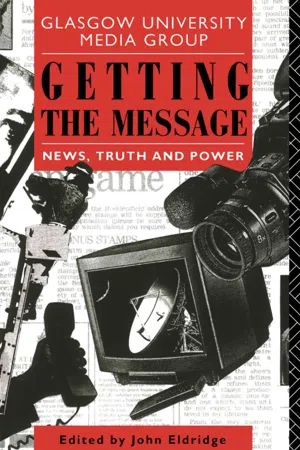
The work of the Glasgow Media Group has long established their place at the forefront of Media Studies, and Getting the Message provides an ideal introduction to recent work by the Group.
Contributors discuss themes such as the relationship between the media and public opinion, the emergence of TV news formats and styles, and the relations between theory and method in media research. Recent work undertaken by the Group on the media's role in reporting on AIDS, Vietnam, Northern Ireland and the Gulf War is also represented.
In its fresh approach to the relationship between journalists and their sources and occupation analysis, the collection also illuminates how the earlier work of the group has been extended, and the ways in which its research has developed both individually and collectively.
Getting the Message offers an invaluable and far-reaching exploration of the inter-relations between the production of media messages and their reception - an invaluable guide for any study of the development of media theory.
- 368 pages
- English
- ePUB (mobile friendly)
- Available on iOS & Android
eBook - ePub
About this book
Information
Part I
Introduction
Chapter 1
News, truth and power
John Eldridge
The essays in this collection have all been written by people who, at one time or another, have contributed to the work of the Glasgow University Media Group. The diversity of topic and substantive areas of interest is evident from the list of contents. However, in their various ways and with differing emphasis, the essays explore the relations between theory and method in media research. Specifically, they contribute to our understanding of the processes of encoding and decoding media messages. Much of our work has focused on the analysis of message content, using both quantitative and qualitative methods. However, it was never exclusively that. The concern to place such work in the overall process of message production and message reception was early stated and then amplified in practice in later studies. We saw the analysis of content not as an exclusive or superior form of communications research but as a bridge that could facilitate our understanding of the communications process. Without it we cannot comment effectively on what producers produce (as distinct from their beliefs or intentions) nor what it is that audiences are responding to. Parts 2, 3 and 4 of this book reflect in sequence this interrelated concern with message production, content and output.
One of the questions pursued in the Glasgow research has been to ask what it is that takes place in British television news under the banner of objectivity, impartiality and neutrality. The BBC’s licence requires it to refrain from editorializing on its news programmes and the Independent Broadcasting Act of 1973 laid down the ruling that due impartiality must be preserved on the part of persons providing programmes as regards to matters of political or industrial controversy or relating to current public policy. This, at least in a formal sense, sets television journalism apart from print journalism where editorial viewpoints and distinctive political perspectives are intrinsic to the activity.
Television news has become a major source of information about the world we live in for millions of people, in the UK as elsewhere. In the course of its coverage it will deal with many controversial matters. There are on-going disagreements between the political parties, about industrial disputes, matters concerning defence, war and foreign policy and the continuing conflict in Northern Ireland. Dr Colin Morris, formerly head of the BBC’s Religious Broadcasting and later Controller of BBC Northern Ireland, devoted the 1986 Hibbert Lecture to the subject of broadcast news. He is sympathetic to the journalists:
In the book of Genesis, it is God who brings order out of chaos; in the modern world, television journalists have to make a stab at doing it. They subdue into harmony a mountain of telex printouts, miles of video tape and a pandemonium of ringing telephones. They organise into a coherent picture a riot of impressions, a chaos, a bedlam of attitudes and opinions that would otherwise send us scurrying to the hills in panic. And they have to construct this world at lightning speed, in a welter of instant judgments.(Morris 1986)
Morris goes on to state that to do this work means putting a context round experience and that journalists knit together verbal or visual symbols into some semblance of reality. Now, to bring order out of chaos and coherence out of bedlam is clearly a formidable task and might forestall the fiercest criticism. Still, we are reminded that however natural, actual and immediate it all looks, television is a massive feat of social construction. Yet it is not reality that is constructed but a semblance of it. And how could it be otherwise? Apart from the constraints of time, budgets and resources there is, necessarily, selection, compression and simplification in the construction of news stories. In a formulation that is more sceptical than Morris, Tom Burns has written:
because television news and current affairs programmes convey action, movement, facial expression and demeanour, scenes and actors, as well as verbal messages, they seem more complete, more satisfactory than any account provided by newspapers. ‘Viewability’ is easily construed as reliability because any intervention by broadcasters is largely invisible, and because the dramatic intensity of film and video recording carries conviction and guarantees authenticity in ways in which words cannot. And the constant striving for ‘viewability’ sets its own traps.(Burns 1977:206)
The issue for us, as researchers, was this: if television puts ‘reality’ together what is the nature of the product? The naturalistic quality of news presentation with its stress on immediacy and accessibility to world events, grounded in professional claims to objectivity and impartiality, led us to ask what kind of cultural artefact it is. One way of breaking into this, and it was the way we chose, is to look at matters that are controversial in a society, or more generally on the international scene, and examine how they are treated on television news. We can proceed to look at the news story as narrative: at the verbal and visual grammar in which it is expressed; at the use of graphics and other symbolic expressions; at the use of headlines; at who is interviewed and the form and content of those encounters; in short, at the way information is organized and at the implicit and explicit explanations that are put before us.
In an amused comment on the debates surrounding the work of the Glasgow University Media Group, Schlesinger (1987:xxxviii) suggests that it has something of the character of a soap opera. I take his point. At the very least it has been a long-running story. As one of the original group members this itself has been one of the most surprising things. When we began in 1974 the Annan Committee on the Future of Broadcasting was beginning its work. It reported in 1977. Channel 4 was still a gleam in the eye of Anthony Smith, although the commercial version set up post-Annan was in contrast to the publicly-owned trust that he had advocated. The twin peaks of the BBC and the IBA represented what some of its critics called ‘the comfortable duopoly’. Now in the early 1990s we are in the post-Peacock, post-Broadcasting Act world of deregulation and satellite television. It is also, of course, the period of post-Thatcherism. In 1991 we witnessed the spectacle of the chairman of TV-AM receiving a letter from Mrs Thatcher saying how sorry and mystified she was that they had not been successful in their bid for the franchise to run the commercial breakfast television station. They lost out in the very bidding system she had promoted. So the everyday story of media folk also continues in changing times and with a changing cast.
What also continues from politicians are accusations of political bias against broadcasters, more particularly in relation to television news programmes. So, in late 1991, the then Conservative Party Chairman, Chris Patten, complained to the BBC about its coverage of the health debate at the party’s annual conference. John Birt, the director-general designate of the BBC became involved in correspondence on the matter with the Conservative Party Central Office. In the 1970s, Birt, with Peter Jay, now the BBC’s Economics Editor for television news, had written a series of articles on the ‘bias against understanding’ which they believed to characterize television news and current affairs. So there is some piquancy in the situation in which these advocates of television’s ‘mission to explain’ are finding that such an answer does not turn away the wrath of the angry politician.
In my view, so long as television news seeks to establish its professional credibility on the basis of claims to impartiality, neutrality and objectivity, those involved will be constantly immersed in challenges and attacks they will find difficult to defend. They can resort to various stratagems of defence: we know our own business and we should be left to get on with it; or since we are attacked from all sides we have got it just about right. Yet as Anthony Smith pointed out in The Shadow in the Cave (1976), while broadcasters are under instructions to be ‘objective’ in many societies, what this means in practice varies enormously. The very concept of objectivity is continuously contested in practice.
Yet none of this detracts from the importance of the concern for accuracy in reporting. At the simplest level, when the football results are given we expect them to be accurate and have good reason to think that they are. Any mistake will be quickly corrected. Verification of such events is straightforward. It is helpful to take a simple example because it reminds us that issues of truth are also involved. The alternative to objectivity in this sense is not undisciplined subjectivity where anything goes and one account is as good or as bad as another. Respect for the nature of evidence remains crucial and that is a proper basis for establishing credibility. Often, however, this is intrinsically much more difficult than in the case of football results. Even in this case we can recognize that once an account of a particular game is given then we are into a narrative with its own selection of facts, judgements, interpretations and sometimes speculation.
If, as the adage has it, journalism is the first draft of history, then we can appreciate that, as with history, selection and interpretation will take place and that we are dealing not with a world of unassailable facts but with provisional accounts. Moreover, to put it formally, the epistemological status on which these accounts are based can vary. We, as audience, will not necessarily be aware of this.
What I am touching on here is the difficult issue of the relationship between truth and power. It is always salutary to go back to Orwell. I do not mean primarily his Appendix on the Principles of Newspeak in 1984 (Orwell 1954) chilling though it is in its perception of the ideological use of language. There, it will be recalled, in his fictional anti-utopia, ‘the purpose of Newspeak was not only to provide a medium of expression for the world-view and mental habits proper to the devotees of Ingsoc, but to make all other modes of thought impossible’ (Orwell 1954:257). It is the extreme example of the powerful becoming the mind managers of the powerless, the ultimate conspiracy of control from above of the many by the few. But if we turn to the comments on the press and propaganda recorded in Homage to Catalonia (1962) we see that this is grounded in his own experience. He argues that nearly all the newspaper accounts of the fighting in Barcelona during the Spanish Civil War were manufactured by journalists at a distance. On the basis of what he had actually seen and heard at first hand he claimed that much of what appeared in the press was untrue and intentionally misleading. In the course of responding to this he writes:
In the English press, in particular, you would have to search for a long time before finding any favourable reference, at any period of the war, to the Spanish Anarchists. They have been systematically denigrated, and, as I got to know from my own experience, it is almost impossible to get anyone to print anything in their defence.
I have tried to write objectively about the Barcelona fighting, though obviously no one can be completely objective on a question of this kind. One is practically obliged to take sides, and it must be clear enough whose side I am on. Again, I must have inevitably made mistakes of fact, not only here but in other parts of this narrative. It is very difficult to write accurately about the Spanish war, because of the lack of non-propagandist documents. I warn everyone against my bias, and I warn everyone against my mistakes. Still I have done my best to be honest. But it will be seen that the account I have given is completely different from that which appeared in the foreign and especially the Communist press.(Orwell 1962:153)
In a characteristically clear way Orwell draws to our attention the propaganda war which surrounds and impinges on the world of the journalist when controversial events or politically significant issues are in focus. The comment that truth becomes the first casualty in time of war has now reached cliché status, yet any discussion of the relationship between truth and power has to come to terms with what this implies. It is the burden of Philip Knightley’s The First Casualty (1982) which provides extended illustration of the argument from the Crimean to the Vietnam Wars.
Among the many examples that could be cited we may recall the experiences of journalists like James Cameron, Rene Cutforth and Ed Murrow in the Korean War (1950–3). Cameron and his photographer, Bert Hardy, witnessed and photographed the brutal treatment given by the South Koreans to political prisoners. The account was prepared for publication by Picture Post, with the support of the editor, Tom Hopkinson. But its proprietor, Edward Hulton, insisted that the article be withdrawn on the grounds that it gave aid and comfort to the enemy. Hopkinson was sacked. Yet the activities depicted were taking place close to the UN headquarters in Seoul and it was on behalf of President Syngham Rhee’s government that the UN had intervened. Rene Cutforth’s account of the effects of American napalm bombing on the population was not broadcast by the BBC, which Cutforth was to describe as a moment of some disillusionment.
The American Ed Murrow of CBS, who became famous for his Second World War reporting, found that CBS did not want his reports about some of the unpleasant facts concerning the conduct of the Korean War. Knightley himself judged:
the prospect of the Korean War’s being reported fully and truthfully receded rapidly, under a variety of pressures, foremost among which was the political atmosphere in the United States at the time. Not one major daily newspaper opposed the war, and even among left-wing journals the National Guardian was almost alone in its anti-war policy. The New York Daily Mirror demanded: ‘Isn’t it time to do something about our native communists?’ Alger Hiss had been convicted, the Rosenbergs had been arrested, and Senator Joe McCarthy was becoming a decisive, dominating Cold War force. Censorship by an army sensitive to its early failures in the field had reached ridiculous heights.(1982:331–2)
Since the Vietnam War the role of television in news reporting has been much debated. But there is a conventional wisdom that attributes to television a decisive part in bringing that war to an end. By showing the horror of war and bringing the brutal reality of it into the home the American government was forced by public opinion to end it. This argument is critically reviewed in this volume by Kevin Williams (Chapter 12). We can readily see that for different reasons the conventional wisdom can be acceptable to hawks and doves: the one can blame the media for an inglorious defeat by a Third World country; the other can celebrate the power of democratic forces from below. For the media, it is a mark of their independence of government. Williams’s reassessment puts a strong question mark against this. He argues that media coverage, for the most part, was characterized by control from above. Dependence on élite sources and informants and a willingness to impose self-censorship strongly impinged on the agenda-setting process. Indeed, some parts of the press were more successful in detaching themselves from the official line than television and, within television, the news was most closely tied to official élite sources. In Williams’s view, it is only when there were differences within the élite about the conduct of the war that the Vietnam War was the subject of more critical reporting. So, to think of that period as an example of the media challenging government policy and thereby discharging a democratic function of questioning the powerful is wide of the mark. Yet the pervasive belief in that myth has fed into subsequent discussions and policy concerning the role of the media, especially television, in war reporting.
In their different ways the Falklands/Malvinas conflict, the American invasion of Grenada and the Gulf War presented governments with the problems of what to do about the media, especially television. Nowhere have questions of news’ management been raised more sharply in the British media than during the Falklands crisis. Even so, the British journalist Robert Harris who has worked in press and broadcasting, including during that period BBC’s Newsnight programme, came to the following conclusion:
The episodes which caused most disquiet, and which have been described in this book, were not necessarily unique to the Falklands crisis. The instinctive secrecy of the military and the Civil Service; the prostitution and hysteria of sections of the press; the lies, the misinformation, the manipulation of public opinion by the authorities; the political intimidation of broadcasters; the ready connivance of the media at their own distortion…all these occur as much in peace-time Britain as in war.(1983:151)
When the Argentinian invasion of the Falklands took place the future of the British government was in jeopardy. The Islands had been left unprotected and the British Foreign Secretary, Lord Carrington, resigned over the affair. However, the decision to send a task force following the emergency parliamentary debate did receive extensive cross-party support. As battle was joined in th...
Table of contents
- Cover Page
- Title Page
- Copyright Page
- Figures and tables
- Acknowledgements
- Notes on contributors
- Part I Introduction
- Part II Message production: strategies and tactics
- Part III Message output: content and formats
- Part IV Message reception: opinion and understanding
- Part V Conclusion
Trusted by 375,005 students
Access to over 1.5 million titles for a fair monthly price.
Study more efficiently using our study tools.
Frequently asked questions
Yes, you can cancel anytime from the Subscription tab in your account settings on the Perlego website. Your subscription will stay active until the end of your current billing period. Learn how to cancel your subscription
No, books cannot be downloaded as external files, such as PDFs, for use outside of Perlego. However, you can download books within the Perlego app for offline reading on mobile or tablet. Learn how to download books offline
Perlego offers two plans: Essential and Complete
- Essential is ideal for learners and professionals who enjoy exploring a wide range of subjects. Access the Essential Library with 800,000+ trusted titles and best-sellers across business, personal growth, and the humanities. Includes unlimited reading time and Standard Read Aloud voice.
- Complete: Perfect for advanced learners and researchers needing full, unrestricted access. Unlock 1.5M+ books across hundreds of subjects, including academic and specialized titles. The Complete Plan also includes advanced features like Premium Read Aloud and Research Assistant.
We are an online textbook subscription service, where you can get access to an entire online library for less than the price of a single book per month. With over 1.5 million books across 990+ topics, we’ve got you covered! Learn about our mission
Look out for the read-aloud symbol on your next book to see if you can listen to it. The read-aloud tool reads text aloud for you, highlighting the text as it is being read. You can pause it, speed it up and slow it down. Learn more about Read Aloud
Yes! You can use the Perlego app on both iOS and Android devices to read anytime, anywhere — even offline. Perfect for commutes or when you’re on the go.
Please note we cannot support devices running on iOS 13 and Android 7 or earlier. Learn more about using the app
Please note we cannot support devices running on iOS 13 and Android 7 or earlier. Learn more about using the app
Yes, you can access Getting the Message by John Eldridge in PDF and/or ePUB format, as well as other popular books in Social Sciences & Media Studies. We have over 1.5 million books available in our catalogue for you to explore.