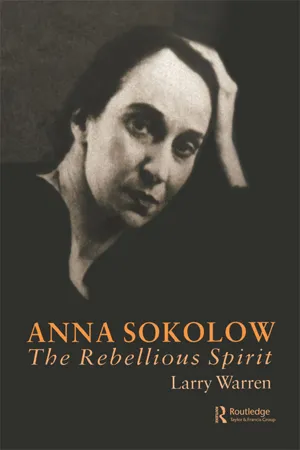
A pioneer choreographer in modern American dance, Anna Sokolow has led a bewildering, active international life. Her meticulous biographer Larry Warren once looked up Anna Sokolow in a few reference books and found that she was born in three different years and that her parents were from Poland except when they were in Russia, and found many other inaccuracies. Drawing on material from nearly 100 interviews, Larry Warren has created a fascinating account and assessment of the life and work of Anna Sokolow, whose nomadic career was divided between New York, Mexico, and Israel. Setting her work on more than 70 dance companies, Anna Sokolow not only pioneered the development of a personal approach to movement, which has become part of the language of contemporary dance, but also created such masterpieces as Rooms, dealing with loneliness and alienation, and Dreams, which concerns the inner torment of victims of the Nazi Holocaust.
- 304 pages
- English
- ePUB (mobile friendly)
- Available on iOS & Android
eBook - ePub
About this book
Information
1
BREAD AND ROSES
During a nine-week textile workers strike in Lawrence, Massachusetts, in 1912, the women strikers carried banners that read: “Bread and Roses.” They were fighting not only for workers’ rights, but for a quality of life. (Edith Fowke and Joe Glazer, Songs of Work and Freedom)
When Anna Sokolow’s niece, Judy Kaplan, was asked why her grandparents had left Russia in the early 1900s, she answered, “Why does any Jew leave Russia?”
There is an old Jewish saying: Ask a Jew a question and he answers with a question. Both parties may well know the answer at the outset; the question is posed merely to emphasize the import of that which is already understood. (A better question might have been: Why would any Jew not want to leave Russia at that time?) Sarah and Samuel Sokolowski (later Sokolow) and their infant son Isadore were among the millions of Jews who left tsarist Russia in a tidal wave of Western migration between 1881 and 1914. These immigrants abandoned their homeland in droves to escape religious and economic persecution. Pogroms — those dreaded periodic attacks on the Jewish community — were on the rise in Russia and few Jews, the Sokolowskis included, regretted leaving.
The vast majority of these immigrants crowded into the steerage holds of steamships bound for the United States and what they hoped would be a new life. Few could afford to travel in a berth, where they could see the light and breathe the fresh air. But they could wait. America, the Promised Land, would be the light. Samuel came first, probably in 1905 or 1906, to find a job and to establish a home.
Samuel Sokolowski might have added to his reasons for wanting to leave tsarist Russia a desire to put some distance between himself and his in-laws, who made it no secret that they considered him a poor match for their pretty, lively, and intelligent daughter, Sarah Cohen. Sarah and the handsome Samuel (who bore a striking resemblance to Marcel Proust) had met, courted, and married in Pinsk, a Belorussian city known at the time for its railroad yards and steamship construction. Some of Sarah's relatives recalled that the Cohen family was in the lumber business and was involved in the building of the Pinsk streetcar system, but however they gained their superior financial status, they managed to make Samuel uncomfortable about his own, more meager, prospects.
Sarah and young Isadore (Izzy) arrived on Ellis Island in September 1907 with five dollars to declare at the immigration station. Their ultimate destination was Hartford, Connecticut, where Samuel and some of his relatives, who lived in nearby New Britain, would help the newcomers become accustomed to life in a strange new place. It was the usual pattern: immigrants would settle where there were relatives or landsmen to ease the shock of assimilation.
During his first year in America, Samuel had discovered that earning a good living was even more difficult for him here than it had been in Russia, where money problems had also plagued him. He took whatever job he could find. When a second child, Rose, was born in 1908, followed by Anna in 1910, the professions he listed on their birth certificates were merchant and laborer, respectively.
Many years later Anna Sokolow summed it up this way:
In the European Jewish tradition, the man was really the scholar, and the woman he married and her family took care of him and their children. When they came here, a lot of them had to change and they did. They learned to cope with the system and realized that they had to earn a living. Well, my father was totally bewildered by it, and he could do nothing. Eventually my mother, with her great energy, stepped in and took over. I think this happened to quite a few of the families who came here.
In 1912, a fourth child, Gertie, was born. Unable to make ends meet in Hartford, the Sokolows decided to move to New York City, where work was available for men and women who could sew or were willing to learn. The family found affordable lodging on the top floor of an East 8th Street (now St. Mark's Place) tenement. After climbing six flights of stairs (the higher up one went, the cheaper the rents became) they reached their long, narrow, railroad apartment with a combination washtub/bathtub in the kitchen and a toilet in the hall. Compared to their previous housing situation in Hartford, this was a nightmare of windowless rooms, thin walls, insufferable heat and cold. But they were surrounded by people who, like themselves, were scraping for a living, and they adjusted to the new surroundings.
Soon after they settled in New York, Samuel began to suffer from disturbing symptoms that were eventually diagnosed as Parkinson's disease. When he was no longer capable of caring for himself, Sarah had no choice but to have him cared for in the charity hospital on Welfare Island in the East River, where he was to live out the rest of his life. Anna and Rose could not recall much about their father, who was ill for many years. On some of their Sunday visits he was barely able to speak with them.
In order to keep her family together, Sarah joined the ranks of the thousands of Russian-born Jews earning their living in the garment trade. Fortunately, a few blocks away from their apartment was a nursery school where Anna could be cared for while her older siblings were in public school. Gertie was simply too young to farm out during the day and was placed in a Jewish orphanage. It was not unusual for immigrant families facing tragedy of one kind or another to accept this alternative. Everyone had to make adjustments; Mama was now a working woman and Papa was too sick to earn a living.
After Samuel's departure from the household, Sarah's younger brother Harry, a bachelor, began to spend a good deal of time with her and the children, sometimes living with them and helping to pay the rent. Uncle Harry, who was a professional photographer and photo retoucher, took many photos of the Sokolows during this period. They show Sarah to be full-figured — not a conventionally attractive woman, but one who radiated vitality. Anna seems small for her age, thin, pretty, and wistful-looking. Rose appears more robust, looking like their mother as Anna did their father. Harry was the official photographer at the International Ladies Garment Workers Union (ILGWU)-run Unity House camp in Pennsylvania’s Pocono Mountains, where Sarah spent her summer vacations in later years. One summer Sarah sent the girls to Unity House summer camp for children, with disastrous results. The mysteries of the country frightened Anna, especially at night when she was troubled by the darkness and strange sounds. She cried and sulked until they returned to the noise and bustle of the city, where she felt secure and comfortable. Anna was a city girl and always would be.
In order to help his family survive, Isadore dropped out of high school and worked at a succession of jobs: newspaper hawker, delivery boy, lamplighter. Eventually he enrolled in night school, finished college, and became a successful real estate attorney. By her own example, Sarah encouraged her daughters to become free souls while they were growing up; Isadore chose a more conventional direction for his life, and his mother's sometimes flamboyant and unconventional behavior was an embarrassment to him. Nevertheless, he continued to look after her and made sure that she was properly provided for.
In the Jewish family structure, a woman was supposed to marry, bear children, make sacrifices to educate those children, and then settle down to a few years of enjoying her offsprings’ accomplishments, perenially subservient to her husband. Sarah decided on a different course. She was going to have some genuine pleasure in her existence, unhampered by the stereotypical role of a relentlessly committed mother or a grieving wife. She insisted that this land fulfill some of its golden promises to her within her lifetime. Had Samuel been well and able to support the family she might possibly have accepted the lot of the good, compliant Jewish wife, but out of necessity and predisposition, she became aggressive and outspoken. Being physically strong and high-spirited, she sought out male companions and lovers. Zelda Blackman, a cousin, remembers Sarah as a bright, outgoing woman whose magnetic quality attracted men to her without her seeming to encourage them:
Once when she was visiting us in New Britain, we took her to see my father ... My brother's father-in-law, a staid and proper gentleman, paid Sarah a great deal of attention. In the presence of all the family, including his wife, he asked her if she would like to go to the movies with him. Everyone gasped because he had never made a pass at another woman. (I don't remember the outcome of his proposal.)
Her independence of spirit was no doubt enhanced by her interest in the Socialist Party and her trade-union activities. In both of those arenas women were treated as equals to their male peers. Here she found herself at home. In the language of her time, she had chosen to be “a person,” not a charity case dependent on handouts from public welfare or her family There were three other brothers besides Harry, and, as the only sister, Sarah was the object of much affection and good-natured teasing. They could and would have helped her financially, but she had her own ideas about how she wanted to live her life and these required independence. She chose to fight for her own survival and that of her children.
Not one to express affection openly, Sarah showed her love for her children by dressing and feeding them well, by spending as much time with them as she could, and by doing everything in her power to give them some semblance of a Jewish upbringing. The Sokolow home was kept kosher, High Holidays were observed, and Sabbath candles were lit every Friday night.
Care was taken that the children were never left without supervision during the day. Rose picked up Anna at the nursery school after her own school-day was over and, when he could, Isadore kept an eye on them until Sarah returned home to make dinner. With Sarah's skills at the sewing machine and an investment of a dollar or two in fabric remnants (which were easily obtained in the garment district where she worked), she created an enviable wardrobe for her young daughters. Rose remembered the precise fitting sessions in which their mother pinned and repinned their dresses until they reached her exacting standards. She remembered, too, how impatient Mama was when she or Anna fidgetted during these sessions. They had to stand perfectly still or they would hear about it. Mama was short-tempered, a trait that she passed along to her children.
The usually undemonstrative Sarah, walking with a daughter's hand in each of hers, would merrily swing them out in front of her to change places as they paraded together down the street in their new outfits. Each special-occasion dress had a matching cape; the girls were sometimes mistaken for twins. Sarah took them with her to Workman's Circle dances, to the Yiddish Theater, and wherever else she could, not only to show them off but also to make it possible for her to go herself. Baby-sitters were an indulgence of the well-to-do. They often went to Central Park together, and in the warm weather there were frequent trips to Coney Island. Sarah took them to the movies on Saturdays. On Sundays they went for a short visit to Papa and then off on an outing of one kind or another.
The girls felt that they were closer in some ways to their mother than other children were whose mothers were home all the time, and they were probably right. They also knew that Mama was different, and that gave them license to be different themselves. The fact that Yiddish was Sarah's first language created something of a barrier to her understanding of the world in which her children were growing up and to some of the values that they were developing. But there was a bond of love and trust between them that made such things seem less important.
“My mother was a real working-class woman,” Anna proudly recalled in later years. “She was a member of the ILGWU and a staunch Socialist. Her idea of a great man was Eugene Debs. People like my mother really fought for the proper conditions for workers in those days.”
In such worldly movements as Zionism, socialism, and combinations of the two, many Eastern European Jews who settled in America transformed their old world religious zeal into energy to fight for social change. It was a period of extreme restlessness and ideological ferment. Everywhere, it seemed, there were new movements, parties, and associations for benevolent and social action, many of which grew into major forces in Jewish public life. In the next generation, Anna's, it would lead to a fierce intensity and independence. Many young people felt deeply committed both to social change and to the arts. In author Irving Howe's words, “... every idea was expressed in absolute and extreme terms.”
Jewish socialism, central to Sarah's life, did not fulfill its goals — the creation of a new society in which all men and women would live without want — but it did help to raise the consciousness of the Jews themselves. Rather than continue to be victims, they became first-rate fighters.
The grim circumstances of the 1911 Triangle Shirtwaist Company fire, in which 141 women and 5 men who were locked into an eighth-story loft during working hours died, brought clearly into focus the fact that working people were often treated little better than slaves. Important and sometimes bloody battles had already been fought and won by the ILGWU by the time Sarah became a member in the early 1920s.
But there was much work left to be done. Workers in nonunion shops still had to put up with crowded, unventilated workrooms and filthy bathroom facilities; lunch areas were often nonexistent; work hours could begin at daybreak and last until nine at night; wages were barely higher than those paid to street cleaners.
Angered by the conditions she observed all around her, Sarah began to take an active interest in politics. She avidly read the Yiddish-language newspapers, Freiheit and Forward, which reported the growing involvement of Russian-Jewish immigrants like herself in socialist causes and political activities. Soon she began to attend meetings and participate in solidarity marches, occasionally taking her daughters along to these stirring events. Sarah could not become overtly involved in organizing union shops because of her family responsibilities and the fear of being blacklisted. Years later, however, she revealed to Rose how she had managed to do her part to further the cause of her beloved ILGWU.
A fast and clean sewing-machine operator/Sarah had no trouble finding work in nonunion shops as a pieceworker (one who was paid for each garment or portion of a garment sewn). After laboring in a shop for a while, she slowly and skillfully interested her fellow workers in taking the necessary steps to become unionized. This usually meant going on strike. When things were close to the boiling point she would ease herself out of that situation, confident that it would take the desired course, and move on to the next sweatshop.
When Anna was seven or eight years old, the family moved to the top floor of an East 12th Street tenement building, remembered by both Anna and Rose as the site of an incident that was frightening at the time, but fun to recall later. The two girls were avid readers, and one warm summer morning as they lay sprawled on the fire escape, their library books propped up under their chins, Anna leaned back too far and fell into the stair opening. Rose, imagining her sister a broken heap on the street below, looked over the railing with terror, only to discover Anna on the fire escape directly below. “Not a scratch — like a bird!” the survivor proudly recalled sixty-five years later. (Anna was pleased, years later, to find out that sokolow is the Russian word for falcon, an association that she rather liked.)
An unusually close bond developed between the sisters in those days. They were together constantly and had much in common, including a love of reading, a fascination with learning, and a mischievousness of spirit. Envy was not an issue between them: what was good for either one of them was good for both. (When asked, in 1986, if they had been streetwise kids, a smile passed between them. How could they have survived in those days with their self-respect intact if they had not been street—wise?)
Around 1919-20 Sarah once again packed up her brood and resettled, this time uptown on East 80th Street. They were to remain there for about five years. The girls attended an elementary school across the street from their apartment and spent their lunch and after-school hours at the Emanuel Sister—hood of Personal Service located on 82nd Street between First and Second Avenues. Such fine nonsectarian settlement houses were built and maintained by prosperous Jews to help look after the youngsters of working mothers and to perform other invaluable services for the community. This particular one — which offered classes in music, drama, the visual arts, sewing, embroidery, cooking, sports, and dance — rapidly became the central focus of the Sokolow sisters’ lives. Often, when Sarah came home from work, her daughters would still be so involved in some activity at the Sisterhood that she would have difficulty coaxing them to come home.
“That place had an important influence on us,” Rose recalled. “It taught us a way of looking at things. It made us curious. There were people there with fine backgrounds who wanted to give us everything they could. We never thought of ourselves as deprived kids. We were having a good time.”
After a few years there, they were the old-timers, with matching status. In Rose's words, they became “king-pins” and they loved it! In 1980 she remembered the Sisterhood vividly:
They had something going on every day after school. The woman who ran the place, Celia Strakosh, was quite a person. She had a vision about how fine such places could be. Elsa Pohl was the dance instructor. She was tall and very impressive, and everybody loved her. We never missed a class — we listened to her as if she were a goddess. She could infuse us with a delirium about dance. When she left to go home, we would follow her down the street, fighting for who walked closest to her.
She was strongly against ballet; she told us it was artificial, that people didn't normally stand on their toes. She was giving us interpretive dancing a la Isadora Duncan. We danced barefoot. Music would be played on the piano and we were told to “dance to the music.”
Years later, when Anna Pavlova came to New York, Anna and I decided to go but felt like we were doing something we shouldn't do. Miss Pohl had made ballet sound so wrong. But we went anyway to the Met and sat way at the top. Pavlova looked so tiny from up there. She did The Dying Swan and we were astonished, mesmerized.
Of the two Sokolow sisters, it was Anna who truly found her niche in the dance classes at the Emanuel Sisterhood; Rose favored sports activities and crafts. (She later became a highly skilled weaver and teacher of weaving.) Anna was around ten years old when she started her ...
Table of contents
- Front Cover
- Half Title
- Choreography and Dance Studies
- Title Page
- Copyright
- Dedication
- CONTENTS
- Introduction to the Series
- List of Plates
- An Appreciation by Jerome Robbins
- Preface
- Acknowledgments
- 1 Bread and Roses
- 2 Neighborhood Playhouse Kid
- 3 Dance as a Weapon
- 4 Radical Theater/Radical Dance
- 5 Anna in the Promised Land: Russia
- 6 Landmarks
- 7 Mexico
- 8 Finding a Fuller Expression
- 9 The Ups and Downs of Broadway
- 10 The Actors Studio
- 11 The Early Fifties
- 12 Anna in the Promised Land: Israel
- 13 Building a Repertoire
- 14 Working the Media
- 15 The Juilliard Connection
- 16 A New Era
- 17 Lyric Theatre (Israel)
- 18 Other Ventures
- 19 The Spirit of Rebellion
- 20 Theater Danced and Danced Theater
- 21 The Seventies
- 22 Resurgence
- 23 PS
- Appendixes
- Notes
- Bibliography
- Index
Trusted by 375,005 students
Access to over 1.5 million titles for a fair monthly price.
Study more efficiently using our study tools.
Frequently asked questions
Yes, you can cancel anytime from the Subscription tab in your account settings on the Perlego website. Your subscription will stay active until the end of your current billing period. Learn how to cancel your subscription
No, books cannot be downloaded as external files, such as PDFs, for use outside of Perlego. However, you can download books within the Perlego app for offline reading on mobile or tablet. Learn how to download books offline
Perlego offers two plans: Essential and Complete
- Essential is ideal for learners and professionals who enjoy exploring a wide range of subjects. Access the Essential Library with 800,000+ trusted titles and best-sellers across business, personal growth, and the humanities. Includes unlimited reading time and Standard Read Aloud voice.
- Complete: Perfect for advanced learners and researchers needing full, unrestricted access. Unlock 1.5M+ books across hundreds of subjects, including academic and specialized titles. The Complete Plan also includes advanced features like Premium Read Aloud and Research Assistant.
We are an online textbook subscription service, where you can get access to an entire online library for less than the price of a single book per month. With over 1.5 million books across 990+ topics, we’ve got you covered! Learn about our mission
Look out for the read-aloud symbol on your next book to see if you can listen to it. The read-aloud tool reads text aloud for you, highlighting the text as it is being read. You can pause it, speed it up and slow it down. Learn more about Read Aloud
Yes! You can use the Perlego app on both iOS and Android devices to read anytime, anywhere — even offline. Perfect for commutes or when you’re on the go.
Please note we cannot support devices running on iOS 13 and Android 7 or earlier. Learn more about using the app
Please note we cannot support devices running on iOS 13 and Android 7 or earlier. Learn more about using the app
Yes, you can access Anna Sokolow by Larry Warren in PDF and/or ePUB format, as well as other popular books in Media & Performing Arts & Dance. We have over 1.5 million books available in our catalogue for you to explore.