1
THE WORLD OF REPUBLICAN ROME
So, in those former times the senate administered the constitution in such a way that though the populace was free, little public business was done by the people, but much by authority of the senate, according to established precedent. Moreover, though the consuls held office for only one year, their power was in effect and in law that of kings, and to ensure that the influence of the nobility was maintained, the principle was firmly upheld that no business of a popular assembly could be ratified without the approval of the senate.
Cicero, On the Republic II. 56
Julius Caesar did not destroy the Roman republic, so much as play a starring role in its obsequies. He was an idealist, a workaholic, and a political enabler and manipulator, who would bend the system to his own ends if the wheels of change did not whirl fast enough for him. As things turned out, his autocratic attitude and his preoccupation with quick results were the principal reasons for his assassination, which signalled the bloodstained dawn of the new era of imperial Rome.
By the first century BC, the traditional distinction between the patricians (members of a group of ancient, aristocratic families) and the plebs (the people, that is the rest of the community) had largely disappeared. The new ruling class comprised the ‘nobility’, a status automatically assumed by patricians and by descendants of former consuls but which could be acquired, as it was by Cicero himself, by achieving the consulship. Members of the nobility exercised their power by means of arrogance, wealth, intrigue, and patronage. Patronage imposed a legal as well as a moral obligation to help one’s clients; its philosophy survives in the public arena today in the state’s provision of legal aid. The nobility effectively controlled the senate and, through their strings of clients, the election of officers of state. These officers included the holders of religious posts (the members of the priestly colleges and the pontifex maximus himself ), all of whom were political appointees. It was nepotism on a grand scale.
Cicero was Caesar’s political, literary, and forensic contemporary; his ideal constitution, if it ever existed, failed to take into account various other destabilizing influences. While allowing for the overriding influence of the nobility and of the senate, he ignored the existence of the class of citizens known as equites, or equestrians. These men, originally numbering about 1800, were, by reason of their property holding, until the second century BC provided at public expense with a horse, with which they were required to report for military duty. Now, their numbers bolstered by anyone else qualified by wealth and by senators’ sons, the equites represented a considerable political power grouping which ranked just below the six hundred or so senators. Since senators were forbidden by law to participate in trade, the equites incorporated the entire commercial elite of Rome.
In the home and in the fields, gods and goddesses presided over the activities of daily life, while the superstitions of the religion of the state pervaded military action as well as the conduct of public business. Armies would take along with them a portable auspice-kit in the form of a cage of sacred chickens. It was a bad sign if the chickens refused to eat offerings of cake. If they ate them and let grains fall from their beaks, the omens for battle were good. Memories of national disaster died hard in the Roman world. When in 216 BC Hannibal the Carthaginian was ensconced in Italy with only a small army, the Romans, who easily outnumbered his force, were still hesitant about being brought to battle. The chickens were duly consulted, and declined their food. Both consuls in charge of the Roman army, Gaius Terentius Varro and Lucius Aemilius Paullus, called to mind their unfortunate predecessor, Publius Claudius Pulcher. In 249 BC, Pulcher had begun a sea-battle against the Carthaginians although the chickens had refused to eat; not only that, but he had thrown the chickens into the sea, remarking that if they would not eat, they could drink. He lost the battle, and with it 93 ships and their crews, captured by the Carthaginians. Ignoring this dire precedent, however, Varro, whose turn of command it was on that particular day, led the Roman army, at Cannae, to one of the greatest defeats in its history.
Omens controlled the affairs, too, of the senate and other assemblies. In 59 BC, Caesar’s consular colleague, Marcus Calpurnius Bibulus, opposed most of his measures on principle. Bibulus’s well-tried tactics were to object on religious grounds to the assemblies sitting. When Caesar took no notice, Bibulus interrupted the public meeting which his colleague was addressing from the steps of the temple of Castor, and tried to make himself heard. Caesar’s hired hands, some of whom were armed, pelted him with dung and beat up his officials.
Fearing for his life, Bibulus barricaded himself in his house, which he did not leave during his remaining eight months of office. Instead, he sent messages to say that he was examining the sky for omens. Any announcement of unfavourable omens had to be made personally before the business of the day began. Bibulus could not do so without risking bodily harm. Was this justified cause for not appearing in person? Nobody was sure. Caesar’s measures were approved, but doubts were sown as to whether they were legal.
The Latin term res publica (matters of public concern), also as one word respublica, is usually translated as state or commonwealth; from it, via the French, comes the English word ‘republic’. The Roman republic was never a democracy in the true Greek sense, with everyone in theory having an equal say. The history of Rome during the latter years of the republic is, in the same way as modern politics, all about power. The Romans had a precise word, imperium, of which a literal translation is something between power and command. It is related to imperator, the title bestowed on a victorious military commander by his troops; from it derive the terms ‘empire’ and ‘emperor’.
The two consuls were invested by right with imperium during their year of office, as to a lesser degree were the praetors, officers of state who ranked immediately below the consuls. Imperium could be extended for further terms in the case of provincial governors and military commanders, who were former consuls or praetors, appointed by the senate. The office of censor, of which there were two, was usually reserved for those who had achieved all the steps on the political ladder or cursus honorum (the race, or course, of honours) from quaestor to consul. Censors were chief registrars, finance and tax officers, inspectors of public works, and governors of public morality. Elections were held every five years, to coincide with the census of the people. The censors, who had wide disciplinary powers, served in office for only 18 months, but their acts remained in force until the next election.
The senate was primarily a consultative body. As a general rule, its members discussed and voted on matters put to them by the presiding officer, but the results of their deliberations had no legal force. They had, however, overriding responsibility for the administration of the state and its empire, finance, and relations with foreign powers.
Outside the senate, a unique system of voting kept the decision-making largely in the hands of those who wielded most power, or commanded most money. The assembly known as the comitia centuriata elected senior state officials, approved legislation, and decided in cases of offences against the state for which the punishment was death or exile. It comprised all Roman citizens, who were allocated to one of 193 centuries according to their means. A century comprised an indefinite and variable number of members, each of whom had one vote. The larger the century, the less was the influence of a single vote, and a simple majority governed the way in which that century would cast its vote on the issue under discussion or on the election of an official. Where the system favoured the rich and the influential was that 98 of the votes (that is, a majority) were in the hands of the 18 centuries of equestrians and the 80 representing the top of the five property bands.
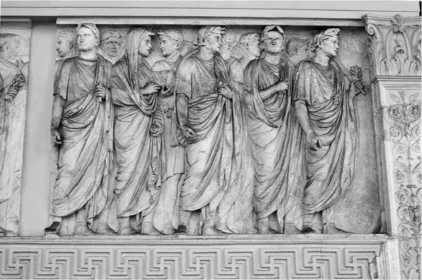
Figure 1.1 A group of Roman senators of the first century BC, from the Ara Pacis (Altar of Peace), completed in 12 BC. (C. M. Dixon/Ancient Art & Architecture Collection)
The comitia tributa (tribal assembly) was also open to all citizens, and voted according to 35 tribal or district divisions. It elected minor officials and approved legislation on a different voting basis to that of the comitia centuriata.
The functions of the comitia curiata, an assembly of representatives of wards, ten each from the original three tribes of Rome, were largely, after the fourth century BC, assumed by the comitia centuriata, but not before there had been a dramatic interruption of its business. By ancient tradition, the Roman constitution had allowed for the appointment in times of national emergency of a single ‘dictator’ (the term, in Latin, means commander, someone who gives orders), to exercise complete control, with overriding imperium, for not more than six months. His second-in-command, even in late republican times, was called ‘master of the cavalry’. In 310 BC, Lucius Papirius was appointed dictator to combat the continuing menace of the Samnites. He was in the process of asking the comitia curiata to go through the formality of ratifying his nomination of Bubulcus as master of the cavalry, when it was noticed that it was curia Faucia’s turn to vote first. This was a sinister omen, because on two earlier occasions when this had happened, the consequence was disastrous to the state. Papirius cancelled the vote, and took it again the next day, with a favourable outcome and a successful conclusion to his campaign.
The people’s right to the highest office was accepted in 367 BC, after which one consul was normally a plebeian. The people’s right to improve their lot was achieved at an even earlier stage, not by violence, but by passive resistance and collective bargaining. There arose out of this the concilium plebis (people’s assembly), with authority to enact legislation which, after 287 BC, could, with the approval of the senate, that is to say if the omens were favourable, be made binding on the whole community. The concilium plebis became the most convenient channel for the passage of legislation, largely for technical reasons, since its religious procedures were less complicated and less formal than those of the other assemblies. Its own elected officers, the tribunes of the people, had the power to veto any measure proposed by an officer of state (including a consul) or by another tribune which appeared to contravene the law or the established conduct of elections. It was a tool open to the most flagrant misuse.
The political system began seriously to unravel during the events of 133 BC, at a time when a further division of alignments is discernible: between the populares, whose political aims were achieved by appealing to the people, and the optimates, whose inclination was to preserve the status quo.
The brothers Gracchus, Tiberius (b. 163 BC) and Gaius (b. 154 BC), were nobles, in that they were the sons of a former consul and the grandsons, through their mother, of the distinguished general Publius Cornelius Scipio Africanus, who was twice consul. They were also populares of a genuine crusading nature.
Tiberius Sempronius Gracchus, elected tribune of the people for 133 BC, proposed an agrarian law whereby large tracts of land acquired by the state in its conquests of Italy should be redistributed to needy smallholders, with guaranteed tenure in return for a nominal rent. The present occupants, who were tenants of the state, were to be restricted to what was nominally the legal limit of 500 Roman acres of public land, plus 250 acres for each of up to two sons, and would be compensated by the grant of a hereditary rent-free lease. It was a significant package of measures, at a time of general expansion abroad, which also restored to the list of those eligible for military service, who traditionally qualified by owning property, a section of society which had become ineligible. The bill was drafted with the help of consultants who included Publius Mucius Scaevola, consul for that year and a noted legal expert, and Licinius Crassus Mucianus, a distinguished lawyer who was also the father-in-law of Gaius Sempronius Gracchus.
Objections were expected from large landowners who had invested money in the development of their estates, many of whom were senators. Tiberius, however, through his family and other connections, could command support in the senate, including that of his father-in-law, Appius Claudius Pulcher, father of the house. So determined was he, though, to get the measures passed without interminable discussion, that he resorted to questionable tactics. Relying on a hundred-year-old precedent, instead of submitting his bill first to the senate, he arranged to propose it direct to the concilium plebis, where it was bound to be accepted without ado. Members of the senate, outraged at their traditional rights being infringed, prevailed upon Marcus Octavius, one of the other tribunes, to veto the bill as it was being read out, which he was entitled to do. Tiberius, having failed to persuade Marcus Octavius to withdraw the veto, flatly refused to refer the issue to the senate. He then took the unprecedented step of calling on the assembly to vote his refractory colleague out of office, which it did. The bill was then approved with acclamation, and, at Tiberius’s suggestion, an independent commission was established to administer it, consisting of himself, his brother, and his father-in-law.
The senate tried to block the commission’s activities by allocating from the public treasury a derisory sum as funding. Tiberius coolly proposed to the concilium plebis that part of the expected inheritance by Rome of the estate of the late king of Pergamum, of which, through his family connections, he had advance knowledge, should be diverted to the commission’s use. This measure, unsurprisingly, was passed too.
The senate had now been outmanoeuvred in two areas which it regarded as its prerogative, finance and foreign policy. There were also suggestions that by manipulating the process of law, packing a commission with members of his family, removing a colleague from office, and appropriating public money for his own purposes, Tiberius Gracchus was setting himself up as some kind of king. He was now a marked man.
State officials could not be prosecuted during their term of office, but a prosecution could not be avoided by moving directly to another post. Tiberius announced that he was standing for the tribuneship for a second term, which was unprecedented if not strictly illegal. When he and his supporters gathered on the Capitol Hill, where the assembly met and where the elections were due to be held, a group of senators, led by Publius Scipio Nasica, the pontifex maximus, charged out of the senate house and clubbed to death Tiberius and 200 of his followers. That night the bodies were unceremoniously thrown into the river Tiber.
This eruption of political violence echoed down the years; 80 years later, politically motivated thuggery and gang warfare had become commonplace in the streets. Further retaliation against Tiberius Gracchus’s supporters was taken in 132 BC by the consuls for that year, who used legal procedures to circumvent the traditional right of the people to pass judgment on those found guilty of plotting to overthrow the state, and in this way were able to sentence them to permanent exile.
Notwithstanding these open expressions of opposition, the work of the land commission continued, with Tiberius Gracchus being replaced by Licinius Crassus Mucianus. Gaius Gracchus, who clearly harboured deep resentment at the treatment of his brother, was biding his time. He was more flamboyant and passionate than Tiberius, but he was methodical in the planning and exercise of his political career, and he was a formidable public speaker. It was not until 126 BC that he offered himself for public office as quaestor, when he was about three years over the minimum age. The post principally involved acting as assistant to the consuls, and it was in this capacity that he served as military aide to the consul Aurelius Orestes in Sardinia, which had been annexed in 241 BC at the end of the First Punic War against Carthage and was one of the earliest provinces of the Roman empire. They were still there in 124 BC, when Gaius returned to Rome, presumably with Orestes’s permission, to stand as tribune of the people. While the votes in the assembly placed him fourth out of the ten tribunes elected, it was clear that he commanded considerable support from the public itself.
Gaius Gracchus was 30 when he took office as tribune. By some means he managed to be elected in 123 BC for a second term; it appears that he may have taken advantage of a constitutional loophole whereby if there were not enough candidates for election, the people might choose further tribunes from the whole body of citizens. For breadth and imaginative scope, the measures that he introduced during those two years were unmatched until Julius Caesar’s energetic dictatorship between 49 and 44 BC, when Caesar was in his early fifties. Gaius’s acts and actions benefited everybody but the aristocracy and the senate, for which institution he maintained an open contempt.
One of his earliest measures was a retrospective law establishing beyond doubt that cases for which the punishment was execution or exile were the prerogative of the people, represented by the comitia centuriata, and quashing all previous unauthorized sentences. By it, all supporters of Tiberius Gracchus effectively received pardons, and the surviving consul for 132 BC, Popillius Laenas, was himself forced into exile.
Gaius removed the privilege of the senate to try fellow-senators for extortion as provincial governors, and handed it over to juries comprised exclusively of equestrians. Provincial governors were former consuls or praetors, and the opportunities for personal enrichment were legendary. Gaius restricted the traditional policy of the senate to reward favoured consuls with the richest pickings, by insisting that the choice of provinces be made before the elections for consul were held. He increased the potential wealth of the equestrian order by transferring responsibility for auctioning the contracts for collecting taxes in the province of Asia from the governor on the spot to the appropriate officials in Rome. He also embarked on an extensive programme of building roads and constructing new granaries, to the benefit of equestrians who won the contracts for...