Today's education and communications media are seen to be the main cause of the anonymity of contemporary music and suggestions are made to improve this situation. Leigh Landy investigates audio-visual applications that have hardly been explored, new timbres and sound sources, the discovery of musical space, new notations, musical politics, and the 'musical community' in an attempt to incite more composers, musicians and musicologists to get this music out into the works and to stimulate the creation of new experimental works.
In the following chapter experimental music will be defined and two of this book’s main “characters” – the parameter and the composer John Cage – will be introduced.
I. What it’s all about
1. EXPERIMENTAL MUSIC DEFINED1
The term experimental music is often used today. Surprisingly the frequency of its use has not had any effect in unifying the term’s meanings. In general there are four distinct views of what experimental music might be. It is the final view which will serve as our definition.
A) The 1970s have become known as a time of “postmodernism” in several of the arts; the term avant-garde therefore has become a cliché as its literal meaning can hardly be used for describing contemporary art. The problem was, and is still, that the modern public has been presented with so much innovation, especially in the 50s and 60s that one might say that almost all art today is avant-garde due to the relatively small amount of appreciation, or conversely, that there is no new avant-garde art as there is really nothing new under the sun any more.
Whatever the reason may be, avant-garde used as a synonym for that which is innovative and difficult to appreciate due to newness had to be labeled differently. Much music has been grouped together as “new music”, “contemporary music” and so on, but these terms are often used as well for all art music of the 20th century.
Experimental music became synonymous with avant-gardism to many as most “before its time” art is by nature experimental. The “Grove” Dictionary (entry by Paul Griffiths) and texts of Robert Fink and Herbert Eimert (all listed in the bibliography), the latter seeing this new notion as a modish cliché, all tended to merge the avant-garde with the experimental. The problem here is that most writers who choose the synonym approach do not define innovation, avant-gardism, or what they call “advanced techniques”.
B) In the late 1950s and early 1960s when the sonological field was growing quickly, two of its foremost composers and writers, Pierre Schaeffer in France and Lejaren Hiller in the U.S. defined experimental music as pertaining to music made in the laboratory, that is in the musique concrète, electronic and/or computer music studios. This is a very narrow definition of the term which only relates to applied electronic technology.
C) Simultaneously another composer-writer, John Cage, came to a totally dissimilar conclusion as to what he saw experimental music to be. To him an experimental action is one in which the outcome cannot be foreseen. In other words, as is typical of Cage, one can speak of the various ways of infiltrating purposelessness into music. Cage calls it indeterminacy; others, including Boulez and Stockhausen, who limited their purposelessness to small nuances of choice, called it aleatory.
This definition, or version of the experiment has been accepted by many prominent writers including Michael Nyman, Wim Mertens, to an extent Konrad Boehmer, and especially Joaquim M. Benitez as is discussed in his article, Avant-garde or Experimental? Classifying Contemporary Music. Benitez claims that “classical avant-gardists” (e.g., Pierre Boulez and Karlheinz Stockhausen) are traditionalists in that they create works of art, whereas composers of the Cage school could hardly speak of making musical works when their outcomes are unknown. Citing Earle Brown he points out that an experimental performance is composed rather than that a composition is performed. The goal is spontaneity and to an extent the loosening of fixed musical boundaries. In citing a manuscript of Susumu Shōno, Benitez presents an interesting four-level division of experimental music-making. The experiment or the indeterminacy takes place:
i. Between the composer and the score (i.e., one uses random-choice operations during the composition process),
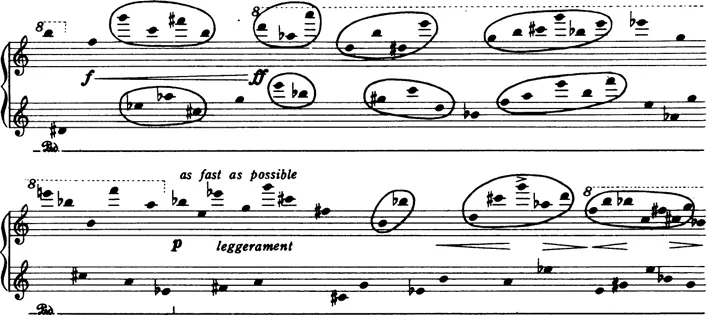
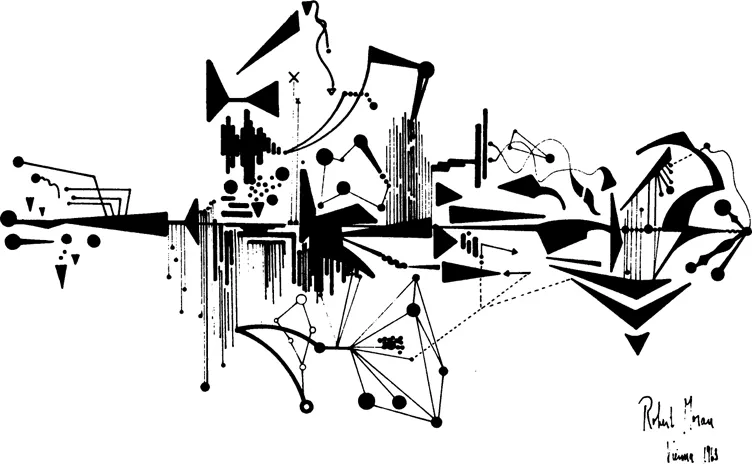
ii. Between score and performer (i.e., the score is indeterminate and demands choice and response by the musician during a performance). This can be manifested in three ways: first, the macro-structure of a piece exists, and the performer fills in the micro-structure elements – this is sometimes called the parameter-freer approach (see illustration I/1); second, the micro-level is completely written out, but macro-level decisions are left free, as in the Available Forms works of Brown (see part 6, chapter XVIf); thirdly, the performer is to react to a graphic image (see illustration I/2) or to a prose text (see also chapter VI) in which both macro-and micro-decisions must be made,
iii. Between performer and sound recording (through electronic modification), and
iv. Between sound recording and listener, the least common (e.g., the record of HPSCHD of Cage and Hiller supplies a unique dynamics chart for each listener to mix a personal stereo version during the duration of the recording).
Illustration I/1 An example of a score in which one parameter (in this case the duration of the piano notes – encircled ones signify unperiodically played “phrases”) is left open to the interpreter: Tone for piano by Shuko Mizuno (Tokyo: Ongaku no Tomo-Sha, 1970).
Illustration I/2 A movement from a graphic score, Four Visions for flute, harp and string quartet by Robert Moran (London: Universal Edition, 1963). This score is preceded by Moran’s instructions to the six players.
Whether one accepts this definition of experimentalism or not, these four levels can be of great use in the analysis of contemporary innovative music.
It is noteworthy that this third definition is totally dissimilar to that of Schaeffer and Hiller. The Cageians consider electronic music on tape to be traditional music created with new instruments. The experimental in electronic music is only present before realizing a tape. After a tape has been mounted, a work of art is born which is, according to this group, no longer experimental.
In a sense it is a shame that Cage and Nyman have chosen the term, experimental music for these composition and performance procedures. The reason for this discontent is twofold: firstly, any good definition of experiment2 shows that purposelessness is by no means an experimental goal. The word is misused a bit perhaps. Secondly, the acceptance of the term for Cageian techniques has led to isolating indeterminate works from other innovative forms of composition.
One wonders whether a more natural coupling to other musical developments through the use of another name might have been more useful. It is this coupling which leads to the fourth definition, the one we will use in the remainder of this book.
D) Experimental music is music in which the innovative3 component (not in the sense of newness found in any artistic work, but instead substantial innovation as clearly intended by a composer) of any aspect of a given piece takes priority above the more general technical craftsmanship expected of any art work. Innovation has always been present throughout music history, yet in this century many composers have chosen to focus specifically on the new, often rejecting accepted values and sometimes ignoring or compromising themselves in terms of accepted levels of generally known techniques. Of all the writers encountered in the preparation of this text, it was only Paul Griffiths (1981)4 who chose this path. As avant-gardism was always to a greater or lesser extent experimental, this definition comes closest to the first of the above three. The laboratory or indeterminacy compositions can mostly be included in this wider category of experimental music. As it is a question of weighing innovation against renewal that is important here, one can indeed find some electroacoustic works which are substantially less experimental than others; to a lesser extent this may also be said of a few aleatoric pieces.
It is inevitable in further refining the definition that criteria will have to be developed to examine the experimental of a given work.5 This will not only concern the most recently composed music, for as said the presence of innovation is a constant factor in music history. Still, one sees a large growth of experimentation beginning around the time of the first surge of electricity and a second, much larger surge after the Second World War. Therefore it is primarily music composed after 1950 that falls into this category.
2. COMP(EXP. ♪) ≅ ft(
“PARAMETERS”(~))
(= The composition of experimental music is approximately equal to the function [in time] of a sum of as many sound parameters as you choose, or, there is more than just one new dimension in recent experimental music.)6
In the early 1950s music’s Wiederaufbau included several developments which demonstrated a great deal of inventiveness as well as creativity. Several of these developments parallel similar activities in the “hard” sciences (as well as in the arts as has always been the case). As in the sciences where one became more acquainted with various minutely small and extremely large worldly phenomena, composers searched to expand their own dimensions.
Take for example the element of musical pitch. In early music history, a typical musical scale contained four or five pitches; modality and tonality utilize a scale of seven tones; in the 20th century, Arnold Schönberg’s dodecaphonic music gave equality to all twelve tones within the musical octave; at the same time the Czech theorist composer Alois Haba and many others even divided the smallest interval on the piano into yet smaller pieces, creating micro-tonal music of up to some fortythree tones/octave. With the first experiments in the electronic music studios in the 1950s, C-D-E (do-re-mi) were replaced by pitch described in terms of its physical characteristic (cycles/second or hertz). C might be called 256 Hz; its upper neighbor no longer needs to be C-sharp, which is many hertz higher, but instead 256.1 Hz or even 256.01 Hz which are both “playable” on many electronic instruments. In other words the pitch domain has grown from a handful of tones as basis to a universe of infinite possibilities.
Also the realms of time (rhythm, tempo), dynamics and even timbre have undergone this form of expansion. And in fact there are many other musical dimensions that have been looked into, as will be shown below. Early avant-gardists were certainly aware of this potential, but lacking apparatus to make such expansion feasible, most early 20th-century composers limited themselves to dreams and manifestos.
Although parametric research is not the only form of experimentation within recent music, it has been singled out for this introduction due to its relative importance in most experimental music along with its link to music tradition (studies of melody, rhythm, harmony, and so on) and to assist in delineating our field of interest. It will also be often referred to in the following chapters.
a. The Parameter
Traditionally the word parameter, which evolved in the latter half of the 18th century and can be found in Diderot’s encyclopedia (Paris, 1756), knows two main connotations, one mathematical and one derived from statistics. In general the first connotation boils down to: characteristics of a variable which make it possible to describe and/or compare mathematical functions and/or systems. In statistics one speaks of “parametric values” which characterize the properties of a probability distribution.
The term found its first application in music in the 1940s in various texts of the (music) theorist, Joseph Schillinger. He saw the arts as one continuum containing a system of unlimited parameters. Each art was said to possess two parametric components: general ones (time, space) and specific ones (“qualities”). Although the later use of musical parameters is implied but not stated here, Schülingens thesis remains idealistic and a bit vague.
In the late 1940s and early 1950s, the information and acoustics theorist, Werner Meyer-Eppler began his long study of potential music parameters independent of Schillinger (see Meyer-Eppler, Christoph von Blumröder 1982a). Essentially he sought – given the arrival of electronic music studios – a new form of musical description, a description which allows a sound to be broken down into its basic components according to the laws of physics. He supported his ideas citing the new objectivity in music derived from Schönberg’s and Anton Webern’s methods of interval manipulation and a drive to precision derived from applications of modern technology. Meyer-Eppler is seen to be one of the father figures of German electronic and serial music. His focus on musical parameters was fundamental to his theory.
Many have defined the term parameter in music. Josef Häusler’s definition will suffice for this discussion: Musical parameters are all sound or compositional components which can be isolated and ordered (1969).
In the Middle Ages, Guillaume de Machaut composed isorhythmic motets which called for a melody of length “X” to be repeated as well as a rhythmic phrase of length “Y”. The fact that “X” and “Y” could be of different lengths meant that there was a certain autonomy of pitch and duration. Schönberg’s twelve-tone music, formulated in the early 20s, was based upon a row of intervals which was to be permuted and combined in various manners without specification of compositional method for any other sound component. Olivier Messiaen’s short piano study, Mode de valeurs et d’intensités, dating from 1949, specified for each pitch its own unique length, dynamic level and attack (e.g. accented notes). In this case four parameters were fused into a single new one...
Table of contents
Cover
Title
Copyright
Contents
Introduction to the Series
Preface
PART 1. INTRODUCTION
I. What it’s all about – Definition, delineation of the area: also the "parameter" question and Cage's double role (composer/philosopher)
PART 2. FOUR EXTRA-MUSICAL SUBJECTS OF RELEVANCE
II. The media/1 - Including a double failure: the media's relative lack of support, the musicians' lack of application and the "perfect" recording
III. Technology - Increased knowledge and utilities in our society ... How are these used/translated in today's music?
IV. Local music - Have we forgotten regional values? and an overflow of "exotic" goods (recordings) in the supermarket
V. Music and politics - Including Henze's salon, Cage's anarchism
PART 3. STATUS REPORT: ADVANCES WITHIN EXPERIMENTAL MUSIC
VI. New notation and instrument practice - Avant-gardism is alive and well - it's the musician who's still suffering/music education and two of Cage's pages
VII. Form and structure, (a)tonality and rhythm and our perception’s fuse box - The questions of the lost melody, the lot of Xenakis' (dis)order, energy; minimalism's twentieth birthday
VIII. Sound sources, color - Organized sounds, notes and silences or not?
IX. The “parameter” space - Quadraphonics, the podium, the street, etc
X. The media/2: How often have you seen your compositions performed? - An often ignored potential
PART 4. CONTEMPORARY MUSIC TODAY
XI. Survey: One step forwards, two steps backwards? - Including neo ≠ new
XII. The maestros of the 50s and 60s in 1989 - Cage, Stockhausen and Xenakis plus Ligeti, Kagel, and others. Also the parameters, "compositional bearing" and "Former
XIII. Today’s music of sounds: Electroacoustic music and extended vocal techniques - e.g. the MIDI influence and computer music is number one
XIV. Fusion music - Fortunately the borders with pop music and jazz are becoming more and more vague
PART 5. CONCLUSION
XV. A possible future for experimental music - Among other subjects: the influence of the economy, our schools, today's perspectives in experimentation
PART 6. Work Descriptions and Cues for the Listener
XVIa. Melodylessness and beatlessness – Ligeti’s Ten Pieces for Wind Quintet - Ligeti's Ten Pieces for Wind Quintet
XVIb. Extended vocal techniques, new instrumental techniques and new virtuosity – Berio’s Sequenza III
XVIc. Dealing with highly complex music – for example Carter’s Concerto for Orchestra
XVId. Sophisticated formal structures in experimental music which you can hear if you try – Xenakis’ Nomos α
XVIe. Music as process – Reich’s Piano Phase
XVIf. Available (open) forms – Brown’s Available Forms I
XVIg. Politically influenced music-making – Wolffs In Between Pieces
XVIh. Music as organized notes and sounds – de Leeuw’s Mountains
XVIi. Recent electroacoustic music – Risset’s Sud
XVIj. An analysis of Shinohara’s Tayutai for koto (1972) – a three-dimensional approach of assimilation in experimental music
Bibliography
Index of names
Trusted by 375,005 students
Access to over 1.5 million titles for a fair monthly price.
Study more efficiently using our study tools.
Frequently asked questions
Yes, you can cancel anytime from the Subscription tab in your account settings on the Perlego website. Your subscription will stay active until the end of your current billing period. Learn how to cancel your subscription
No, books cannot be downloaded as external files, such as PDFs, for use outside of Perlego. However, you can download books within the Perlego app for offline reading on mobile or tablet. Learn how to download books offline
Perlego offers two plans: Essential and Complete
Essential is ideal for learners and professionals who enjoy exploring a wide range of subjects. Access the Essential Library with 800,000+ trusted titles and best-sellers across business, personal growth, and the humanities. Includes unlimited reading time and Standard Read Aloud voice.
Complete: Perfect for advanced learners and researchers needing full, unrestricted access. Unlock 1.5M+ books across hundreds of subjects, including academic and specialized titles. The Complete Plan also includes advanced features like Premium Read Aloud and Research Assistant.
Both plans are available with monthly, semester, or annual billing cycles.
We are an online textbook subscription service, where you can get access to an entire online library for less than the price of a single book per month. With over 1.5 million books across 990+ topics, we’ve got you covered! Learn about our mission
Look out for the read-aloud symbol on your next book to see if you can listen to it. The read-aloud tool reads text aloud for you, highlighting the text as it is being read. You can pause it, speed it up and slow it down. Learn more about Read Aloud
Yes! You can use the Perlego app on both iOS and Android devices to read anytime, anywhere — even offline. Perfect for commutes or when you’re on the go. Please note we cannot support devices running on iOS 13 and Android 7 or earlier. Learn more about using the app
Yes, you can access What's the Matter with Today's Experimental Music? by Leigh Landy in PDF and/or ePUB format, as well as other popular books in Media & Performing Arts & Music Theory & Appreciation. We have over 1.5 million books available in our catalogue for you to explore.