- 352 pages
- English
- ePUB (mobile friendly)
- Available on iOS & Android
eBook - ePub
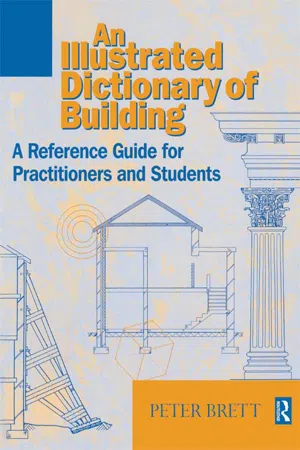
Illustrated Dictionary of Building
About this book
An Illustrated Dictionary of Building is ideal for practitioners and students on GNVQ, NVQ Construction and The Built Environment and Building Craft Operative courses. The guide is also useful reference for those in Higher Education on Professional, Architectural and other associated courses with a building element.
First published in 1989 as Building Terminology, this second edition has been expanded and updated to cover an even wider range of terms, concepts and new practices. Including slang and regional variations, these are clearly defined and cross-referenced, many with the aid of illustrations, to provide an insight into the building industry as a whole.
The logical A-Z arrangement in each section makes this an ideal reference source. The book is also highly illustrated with over 350 diagrams and photographs. The subjects covered include: architectural style; building construction; documentation, administration and control; materials and scientific principles and services and finishes.
Peter Brett was formerly a Head of Faculty for construction at Brooklyn College, Birmingham. He is now in private practice undertaking design, construction and consultancy projects. Brett is an Honorary Member of the City and Guilds of London Institute and a Construction Education Consultant, in addition to being a Chief Examiner and Assessor for various UK, overseas and NVQ schemes.
Information
A
Abacus The slab at the top of a column capital. See also Orders. (39)
Abbey Originally the dwelling of the head of a monastery or convent. Later used to include the church and all buildings associated with a monastic establishment.
Abutment A pier from which an arch springs. Also the junction where building elements meet.

Acanthus
Acanthus A spiny, thick-leaved plant used to model the leaves for the capital of Corinthian columns. See also Orders.
Adam’s style A classical style of architecture, furniture and interior decoration associated with Robert Adam in the eighteenth century. Laid out much of London, introduced stucco to England – main features include moulded plaster, spider’s web fanlights, white fireplaces and fine pictures on ceilings. (24)
Aedicule An opening (door, window cr shrine etc.) framed by columns or pilasters and topped by an entablature and pediment. Such an opening is said to be aediculated.
Aesthetics The beauty or otherwise of an object.
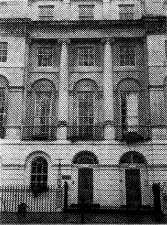
Adam’s style
Aisle An area of a church flanking the nave on either side. Divided from the nave by arcades. (38)
Alcove Recess in a room set aside to hold a bed. Often closed off with doors or railed off with a balustrade.
Alley An aisle, a narrow street or passage in a built-up area, an enclosed garden walkway.
Alms house A dwelling provided for the shelter of poor persons.
Ambulatory A walkway or church aisle.
Amphitheatre An elliptical or circular building with rising tiers of seats. Originally used by the Romans for public spectacles.
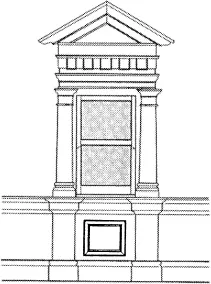
Aedicule
Ancient light A window that has had continuous access to light for a substantial number of years. It is legally entitled to the continuance of that light, unobstructed by the construction of any new building, structure or addition.
Ancones The decorated brackets or consoles with support cornices above openings in classical buildings.
Anta A classical pilaster, the base and capital of which does not conform to the order of adjacent columns. These usually occur at the ends of the flanking walls of a portico. If there are columns between the flanking walls they are said to be in antis. See also Prostyle. (21)
Antechamber or anteroom A room which is used to provide access to a further room beyond.
Anticum The porch to a front door.
Apartment A single room or suite of rooms that are self-contained and form a complete dwelling.
Apse A semicircular, arched or domed recess. See also Church.
Aqueduct An elevated trough or channel for the conveyance of water. See also Viaduct.
Araeostyle One of five forms of intercolumniation, having an arrangement of columns spaced four shaft diameters apart. See also Diastyle, Eustyle, Pycnostyle and Systyle.
Arcade A series of arches supported on columns or piers. See also Arch. (38)
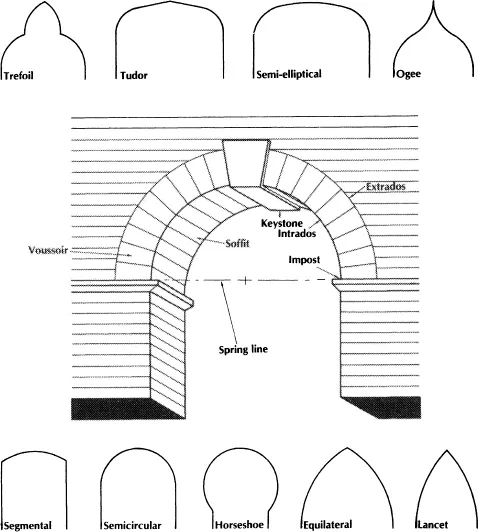
Arch
Arch A curved structure bridging an opening and capable of supporting a load. Built of separate components each supporting one another by mutual pressure. Variously named according to shape.
Architect One who designs a building. See also heading under Documentation, administration and control.
Architecture A distinctive style of building. Also the science of building design.
Architrave The lowest division of the entablature resting directly on the supporting column capitals. Also used to describe the trim around doors and windows which covers the joint between wall and frame. (21, 39)
Arcuated A building which uses the arch principle as its form of construction, as opposed to the post and beam trabeated method.
Area The sunken space around a building to allow light into the basement storey and prevent damp penetration. Also used to mean the surface of a space or the superficial extent of a figure.
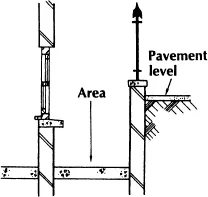
Area
Arena The central area of an amphitheatre where the contest or action took place.
Armoury A storage place for weapons.
Arris The sharp edge or corner where two surfaces join.
Arsenal A public storage place for weapons.
Art Deco The decorative style of the 1920s and 1930s which derives its name from a Paris exhibition of decorative and industrial arts in 1925. It is characterized by geometric design and bright metalic surfaces.
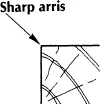
Arris
Art Nouveau A style of decorative art which reached its height between 1890 and 1910. It was a move away from the imitation of past style. Characterized by curved designs based on either natural or abstract forms.
Articulation The design of a buildin...
Table of contents
- Fornt Cover
- Half Title
- Title Page
- Copyright
- Contents
- Preface
- How to use this guide
- 1 Architectural style
- 2 Building construction
- 3 Documentation, administration and control
- 4 General
- 5 Materials and scientific principles
- 6 Services and finishes
- Alphabetical index
Trusted by 375,005 students
Access to over 1.5 million titles for a fair monthly price.
Study more efficiently using our study tools.
Frequently asked questions
Yes, you can cancel anytime from the Subscription tab in your account settings on the Perlego website. Your subscription will stay active until the end of your current billing period. Learn how to cancel your subscription
No, books cannot be downloaded as external files, such as PDFs, for use outside of Perlego. However, you can download books within the Perlego app for offline reading on mobile or tablet. Learn how to download books offline
Perlego offers two plans: Essential and Complete
- Essential is ideal for learners and professionals who enjoy exploring a wide range of subjects. Access the Essential Library with 800,000+ trusted titles and best-sellers across business, personal growth, and the humanities. Includes unlimited reading time and Standard Read Aloud voice.
- Complete: Perfect for advanced learners and researchers needing full, unrestricted access. Unlock 1.5M+ books across hundreds of subjects, including academic and specialized titles. The Complete Plan also includes advanced features like Premium Read Aloud and Research Assistant.
We are an online textbook subscription service, where you can get access to an entire online library for less than the price of a single book per month. With over 1.5 million books across 990+ topics, we’ve got you covered! Learn about our mission
Look out for the read-aloud symbol on your next book to see if you can listen to it. The read-aloud tool reads text aloud for you, highlighting the text as it is being read. You can pause it, speed it up and slow it down. Learn more about Read Aloud
Yes! You can use the Perlego app on both iOS and Android devices to read anytime, anywhere — even offline. Perfect for commutes or when you’re on the go.
Please note we cannot support devices running on iOS 13 and Android 7 or earlier. Learn more about using the app
Please note we cannot support devices running on iOS 13 and Android 7 or earlier. Learn more about using the app
Yes, you can access Illustrated Dictionary of Building by Peter Brett in PDF and/or ePUB format, as well as other popular books in Technology & Engineering & Architecture General. We have over 1.5 million books available in our catalogue for you to explore.