This thoroughly updated edition of Angus J. Macdonald's insightful book Structure and Architecture offers an in depth analysis of structural design and its relationship with architecture. It draws on clear explanations of the connections between structural form, structural performance and architectural design to explore the interface between the technical and the visual in architecture. Additional chapters in this new edition cover the fields of structural theory, structural philosophy, the contributions of prominent engineers to the evolution of Modern architecture, and the concept and practice of sustainable design. Fully illustrated, this critical appraisal of structures is a core-curriculum text for students of architecture, structural engineering and architectural history, and is also a valuable resource for practitioners of these disciplines.

- 350 pages
- English
- ePUB (mobile friendly)
- Available on iOS & Android
eBook - ePub
Structure and Architecture
About this book
Information
CHAPTER 1
The relationship of structure to building
The simplest way of describing the function of an architectural structure is to say that it is the part of a building that resists the loads that are imposed on it. A building may be regarded as simply an envelope that encloses and subdivides space in order to create a protected environment. The surfaces that form the envelope, that is the walls, the floors and the roof of the building, are subjected to various types of loading: external surfaces are exposed to the climatic loads of snow, wind and rain; floors are subjected to the gravitational loads of the occupants and their effects; and most of the surfaces also have to carry their own weight (Figure 1.1). All of these loads tend to distort the building envelope and to induce it to collapse; it is to prevent this from happening that a structure is provided. The function of a structure may be summed up, therefore, as being to supply the strength and rigidity that are required to prevent a building from collapsing. More precisely, it is the part of a building that conducts the loads that are imposed on it from the points where they arise to the ground underneath the building, where they can ultimately be resisted.
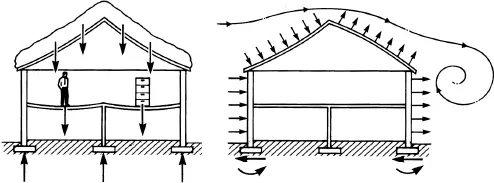
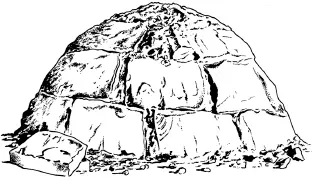

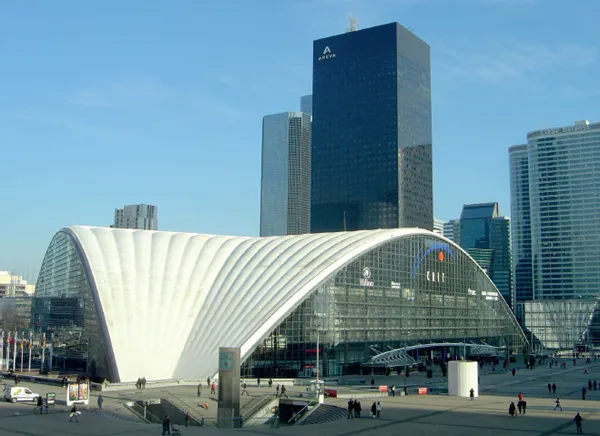
Photo: David Monniaux/Wikimedia Commons.
The location of the structure within a building is not always obvious because the structure can be integrated with the non-structural parts in various ways. Sometimes, as in the simple example of an igloo (Figure 1.2), in which ice blocks form a self-supporting protective dome, the structure and the space enclosing elements are one and the same thing. Alternatively, the structural and space-enclosing elements can be entirely separate. A very simple example is the tepee (Figure 1.3) in which the protecting envelope is a skin of fabric or hide that has insufficient rigidity to form an enclosure by itself and that is supported on a framework of timber poles. Complete separation of structure and envelope occurs here: the envelope is entirely non-structural and the poles have a purely structural function.
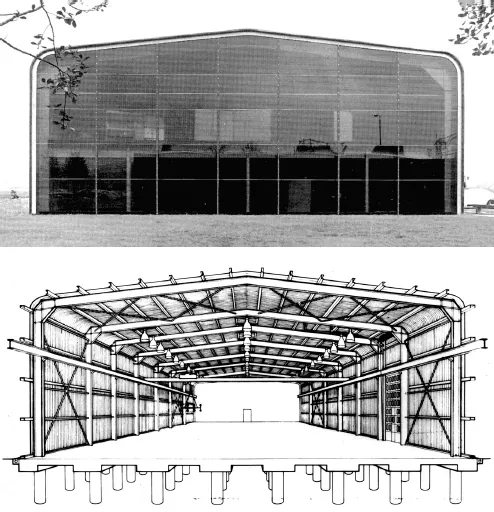
Photo: Andrew Mead.
The CNIT exhibition hall in Paris (Figure 1.4) is a sophisticated version of the igloo; the reinforced concrete shell that forms the main element of this enclosure is self-supporting and therefore structural. Separation of skin and structure occurs in the transparent walls, however, where the glass envelope is supported on a structure of mullions. The roof of the Centre Pompidou building at Metz (Figure 11.6), the overall form of which was largely determined by the requirements of its lattice-timber ‘shell’ structure, is similarly configured although in this case the timber structural elements are distinct from the enclosing roof surface that it supports and the building is therefore similar to the tepee in its separation of structural from enclosing elements.
The steel frame warehouse by Foster Associates at Thamesmead, UK (Figure 1.5), is almost a direct equivalent of the tepee. The elements that form it are either purely structural or entirely non-structural because the corrugated sheet metal skin is entirely supported by the steel frame, which has a purely structural function. A similar breakdown may be seen in later buildings by the same architects, such as the Sainsbury Centre for the Visual Arts at Norwich, UK (Figures 9.33 and 9.34) and the warehouse and showroom for the Renault car company at Swindon (Figure 3.19).
In most buildings the relationship between the envelope and the structure is more complicated than in the above examples and frequently this is because the interior of the building is subdivided to a greater extent by internal walls and floors. For instance, in Foster Associates’ building for Willis, Faber & Dumas (WFD), Ipswich, UK (Figures 1.6 and 5.16) the reinforced concrete structure of floor slabs and columns may be thought of as having a dual function. The columns are purely structural, although they do punctuate the interior spaces and are space-dividing elements, to some extent. The floors are both structural and space-dividing elements. Here, however, the situation is complicated by the fact that the structural floor slabs are topped by nonstructural floor finishing materials and have ceilings suspended underneath them. The floor finishes and ceilings could be regarded as the true space-defining elements and the slab itself as having a purely structural function. The glass walls of the building are entirely non-structural and have a space-enclosing function only.
The Solaris Building in Singapore by Ken Yeang, with Arups as engineers, (Figures 1.7 and 1.8) is also supported by a reinforced concrete structure. Here the structural continuity (see Glossary) and mouldability that concrete offers were exploited to create a complex juxtaposition of solid and void. The building is of the same basic type as the WFD building however: a structural framework of reinforced concrete supports cladding elements that are non-structural.
In the Centre Pompidou in Paris by Piano and Rogers a multi-storey steel framework is used to support reinforced concrete floors and non-loadbearing glass walls. The breakdown of parts is straightforward (Figs 9.28 to 31): identical plane-frames, consisting of long steel columns which rise through the entire height of the building supporting triangulated girders at each floor level, are placed parallel to each other to form a rectangular plan. The concrete floors span between the triangulated girders. Additional small cast-steel girders project beyond the line of columns and are used to support stairs, escalators and servicing components positioned along the sides of the building outside the glass wall, which is attached to the frame near the columns. A system of cross-bracing on the sides of the framework prevents it from collapsing through instability. In this type of building the structure not only provides support but makes a significant contribution to the visual aspects of the architecture.
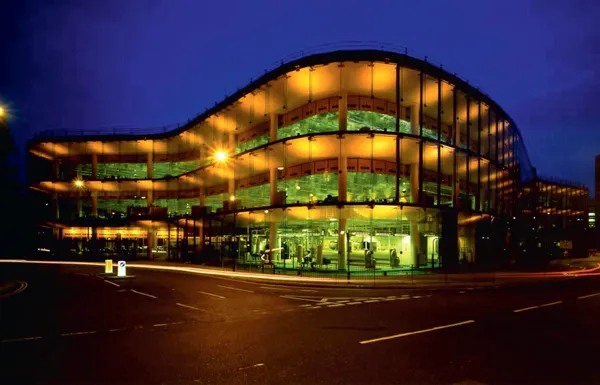
Photo: A. Hunt.
The free form, in both plan and cross-section, of the Riverside Museum in Glasgow by architect Zaha Hadid (Figures 1.9 and 10.25 and 26), make it in some respects a complete contrast to the controlled order of the C...
Table of contents
- Cover
- Half Title
- Title Page
- Copyright Page
- Table of Contents
- Preface to the third edition
- Acknowledgements
- Introduction
- 1 The relationship of structure to building
- 2 Structural requirements
- 3 Structural materials
- 4 The archetypes of structural form – the relationship between structural form and structural efficiency
- 5 Complete structural arrangements
- 6 The critical appraisal of structures
- 7 Theory of structures
- 8 Philosophy of structures and its relationship to architectural theory in the Modern period
- 9 The engineers – their role in developing the imagery of Modern architecture
- 10 Structure and architecture
- 11 Structure and sustainability
- Glossary of structural terms
- Selected bibliography
- Index
Trusted by 375,005 students
Access to over 1.5 million titles for a fair monthly price.
Study more efficiently using our study tools.
Frequently asked questions
Yes, you can cancel anytime from the Subscription tab in your account settings on the Perlego website. Your subscription will stay active until the end of your current billing period. Learn how to cancel your subscription
No, books cannot be downloaded as external files, such as PDFs, for use outside of Perlego. However, you can download books within the Perlego app for offline reading on mobile or tablet. Learn how to download books offline
Perlego offers two plans: Essential and Complete
- Essential is ideal for learners and professionals who enjoy exploring a wide range of subjects. Access the Essential Library with 800,000+ trusted titles and best-sellers across business, personal growth, and the humanities. Includes unlimited reading time and Standard Read Aloud voice.
- Complete: Perfect for advanced learners and researchers needing full, unrestricted access. Unlock 1.5M+ books across hundreds of subjects, including academic and specialized titles. The Complete Plan also includes advanced features like Premium Read Aloud and Research Assistant.
We are an online textbook subscription service, where you can get access to an entire online library for less than the price of a single book per month. With over 1.5 million books across 990+ topics, we’ve got you covered! Learn about our mission
Look out for the read-aloud symbol on your next book to see if you can listen to it. The read-aloud tool reads text aloud for you, highlighting the text as it is being read. You can pause it, speed it up and slow it down. Learn more about Read Aloud
Yes! You can use the Perlego app on both iOS and Android devices to read anytime, anywhere — even offline. Perfect for commutes or when you’re on the go.
Please note we cannot support devices running on iOS 13 and Android 7 or earlier. Learn more about using the app
Please note we cannot support devices running on iOS 13 and Android 7 or earlier. Learn more about using the app
Yes, you can access Structure and Architecture by Angus J. Macdonald in PDF and/or ePUB format, as well as other popular books in Architecture & Architecture General. We have over 1.5 million books available in our catalogue for you to explore.