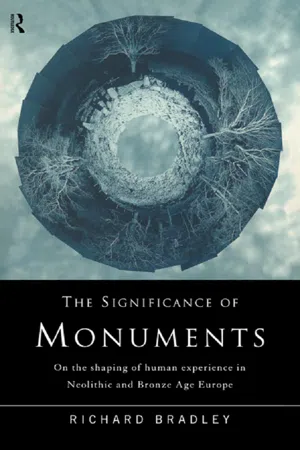
The Neolithic period, when agriculture began and many monuments - including Stonehenge - were constructed, is an era fraught with paradoxes and ambiguities. Starting in the Mesolithic and carrying his analysis through to the Late Bronze Age, Richard Bradley sheds light on this complex period and the changing consciousness of these prehistoric peoples.
The Significance of Monuments studies the importance of monuments tracing their history from their first creation over six thousand years later. Part One discusses how monuments first developed and their role in developing a new sense of time and space among the inhabitants of prehistoric Europe. Other features of the prehistoric landscape - such as mounds and enclosures - across Continental Europe are also examined. Part Two studies how such monuments were modified and reinterpreted to suit the changing needs of society through a series of detailed case studies.
The Significance of Monuments is an indispensable text for all students of European prehistory. It is also an enlightening read for professional archaeologists and all those interested in this fascinating period.
eBook - ePub
The Significance of Monuments
On the Shaping of Human Experience in Neolithic and Bronze Age Europe
- 192 pages
- English
- ePUB (mobile friendly)
- Available on iOS & Android
eBook - ePub
The Significance of Monuments
On the Shaping of Human Experience in Neolithic and Bronze Age Europe
About this book
Information
Part I
From the house of the dead
But the masons leave
For the lime-pits of time, with flowers, chaff, ashes,
Their plans are spattered with blood, lost,
And the golden plumb-line of sun says: the world is leaning,
Bedded in a base where the fingers
Of ancient waters touch the foundation.
But feel the walls: the glow stays on your hands.
(from Ivan Lalic, 1996, ‘Of the Builders’,
translated by Francis R. Jones)
translated by Francis R. Jones)
Chapter 1
Structures of sand
Settlements, monuments and the nature of the Neolithic
For many years the Neolithic long barrows at Barkaer in Denmark were interpreted as two of the largest houses in prehistoric Europe. The recent report on fieldwork at this site has involved a new interpretation. These were not houses at all but massive funerary monuments, built at the beginning of the Neolithic period. This example serves to introduce a wider problem which runs throughout this book, for it now seems that among the earliest indications of Neolithic activity in north and north-west Europe were enormous constructions of this kind. They played no part in everyday affairs and their prominent place in the prehistoric landscape contrasts sharply with what little is known about settlements and houses at this time. Even the evidence for early agriculture is very limited indeed. This is a situation that is found in many areas during the Neolithic and Early Bronze Age. This chapter sets out some of the problems of studying the archaeology of these periods, and argues that the development of monumental architecture should be treated as a topic in its own right.
THE PROBLEM WITH ARCHAEOLOGY
The practice of archaeology is not as objective as fieldworkers would like to believe; nor is it as subjective as theorists often suppose. Its procedures employ a mixture of objectivity and subjectivity, and it is the business of anyone examining the intellectual development of the discipline to decide where those boundaries were set at different times. The observations made in the field depend on a whole series of assumptions that are not discussed because they are taken for granted. It is only when those ideas are challenged that archaeologists can recognise their own vulnerability. All their primary observations are influenced by their knowledge and experience, but what they accept as knowledge, and what they think of as relevant experience, will change when the assumptions behind them are questioned. The methods used in the field constrain the interpretations formed at the time, and those techniques may not be the best ones for investigating different problems.
Normally, these faultlines in archaeological thinking are concealed from view because the results of an investigation are published while they are fresh. They are more likely to cause confusion where the final report is delayed, so that it appears in a different intellectual climate from the original research. A good example of this problem can be found in Danish prehistory. For nearly thirty years, between 1947 and 1975, it seemed as if two of the largest houses in Neolithic Europe were to be found at Barkaer in Jutland. Excavation had begun even before that period, with a first season of research in 1931. Eighteen years passed before the fieldwork was completed, and another forty-three elapsed before the results were brought to publication. By then the excavator, P. V. Glob, had died and the report was written by someone else (Liversage 1992).
The effect of such a long delay between fieldwork and publication was that Glob’s interpretation remained unchallenged until the end of his life, when he became aware of other ways of thinking about the site. It so happened that the intellectual climate in which the work was undertaken remained the same over the greater part of that period. The excavator’s interpretation conformed so well to what was thought at the time that there seemed no reason to believe that the results of his work would need to be revised. In any case, since his primary observations had been withheld, it would have been difficult for anyone to feel confident that another interpretation was more appropriate.
The Barkaer excavations are generally acknowledged to have been among the best of their time, and they constitute an admirable programme of research. As early as 1928, Glob had become aware that the site contained Neolithic material, and when he worked there in earnest it was in the expectation that this might be one of the best preserved Neolithic settlements in northern Europe. There seemed to be the remains of four houses on the site, and Iversen’s investigation of the pollen in a nearby lake held out the prospect of integrating Barkaer into the early history of agriculture in Scandinavia (Iversen 1941). Becker’s account of the pottery found in the first major excavation gave an added impetus to the project, for it suggested that the settlement belonged to the first period of the Danish Neolithic (Becker 1947). More extensive excavation at Barkaer might be expected to shed light on the character of settlement and land use during a formative phase.
Those seem to have been the assumptions with which the main campaign of excavation was undertaken between 1947 and 1949. The work was conducted on an unusually large scale for this time, and an area of nearly 3,000 square metres was investigated. The archaeological deposits were about a metre thick, and were cleared across large areas of the site and recorded in plan at several different levels. The result was the identification, not of four small houses, as Glob had previously supposed, but of two enormous rectangular structures which had been built side by side. Each was just under 90 metres long and approximately 7 metres wide. They were defined by stone walls and by the remains of internal partitions, which could be recognised from sudden changes in the colour of the sand that filled these buildings. These divisions were also marked by lines of stakeholes, while the outer walls of the houses included a number of postholes cut into the subsoil (see Figure 1).
It was not difficult to identify these structures as the well-preserved remains of longhouses, for buildings of that type were already known in earlier contexts further to the south, and most especially on the loess soils of the Rhineland. This was the likely source of Neolithic agriculture in Scandinavia, and it was also the point of origin of some of the artefacts that had already been imported into Mesolithic settlements from across the agricultural frontier. The two houses at Barkaer were later than those excavated on the loess, but they also seemed to be more massive structures. They gained an added significance because of the remarkable conditions of preservation, which allowed individual room divisions to be recognised in a way that could not be achieved with buildings that had been reduced to subsoil features.
Because the structural evidence at Barkaer had survived so well, it was possible to suggest that each of the longhouses had been divided into nearly thirty compartments, separated from one another by light partitions or screens. These compartments extended across the full width of the house, and, as most of the screens that defined them do not seem to have been interrupted by doorways, it was likely that each had its own entrance through the side of the building. On that basis they might be thought of as independent residential units. Each occupied approximately the same amount of space: an area of a little under 20 square metres. These units were long and narrow – just over 6 metres in length and 3 metres in width – and in one of the houses they may have been divided in two by a row of posts running along the middle of the building. Although areas of burnt clay were recognised in the excavation, there was nothing to suggest that each room or pair of rooms was provided with its own hearth.
The outer walls of both houses were apparently of stone, although the roofs were supported by a framework of wooden posts. The buildings were laid out on virtually the same alignment and faced one another across what Glob called a village street. That village was located on a small area of raised ground near to a lake (see Figure 2).
The excavator found other features which were not so easy to fit into this scheme, but none was sufficiently anomalous for him to doubt his interpretation. The first problem was the presence of a stone cist towards the east end of one of the houses. This seems to have been the first feature to be discovered at Barkaer, and, although no bones survived in the acid soil, it seems to have contained two pots and an amber bead: a collection of artefacts which might well have served as grave goods. Glob accepted this interpretation but suggested that this feature was not built until the Late Neolithic.
There were three other features with similar material, each characterised by a pair of upright posts in similar positions to the end stones of that cist. They contained a number of artefacts, which seemed to be of the same date as those associated with the houses, including complete pots, amber beads and copper ornaments. At the eastern end of each of the houses a row of massive posts had been bedded in the ground, and each was associated with another decorated vessel. Glob recognised the exceptional character of such finds and initially suggested that they had been deposited during rituals associated with the use of the houses, although he later came to believe that the finds of copper and amber had been deposited in graves.

Figure 1. The Neolithic ‘longhouses’ at Barkaer, Jutland, simplified from Liversage (1992). The drawing also indicates the positions of the mortuary structures and the timber facades at the original ends of the mounds.

Figure 2. The local setting of the excavated monuments at Barkaer, after Liversage (1992).
That interpretation was almost certainly correct, for, with increasing excavation on both sides of the North Sea, it became apparent that there were many Neolithic burials in graves associated with similar settings of posts: stone-built dolmens were not the only form of mortuary monument in Early Neolithic Denmark. At the same time, those excavations showed that the long mounds that were sometimes associated with wooden mortuary structures could be divided into a series of bays defined by rows of uprights just like those at Barkaer. The possibility arose that Glob’s longhouses might actually be the remains of two mounds. That certainly seemed to explain some problems that had been identified since he published his interim report. It was clear that the floors of the houses could be almost a metre thick, although the same divisions between the compartments were identified throughout this deposit (see Figure 3). At first, it was suggested that this material might be windblown sand, filling the inside of the buildings and causing them to be abandoned, but this could hardly explain why separate rooms were filled with sand of different colours. The outer walls of the houses presented problems too, for they consisted of single rows of boulders, which could be found at quite different levels abutting the ‘floors’ of the houses. Eventually, Glob himself recognised the difficulties of maintaining his original interpretation and accepted that both structures had been rectangular mounds. Having done so, he held to his original view that the postholes found beneath them were the remains of wooden houses of exactly the same dimensions as the later earthworks. Thus the houses of the living were converted directly into the houses of the dead.

Figure 3. The internal structure of one of the monuments at Barkaer, simplified from Liversage (1992). The different kinds of shading represent the separate layers of sand in the filling of the mound.
There is no doubt that the site at Barkaer had been occupied before either of these mounds was built. Neolithic artefacts were found throughout the excavated area, but not in particularly large numbers. As we have seen, postholes were also recorded, but these raise many problems, for even on the most optimistic account they do not provide much evidence for buildings in the same positions as the mounds. Moreover, it seems as if the areas thought to be occupied by houses may have been investigated for postholes at the expense of the surrounding area; Glob had already decided that he was excavating two buildings and was looking for their outer walls. This may be why these features seem to cluster in the area covered by the mounds.
The new interpretation of the sequence at Barkaer suggests that a massive structure associated with the dead was built over the ephemeral traces of a settlement of the living. How can that be reconciled with the environmental sequence from the nearby lake? Again, the evidence needs to be reassessed. Iversen’s pollen core from Korup Lake lacked any dating evidence, although an outline chronology is now suggested by radiocarbon. This indicates that the episodes of clearance and land use that he recognised there may have been spread over roughly six hundred years. Moreover, the catchment represented by his pollen core could have covered an area extending as far as 10 kilometres from the sample site. As a result, the diagram can only be interpreted in the most general terms. Even accepting these caveats, there is another problem, for Iversen recognised that in the early stages of this sequence the evidence for human activity was actually rather limited. Apart from an elm decline, which may have been the result of natural disease, there was a fall in oak and hazel pollen and a rise in the proportion of grasses. It was only in the following phase that plantain was strongly represented and the increase in the pollen of this plant was matched by the distribution of cereal pollen in the lake. Here we do have evidence of Neolithic farming, although almost 90 percent of the pollen was still contributed by trees. According to the dating evidence currently available, this episode happened some while after the building of the barrows at Barkaer. As early as 1941, Iversen was aware of this problem, arguing that the settlement on that site could not belong to the earliest Neolithic period (Iversen 1941: 58–9). The fact that it did so suggests that its occupants had little impact on the local vegetation: they need not have been growing cereals at all. In any case, Liversage comments that the subsoil at Barkaer would not have been suited to cultivation.
THE PROBLEM WITH THE NEOLITHIC
I have considered Barkaer in detail because it epitomises a series of problems experienced in many parts of north and north-west Europe, where long-held preconceptions about the character of Neolithic activity are having to be reconsidered. Glob’s excavation strategy was the inevitable outcome of a particular conception of Neolithic life, and so was his interpretation of the results. He assumed that the Neolithic period saw the adoption of stable mixed farming, and for a while the pollen core from Korup Lake seemed to support this contention. He assumed that early farmers would live in permanent settlements, and this view influenced his perceptions of Barkaer. The evidence of the burials on the site was played down; the problem of the metre-thick house floors was overlooked; and he postulated stone walls from a mixture of boulders and loose sand that could never have supported the superstructure of a building. I do not wish to be too critical, for in its time this was a most accomplished excavation. Its shortcomings are simply those of archaeology itself: a subject in which complete objectivity is impossible and in which the extent of subjective interpretations can only be recognised in retrospect.
Glob’s confusions were the confusions of an entire generation, faced with a Neolithic that failed to measure up to what was expected of it. Even now archaeologists find it difficult to recognise that, over large parts of Europe, Neolithic activity did not take the form that they had been led to expect. Instead of evidence for stable mixed farming, there are signs of a more mobile pattern of settlement (Whittle 1996a: ch. 7). Instead of the houses of the living, they find monuments to the dead (Bradley 1993: ch. 1). Where they can combine both kinds of evidence, as Liversage has at Barkaer, events might not take place in the expected sequence. It is often supposed that monument building was financed through the surplus created by farming (Case 1969), but in northern Europe the first monuments may be found alongside the first domesticates, and sometimes the earliest evidence for more intensive land use does not come until after mounds or cairns had been built. The conventional definition of the Neolithic period combines monument building with farming and the adoption of a new material culture, but all too often this association falls apart (Thomas 1993). Beyond the longhouse settlements of the loess, t...
Table of contents
- Cover
- Title
- Copyright
- Dedication
- Contents
- List of figures
- Preface
- Part I From the house of the dead
- Part II Describing a circle
- References
- Index
Trusted by 375,005 students
Access to over 1.5 million titles for a fair monthly price.
Study more efficiently using our study tools.
Frequently asked questions
Yes, you can cancel anytime from the Subscription tab in your account settings on the Perlego website. Your subscription will stay active until the end of your current billing period. Learn how to cancel your subscription
No, books cannot be downloaded as external files, such as PDFs, for use outside of Perlego. However, you can download books within the Perlego app for offline reading on mobile or tablet. Learn how to download books offline
We are an online textbook subscription service, where you can get access to an entire online library for less than the price of a single book per month. With over 1.5 million books across 990+ topics, we’ve got you covered! Learn about our mission
Look out for the read-aloud symbol on your next book to see if you can listen to it. The read-aloud tool reads text aloud for you, highlighting the text as it is being read. You can pause it, speed it up and slow it down. Learn more about Read Aloud
Yes! You can use the Perlego app on both iOS and Android devices to read anytime, anywhere — even offline. Perfect for commutes or when you’re on the go.
Please note we cannot support devices running on iOS 13 and Android 7 or earlier. Learn more about using the app
Please note we cannot support devices running on iOS 13 and Android 7 or earlier. Learn more about using the app
Yes, you can access The Significance of Monuments by Richard Bradley in PDF and/or ePUB format, as well as other popular books in Social Sciences & History of Architecture. We have over 1.5 million books available in our catalogue for you to explore.