Germinal Life is the sequel to the highly successful Viroid Life. Where Viroid Life provided a compelling reading of Nietzsche's philosophy of the human, Germinal Life is an original and groundbreaking analysis of little known and difficult theoretical aspects of the work of French philosopher Gilles Deleuze.
In particular, Keith Ansell Pearson provides fresh and insightful readings of Deleuze's work on Bergson and Deleuze's most famous texts Difference and Repetition and A Thousand Plateaus. Germinal Life also provides new insights into Deleuze's relation to some of the most original thinkers of modernity, from Darwin to Freud and Nietzsche, and explores the connections between Deleuze and more recent thinkers such as Adorno and Merleau-Ponty.
eBook - ePub
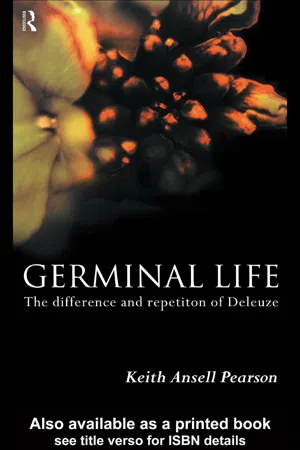
Germinal Life
The Difference and Repetition of Deleuze
- 288 pages
- English
- ePUB (mobile friendly)
- Available on iOS & Android
eBook - ePub
About this book
Information
1
THE DIFFERENCE OF BERGSON
Duration and creative evolution
Deleuze is a magical reader of Bergson, who in my opinion is his real maitre, even more than Spinoza, and perhaps even more than Nietzsche.
(Badiou 1997:62)
If the thought really yielded to the object, if its attention were on the object, not on its category, the objects would start talking under the lingering eye.
(Adorno 1966:38; 1973:27–8)
Introduction
It is Bergson who defines the task of philosophy as one of learning to think beyond the human condition. What exactly is the meaning of this ‘beyond’? Deleuze configures the task as follows:
To open us up to the inhuman and the superhuman (durations which are inferior or superior to our own), to go beyond the human condition: This is the meaning of philosophy, in so far as our condition condemns us to live among badly analyzed composites, and to be badly analyzed composites ourselves.
(Deleuze 1966:19; 1988:28)
Why are we caught up in the investigation of badly analysed composites and why are we those ourselves? What does it mean to be open to other durations? Addressing these questions through a careful reading of Deleuze’s 1956 essay on Bergson and his 1966 text, Bergsonism, will take us to the heart of the project of philosophy as Deleuze conceives it, and also show that going ‘beyond’ the human condition does not entail leaving the ‘human’ behind, but rather aims to broaden the horizon of its experience. Throughout the contours and detours of his intellectual life Deleuze never ceased to grant a fundamental and vital autonomy to philosophy. It was from an essentially Bergsonian influence that Deleuze cultivated the idea that philosophy could go beyond human experience in a way that would deepen and enhance it. This requires a major reorientation of philosophy, a new conception of critique, and a new logic which proceeds not via contradictions but through nuances.
Deleuze’s first sustained and published encounter with Bergson has several notable features. First, there is the fact that it took place in the 1950s, less than a decade after the end of the war, when the climate would have been unfavourable to a novel reworking of Bergson’s philosophy with its underlying optimism (although the essay on difference was published in 1956 it had been composed a few years earlier). Vitalism was largely a dead tradition in 1950s and Bergson’s significance reduced to that of being a philosopher of insects. Second, and perhaps most significant, is that Deleuze should have returned to Bergson in order to articulate on the basis of his philosophy a thinking of difference as a thinking of internal difference. This conception of difference is extended to the notion that many have taken to be the most problematic aspect of Bergson’s so-called vitalism, that of élan vital, which is conceived by Deleuze as an internal explosive force that can account for the ‘time’ of evolution as a virtual and self-differentiated movement of invention.
The 1956 essay begins very precisely, and seemingly uncontentiously, by opening out a problematic that the rest of the essay will then pursue in all its ramifications: ‘The notion of difference must throw a certain light on Bergson’s philosophy, but inversely Bergsonism must bring the greatest contribution to a philosophy of difference’ (1956:79; 1997:1). It is a quasiphenomenological venture since the aim, Deleuze declares, is to ‘return’ to things themselves. The promise, if this is got right, is nothing less than one of difference delivering Being to us. A careful consideration of the differences of nature will lead us to the nature of difference. Hitherto, thinking has confused two kinds of differences and covered one over with the other: differences of degree over differences of kind or nature. At other times, it has effected the reverse and focused only on differences of kind (such as between the perception of matter and matter itself). The task of philosophy is to grasp the thing itself in its positivity, and this requires a notion of internal difference. Deleuze fully appreciates that a certain strand of modern philosophy finds such a notion of difference to be absurd. In the Hegelian schema of difference a thing differs from itself only because it differs in the first place from all that it is not. Difference is, therefore, said to be constituted at the point of contradiction and negation. The novel modernity of Bergsonism lies, for Deleuze, in its critique of metaphysics and of a science that has forgotten the durational character of life and imposed on it an abstract mechanics. It rests on a schema that homogenizes difference by selecting only differences of degree through a spatialized representation of the real. General ideas simply present for our reflection completely different givens that get collected in utilitarian groupings. The task for Deleuze is one of breaking out of a merely ‘external state of reflection’, so that philosophy no longer has a merely negative and generic relation with things in which it remains entirely in the element of generality (1956:80).
Deleuze’s thinking of difference ‘and’ repetition is already fairly well worked out in the 1956 essay in terms of its essential components. In the following reading I shall commence with the 1966 essay since it begins in instructive fashion by seeking to expose the particular character of the Bergsonian method (intuition). I will then show how this links up to the question of duration and to the élan vital. Throughout I will supplement the analysis of the 1966 text by drawing on material outlined in the 1956 essay. There is a remarkable continuity between the two pieces of writing in spite of the ten-year gap in Deleuze’s public engagement with Bergson. We should note, however, that some of the earlier material gets dropped or reconfigured, such as, for example, an examination of the character of historical consciousness (‘If difference itself is biological, consciousness of difference is historical’, 1956:94).1 My aim is not to assess the correctness of Deleuze’s reading of Bergson (by describing it as ‘Bergsonism’ Deleuze is surely drawing our attention to the inventive character of his reading), which is often accused of making him sound too much like Nietzsche. Rather, I have set myself the task of providing instructive insight into its most salient features as it pertains to the matter of ‘creative evolution’ in terms of a thinking of difference.
The method of intuition
The Absolute is difference, but difference has two facets, differences in degree and differences in kind.
(Deleuze 1966:27; 1988:35)
The ambition of philosophy, Deleuze writes in the 1956 essay, is to articulate for the object a concept appropriate to it, even though it may no longer remain from that point on a concept as such given its singularity. In order to articulate this philosophy it will be necessary to have recourse not simply to a method but to a method capable of disclosing ‘the jouissance of difference’ (1956:81). Deleuze stresses in his 1966 text that intuition is the method peculiar to ‘Bergsonism’ and denotes neither a vague feeling or incommunicable experience nor a disordered sympathy. Rather, it is a fully developed method that aims at precision in philosophy (see Bergson 1965:11). Where duration and memory denote lived realities and concrete experiences, intuition is the only means we have at our disposal for crafting a knowledge of experience and reality. ‘We may say, strangely enough’, Deleuze notes, ‘that duration would remain purely intuitive, in the ordinary sense of the word, if intuition—in the properly Bergsonian sense—were not there as method’ (Deleuze 1966:2; 1988:14). However, intuition is a complex method that cannot be contained in a single act. Instead, it has to be seen as involving a plurality of determinations and a variety of mediations. The first task is to stage and create problems; the second is to locate differences in kind; and the third is to comprehend ‘real time’, that is, duration as a heterogeneous and continuous multiplicity. Indeed, Bergson himself acknowledges that other philosophers before him, notably Schelling and Schopenhauer, had drawn heavily on intuition as a method. Their task, however, he says, was not to discover duration but to search for the eternal (Bergson 1965:30).
Concerning the first problem, Deleuze argues that we go wrong when we hold that notions of true and false can only be brought to bear on problems in terms of ready-made solutions. This is a far too pre-emptive strategy that does not take us beyond experience but locks us in it. This negative freedom is the result of manufactured social prejudices where, through social institutions such as education and language, we become enslaved by ‘orderwords’ that identify for us ready-made problems which we are forced to solve. This is not ‘life’, and it is not the way life itself has ‘creatively’ evolved. Therefore, true freedom, which can only be a positive freedom, lies in the power to decide through hesitation and indeterminacy and to constitute problems themselves. This might involve the freedom to uncover certain truths for oneself, but the excessive freedom is not so much one of discovery as more one of invention. Discovery is too much involved in uncovering what already exists, an act of discovery that was bound to happen sooner or later and contingent upon circumstances. Invention, however, gives Being to what did not exist and might never have happened since it was not destined to happen, there was no pre-existing programme by which it could be actualized. In mathematics and in metaphysics the effort of invention consists in raising the problem and in creating the terms through which it might be solved but never as something ready-made. As Merleau-Ponty notes in a reading of Bergson that is consonant with Deleuze’s on some of these points, when it is said that well-posed problems are close to being solved, ‘this does not mean that we have already found what we are looking for, but that we have already invented it’ (Merleau-Ponty 1988:14).
Deleuze offers a Bergsonian reading of Marx on this point. When Marx says that humanity only sets itself problems it is capable of solving this is not the empiricist, or rather, positivist, trap we might think, since the problems take us beyond what we think we are and are capable of. Marx’s thought, therefore, is a vital empiricism. For Deleuze, the history of humanity, considered from both theoretical and practical points of view, is a history of the construction of problems (it is a history of overhumanity, one might say). It is in this excessive sense that we can say humankind makes its own history, and becoming conscious of this praxis amounts to a drama of freedom as the ‘meaning’ of human life and of its germinal existence (the fact that it lives on and survives only by living beyond itself). In a deeper sense, however, the historical character of human existence is an expression of the élan vital which marks life as creative: ‘Life itself is essentially determined in the act of avoiding obstacles, stating and solving a problem. The construction of the organism is both the stating of a problem and a solution’(Deleuze 1966:5; 1988:16).
We will shortly examine in greater detail this point on the organism as an invention of life and as the staging of a problem. Does it suggest that the organism is constructed for a purpose or an end? Is it an end-in-itself or merely a vehicle through which life limits itself only in order to enhance and revitalize its powers of invention? Can one speak of an end of evolution, granting it a final purpose, or is constant invention and re-invention the only end? Let us note at this stage that Deleuze locates the novelty of Bergson’s approach in its attempt to think ‘creative’ evolution beyond both mechanism and finalism and, in this way, to grant an important role to invention in evolution, an invention that is only possible to the extent that evolution involves duration. It is with Bergson’s approach in mind that Deleuze argues that in the cases of both living matter and organized matter, such as organismic life, what one finds in evolution is the stating of problems in which the ‘negative’ articulations of opposition and contradiction, derived from notions of obstacle and need, are secondary phenomena and of secondary importance (for a clear statement of this view see Deleuze 1968:272; 1994:211). We may note how remarkably close this is to Nietzsche’s ‘contra Darwin’ position articulated in his Genealogy of Morality, in which the critique takes the form of challenging the emphasis placed in Darwinian theory on ‘adaptation’. To construe evolution in terms of adaptation is to overlook the prime importance of the form-shaping forces or powers that provide life with new directions and from which adaptation derives only once these powers have had their effect. Speaking of Herbert Spencer, Nietzsche argues that the dominant role these powers play in ‘the organism itself’, in which the life-will is active and reveals itself, is denied (Nietzsche 1994:56; for more detailed insight into Nietzsche’s relation to Darwinism see my Viroid Life, 1997, Essay 4). This suggests that there may be a more objective basis to Deleuze’s ‘Nietzschean’ reading of Bergson than commonly supposed. Indeed, it is astonishing how close to Nietzsche Bergson is in the way he approaches questions of philosophy. Equally surprising is the fact that Nietzsche nowhere figures in the text Creative Evolution, since it is Nietzsche who had already endeavoured to think evolution beyond the terms of both mechanism and finalism.
Let me return, however, to Deleuze’s reading of Bergson. The second rule of intuition is to do away with false problems, which are said to be of two kinds: first, those which are caught up in terms that contain a confusion of the ‘more’ and the ‘less’; and, second, questions which are stated badly in the specific sense that their terms represent only badly analysed composites. In the first case the error consists in positing an origin of being and of order from which nonbeing and disorder are then made to appear as primordial. On this schema order can only appear as the negation of disorder and being as the negation of nonbeing (see Bergson 1962:223; 1983:222). Such a way of thinking introduces lack into the heart of Being. It more or less errs in not seeing that there are kinds of order and forgetting the fact that Being is not homogeneous but fundamentally heterogeneous. Badly analysed composites result from an arbitrary grouping of things that are constituted as differences in kind. For example, in Creative Evolution Bergson contends that the cardinal error that has vitiated the philosophy of nature from Aristotle onwards is identifying in forms of life, such as the vegetative, instinctive, and rational, ‘three successive degrees of the development of one and the same tendency, whereas they are divergent directions of an activity that has split up as it grew’. He insists that the difference between them is neither one of intensity nor of degree but of kind (1962:136; 1983:135). Bergson wants to know how it is that we deem certain life-forms to be ‘superior’ to others, even though they are not of the same order, and neither can they be posited in terms of a simple unilinear evolutionism with one life-form succeeding another in terms of a progress towards perfection in self-consciousness (175; 174). Life proceeds neither via lack nor the power of the negative but through internal self-differentiation along lines of divergence. Indeed, Bergson goes so far as to claim that the root cause of the difficulties and errors we are confronted with in thinking creative evolution resides in the power we ascribe to negation, to the point where we represent it as symmetrical with affirmation (286; 287). When Deleuze says that resemblance or identity bears on difference qua difference, he is being faithful to Bergson’s critical insight into the character of negation, chiefly, that it is implicated in a more global power of affirmation.
It is through a focus on badly analysed composites that we are led, in fact, to positing things in terms of the more and the less, so that the idea of disorder only arises from a general idea of order as a badly analysed composite. This amounts to claiming, as Deleuze cognizes, that we are the victims of illusions which have their source in aspects of our intelligence. However, although these illusions refer to Kant’s analysis in the Critique of Pure Reason, where Reason is shown to generate for itself in exceeding the boundaries of the Understanding inevitable illusions and not simple mistakes, they are not of the same order. There is a natural tendency of the intellect to see only differences in degree and to neglect differences in kind. This is because the fundamental motivation of the intellect is to implement and orientate action in the world. For the purposes of social praxis and communication the intellect needs to order reality in a certain way, making it something calculable, regular, and necessary. Nietzsche applies this insight not only to our action on the world but also to the constitution of our ‘inner world’ (the ‘soul’). Human consciousness and memory have been cultivated by making the individual self itself something regular and calculable and this has been done by constituting the self as a site of discipline and culture. Bergson is incredibly close to Nietzsche on some of these points. In terms reminiscent of Nietzsche he attacks the notion of a timeless substratum lying behind all reality, adding that an ego which does not change does not endure either: ‘If our existence were composed of separate states with an impassive ego to unite them, for us there would be no duration’ (Bergson 1962:4; 1983:4). What is obtained by construing the flow of life in this way is an ‘artificial limitation’ of the internal life, a stasis which lends itself to the requirements of logic and language. For Bergson it is possible—indeed necessary—to think of movement without the support of an invariable substance that is posited as underlying all becoming, while Nietzsche is insistent that logical-metaphysical postulates, such as the belief in substance, are the result of our habit of treating all our deeds as consequences of our will in which the ego is protected from vanishing in the ‘multiplicity of change’ (compare Nietzsche 1968: Section 488; see also Sections 484–5, 515–16; and 1974: Section 354). The intellect schematizes in order to impose upon the chaos it encounters the degree of regularity and uniformity that its practical needs require. Therefore, the ‘meaning’ of our knowledge, Nietzsche insists, is to be approached in ‘a strict and narrow anthropocentric and biological sense’. In order for a certain species to maintain itself and increase its feeling of power over the world it is necessary that it develop a conception of calculable and constant reality in order to establish a schema of behaviour on it (Nietzsche 1968: Section 480). Informing the development of our ‘organs of knowledge’, therefore—organs that have evolved in terms of their formation through a culture of external technics—is the ‘utility of preservation’ (ibid.).
To bring into play a different kind of intelligence is for Deleuze to introduce the ‘critical’ element into philosophy that will enable us to go beyond the human condition and to widen the canvas of its experience. It is intuition which allows this critical tendency to express itself through two procedures: the discovery of differences in kind and the formulation of criteria for differentiating between true and false problems. But at this point things get even more complex. This is for several reasons. Thought can only move beyond dualisms in the activity of their construction (extensity and intensity, space and time, matter and memory, instinct and intelligence, etc.). Second, if intuition is to be conceived as a method which proceeds via division—the division of a composite into differences of kind—is this not to deny that reality is, in fact, made up of composites and mixtures of all kinds? For Bergson, Deleuze argues, the crucial factor is to recognize that it is not things that differ in kind but rather tendencies: ‘a thing in itself and in its true nature is the expression of a tendency before being the effect of a cause’ (Deleuze 1956:83; 1997:4). In other words, what differs in nature are not things (their states or traits) but the tendency things possess for change and development. A simple difference of degree would denote the correct status of things if they could be separated from their tendencies. For Bergson the tendency is primary not simply in relation to its product but rather in relation to the causes of productions in time, ‘causes always being retroactively obtained starting from the product itself’ (ibid.). Any composite, therefore, needs to be divided according to qualitative tendencies. Again, this brings Bergsonism close to Kant’s transcendental analysis, going beyond experience as given and constituting its conditions of possibility. However, these are not conditions of all possible experience but of ‘real’ experience (the experience of inferior and superior durations). Th...
Table of contents
- Cover
- Halftitle
- Title
- Copyright
- Dedication
- Contents
- Acknowledgements
- A note on translations
- Introduction: repeating the difference of Deleuze
- 1 The difference of Bergson: duration and creative evolution
- 2 Difference and repetition: the germinal life of the event
- 3 The memories of a Bergsonian: from creative evolution to creative ethology
- Conclusion: fold and superfold
- Notes
- Bibliography
- Index
Trusted by 375,005 students
Access to over 1.5 million titles for a fair monthly price.
Study more efficiently using our study tools.
Frequently asked questions
Yes, you can cancel anytime from the Subscription tab in your account settings on the Perlego website. Your subscription will stay active until the end of your current billing period. Learn how to cancel your subscription
No, books cannot be downloaded as external files, such as PDFs, for use outside of Perlego. However, you can download books within the Perlego app for offline reading on mobile or tablet. Learn how to download books offline
Perlego offers two plans: Essential and Complete
- Essential is ideal for learners and professionals who enjoy exploring a wide range of subjects. Access the Essential Library with 800,000+ trusted titles and best-sellers across business, personal growth, and the humanities. Includes unlimited reading time and Standard Read Aloud voice.
- Complete: Perfect for advanced learners and researchers needing full, unrestricted access. Unlock 1.5M+ books across hundreds of subjects, including academic and specialized titles. The Complete Plan also includes advanced features like Premium Read Aloud and Research Assistant.
We are an online textbook subscription service, where you can get access to an entire online library for less than the price of a single book per month. With over 1.5 million books across 990+ topics, we’ve got you covered! Learn about our mission
Look out for the read-aloud symbol on your next book to see if you can listen to it. The read-aloud tool reads text aloud for you, highlighting the text as it is being read. You can pause it, speed it up and slow it down. Learn more about Read Aloud
Yes! You can use the Perlego app on both iOS and Android devices to read anytime, anywhere — even offline. Perfect for commutes or when you’re on the go.
Please note we cannot support devices running on iOS 13 and Android 7 or earlier. Learn more about using the app
Please note we cannot support devices running on iOS 13 and Android 7 or earlier. Learn more about using the app
Yes, you can access Germinal Life by Keith Ansell-Pearson,Keith Ansell Pearson in PDF and/or ePUB format, as well as other popular books in Philosophy & Philosophers. We have over 1.5 million books available in our catalogue for you to explore.