- 416 pages
- English
- ePUB (mobile friendly)
- Available on iOS & Android
eBook - ePub
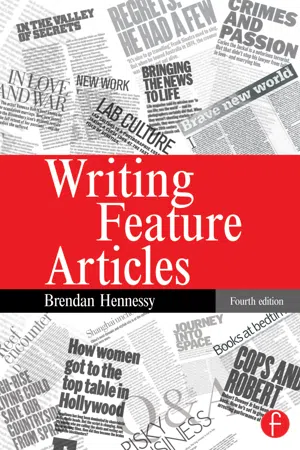
Writing Feature Articles
About this book
Hennessy's classic text tells you everything you need to know about writing successful features. You will learn how to formulate and develop ideas and how to shape them to fit different markets.
Now in its fourth edition, Writing Feature Articles has been fully revised and updated to take into account the changing requirements of journalism and media courses. You will also discover how to exploit new technology for both researching and writing online.
Learn step-by-step how to plan, research and write articles for a wide variety of 'popular', 'quality' and specialist publications. Discover more and make the advice stick by completing the tasks and reading the keen analysis of extracts from the best of today's writing.
Packed with inspirational advice in a friendly, highly readable style, this guide is a must-have for practising and aspiring journalists and writers.
Information
Appendix 1 Suggested responses to assignments
CHAPTER 3
Assignment 3
The style is that of an academic essay rather than that of a feature article. It is very wordy. Apart from that, it sounds like a pitch to an editor. Have you removed such expressions as:
the primary question is …
this article attempts to explore
it is my personal belief that …
And have you removed most of those ‘I’s’ and ‘this’s’?
Suggested start:
(First, perhaps, a brief anecdote about a patient who was the subject of euthanasia and the people involved.) Then:
At some time in their careers most nurses will have thoughts of euthanasia. They will meet patients without hope of regaining much quality of life. I talked to two nurses, with opposing points of view. Philippa … Anne … (In each case give a brief summary of their struggle to adhere to the principles inculcated by their training.)
CHAPTER 5
Assignment 3
One or two of the points you would need to add:
• Why would you call complaining ‘a duty’?
• The different ways of complaining: telephone, face to face, in writing, email, recourse to the law.
• Give examples of when different methods were used and results.
• The pros and cons of each method.
CHAPTER 11
Assignment
The feature ‘House-husbands: how well do they cope?’
The jargon includes such phrases as ‘reflect this growing trend’ and ‘maximize our position in the workforce’.
Updating examples: references to such films as Mr Mum and Trading Places need to be updated and their relevance to the discussion indicated.
‘Research shows. … ’ Indicate research evidence more clearly (for example, giving brief details of any survey that provided evidence), but avoid using the word ‘research’.
An attention-grabbing intro is needed. Facts, figures, case study, quote? Pars 5, 6 and 7 rewritten might serve.
Consider how to order:
1 Problems/solutions? Or:
2 Problems/solutions, problems/solutions …, one by one?
Going with the first of these, something like:
• Intro
• The couple’s problems (difficulties, disadvantages) as a team
• The individuals’ problems separately
• Others’ problems
• Solutions (compensations, advantages): follow order of problems
• Conclusion.
The feature is long on problems and short on solutions. The conclusion begins too feebly: ‘Let’s hope that …’.
The solutions provided by the various people wheeled on at the end (employers, etc.) should have been discussed throughout.
In what ways should their attitudes change and what should they be doing in the future?
Interviewees ‘say’ rather than ‘said’, which suggests it’s all over and done with. It’s still their opinion, one presumes.
CHAPTER 12
Assignment 2
Was it like this?:
By 11 September 2000 the jihadis (holy warriors) were using Yemen as a major base of operations. In cooperation with local extremist groups, also kidnapping to achieve political ends, they sank an American warship in Aden harbour – their most spectacular success.
CHAPTER 15
Assignment 1
Check your words with a good thesaurus.
Assignment 3
Generally, did you get the main selling point upfront?
(a) Did you avoid a blatant plug?
(b) Did you recognize the needs of various age groups?
(c) Did you avoid hyping it up?
CHAPTER 16
Assignment 2
Did you avoid repeating too-well-known facts about the celebrity (that tend to be repeated in the cuttings)? Did you find points in each case that would not be too familiar to the target audience and which would grab them?
CHAPTER 19
Check your pieces for style against similar pieces (even better, pieces covering the same things) in the target publications.
CHAPTER 20
Check that you’ve adapted cultural references to the new targets. For the USA, for example, find American equivalents for references to British TV shows, meals, sports and so on. Check that you’ve used American spellings.
Appendix 2 National Union of Journalists – Professional Code of Conduct
THE PUBLIC INTEREST
The NUJ’s Code of Conduct has set out the main principles of British and Irish journalism since 1936. It is part of the rules and all journalists joining the union must sign that they will strive to adhere to it.
1 A journalist has a duty to maintain the highest professional and ethical standards.
2 A journalist shall at all times defend the principle of the freedom of the press and other media in relation to the collection of information and the expression of comment and criticism. He/she shall strive to eliminate distortion, news suppression and censorship.
3 A journalist shall strive to ensure that the information he/she disseminates is fair and accurate, avoid the expression of comment and conjecture as established fact and falsification by distortion, selection or misrepresentation.
4 A journalist shall rectify promptly any harmful inaccuracies, ensure that correction and apologies receive due prominence and afford the right of reply to persons criticized when the issue is of sufficient importance.
5 A journalist shall obtain information, photographs and illustrations only by straightforward means. The use of other means can be justified only by overriding considerations of the public interest. The journalist is entitled to exercise a personal conscientious objection to the use of such means.
6 A journalist shall do nothing which entails intrusion into anybody’s private life, grief or distress, subject to justification by overriding considerations of the public interest.
7 A journalist shall protect confidential sources of information.
8 A journalist shall not accept bribes nor shall he/she allow other inducements to influence the performance of his/her professional duties.
9 A journalist shall not lend himself/herself to the distortion or suppression of the truth because of advertising or other considerations.
10 A journalist shall mention a person’s age, sex, race, colour, creed, illegitimacy, disability, marital status or sexual orientation only if this information is strictly relevant. A journalist shall neither originate nor process material which encourages discrimination, ridicule, prejudice or hatred on any of the above-mentioned grounds.
11 No journalist shall knowingly cause or allow the publication or broadcast of a photograph that has been manipulated unless that photograph is clearly labelled as such. Manipulation does not include normal dodging, burning, colour balancing, spotting, contrast adjustment, cropping and obvious masking for legal or safety reasons.
12 A journalist shall not take private advantage of information gained in the course of his/her duties before the information is public knowledge.
13 A journalist shall not by way of statement, voice or appearance endorse by advertisement any commercial product or service save for the promotion of his/her own work or of the medium by which he/she is employed.
Source: http://www.nuj.org.uk/inner.php?docid=59; ©National Union of Journalists 2004
Appendix 3 Press Complaints Commission: Code of Practice for the Press
CODE OF PRACTICE
All members of the press have a duty to maintain the highest professional standards. This Code sets the benchmark for those ethical standards, protecting both the rights of the individual and the public’s right to know. It is the cornerstone of the system of self-regulation to which the industry has made a binding commitment.
It is essential that an agreed code be honoured not only to the letter but in the full spirit. It should not be interpreted so narrowly as to compromise its commitment to respect the rights of the individual, nor so broadly that it constitutes an unnecessary interference with freedom of expression or prevents publication in the public interest.
It is the responsibility of editors and publishers to implement the Cod...
Table of contents
- Cover
- Halftitle
- Title
- Copyright
- Contents
- Illustrations
- Foreword: From a lecturer
- Foreword: From a writer
- Preface
- Acknowledgements
- I PRACTISING THE SKILLS
- II EXPANDING YOUR HORIZONS
- Appendix 1 Suggested responses to assignments
- Appendix 2 National Union of Journalists – Professional Code of Conduct
- Appendix 3 Press Complaints Commission: Code of Practice for the Press
- Appendix 4 The Society of Authors’ Quick Guide 1: Copyright and Moral Rights
- Appendix 5 Useful contacts
- Appendix 6 Training
- Bibliography
- Index
Trusted by 375,005 students
Access to over 1.5 million titles for a fair monthly price.
Study more efficiently using our study tools.
Frequently asked questions
Yes, you can cancel anytime from the Subscription tab in your account settings on the Perlego website. Your subscription will stay active until the end of your current billing period. Learn how to cancel your subscription
No, books cannot be downloaded as external files, such as PDFs, for use outside of Perlego. However, you can download books within the Perlego app for offline reading on mobile or tablet. Learn how to download books offline
Perlego offers two plans: Essential and Complete
- Essential is ideal for learners and professionals who enjoy exploring a wide range of subjects. Access the Essential Library with 800,000+ trusted titles and best-sellers across business, personal growth, and the humanities. Includes unlimited reading time and Standard Read Aloud voice.
- Complete: Perfect for advanced learners and researchers needing full, unrestricted access. Unlock 1.5M+ books across hundreds of subjects, including academic and specialized titles. The Complete Plan also includes advanced features like Premium Read Aloud and Research Assistant.
We are an online textbook subscription service, where you can get access to an entire online library for less than the price of a single book per month. With over 1.5 million books across 990+ topics, we’ve got you covered! Learn about our mission
Look out for the read-aloud symbol on your next book to see if you can listen to it. The read-aloud tool reads text aloud for you, highlighting the text as it is being read. You can pause it, speed it up and slow it down. Learn more about Read Aloud
Yes! You can use the Perlego app on both iOS and Android devices to read anytime, anywhere — even offline. Perfect for commutes or when you’re on the go.
Please note we cannot support devices running on iOS 13 and Android 7 or earlier. Learn more about using the app
Please note we cannot support devices running on iOS 13 and Android 7 or earlier. Learn more about using the app
Yes, you can access Writing Feature Articles by Brendan Hennessy in PDF and/or ePUB format, as well as other popular books in Languages & Linguistics & Communication Studies. We have over 1.5 million books available in our catalogue for you to explore.