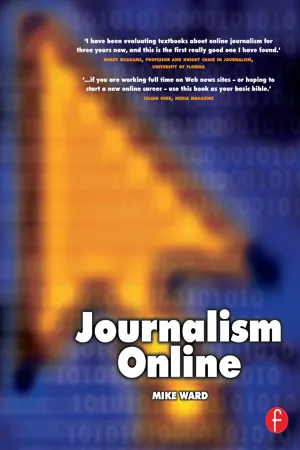
Journalism Online tackles the pressing question of how to apply fundamental journalism skills to the online medium. It provides an essential guide to the Internet as a research and publishing tool. In particular, it examines how to forge key journalism skills with the distinctive qualities of the World Wide Web to provide compelling web content.
Trainee and practicing online journalists will learn:
- core journalism skills of identifying, collecting, selecting and presenting news and information;
- multimedia skills such as audio recording and editing;
- online research methods including use of search tools, newsgroups and listservs;
- story construction and writing for the Web;
- an introduction to HTML;
- web site design for the effective use of content.
Journalism Online takes the best of the 'new' and 'old' media to provide an essential primer for this emerging discipline. Leading web designers such as Jakob Nielsen rub shoulders with established journalists like Harold Evans in the search for clear guidance in this rapidly developing field. It also provides a useful insight for non-news organisations into how to prepare and present effective web content and avoid the deepest pitfall of the online world - being ignored.
Supplementary resources can be found on the book's supporting web site www.journalismonline.co.uk, which features additional exercises, useful links and reviews.
- 224 pages
- English
- ePUB (mobile friendly)
- Available on iOS & Android
eBook - ePub
Journalism Online
About this book
Information
| 1 | What is online journalism? |
‘Online Media may have come of age. But has online journalism?’
Duncan Campbell, investigative journalist1
Dot coms, dot bombs, dot rot and roll
Bob Eggington was sitting in a bar with some US online publishers. Talk, as it has a habit of doing, got round to money; in particular, how to make the Web pay. At that time, Bob was the project director of BBC News Online. The journalists wanted to know the BBC’s business model for its online news operation.
I looked at them and said, ‘Well here’s my business model. We spend a lot of money to collect a lot of data. Then we make it free on the Web, for anybody to consume, and we don’t make any money out of it.
At this point they started grinning and said, ‘Hey, that’s no business model’. I said, ‘No, we just get a bunch of money and we spend it.’
Three years later, reality has bitten, hard. The NASDAQ index of technology stocks has been in free-fall with dot com enterprises dropping like flies. The dot rot has truly set in. Eggington reflects:
I suppose the laugh was on them … because what we were doing at the BBC was what they were doing too. The difference is, the public service model is supposed to work that way. The commercial model is not.
That’s why there’s been this market correction. This had to happen when you had stocks with a capitalization of several hundred million pounds and the annual turn-over of a medium-sized pub.
But none of that is affecting the people who are thinking about how to make journalism work on the Web. In the end, that’s not a commercial issue as much as an intellectual challenge.2
Eggington’s anecdote reflects the setting for this book. But his optimistic postscript lies closer to the heart of the text. Life in the e-conomy has become something of a soap opera – a steady diet of synthetic drama and excitement, complete with predictable denouements, obvious to all, it appears, except the main characters, such as those who invested heavily in the technology stocks.
As a result, the public’s reaction to digital media developments has yawed like a drunken sailor from hopeless optimism to excessive gloom and cynicism. In the midst of such instability, it is difficult to plot a steady course; to settle for the solid advance, rather than the ‘paradigm shift’.
One minute we are told that mobile Internet technology such as Wireless Application Protocol (Wap) will revolutionize the way we live and do business. The next minute it is decided that Wap has all the qualities of an uncomplimentary word that rhymes with it. Mobile operators are accused of running ‘ludicrous adverts (which) have completely over-positioned this new technology and raised user expectations far beyond a level attainable by anyone at the present time’.3 Influential commentators, such as Jakob Nielsen, deride Wap for its ‘miserable usability’.4 We live in confusing times.
Hard-headed businessmen are not immune to the excitement. At the height of the mobile Internet frenzy, the UK telecommunications group BT paid the British government £4 billion pounds for a licence to use ‘third generation’ mobile phones at some future date. At least they cannot be accused of not putting their money where their mouth is.
New economic models have been floated. In his excellent collection of ‘Web studies’, David Gauntlett (2000) expands on Michael Goldhaber’s concept of the ‘attention economy’. With so much to see on the Web, and so little time to look, attention has become the new gold standard.
You can’t buy attention … you can’t make (people) interested in what you have to say, unless they actually find the content of what you have to say engaging. So money is less powerful than usual on the Web. But if you can gather a lot of attention, you can then, potentially, translate that into money.
Note the word ‘potentially’. As Gauntlett acknowledges, some of the ‘money’ made in the attention economy is based on stock market valuation. And we have seen what can happen to that. However, he cites others such as Netscape and Vincent Flanders, who have benefited in more tangible ways.
Of course, the problem is that for every Netscape there have been a thousand net losses. Much of this has been the fault of the digital evangelists, some of whom have elevated hyperbole beyond an art form.
As Greg Knauss explains:
Twice a year or so, like clockwork, a new technology or paradigm sweeps over the face of the Internet, promising to transform not only the medium, but the very fabric of our lives. ‘It’s revolutionary!’ proponents shout. ‘It’s amazing. It’s the next new thing!’
And instead, it turns out to be, well, nothing. Given a few months in the sun, the next new thing inevitable sags and wilts, either disappearing altogether or simply fading into the background of niche usage.5
The innocent are swept up in the lemming rush too. Overnight, companies – widget makers the world over – were told that they had to have a web presence. Never mind that they knew as much about content creation and design as the average journalist knows about commerce and balance sheets.
The results, on display for all (and that means the whole world) to see can be painful. In a recent survey of UK companies6, the content management consultancy MediaSurface found that 77% published out-of-date information on the web. Many companies, they concluded, had ‘lost control’ of their web sites.
But let’s stop there. Time to give the barometer a tap. The needle seems to be stuck again on doom and gloom. Is there no middle ground?
One of the problems, of course, is that the ‘digital revolution’, with all the attendant hype, is a child of its time. The Internet and its applications such as the World Wide Web have not enjoyed the freedom of other, earlier, media. Radio and television were both revolutionary in their day. But they were allowed to experience their growing pains away from the glare of intense expectation on a global scale. They also didn’t have to grapple with that most voracious monster, the marketing machinery of late-twentieth-century capitalism.
If people had bought their first television sets in the UK, to watch the coronation of Queen Elizabeth II, expecting to see the ceremony in full colour from fifteen different camera angles, with edited highlights and slow motion replays, they would have queued up to return their sets afterwards and demand their money back.
They would also have given television up as a bad job. As it was, most were just amazed, even grateful, to be able to witness something that otherwise would not have been available to them.
We have seen that, after a tentative start, each new medium has become established, with two significant effects. One has been to ‘up the ante’ and so, eventually, raise expectations. The other has been to improve communication and so people’s ability to share expectations, and disappointments. The irony of people using e-mail and newsgroups to complain about the performance of their technology stocks seems lost on many.
In such an environment, it is not surprising that we have the digitally disappointed. The very word ‘correction’ has implied for some a return to normality, like setting a ship back on to the right course. The many who chafed against, or even ignored, the initial advance of digital technology feel comforted somehow by recent events.
No, the surprise perhaps is that there are still so many who hope for so much. These people know that something, beneath the market froth, has changed for ever. There has been a shift, paradigm or otherwise, in the way we communicate and live. The ubiquitous access to digitized information, enjoyed by an increasing percentage of the world’s population, is a genie that has escaped from the bottle and has no intention of going back.
When you can publish to the world from your bedroom, you know something has changed. When you can trace a relative in an earthquake zone by posting a message on a bulletin board on the other side of the world, you know something has changed. The question for these people is not ‘if’, but ‘how’. How has it changed, and, how can this new medium be harnessed to best effect?
For the professional, this is a complex question. Journalists in newspapers, radio and television have taken the core journalistic values, knowledge and skills and applied them to their distinctive medium. How to do the same for online, given its range and scope as a medium, is a question still exercising the minds of many.
Equally, the question has validity for the non-professional. The widget makers and the bedroom publishers are playing the same field as the professionals. They too can benefit from learning how to create effective web content. For, as David Gauntlett remarked, it is the provision of engaging content that gets the attention of the web audience; and where you have content creation, you have journalism.
This brings us back to Bob Eggington’s postscript – the challenge of making journalism work on the Web. It is a challenge that lies at the heart of this book and is based on defining what online journalism is and how it can be practised best within this new medium. This, perhaps, is the solid middle ground – the way forward.
Trying to look through and beyond the smoke of current battles, this book is based on the following premises.
■ Online is a distinctive medium because it is user-driven and multifaceted.
■ All elements of the medium should support the offering of the content.
■ The application of core journalistic principles and processes should inform all stages of online content creation and presentation, from the original idea to the finished page or site.
■ Online journalism is a broad church – embracing content creation across a wide range of types (e.g. news and information) and settings (e.g. commercial as well as news-based).
Bob Eggington sees this as primarily an intellectual challenge. Yet making web journalism work may have commercial potential as well. As yet, there is no viable revenue model for web publishing. One reason for this may be that too many people do it badly.
There is certainly a commercial prize to be won, according to recent research by the Forrester Group.7 It forecasts that sites offering news, sport, music and games will receive a share of a US$27 billion advertising market in 2005, with US$13 billion available through syndication, subscriptions and electronic commerce (e-commerce).
There is, as ever, a Catch 22. Doing anything reasonably well requires resources, not cutbacks. Yet cutbacks are part of the new reality. As part of its research, the Forrester Group interviewed 75 online content co...
Table of contents
- Cover
- Halftitle
- Title
- Copyright
- Contents
- Acknowledgements
- 1. What is online journalism?
- 2. The core journalism
- 3. Online research and reporting
- 4. Writing
- 5. Online story construction
- 6. Who’s afraid of HTML?
- 7. Design your web resource
- Index
Trusted by 375,005 students
Access to over 1.5 million titles for a fair monthly price.
Study more efficiently using our study tools.
Frequently asked questions
Yes, you can cancel anytime from the Subscription tab in your account settings on the Perlego website. Your subscription will stay active until the end of your current billing period. Learn how to cancel your subscription
No, books cannot be downloaded as external files, such as PDFs, for use outside of Perlego. However, you can download books within the Perlego app for offline reading on mobile or tablet. Learn how to download books offline
Perlego offers two plans: Essential and Complete
- Essential is ideal for learners and professionals who enjoy exploring a wide range of subjects. Access the Essential Library with 800,000+ trusted titles and best-sellers across business, personal growth, and the humanities. Includes unlimited reading time and Standard Read Aloud voice.
- Complete: Perfect for advanced learners and researchers needing full, unrestricted access. Unlock 1.5M+ books across hundreds of subjects, including academic and specialized titles. The Complete Plan also includes advanced features like Premium Read Aloud and Research Assistant.
We are an online textbook subscription service, where you can get access to an entire online library for less than the price of a single book per month. With over 1.5 million books across 990+ topics, we’ve got you covered! Learn about our mission
Look out for the read-aloud symbol on your next book to see if you can listen to it. The read-aloud tool reads text aloud for you, highlighting the text as it is being read. You can pause it, speed it up and slow it down. Learn more about Read Aloud
Yes! You can use the Perlego app on both iOS and Android devices to read anytime, anywhere — even offline. Perfect for commutes or when you’re on the go.
Please note we cannot support devices running on iOS 13 and Android 7 or earlier. Learn more about using the app
Please note we cannot support devices running on iOS 13 and Android 7 or earlier. Learn more about using the app
Yes, you can access Journalism Online by Mike Ward in PDF and/or ePUB format, as well as other popular books in Languages & Linguistics & Communication Studies. We have over 1.5 million books available in our catalogue for you to explore.