- 196 pages
- English
- ePUB (mobile friendly)
- Available on iOS & Android
eBook - ePub
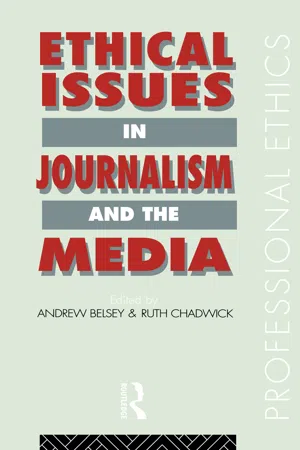
Ethical Issues in Journalism and the Media
About this book
This book examines the ethical concepts which lie at the heart of journalism, including freedom, democracy, truth, objectivity, honesty and privacy. The common concern of the authors is to promote ethical conduct in the practice of journalism, as well as the quality of the information that readers and audience receive from the media.
Information
Chapter 1
Ethics and politics of the media: the quest for quality
Andrew Belsey and Ruth Chadwick
Journalism is an honourable profession, though many of those who should care for it, often including its own professionals, have dishonoured it. Governments of most ideological leanings, when not actively persecuting it, have sought to censor and control it, usually with success. Owners have used it as a means of satisfying their quest for power and wealth, not to mention megalomania. As for journalists, they, as the humorous rhyme reminds us, do not even need to be bribed to behave unethically. Even ‘consumers’ have done journalism no service by putting up with trivia and trash, accepting execrable standards as the norm.
Yet journalism remains an honourable profession, because it has an honourable aim, the circulation of information, including news, comment and opinion. This is an honourable aim because the health of a community – especially a community that has any pretensions to democracy – depends on it. There is no reason why journalism should not have further aims as well, such as entertainment, so long as these are subordinated to the overall aim of the circulation of information.
Many of the issues raised so far are taken up in the essays in this book, and some of them will be commented on later in this introduction. But we are also concerned with the question of whether the honour of journalism can be restored, and with the global context which matters to do with community, democracy and the media cannot ignore as the world approaches the millennium. In both cases the issue of quality will be at the forefront.
THE GLOBAL CONTEXT
Unprecedented changes as the world enters the final decade of the twentieth century present the media with great opportunities and great problems. The opportunities arise from the global need for information as human beings assess the chances of their own survival as a species, or, at a less fateful level, just worry about what sort of world and what sort of life for its inhabitants there will be in the future. Global politics presents daunting challenges, but authoritarian structures are no longer regarded as an acceptable means to political ends. The sort of alternative democratic participation and involvement that is required is impossible without information. Here then, as the people of the world struggle for a worthwhile way of life within a sustainable future, is a role for the media, especially those media that can still be called the press, whether they are part of print or broadcast journalism, so long as they follow the traditional role of the press as providers of information.
It is something of a cliché that the world has shrunk to a village in which the major problems are problems for everyone, for they are unavoidable and cannot be escaped from by futile attempts to keep your own back yard clean. Further, it is said that the world has become an electronic village, for almost everyone has instant access through radio and television and newer electronic media to the latest circulated information. But it is precisely the quality of this information which is at issue.
The major problems facing humanity seem to arise from an unstable mixture of politics and science, using both these terms in a broad sense. First of all there is the global problem of environment, resources and population, a single whole which is a compound of numerous elements. These include the problem of feeding the world’s hungry, which could be done now if existing food resources were distributed properly and fairly (though the effect on world food supply of the collapse of the Soviet Union remains to be assessed). But even so, there is an upward pressure on all resources as the world population continues to grow exponentially, and at the same time the environment faces increasing degradation from pollution of all kinds, including that which contributes to the alleged greenhouse effect.
In addition, national rivalries, often over resources, but fuelled by chauvinistic, ideological and religious differences, threaten to bring permanent instability to international relations, together with the constant threat of war based on the mass availability of sophisticated weaponry, including perhaps nuclear weapons released by the breakup of the Soviet Union. The falling-apart of this once fairly stable structure is itself a major world problem, promising a very uncertain future for the inhabitants of the former political conglomerate, together with highly unpredictable consequences for the rest of the world, as a large part of the largest continent faces the prospect of involuntary transfer from the Second World to the Third, unless some sort of stable and reasonably prosperous future can be invented for it.
Underlying the other problems is something which itself is a problem, science. It promises so much and yet threatens even more. Instead of being the disinterested pursuit of knowledge allied to the application of theoretical advances to worthwhile practical projects of global significance, science has become a commodity, dedicated to the production of further commodities for the market, from nuclear power stations to microscopic eavesdropping devices to artificially engineered viruses. Taken over by capitalism, science has become the slave of a consumerism which demands the instant gratification of the latest want, whether it be for a piece of electronic wizardry or a genetically perfect baby.
The dissemination and discussion of information concerning the major problems the world and its people face is necessary to both the democratic understanding and the democratic action without which the problems cannot be solved – without which, in fact, they will escalate. So here is a great opportunity for the media to contribute to the advancement of peace, prosperity and progress. But can the media respond effectively? For they themselves are not free from many of the problems that contribute to the world’s difficulties.
It is another cliché that the question of the relations of production has been replaced by the question of the relations of information and communication; but as is the case with many political clichés there is a good deal of ideological fog about this one. With one fifth of the world’s population – one billion people – in a state of dire physical need, questions about the production, distribution and consumption, the ownership and control, of the world’s material resources will continue to be of central relevance and importance to the political agenda.
No doubt questions about information and communication have increased in significance and will continue to do so, but they are the same questions, about production, distribution and consumption, ownership and control. Furthermore, it would be a mistake to regard the world’s informational and communicational resources as any less material than its food and mineral resources.
All the different questions about information can be brought into focus on the issue of quality. In the light of the problems the world faces, the typical daily content of an American television channel or a British tabloid newspaper is not just a shame but a crime. This is at a time when many parts of the world with no tradition of a free press are trying to develop media that better serve and reflect the rising tide of democracy, and are looking to the West for models to emulate. But disappointment and disillusionment could quickly follow. For in addition to stunning triviality, these searchers after new exemplars will find enormous concentration of ownership in the hands of transnational corporations, together with governments who think little of selling television channels to the highest bidder.
However, governments with a purely ‘market’ approach to communications are not the only ones with no interest in the free flow of information. This, however, raises the interesting question of whether it is now possible for individual governments to have much control over the information available to their populations. The Islamic Salvation Front, which won the first round of the Algerian election late in 1991, proposed (in addition to the suppression of the civil and political rights of women) to ‘challenge the vibrant independent press’,1 But could they have done it? No doubt newspapers can be closed down and journalists persecuted, but even the former Soviet bloc, with its strict controls on printing presses, photocopiers, duplicators and even typewriters, was unable to suppress the underground press. But this was old technology, and new authoritarian rulers cannot achieve their aims without a major and unprecedented act of techno-censorship which would ban faxes, computer networks and satellite dishes.2
For many years the apartheid regime in South Africa held out against a television network on the grounds that it would corrupt the moral fibre of the people – meaning, of course, challenge the survival of the potentially unstable minority regime. When the government finally gave in over television, many people predicted the end of apartheid. They were correct, although whether there has been any causal connection is much harder to establish.
But any investigation of this would have to make some sort of stab at distinguishing between form and content, a distinction often attacked these days, but one which is unavoidable when considering global informational flow. For some forms of media can be more convivial than others, to use Illich’s term.3 Desktop publishing and local electronic networks, for instance, can be organised in cooperative and participatory structures which encourage communitarian and democratic outlooks and behaviour. Global, monopolistic media networks controlled by transnational corporations are more likely to pander to a passive consumerism with negative psychological and political consequences. There is nothing inevitable about these outcomes, of course. Local networks might encourage parochialism and hostile nationalisms, while global networks might promote cosmopolitanism and internationalism, as telephones and fax machines already have. But whatever form the informational structures take, there is still the matter of their content, and more especially, its quality.
Still, on the global level the need for information to enable people to play their parts as citizens of the world is indisputable, and the opportunities for the media are therefore legion. But beyond this, because both the politics and the technology of the media are rapidly changing in unpredictable ways, it is questions rather than answers that suggest themselves as conclusions. Who will provide, produce, edit, control and distribute the information? If it is local networks, how can they provide the necessary international outlook? If it is global monopolies, how can they be encouraged to have aims more responsible than the mere pursuit of profit? Can the media play down national, ideological and other rivalries and emphasise common humanity facing common problems? As old totalitarianisms collapse, how can the threat from new ones be overcome without plunging the world into further risks of war?
These questions raise the issue of whether the pursuit of profit or power is compatible with quality in the media, and this in turn raises the question of freedom. What is meant by a ‘free press’? Is it the freedom of democratically elected governments (no matter how imperfect the democracy) to propose and dispose? Is it the freedom of corporations or individual owners to buy up large chunks of the world’s media and to mould them in their image? Is it the freedom of editors to decide what gets broadcast or published? Is it the freedom of journalists to offer fact and opinion without fear of sanction or persecution? Or is it the freedom of ordinary people to receive full and fair information on all issues that are likely to affect their lives and their interests?
QUALITY CONTROL: LAW OR ETHICS?
Turning now from the global to the national level, we find that the issue of quality is still inescapable. A free and vigorous press and other organs of mass media and mass communications are agreed to be among the essential ingredients of a healthy democracy. (We include the word ‘vigorous’ because it is clear that freedom is not sufficient: a press could be free yet timid or torpid.) This need for media freedom is recognised in various charters and conventions of human rights, as well as in, famously, the First Amendment to the Constitution of the United States of America. In Britain, however, the media are already more restricted by the law, both criminal and civil, than in most other countries of the democratic world. So can the law act as a mechanism for quality control, or should this be rather a matter of morality – of ethics? But is it really wise to suggest yet further restrictions of any sort, however inspiring the idea of moral principles and ethical codes of conduct might initially sound?
In Britain the media are restricted by the criminal laws of official secrets, obscenity, blasphemy, sedition, and reporting restrictions on Irish terrorist groups and their alleged supporters; by the civil laws of libel and breach of confidence; and by the judge-made law of contempt of court. In addition to the laws themselves there is the problem of a judiciary generally unsympathetic to the ideas of a free press and freedom of information and firmly wedded to prior restraint through the use of interlocutory (‘gagging’) injunctions, a legal move virtually impossible in the United States.
But there is nothing obscure about the difference between the British and American situations. It is a matter of the different constitutions, but beyond this, a fundamental cleavage in political ideology. Britain is not a republic of citizens but a monarchy of subjects, living in a system in which parliament is both supreme in legislation, largely independent of judicial review, and yet still hemmed in by crown prerogative exercised by the government of the day. Subjects do not, or indeed cannot, have rights in the way citizens can, which is why the British constitution finds it so hard to accommodate itself to the European Convention on Human Rights, or to incorporate it into domestic legislation. Nor can the constitution recognise freedom of information: British public life depends on a strictly interpreted need-to-know principle, and those who are on the receiving end of government – the electorate – are not regarded as needing to know. The fact that this fetters the exercise of the supposedly democratic franchise is a problem hardly yet tackled except by pressure groups like Liberty, Charter 88 and the Campaign for Freedom of Information, and the depth of the problem is shown by the further fact that individual members of parliament are little better off than their constituents when it comes to access to information.
The general laws of the land and the peculiarities of the constitution do not exhaust the legal controls over the British media. Broadcasting is subject to a number of statutory licensing and regulating bodies, including the Independent Television Commission, the Radio Authority, the Broadcasting Complaints Commission and the Broadcasting Standards Council. This system of controls has been criticised for several reasons, including the charge that the bodies have unclear and overlapping jurisdictions. The Broadcasting Complaints Commission, for instance, is supposed to deal with complaints concerning matters such as lack of factual accuracy, unfairness in presentation and intrusions into privacy, whereas the Broadcasting Standards Council deals with alleged offences against taste and decency in the areas of sex, violence, bad language and the treatment of disasters. But broadcasters have found the bodies to have expansionist ambitions, while at the same time being narrow-minded and generally unsympathetic to the claims of media freedom.4
In the case of print journalism there is no statutory regulatory body, but the peculiar history and status of the Press Complaints Commission (PCC) might suggest that there is no real difference. In 1990 the Report of the Calcutt Committee on Privacy and Related Matters proposed that the previous voluntary body, the Press Council, which had become widely regarded on all sides as ineffective, should be replaced by the new PCC, the function of which would be to supervise a code of practice drawn up by the newspaper industry itself.5 The Calcutt Committee further proposed that this double-act would have 18 months, starting 1 January 1991, to clean up the industry, and more especially to eliminate intrusions into private lives, otherwise parliament should feel free to introduce statutory protection for privacy. (The Calcutt Committee had proposed that physical intrusion, including ‘doorstepping’ and electronic eavesdropping, should become illegal.) The press, rightly alarmed that neither the draconian nature of this intimidation nor the disastrous consequences of trying to enforce it would inhibit parliamentary action, has attempted what was probably intended all along: to behave better. At the time of writing the press is still undergoing its period of probation.6
So what have the actual and potential legislative and statutory barriers done for the quality of the British media? Very little, but this is hardly surprising, since the emphasis has been on restriction, on negativity, on what the media must not publish, rather than on the quality of what does appear on screens and pages. Only in one area – a reduction of the more vile or grotesque invasions of privacy by the tabloid press – has this negative approach had a beneficial effect. But if there has been at least this consequence, might it not be taken further, by giving privacy some statutory protection? The problem with this is that it would almost certainly have a severely deleterious effect on serious journalism, while leaving untouched the trivia and gossip that form the staple of the tabloids. And in general any legal restriction on the press, in the absence of a constitutional guarantee of press freedom and some sort of freedom of information legislation, is a one-sided detraction, preventing the press from fulfilling a proper democratic role.
So is it to ethics, and self-regulation along th...
Table of contents
- Cover
- Halftitle
- Title
- Copyright
- Contents
- Notes on contributors
- General editors’ foreword
- Preface
- 1 Ethics and politics of the media: the quest for quality
- 2 Journalism in the market place
- 3 Owners, editors and journalists
- 4 Freedom of speech, the media and the law
- 5 Codes of conduct for journalists
- 6 Privacy, publicity and politics
- 7 Honesty in investigative journalism
- 8 Objectivity, bias and truth
- 9 Women and the press
- 10 The oxygen of publicity: terrorism and reporting restrictions
- 11 Something more important than truth: ethical issues in war reporting
- Select bibliography on ethics, journalism and the media
- Index
Trusted by 375,005 students
Access to over 1.5 million titles for a fair monthly price.
Study more efficiently using our study tools.
Frequently asked questions
Yes, you can cancel anytime from the Subscription tab in your account settings on the Perlego website. Your subscription will stay active until the end of your current billing period. Learn how to cancel your subscription
No, books cannot be downloaded as external files, such as PDFs, for use outside of Perlego. However, you can download books within the Perlego app for offline reading on mobile or tablet. Learn how to download books offline
Perlego offers two plans: Essential and Complete
- Essential is ideal for learners and professionals who enjoy exploring a wide range of subjects. Access the Essential Library with 800,000+ trusted titles and best-sellers across business, personal growth, and the humanities. Includes unlimited reading time and Standard Read Aloud voice.
- Complete: Perfect for advanced learners and researchers needing full, unrestricted access. Unlock 1.5M+ books across hundreds of subjects, including academic and specialized titles. The Complete Plan also includes advanced features like Premium Read Aloud and Research Assistant.
We are an online textbook subscription service, where you can get access to an entire online library for less than the price of a single book per month. With over 1.5 million books across 990+ topics, we’ve got you covered! Learn about our mission
Look out for the read-aloud symbol on your next book to see if you can listen to it. The read-aloud tool reads text aloud for you, highlighting the text as it is being read. You can pause it, speed it up and slow it down. Learn more about Read Aloud
Yes! You can use the Perlego app on both iOS and Android devices to read anytime, anywhere — even offline. Perfect for commutes or when you’re on the go.
Please note we cannot support devices running on iOS 13 and Android 7 or earlier. Learn more about using the app
Please note we cannot support devices running on iOS 13 and Android 7 or earlier. Learn more about using the app
Yes, you can access Ethical Issues in Journalism and the Media by Andrew Belsey,Ruth Chadwick in PDF and/or ePUB format, as well as other popular books in Social Sciences & Ethics & Moral Philosophy. We have over 1.5 million books available in our catalogue for you to explore.