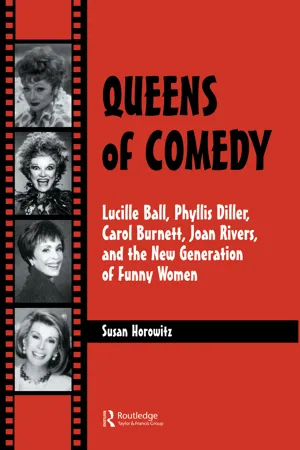
Through candid personal interviews with Lucille Ball, Carol Burnett, and other visionary performers, Queens of Comedy explores how comediennes have redefined the roles of women in not only the entertainment business, but society as a whole. Detailing both their public and private lives - as well as their many and varied performances - Queen of Comedy examines the impact these women have had on the predominantly male-oriented world of comedy. Performers like Carol Burnett, Joan Rivers, and their more recent counterparts, comediennes Brett Butler and Roseanne, have helped to sift women's roles in comedy from object to subject. This book maps out this shift, providing an often brutally honest picture of women's lives in both the spotlight of comedy and this modern world.
eBook - ePub
Queens of Comedy
Lucille Ball, Phyllis Diller, Carol Burnett, Joan Rivers, and the New Generation of Funny Women
- 172 pages
- English
- ePUB (mobile friendly)
- Available on iOS & Android
eBook - ePub
Queens of Comedy
Lucille Ball, Phyllis Diller, Carol Burnett, Joan Rivers, and the New Generation of Funny Women
About this book
Information

Wits and Wisecrackers
The Dumb Doras and Gawky Gertrudes entertain audiences by presenting images of women that are non-threatening—mentally limited, sexually neutered, or childish. They reflect fantasies about women—and only a fraction of women’s real experience. No matter how brilliantly amusing, they are essentially objects of desire—or derision.
What happens when a woman presents herself not as object, but as subject? As not just desirable but as lustful—and not thereby ludricous, inept, or immoral? As not laughably ugly, but as laughing at rigid standards of beauty? As not mentally limited or silly, but as intelligent, with sometimes radical opinions? As fully conscious and fully human? Can she still be accepted? Can she still be funny?
The comic type that allows for conscious self-expression is the wit or wisecracker. She invites us to laugh not at her, but with her—often at some of our most cherished notions. She knows what’s going on—and is articulate about what she thinks, feels, and wants. She is also apt to meet with a lot of resistance.
Historically, women were not supposed to be funny in the first place. The first American variety-type entertainments took place in “concert-saloons” and were designed to entertain a rowdy, male clientele. Women were a popular attraction at these saloons, not as performers but as waitresses. Their job was to serve drinks and flirt with the customers, often pocketing a percentage of the drinks they sold. Many of these “waitresses” were prostitutes. The concert-saloons and the women associated with them were popular with paying customers but scorned by respectable society. (Since the male customers came from all social stations, they were, of course, part of that society.)
By the 1850s, the entertainment included songs, dances, acrobatics, banjo playing, and crude comedy. To placate public opinion, the proprietors of these establishments removed the prostitutes (or at least kept them behind the scenes). To entice customers, women became part of the stage show—not as comics but as scantily clad chorus dancers. Their dances, which included the infamous can-can, were considered risqué and indecent—and, were of course, very enticing to the male clientele.
(Today’s closest parallels are probably the topless bars, strip joints, and go-go clubs which feature titillating female entertainment. It is in establishments like these that many male comics [for example, Lenny Bruce, who was married to a stripper] and comediennes—including Totie Fields, Joan Rivers, and Goldie Hawn—got their start thirty or more years ago. The humor in most of these places was lewd and male-oriented, and the difficulty many of today’s female comics have in establishing themselves can be traced back to the origin of stand-up comedy as part of crude saloon entertainment performed by men for a male clientele.)
In the 1860s the New York legislature passed a law prohibiting women from acting as waitresses in concert-saloons. Instead of using women to hustle drinks, saloon proprietors were forced to restrict the charms of their female employees to the stage. They changed the name of their establishments to “variety theatres” or “variety halls,” and slowly women began to establish themselves as entertainers. Most female performers were still part of a briefly clad chorus line and expected to fraternize with the male customers. But a few were part of “man-woman” acts, with the man providing the comedy. (Many of the performing couples were married, which provided the wife with protection from the demands of the often lecherous male customers.)
An enterprising proprietor named Tony Pastor attempted to attract women customers by imposing a no-drinking, no-smoking policy, protecting female clients from “mashers” and cleaning up some of the off-color material. As other producers followed suit, the audience began to include more women—who liked to see material of interest to them, including domestic comedy.
By the 1890s the more gifted female performers in the “man-woman” acts were getting their share of laughs, and these variety shows were known as vaudeville. (“Vaudeville” is thought to be derived from “Val de Vire,” the river valley in France with a tradition of bawdy songs.) Vaudeville, which was headquartered in New York, sent performers on tour all over the United States and had an enormous influence on the development of new talent, including many performers who went on to careers in film, radio, and television.
Besides the women who appeared in comedy/singing/dancing duos, there were a few solo female performers who did comedy. These unusual women did not present themselves as Dumb Doras or Gawky Gertrudes but as clever monologuists. One of the first was Beatrice Hereford, who portrayed a variety of comic characters in short pieces which she wrote herself. Hereford was appreciated by critics and fellow wits, including Dorothy Parker, who was an ardent fan. Another popular monologuist was Ruth Draper. Using a few props and elements of costume, Draper performed amusing playlets in imaginary settings, often involving other, invisible characters.
The story-like sketches of Hereford and Draper were part of a theatrical tradition which had included female performers since the European sixteenth century commedia dell’arte. Far more than stand-up comedy, which had its roots in the raucous variety halls of the nineteenth century and burst into bloom in the 1950s “Borsht Belt” (Catskill Mountain resort-hotels where the comics were almost exclusively male), sketch comedy and comedic plays, often with music or dancing, have been comparatively open to women. Until recently, a boy with show business ambitions and a flair for humor might well consider stand up comedy; a girl with similar aspirations and talents was far more likely to go into acting, singing, or dancing (especially if she were pretty). If she did go into comedy, it would most likely be as part of duo or ensemble, with only the exceptional woman braving the frontier of a solo act.
One of those who did was Sophie Tucker, who mixed music and humor. Tucker, born in 1884 and with a career that lasted through the 1960s, used a mixture of comedy patter and songs to put forward her own witty, sensual, philosophy of life. Instead of playing a dependent, Dumb Dora, or a sexually frustrated Gawky Gertrude, she portrayed herself as a strong individual—and a successful man-chaser.
For most of her career, Tucker was neither young nor svelte. But she advertised a sensuality as robust as a slim, glamour girl’s and sang, “I’ve put a little more meat on. So what, there’s more schmaltz (chicken fat) to sizzle when I turn the heat on!”
At two-hundred pounds, Tucker looked like a food-pushing/ consuming Jewish Mama. She underscored the maternal connection by singing a tear-wrenching version of “My Yiddisheh Mama,” which regularly brought down the house.
(The idealized, immigrant mother was a popular type for many decades. Gertrude Berg, played a warm-hearted Jewish mother on the 1930s and 40s radio and television situation comedy, The Goldbergs, which she also wrote and produced. [The show was canceled in 1951 when Philip Loeb, who played Jake Goldberg, was blacklisted.] I Remember Mama, a 1950s television situation comedy based on the Broadway play of the same name, centered around a loving, strong Norwegian immigrant mother.)
However, despite Tucker’s sentimental paean to the self-sacrificing, immigrant mother/homemaker, the singer herself (born while her parents were en route to America) rejected the restrictions of marriage and motherhood to carve out an independent career that lasted for sixty years. By age thirteen (and 145 pounds), she was helping support her family by singing in amateur contests. To get away from home and give vent to her own lusty nature, she married at a local boy, Louis Tuck, at sixteen without parental consent. Then, pregnant and desperate to escape the poverty that had entrapped her own mother, she left the baby with her parents and set out to seek her fortune in show business.
Considered too fat and homely to sing as a white woman, Tucker sang “coon melodies” in blackface, but made her mark as a Jewish comedienne by mixing the maternal with the sexual, billing herself as a “red-hot mama,” and kidding sex. She mocked both Jewish and Gentile concepts of feminine modesty, and belted out ribald plaints (mainly by Fred Fish, her favorite songwriter) against her ice-cold papa and the general unreliability of men.
One of her most popular songs by Fish went: “Mistah Siegal, you better make it legal” and reduced the tragedy of a seduced and abandoned woman to a pathetic-funny plight of a Jewish girl trying to get the no-goodnik who who put a kiegle (noodle pudding) in her belly to marry her. Instead of Hester Prynne’s Scarlet Letter, we have a pregnant schlimazl’s (luckless fool)’s kiegle.
In another song, a pregnant secretary demands payment for services rendered, “When am I getting my mink, Mr. Fink?” Instead of a shamefaced, fallen woman, we have a brassy employee demanding fair wages from her “cheapskate” boss. And from the Yiddish tradition, we have the schnorrer (beggar)—who demands her due (“look at all the room rent I saved you in the back seat of your automobile!”) with wit and chutzpah (nerve).
Unlike Fanny Brice, whose signature song “My Man” proclaimed her undying devotion to a faithless man, Tucker’s songs and comic advice declared her emotional independence from the vagaries of romance. If a man strayed, she advised women to face facts: “No One Woman Can Satisfy Any One Man All the Time,” dry her tears, and “get yourself a filler-inner.”
She further advised her audience to enjoy sensuality without apology, proclaiming: “You’ve Got to Be Loved to Be Healthy.” Nor was marriage necessary for a fully satisfying life. Long before the modern women’s liberation movement, Tucker sang her own declaration of independence: “I’m Living Alone and I Like It.”
In her own life, Tucker, who was married and divorced three times, felt her hard-won independence cost her some romantic appeal “Once you start carrying your own suitcases, paying your own bills, running your own show, you’ve done something to yourself that makes you one of those women men may like and call a pal and a good sport, the sort of woman they tell their troubles to. But you’ve cut yourself off from the orchids and diamond bracelets, except those you buy yourself.” Whether the homely, two-hundred pound, middle-aged Tucker would have gotten orchids and diamonds without a successful entertainment career is certainly open to speculation. In any case, fat, feisty, and fifty- plus, Tucker continued delighting audiences with a droll, robust attitude toward sensuality until 1966 when she died at the age of seventy nine.
Mae West, Tucker’s slightly younger contemporary, also played the role of the strong, smart, sensual woman. Born in 1892, Mae West began in vaudeville in 1914 and wrote her own starring vehicle Diamond Lil for the Broadway stage in the 1920s. She transferred her basic character—a swaggering, diamond-sporting, tongue-in-cheek sex goddess—to her 1930s comedy films, wrote her own slyly suggestive dialogue, and became the highest paid entertainer in the country.
West was forty when she made her first film, with a matronly figure that was fully covered in period costumes from the 1890s. Although not as fat as Tucker, her figure was hefty; and her sexuality was also primarily verbal and based on innuendo—not direct physical display. Some of her most famous lines have become classics of innuendo.
Between two evils, I always pick the one I never tried before.
Do you have a gun in your pocket … or are you just glad to see me?
And of course:
Come up and see me sometime … (The original version, spoken to Cary Grant in the film She Done Him Wrong, was “Why don’t you come sometime and see me? I’m home every evening. Come up. I’ll tell your fortune.”)
Like Tucker, West’s relations with other female characters were sisterly and helpful (unless crossed by a snobbish, so-called “respectable” women who patronized her manners or morals). She comforts a tearful girl who had been seduced and abandoned with a salty observation: “When girls go wrong, men go right after them.” Both Tucker and West flaunted a level of sexuality and aggression that was softened by their age, matronly appearance and good humor. (Moms Mabley, a black comedienne whose act was even more bawdy, presented an even less sexy, motherly appearance. Dr. Ruth Westheimer, a contemporary sex therapist and entertaining media personality, operates in much the same mode. Her enthusiastic, even graphic references to sexuality are tempered by her matronly appearance, friendly attitude, and humor.)
Despite all her innuendoes, West was not a sex object like Marilyn Monroe, who portrayed herself as the vulnerab...
Table of contents
- Cover Page
- Title Page
- Copyright Page
- Contents
- Introduction to the Series
- Preface
- Acknowledgments
- I: Comic Appeal, Sex Appeal, and Power
- II: Lucille Ball
- III: Phyllis Diller
- IV: Carol Burnett
- V: Joan Rivers
- VI: Dumb Doras and Gawky Gertrudes
- VII: Wits And Wisecrackers
- Bibliography
Trusted by 375,005 students
Access to over 1.5 million titles for a fair monthly price.
Study more efficiently using our study tools.
Frequently asked questions
Yes, you can cancel anytime from the Subscription tab in your account settings on the Perlego website. Your subscription will stay active until the end of your current billing period. Learn how to cancel your subscription
No, books cannot be downloaded as external files, such as PDFs, for use outside of Perlego. However, you can download books within the Perlego app for offline reading on mobile or tablet. Learn how to download books offline
Perlego offers two plans: Essential and Complete
- Essential is ideal for learners and professionals who enjoy exploring a wide range of subjects. Access the Essential Library with 800,000+ trusted titles and best-sellers across business, personal growth, and the humanities. Includes unlimited reading time and Standard Read Aloud voice.
- Complete: Perfect for advanced learners and researchers needing full, unrestricted access. Unlock 1.5M+ books across hundreds of subjects, including academic and specialized titles. The Complete Plan also includes advanced features like Premium Read Aloud and Research Assistant.
We are an online textbook subscription service, where you can get access to an entire online library for less than the price of a single book per month. With over 1.5 million books across 990+ topics, we’ve got you covered! Learn about our mission
Look out for the read-aloud symbol on your next book to see if you can listen to it. The read-aloud tool reads text aloud for you, highlighting the text as it is being read. You can pause it, speed it up and slow it down. Learn more about Read Aloud
Yes! You can use the Perlego app on both iOS and Android devices to read anytime, anywhere — even offline. Perfect for commutes or when you’re on the go.
Please note we cannot support devices running on iOS 13 and Android 7 or earlier. Learn more about using the app
Please note we cannot support devices running on iOS 13 and Android 7 or earlier. Learn more about using the app
Yes, you can access Queens of Comedy by Susan Horowitz in PDF and/or ePUB format, as well as other popular books in Media & Performing Arts & Television. We have over 1.5 million books available in our catalogue for you to explore.