- 344 pages
- English
- ePUB (mobile friendly)
- Available on iOS & Android
eBook - ePub
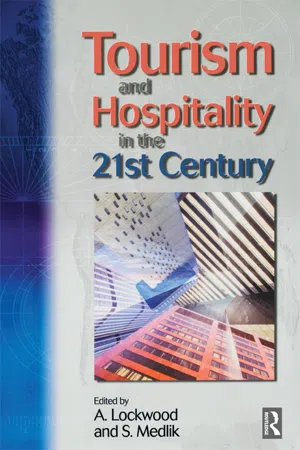
Tourism and Hospitality in the 21st Century
About this book
'Tourism and Hospitality in the 21st Century' is a collection of essays which consider the future of tourism and hospitality. The international team of contributors represent a wide range of interests involved in tourism and hospitality.
Divided into three parts, this book analyses:
· Global dimensions, patterns and trends -demographic, social, economic and technical
· Regional development of such areas as Africa, Asia, Europe and America, among others
· The future of various sectors within the industries - such as transport, tourist attractions, coastal resorts and timesharing.
'Tourism and Hospitality in the 21st Century' is suitable for: senior personnel in private and public sector tourism and hospitality operations; international and national official tourism bodies and other organizations; universities and other higher education institutions; universitties and other higher education institutions; consultancy; finance, construction and supply industries; and as a reference point for students.
Part | |
Global Views |
1 | |
World travel and | |
This chapter examines the current global dimensions and patterns of, and the recent trends in, travel and tourism, in order to provide a framework within which to consider the likely future of this global industry. It highlights the main generators of tourism demand, the main destinations of tourists and the main international tourism flows. Reference is made to the three leading tourism regions – Europe, North America and the Pacific Rim – and comments are also offered on the position of Africa, Asia and Latin America. The main trends of the 1990s are examined and the chapter concludes with some indicative pointers to the issues likely to influence tourism in the coming decades.
Definitions
It is important to acknowledge at the outset that the measurement of tourism is both an imprecise science and is increasingly susceptible to definitional problems. The central source of data on international tourism, and the one upon which this chapter primarily draws, is provided by the World Tourism Organization (WTO) using data drawn from government sources. These data are largely concerned with two common measures of tourism – the number of arrivals registered in each country, and the levels of expenditure made by visitors. They also permit some analysis of the main generators of international tourism demand. However, as Edwards and Graham (1997) point out, destination countries use ten different measures of tourism, and origin countries use a further five, and there are often quite wide discrepancies between different data sources. They conclude that expenditure measures are the most reliable in assessing tourism's magnitude, yet it is immediately obvious that most countries, in discussing, planning and promoting their tourism industries, tend mainly to refer to arrivals numbers as if these were a reliable economic indicator. Clearly, without accurately analysing the types of arrivals, they are not.
Furthermore, international tourism traffic is the tip of the iceberg. Domestic travel, in terms of the number of trips taken, far exceeds the level of international trips. Domestic travel is rarely measured with much accuracy other than through macro-economic estimations and/or sample survey data. However, to provide just one indication of the magnitudes involved, the Prime Minister of China, Li Peng, in his opening address to the Pacific Asia Travel Association conference held in Beijing in 1997 reported that the Chinese had made 640 million domestic tourist trips in the previous year. This is 45 million more than the global total of international tourist arrivals in that same year.
It is obvious that the magnitude of domestic tourism in the industrialized world is vast – notably in North America and Europe. The oft-quoted statistic that less than 10% of Americans hold passports (despite the fact that the USA is the world's largest spender on international tourism, excluding transport costs), hints at just how massive this domestic business can be. However, the main thrust of this chapter is to focus on international tourism on which, notwithstanding data problems, information is most readily available.
Growth and magnitudes
Today's massive tourism industry has been driven by a number of factors – and these are the factors whose future directions need to be considered. They are:
 | growth in real incomes; |
| the advance in personal wealth as expressed in the ability of individuals to generate resources beyond those needed to pay for life's basic needs – food, housing, clothing, education, health and, in more recent times, ‘essential’ consumer goods – in other words, the expanding ability for discretionary expenditure on non-essential items; |
| increases in leisure time; |
| peace amongst nations; |
| freedom from administrative restraints on international travel; |
| freedoms within international currency markets; |
| expansion of fast, efficient and widely affordable public transport, coupled with wide access to private transport. |
In a word, tourism depends upon economic development and open, free societies. It can be immediately seen that, measured against these basic criteria, much of today's world fares very badly. Such a comparison reveals two important facts. First, the majority of the world's population has yet to attain what we in the industrialized world would regard as a minimum level of supply of these elements. Second, and as a consequence, if the world's under-privileged can reasonably hope to attain access to these elements during the next century, the capacity for demand growth in national and international tourism is, for all practical purposes, unlimited.
For the advocates of tourism, this is wonderful news. For those concerned about wider issues of environmental integrity, it is potentially terrifying. For pragmatists, it raises issues to explore and elucidate.
The basic facts of the modern international tourism industry are well known and can be briefly stated. According to WTO data, in 1950 there were 25 million international tourist arrivals and the value of tourism receipts was US$2.1 billion. In 1998 international arrivals had risen to an estimated 635 million and the value of receipts to US$439 billion. Over those 48 years, the average annual increase in arrivals was around 7%; in terms of (current) tourism receipts, the average was just over 11.5%. The temptation to conclude that international tourism is subject to uninterrupted exponential growth is thus obvious but, as this chapter will show, it is also misleading, since there is clear evidence that rates of growth are now slowing down.
This chapter concentrates on the trends evident during the 1990s. As Table 1.1 shows, the rate of growth in international tourism arrivals averaged just over 4% a year between 1990 and 1998, but with very wide differences by region. The world's two major tourism regions – Europe and North America – both exhibited below-average growth. The fastest growing regions were Latin America, the Middle East and Africa – all relative back-markers in volume terms.
Table 1.1 International tourist arrivals by region, 1990–98 (mn)
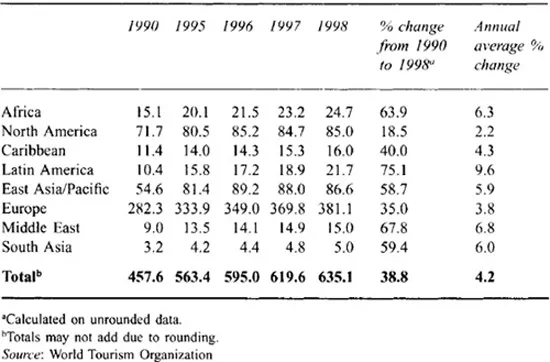
Table 1.2 Regional shares of international tourist arrivals, 1990–98 (%)
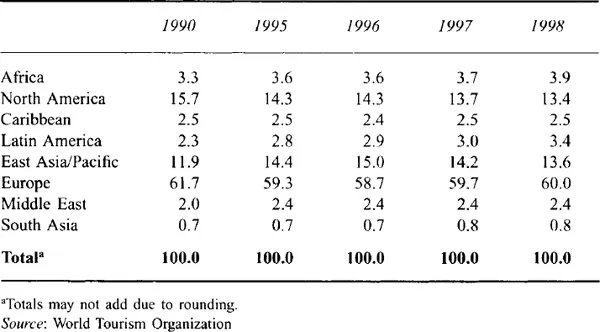
In terms of market share, Europe remains the dominant influence on international tourism by the arrivals measure, accounting for 60% of all international arrivals in 1998, with East Asia/Pacific and North America next in importance. Together, these three regions account for almost nine out of every ten arrivals globally.
Table 1.3 International tourism receipts by region, 1990-98 (US$ bn)
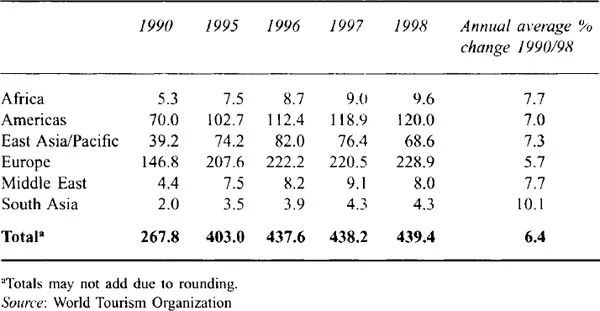
Looking now at tourism receipts, during the 1990s these grew in current US dollar terms at an average annual rate of 6.4% to 1998. Only Europe was below average during this period, with South Asia leading the pack, and Africa and the Middle East being the next best performers.
However, the major earners in terms of the volume of total receipts remain again Europe, the Americas (of which North America accounts for almost three-quarters) and East Asia/Pacific. The fastest growin...
Table of contents
- Cover Page
- Half Title Page
- Title Page
- Copyright Page
- Contents
- Preface
- Principal contributors
- Part One Global Views
- Part Two Global Regions' Futures
- Part Three Sectoral Futures
- Index
Trusted by 375,005 students
Access to over 1.5 million titles for a fair monthly price.
Study more efficiently using our study tools.
Frequently asked questions
Yes, you can cancel anytime from the Subscription tab in your account settings on the Perlego website. Your subscription will stay active until the end of your current billing period. Learn how to cancel your subscription
No, books cannot be downloaded as external files, such as PDFs, for use outside of Perlego. However, you can download books within the Perlego app for offline reading on mobile or tablet. Learn how to download books offline
We are an online textbook subscription service, where you can get access to an entire online library for less than the price of a single book per month. With over 1.5 million books across 990+ topics, we’ve got you covered! Learn about our mission
Look out for the read-aloud symbol on your next book to see if you can listen to it. The read-aloud tool reads text aloud for you, highlighting the text as it is being read. You can pause it, speed it up and slow it down. Learn more about Read Aloud
Yes! You can use the Perlego app on both iOS and Android devices to read anytime, anywhere — even offline. Perfect for commutes or when you’re on the go.
Please note we cannot support devices running on iOS 13 and Android 7 or earlier. Learn more about using the app
Please note we cannot support devices running on iOS 13 and Android 7 or earlier. Learn more about using the app
Yes, you can access Tourism and Hospitality in the 21st Century by S Medlik, Andrew Lockwood in PDF and/or ePUB format, as well as other popular books in Business & Hospitality, Travel & Tourism Industry. We have over 1.5 million books available in our catalogue for you to explore.