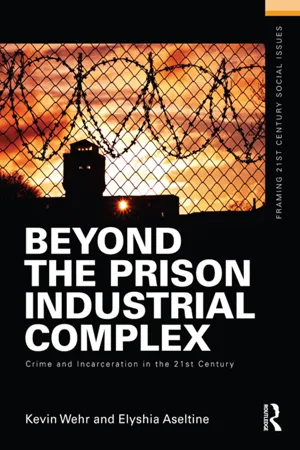
This short text, ideal for Social Problems and Criminal Justice courses, examines the American prison system, its conditions, and its impact on society. Wehr and Aseltine define the prison industrial complex and explain how the current prison system is a contemporary social problem. They conclude by using California as a case study, and propose alternatives and alterations to the prison system.
eBook - ePub
Beyond the Prison Industrial Complex
Crime and Incarceration in the 21st Century
- 80 pages
- English
- ePUB (mobile friendly)
- Available on iOS & Android
eBook - ePub
Beyond the Prison Industrial Complex
Crime and Incarceration in the 21st Century
About this book
Information
The Prison Industrial Complex: Principles, Processes, and Products
I:
Introduction
The prison is a massive and totalizing institution at the heart of society. The specter of the prison is all around: police cars, surveillance cameras, signs warning that shoplifters will be prosecuted. These reminders of the consequences of law-breaking are everywhere: keep in line, or else. The “or else” is the threat of incarceration, curtailed freedoms, financial penalties, and social approbation. The shadow of the prison is long throughout society, and yet, paradoxically, we keep prisons hidden.
The modern prison is about 200 years old. The first prison in the United States was established in Philadelphia, Pennsylvania in 1790, although incarceration had been practiced in Europe for some time. Michel Foucault, in his classic 1979 work Discipline and Punish, described the critiques of prisons that arose in the first 50 years of carceral history. We have known since the 1830s that prisons do not reduce crime. Quite the opposite: Detention in prisons causes recidivism, fosters the social learning of crime and a criminal culture, and creates new criminals by throwing inmates’ families into destitution.
Yet the prison remains a major institution of society, with the number of prisons spiraling ever upward, gobbling up state budgets and consuming both inmates’ and guards’ lives. Even public schools now have police officers, metal detectors, and the look and feel of prisons. Why does the prison persist, even after 200 years of ineffectiveness? Could the prison serve functions other than crime deterrence? What can be done about this state of affairs?
The Prison Industrial Complex: A Definition
Over the last 50 years, social and economic crises accelerated in the United States, and social protest increased in tandem. The collective tenor of this protest combined militant voices for free speech, black power, gay rights, women’s rights, valuation of the natural environment, and prisoners’ rights. Contemporary prison research has shifted from improving living conditions to critically assessing the interlocking interests of politicians and corporations in what has come to be called the “punishment industry.” This recognition of political and economic investment in the expansion of prisons has given rise to the concept of the Prison Industrial Complex (PIC).
The PIC term is used in popular discourse and in lecture halls, but a full definition built on theoretical foundations and empirical evidence requires further exploration. The Prison Industrial Complex can be defined as a set of governmental, private, and corporate interests that develop policies and practices in order to exert social, political, and economic control, and to perpetuate social processes that are biased by race, class, gender, and political perspective. In the PIC, citizens’ fears are stoked by “tough on crime” politicians, who garner support for the expansion of penal programs in partnership with all-too-willing corporations. These interests are circular and cumulative—they reinforce one another, making it extremely difficult to imagine a world without the prison.
Section 1 will unpack this dense definition, establishing the theoretical frame we use to understand the PIC, and elaborating the contours of the PIC through empirical examples. Section 2 will address the question, “How does the PIC represent a fundamental social problem of the 21st Century?” We consider the direct costs of incarceration to prisoners and prison employees, as well as the fiscal and social costs to the public. Section 3 looks toward the future and focuses on the question, “How can the United States cope with crime and incarceration in a socially equitable manner?” We use California as a case study of both the problems and potential future of American prisons, and conclude with a discussion of alternatives that currently exist, and some that have only thus far been imagined.
II:
The Prison Industrial Complex
Social Functions of Crime and Prisons
In Chapter 1 we encountered a general definition of the Prison Industrial Complex (PIC). The PIC can be defined as a set of governmental and private institutions with vested interests in perpetuating policies and social processes that exert social, political, and economic control, and are biased by race, class, gender, and political perspective. This chapter has twin goals: establishing our basic theoretical frame and elaborating the first portion of our PIC definition—public and private interests that benefit from maintaining a complex, biased system of economic, political, and social control. It also describes the ways in which wide-scale public support for the PIC is strategically solicited by enterprising political figures and corporate-sponsored media. Chapter 3 is an empirical discussion of how the PIC perpetuates and exacerbates inequality by race, class, gender, and political orientation.
Theoretical Frame
Before describing the details of the theoretical frame that we selected in order to explore the Prison Industrial Complex, it is beneficial to have a general introduction to the purposes of a theoretical frame. In the social sciences, theoretical frames are used to guide the study of a particular phenomenon. Our social world is extremely complex, and without a theoretical frame it is difficult to identify what is important and what is not. Theoretical frames offer a way for the researcher to determine what should be observed and what needs to be explained. Good research should be explicit about the theoretical frame that is being used—we offer our discussion below. There are various options for theoretical frames from which a researcher may select. Our broad theoretical frame is critical. This means that we focus on the relationship between social phenomena—in this case, incarceration and prisons—and the continuation of oppression and inequality. In illuminating the contours of oppression, critical research has the potential to reveal how such inequality can be reduced, or better yet, eliminated.
There are several theoretical lenses to understand the PIC, including functionalism, Marxism, feminism, postmodernism, and Critical Race Theory. Using selected insights from each of these theories, we reveal the social functions of crime and the criminal justice system; the role of capitalism in keeping incarceration rates high; and the ways in which the criminal justice system assists in controlling populations based on race, class, gender, and political views. These theoretical tools also aid in understanding how the growth in penal institutions has contributed to an increased internalization of surveillance and a reduction of freedom for all members of society, not just those perceived as misfits or potential threats.
Emile Durkheim (1858–1917) was a pioneer of criminology. Durkheim described the idea of “social solidarity,” or a shared sense of belonging to society. Social solidarity unites social groups and promotes consensus about social norms and behaviors. Durkheim argues that we all know the norms or rules of daily life and the laws of the land (laws being norms that are codified in complex societies), that we more-or-less agree with them, and that we tend to be surprised when those rules are violated. Those who break social norms might be ostracized, diagnosed and medically treated, or incarcerated (1984 [1893]).
Durkheim further describes societies that are unable to forge broad social solidarity as pathological or “anomic.” Anomie, or the condition of being without norms, results when society changes too quickly. Under normal conditions, social behaviors change slowly over time and social norms are altered to reflect the new behavioral reality. What in the past was considered unacceptable behavior can become commonplace. Anomie is when these changes occur too fast for agreed-upon norms to evolve alongside behavioral change. Under anomie there may be great confrontations over relatively simple acts. For example, possession of marijuana was recently a crime punishable by years of incarceration, but today in many communities in the United States it is punished very lightly. In fact, in California, Washington and Colorado, with the passage of medical marijuana and other legislation, it may not be punished at all. Behaviors change, norms and laws slowly catch up, and there are great political debates over what is right and proper.
For society to function, Durkheim argued, the need for social solidarity and cohesion is paramount. There needs to be a general consensus about the accepted norms so that members of society can be bonded together. In modern societies, individuals may view themselves as belonging to some groups (in-groups) but not others (out-groups). The ties that bind an in-group vary according to any number of social categories, such as Christians, working class, and Americans. The social function of crime is to promote social solidarity among members of a particular in-group (the “good, law-abiding citizens”) by giving them an out-group to compare themselves with, the “criminals.” The criminal out-group is composed of the “bad people,” the “boogey-men” who scare our children into good behavior. In this way, crime is functional for society: “Crime therefore draws honest consciousnesses together, concentrating them [so that] a common indignation is expressed” (Durkheim 1984 [1893]: 58). For Durkheim, then, crime is an important social fact, and one that will never disappear because it serves a crucial social function. Society needs unacceptable behavior (crime) in order to maintain social solidarity and cohesion.
Durkheim’s ideas were built upon by several important theorists of crime and delinquency, generally categorized as “functionalist” or “consensus” theorists. A leading example is Robert Merton. Merton argued that markers of “success” in the United States are primarily material (achieving financial wealth, living in a nice house, driving an expensive car). Those who are unable to reach these culturally valued material goals through socially acceptable channels adapt by employing alternate means in order to acquire wealth. Merton’s “strain theory” describes how people may use illegal or illegitimate means (crime) to achieve the normal goals of success in the society in which they live (Merton 1938). For consensus theorists generally, crime is something that can be reduced but will never be eliminated. In fact, for such theorists, getting rid of crime entirely would be bad for society.
Like crime, the prison serves a social function. The American criminal justice system is often described as fulfilling goals of deterrence, incapacitation, retribution, and rehabilitation. The primary means of achieving these goals is incarceration. Although incarceration is a commonly applied method, it has proven ill-suited for achieving most of its goals: incarceration does not deter nor incapacitate individuals from committing crime—murder, drug use, rape, extortion, and other crimes exist in prisons. Nor does it rehabilitate criminals, particularly as job training, education, and social and mental-health programs in prisons are reduced or eliminated.
Erickson (1966), Reiman (1995), and Foucault (1979) argue that if prisons do not work to deter, incapacitate, or rehabilitate, there must be another reason for their continued existence. Returning to functionalist/consensus theory, they argue that the apparent purpose of prison is to produce crime and criminals. In other words, the criminal justice system works to meet the social demand for deviants, so as to bolster social solidarity among members of the in-group. Foucault (1979: 277) argues: “For the observation that prison fails to eliminate crime, one should perhaps substitute the hypothesis that prison has succeeded extremely well in producing delinquency.” Like Durkheim, Foucault sees crime as being functional because it creates a demonized “other” and it supports and reproduces societal norms (the status quo).
Taking the argument further, Foucault states that society’s misfits are likely to be the target of social control institutions. Putting focus on the poor, the mentally ill, and other deviant groups serves as a diversion to detract attention from the more powerful elements of society. This distraction serves a dual purpose: it allows those in power to reinforce their dominance by minimizing their subjection to social control, and it also allows those in power to maximize control of less powerful groups. Also, powerful groups in society can use their influence to generate profits from social control efforts, for example, the operation of private prisons that profit from incarceration.
To discern who constitutes this “ruling class,” it is helpful to consider the larger economic structure of the United States. Karl Marx (1818–83) understood that the economic system exerts a strong influence on all aspects of a society—culture, art, philosophy, law, education, and politics. Central to a capitalist economic system like that of the United States is the notion of private property. Without a defensible system of property ownership, no capitalist would undertake risky investment. In fact, Marx argues that the idea of policing arose in order to protect private property. Protect from whom? Conflict between the working and owning classes is a main driver of social change in a capitalist society: Marx argued that workers’ labor is what produces wealth, but owners appropriate this wealth in the form of profit, paying meager wages to the majority of workers. This represents a “contradiction” of capitalism: the social production of wealth but the private accumulation of profit. The workers build commodities for paltry wages, and the capitalists take them, sell them, and reap significant profits. The drive for profit through the reduction of worker benefits eventually leads to crisis, when the worker is no longer paid a living wage and cannot purchase those very same needed commodities (Marx 1859, 1867).
In capitalist society, the owning classes have access to property and economic power, through which they gain political power. As Marx suggests: “The executive of the modern State is but a committee for managing the common affairs of the whole bourgeoisie” (Marx cited in Tucker 1978: 475). Through this power the ruling class dominates general culture as well as the norms and laws of a society (called hegemony). The workers come to view themselves in the terms that the ruling class gives them. To the extent that subordinate classes accept the ideas of the ruling class, the ideas are hegemonic, or as Marx writes: “The ruling ideas of every epoch are ever the ideas of the ruling class” (Marx cited in Tucker 1978: 489).
What does this mean for crime and imprisonment? According to a Marxist perspective, sometimes called “conflict theory,” the state crafts laws that serve not only to protect the values and interests of the owning class, but also to control and punish dissent amongst the workers. For example, in England during the development of capitalism, strict vagrancy laws controlled the movement of workers. English enclosure laws privatized common lands and led to mass migration to the cities, where the only choice was to sell one’s labor on the market. As labor supplies increased there was less need to control workers, and so vagrancy laws were relaxed. In the United States, indentured servitude and the slavery system provided for ownership of workers and ensured the concentration of wealth among rich southern whites. Meanwhile, until the formal implementation of a criminal justice system (policing, courts, and prisons), rape, lynching, and vigilante justice were widely practiced means of social control over enslaved people. According to conflict theory, laws were written to allow the concentration of wealth, but laws meant to protect all people from violence were selectively enforced (Hartman 1997; Parenti 2003).
Society’s out-groups, or the “non-ruling” classes, include people of color, the poor, the under-educated, the homeless, those who struggle with mental illness, those who are critical of capitalism, and those who are critical of the government. As demonstrated in the next chapter, it is individuals from these groups that comprise the bulk of the U.S. prison population. These groups are targeted because they pose direct or indirect threats to the capitalist system and/or because they do not fit into the normative conceptions of the in-group. In the United States, the ideal person has long been a “young, married, white, urban, northern, heterosexual Protestant father with a college education, fully employed, of good complexion, weight, and height, and a recent record in sports” (Goffman 1963: 128). Persons not fitting the mold are seen as deviant or, worse, criminal.
It is important to note that in-group/out-group membership is a complicated affair. To understand the nature of oppression by identity, we turn to feminists and critical race theorists. Patricia Hill Collins’ concept of the “matrix of domination” is a useful theoretical tool to describe how oppression is experienced in complex ways. This is because of the interesection of multiple social identities such as race, gender, and sexual orientation. In her pioneering work Black Feminist Thought, Collins moves away from “additive” conceptualizations, where one is either black or white, male or female, rich or poor. In reality, we are all much more complex than any one or two of these dichotomies can describe. The matrix of domination posits an interlo...
Table of contents
- Cover Page
- Half Title page
- Series Page
- Title Page
- Copyright Page
- Dedication
- Contents
- Series Foreword
- Acknowledgments
- Section 1: The Prison Industrial Complex: Principles, Processes, and Products
- Section 2: Crime and Incarceration in the 21st Century
- Section 3: Beyond the Prison Industrial Complex
- References
- Glossary/Index
Trusted by 375,005 students
Access to over 1.5 million titles for a fair monthly price.
Study more efficiently using our study tools.
Frequently asked questions
Yes, you can cancel anytime from the Subscription tab in your account settings on the Perlego website. Your subscription will stay active until the end of your current billing period. Learn how to cancel your subscription
No, books cannot be downloaded as external files, such as PDFs, for use outside of Perlego. However, you can download books within the Perlego app for offline reading on mobile or tablet. Learn how to download books offline
Perlego offers two plans: Essential and Complete
- Essential is ideal for learners and professionals who enjoy exploring a wide range of subjects. Access the Essential Library with 800,000+ trusted titles and best-sellers across business, personal growth, and the humanities. Includes unlimited reading time and Standard Read Aloud voice.
- Complete: Perfect for advanced learners and researchers needing full, unrestricted access. Unlock 1.5M+ books across hundreds of subjects, including academic and specialized titles. The Complete Plan also includes advanced features like Premium Read Aloud and Research Assistant.
We are an online textbook subscription service, where you can get access to an entire online library for less than the price of a single book per month. With over 1.5 million books across 990+ topics, we’ve got you covered! Learn about our mission
Look out for the read-aloud symbol on your next book to see if you can listen to it. The read-aloud tool reads text aloud for you, highlighting the text as it is being read. You can pause it, speed it up and slow it down. Learn more about Read Aloud
Yes! You can use the Perlego app on both iOS and Android devices to read anytime, anywhere — even offline. Perfect for commutes or when you’re on the go.
Please note we cannot support devices running on iOS 13 and Android 7 or earlier. Learn more about using the app
Please note we cannot support devices running on iOS 13 and Android 7 or earlier. Learn more about using the app
Yes, you can access Beyond the Prison Industrial Complex by Kevin Wehr,Elyshia Aseltine in PDF and/or ePUB format, as well as other popular books in Social Sciences & Criminology. We have over 1.5 million books available in our catalogue for you to explore.