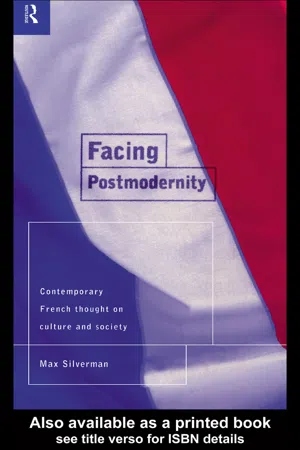
Facing Postmodernity explains French cultural theory by grounding it in the politics of the issues facing France today such as:
* the breaking of the city
* racism
* the crisis of culture
* new citizenship.
It discusses some of the major responses to postmodernity by contemporary French thinkers, both the very well known -Lyotard, Levinas, Derrida - and those who will be less familiar to a non-French audience. In doing so, it addresses the questions central to the postmodern debate whatever country it takes place in; questions of history, of representation, identity and community.
- 208 pages
- English
- ePUB (mobile friendly)
- Available on iOS & Android
eBook - ePub
About this book
Information
Topic
PhilosophySubtopic
Sociology1 In the shadow of the Holocaust
The Holocaust rediscovered
In the immediate post-war years, discussion of the catastrophe that had just taken place rarely mentioned the plight of the Jews or the genocide which became known as the Holocaust. In Le Spectateur engagé, Raymond Aron recalls his conversation with Jean-Paul Sartre in 1945 about this silence:
We asked ourselves the question why is there not one single article, not one that says: ‘Welcome home to Jews, back once more in the French community.’ The fundamental reason for this silence is that what had happened had been erased.
(cited in Finkielkraut 1996:41)
Sartre himself remarked on this silence about the Jews in his famous Réflexions sur la question juive (1954) written in 1946 (although this same book contains no references to the Holocaust itself), and the anti-racist organisation MRAP (Movement against Racism and for Friendship Between Peoples) was established in 1949 with the specific aim of preserving the memory of victims of anti-Semitism and guarding against its reappearance in all its forms. It is also true, as Michael Bernstein (1998) points out, that David Rousset's L'Univers concentrationnaire (1946), Robert Antelme's L'Espèce humaine (1947) and novels by Roger Ikor (Les Fils d'Avrom: Les Eaux mêlées) and André Schwarz-Bart (Le Dernier des justes) in the 1950s show that serious work about the Holocaust was being written shortly after the war in France. Yet these were isolated voices. As the film-maker and critic Claude Lanzmann has said, in an explicit reference to Sartre's work on anti-Semitism, ‘the Holocaust is an event [which] no one at the time could grasp in its full scope’ (cited in Kritzman 1995a:5).
In fact, the talk in the immediate post-war years was predominantly of the victims of and resistance to fascism, not anti-Semitism. As the Belgian historian Jean-Michel Chaumont points out:
this was the era of the almost absolute hegemony of the anti-fascist model. The survivor from Buchenwald was the emblematic witness of Nazi crimes and it was his or her version of history and experience, filtered by organizations usually under the direction of the Communist Party, which was transmitted via the media to the public. Even in 1967, at the time of the inauguration of the international monument at Birkenau, Jews were hardly mentioned in official discourse and the plaques erected at the monument were dedicated to the indistinct mass of ‘victims of Nazi barbarism’.1
(Chaumont 1994:77)
The ‘anti-fascist model’ was itself bound up with the process of ‘épuration (cleansing)’ after the war, whose raison d'être was to purge France of foreign (German) influences, to marginalize Vichy (and certainly fascism) from mainstream French republicanism, and confirm the story of a France which heroically resisted occupation (cf. Rousso 1987).2
At this time, it was not simply a question of the hegemony of the anti-fascist model for the revelations about the camps in the USSR provided another model for extermination of ‘undesirables’.3 Annette Wieviorka (1992:20) refers to these two post-war debates—anti-fascist and anti-communist—which both, in their different ways, removed attention from the specificity of Nazi crimes, the Holocaust and the annihilation of the Jews. It seems astonishing today that Alain Resnais's classic film about the Holocaust, Nuit et brouillard (Night and Fog) (1955) —made to commemorate the tenth anniversary of the end of the war— makes virtually no reference to Jews. But this becomes understandable if we remember to what extent, in those post-war years, ‘the perception of genocide was in France inextricably associated with that of deportation to Nazi concentration camps’ (A.Wieviorka 1992:20), a process which, of course, involved non-Jews as well as Jews.4 As Éric Conan and Daniel Lindenberg observe, France preferred ‘political and resistance deportees to so-called “racial” deportees’. The relationship between Vichy and the ‘final solution’ was merely of secondary importance.
The majority of condemnations arising from the épuration, based on a classical body of law, invoked Article 75 of the penal code which refers to ‘intelligence with the enemy’. The notion of crimes against humanity, defined in 1945 and used in 1946 at the Nuremberg trial, was never invoked. And the question of state anti-Semitism, which was introduced spontaneously and independently by the Vichy regime, was not the object of any specific judicial debates (Conan and Lindenberg 1992:10) (cf. Klarsfeld and Rousso 1992).
In the aftermath of the war, the attention of the newly created Fourth Republic was focused elsewhere, especially on the Cold War, the struggle against communism and colonial wars in the Far East and North Africa (Edwy Plenel, ‘Le piège Touvier’, Le Monde, 22 April 1992).
This relative silence about the Holocaust in the immediate postwar period (and ‘occultation’ of the genocide of the Jews) seems astonishing today in the light of the sea-change that has occurred in perceptions of that event. At the beginning of the 1970s, the death of Charles de Gaulle (1969) and the challenge to the great resistance myth that he personified—epitomized by Marcel Ophuls's documentary Le Chagrin et la pitié (1971) and Robert Paxton's book (1972) on Vichy France— opened the way to a reappraisal of the question of anti-Semitism and the relationship between Vichy and the ‘final solution’. Since then the Holocaust—recognized as the genocide of the Jews, and frequently referred to now as the Shoah— has become the major focus for commentators on that period.5 This ‘judeocentric’ approach (Chaumont 1994) has brought to the fore the experience and the memories of survivors as witnesses, the question of crimes against humanity, and the irreducible nature of the event itself. Annette Wieviorka (1992:19) lists the proliferation of debates and controversies about the Holocaust which have taken place in France over the last twenty-five years, including ‘the Faurisson affair, the affair of the American soap-opera Holocaust, the Roques affair, the affair of the convent at Auschwitz, the Barbie trial, the indictments of Leguay, Touvier, Papon and Bousquet, the affair of Le Pen's “detail”, and the Carpentras affair’, to which we might add the controversies over Claude Lanzmann's film Shoah (1985), the Farias/ Heidegger affair, and the Paul de Man affair.
This obsession with the Holocaust in recent years is as linked to the contemporary conjuncture as much as the former silence around it was a product of the post-war period. The challenge to the Gaullist and communist myths about the Second World War, and the accompanying charge of French involvement in the ‘final solution’, are themselves symptomatic of a new problematic around national identity and national history which was taking shape during the 1960s. New demands for ‘the right to difference’ for minorities (le droit à la différence), the challenge to the state's monolithic hold on memories of national history, and the anti- and post-colonial critique of the ethnocentrism and racism of the West in general all threatened the postwar consensus on national unity. Furthermore, there was a renewal of Jewish thought in the 1960s (especially that of Emmanuel Lévinas) which had a considerable influence on French anti-humanist philosophy and the challenge to ‘the order of the ego, self-consciousness and freedom’ (Rose 1993:14) of rationalizing Western modernity.
In other words, the rediscovery of the Holocaust is symptomatic of the crisis of modern France and Western modernity as a whole. Michael Bernstein (1998) suggests that the contemporary obsession with ‘the issues raised by the Nazi genocide’ is not so much a question of the return of the repressed but rather ‘our readiness to see those issues as simultaneously unique to the devastation of European Jewry and yet paradigmatic for Western culture as a whole’. In France this obsession epitomizes a country ill at ease not only with its own involvement in genocide but also with the very ideals of modernity which France upheld. The following discussion therefore considers not those events connected directly with the Vichy regime (about which much has been written in recent years; see, for example, Rousso 1987, Esprit 1992, Kedward and Wood, eds, 1995) but some of the ways in which the Holocaust, and also the figure of ‘the Jew’, have been mobilized in the wider contemporary polemic around the crisis of Western modernity. In terms of the philosophical debate, this polemic has pitted humanist neo-Kantians against anti-humanist Heideggerians; in terms of the cultural debate, it has pitted neo-representationalists against anti-representationalists. It could be defined as the moment at which the post-Holocaust era meets the postmodern era.
‘Jews’, ‘Greeks’ and the decline of the West
The pronouncement by the German philosopher Theodor Adorno on the impossibility of thought after Auschwitz transformed the Holocaust into a metaphor for the end of modernity. Auschwitz became the point of transition from an age of rational planning of societies—whose ultimate goal was human emancipation and freedom—to one of scepticism of all social engineering. As the political and cultural commentator and editor of the journal Esprit, Olivier Mongin, observes, ‘Adorno's question on the possibility of thought after Auschwitz exacerbated a profound scepticism at the heart of modern society’ (Mongin 1994a:73). For some, the Holocaust has become the sign of the totalitarian nature of the West, and the point of departure for a rejection of all totalizing systems of thought. Zygmunt Bauman (1988), for example, has argued that the absence of a moral dimension which made the Holocaust possible was a direct product of the technological and bureaucratic instrumentalism of modern industrial society.
Adorno's injunction is therefore the starting point for what one might term postmodern philosophy's ‘appropriation’ of ‘Auschwitz’ for the purpose of challenging Western philosophy. Jean-François Lyotard (1988a:110) recognizes his debt to Adorno: ‘Following Theodor Adorno, I have used the name “Auschwitz” to signify the inconsistency between the course of Western history and the “modern” project of the emancipation of humanity.’ For Lyotard, Auschwitz signifies the tragic end of modernity's grand vision of emancipation and a cruel indictment of the concept of history on which it was founded. After Auschwitz the ‘grand narrative’ of history dissolves into the ‘small narratives (petits récits)’ of particular knowledges and fragmented spaces of communication (Lyotard 1979). ‘Auschwitz’ therefore signifies the end of universalism and the end of the Enlightenment idea of progress. In short, Lyotard employs ‘Auschwitz’ as a metaphor for the failure of the whole enterprise of modernity. As he says, ‘“Auschwitz” can be taken as a paradigmatic name for the tragic failure of modernity’ (Lyotard 1988a:32).6 Hence the quote marks surrounding the name to designate its paradigmatic function.
For Lyotard, and for all those commentators mentioned above, ‘Auschwitz’ is not simply the product of fascist ideology but of a whole tradition of Western philosophy and history. The logocentrism of Western thought and the evolutionist concept of history inherited from Hegel (both of which are founded on binary oppositions) are two of the principal pillars propping up the modern edifice—which have produced dictatorships and democracies alike. There is therefore a ‘contamination’ (Derrida 1987) at a more profound level across modern conceptual and political structures which challenges the neat distinction between democracy and dictatorship. (This point will be developed later in this chapter; see ‘History, memory, representation’.) The philosopher Philippe Lacoue-Labarthe (1988–1989:484) employs ‘Auschwitz’ in the same way to castigate the West in general: ‘In the apocalypse at Auschwitz, it is no more or less than the essence of the West that is revealed—and that has not ceased since that time to reveal itself.’ The West is ultimately responsible for the attempted annihilation of ‘the other’ which took place at Auschwitz, and it is therefore the whole system underpinning the Enlightenment tradition which stands indicted. It is not simply Jews who died in the gas chambers but the very spirit of modernity itself. Auschwitz becomes the metaphorical dividing line between modernity and postmodernity.
A significant aspect of this postmodern critique of modernity and the West is the link traced between rationality, Christianity and the Greco-Roman tradition of thought, within which Judaism has been a perpetual outsider and victim, and which reached its apotheosis at Auschwitz. Once again the critique is aimed not simply at those forms of modern political anti-Semitism which overtly stigmatized the Jew, but at modernity as a whole in its dealings with ‘the other’. Lacoue-Labarthe gives a clear expression of this position:
God effectively died at Auschwitz, in any case the God of the Greco-Christian West, and it is no coincidence that those who were the objects of extermination were the witnesses, in that West, of another origin of God, one which remains outside the Hellenic and Roman framework and which therefore impedes its programme of fulfilment.
(cited in Mongin 1988:91)
Here the Jew and Judaism are perceived as ‘other’ to ‘Christian Europe’, ‘other’ to rationality, logocentrism and the law, and ‘other’ to the autonomous and self-constituted self at the heart of Western ‘Hellenic’ humanistic philosophy. The Jew is that which, ultimately, gives the lie to the grand modern vision of totality, harmony, purity and order, and is the witness to modernity's reckless pursuit of uniformity. In this sense, ‘the Jew’ is equivalent to what Julia Kristeva (following Freud) calls ‘the disturbing strangeness…which inhabits us all…the hidden face of our identity, the space which challenges our fixed nature’ (Kristeva 1988:9). Derrida, Lyotard, Lacoue-Labarthe and Jean-Luc Nancy have all mobilized the figure of ‘the Jew’ in this way: as a sign of otherness and strangeness, that which is left out, leftover, suppressed, eradicated in modernity's mad rush towards the creation of a rational order, and that which unsettles all attempts at fixing and recuperation.
‘The Jew’ is therefore a sign of otherness. In Heidegger et ‘les juifs’, Lyotard writes ‘jew’ not only in inverted commas but also with a lowercase ‘j’ in order to distinguish these ‘jews’ —employed figuratively or allegorically—from real Jews. Lyotard's ‘jews’ are the sign of the challenge to the perfect autonomy and unity of the self. He says:
‘the jews’ are in ‘the spirit’ of the West…they are that which resists this spirit, in its wilfulness, the wilfulness of wanting, that which impedes this wilfulness, in its accomplishment, project and progress, that which ceaselessly opens up the wound of what is unaccomplished…. They are that which resists domestication within the obsession to dominate, within the compulsive quest for the acquisition of property, within the passion for empire, recurrent since Hellenic Greece and Christian Rome. ‘The jews’ are never at home wherever they may be, they cannot be integrated, converted or expelled. They are always outsiders even when they are in their own place, within their own traditions, since at their very origin is exodus, excision, impropriety and respect for what has been forgotten.
(Lyotard 1988b:45)
Nancy (1986) invokes ‘the jew’ as the allegorical marker of the interruption or disruption of myth and community. Lyotard (1993: 100) makes the same point when he observes that ‘the jew’ is the challenge to ‘the blind narcissism of the community’ or again when he designates Auschwitz as a sign of the impossibility of constructing an autonomous and unproblematic ‘we’: ‘In the camps, there was no first person plural subject. The absence of this subject means that “after Auschwitz” there is no subject at all, no Selbst which might name itself in naming “Auschwitz”…. There is no collective witness’ (Lyotard 1983:146); ‘the name “Auschwitz” is certainly not the total sum of Is, yous and hes, since this name designates the impossibility of any such totalization’ (Lyotard 1983:152). Kristeva's ‘stranger’ is also ‘a symptom which renders any “we” problematic, perhaps even impossible’ (Kristeva 1988:9).
Hence, if ‘Auschwitz’ has been adopted as a sign of the end of modernity, the figure of ‘the Jew’ has b...
Table of contents
- Cover
- Half Title
- SOCIAL FUTURES SERIES
- Full Title
- Copyright
- Dedication
- Contents
- Acknowledgements
- Introduction: The unmaking of modern France
- 1 In the shadow of the Holocaust
- 2 New racisms
- 3 City spaces
- 4 Cultural debates
- 5 Citizens all?
- Conclusion: Millennium talk
- Notes
- Bibliography
- Index
Trusted by 375,005 students
Access to over 1.5 million titles for a fair monthly price.
Study more efficiently using our study tools.
Frequently asked questions
Yes, you can cancel anytime from the Subscription tab in your account settings on the Perlego website. Your subscription will stay active until the end of your current billing period. Learn how to cancel your subscription
No, books cannot be downloaded as external files, such as PDFs, for use outside of Perlego. However, you can download books within the Perlego app for offline reading on mobile or tablet. Learn how to download books offline
Perlego offers two plans: Essential and Complete
- Essential is ideal for learners and professionals who enjoy exploring a wide range of subjects. Access the Essential Library with 800,000+ trusted titles and best-sellers across business, personal growth, and the humanities. Includes unlimited reading time and Standard Read Aloud voice.
- Complete: Perfect for advanced learners and researchers needing full, unrestricted access. Unlock 1.5M+ books across hundreds of subjects, including academic and specialized titles. The Complete Plan also includes advanced features like Premium Read Aloud and Research Assistant.
We are an online textbook subscription service, where you can get access to an entire online library for less than the price of a single book per month. With over 1.5 million books across 990+ topics, we’ve got you covered! Learn about our mission
Look out for the read-aloud symbol on your next book to see if you can listen to it. The read-aloud tool reads text aloud for you, highlighting the text as it is being read. You can pause it, speed it up and slow it down. Learn more about Read Aloud
Yes! You can use the Perlego app on both iOS and Android devices to read anytime, anywhere — even offline. Perfect for commutes or when you’re on the go.
Please note we cannot support devices running on iOS 13 and Android 7 or earlier. Learn more about using the app
Please note we cannot support devices running on iOS 13 and Android 7 or earlier. Learn more about using the app
Yes, you can access Facing Postmodernity by Max Silverman in PDF and/or ePUB format, as well as other popular books in Philosophy & Sociology. We have over 1.5 million books available in our catalogue for you to explore.