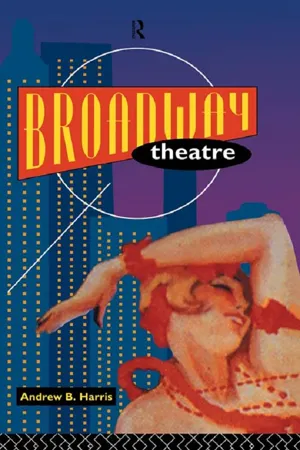
'Broadway' has been the stuff of theatrical legends for generations. In this fascinating and affectionate account of a unique theatrical phenomenon, Andrew Harris takes an intriguing look at both the reality and the myth behind the heart and soul of American Drama
Broadway Theatre explores:
* the aims and achievements of such major figures as Tennessee Williams, Eugene O'Neill and David Mamet
* the processes a play goes through from preliminary draft to opening night
* the careful balancing between aesthetic ideals and commercial considerations
* the place of producers, reviewers, agents and managers and their contribution to the process
* the relationship between acting styles and writing syles for Broadway plays
- 208 pages
- English
- ePUB (mobile friendly)
- Available on iOS & Android
eBook - ePub
Broadway Theatre
About this book
Information
1
CURTAINS UP!
With me the play is not only the thing — it's absolutely everything.Jed Harris
Our journey begins in the 1920s, because not only was this Broadway's golden era, but it was also the literary beginning of Broadway's modern realistic stage tradition. However, it is necessary to discuss prior periods since much of what is Broadway from theatre buildings to labor relations, has its origins even earlier. Before the 1920s Broadway theatre was best known for light entertainment: farces, melodramas, and musicals. As diverting as these plays were, they were for the most part devoid of any serious literary merit. Although Broadway had spawned several promising playwrights, the most notable was Clyde Fitch. Others worthy of consideration were Edward Sheldon, Percy MacKaye, Augustus Thomas, Lang-don Mitchell, James A. Herne, and William Vaughn Moody. However, none of these writers was ever able to break away from the formulaic constrictions inherited from the nineteenth century.
The period of development we will deal with is where Broadway producers, directors, designers, and writers attempted to combine ideas derived from European models such as the Moscow Art Theatre with American practice. The result was a manifestation of a stage realism tempered by expressionistic and other theatrical devices. Eventually, this evolved into a style which has become identified with Broadway. It was a time when the post-First World War generation of writers — which we extend to include playwrights such as Eugene O'Neill, Maxwell Anderson, Elmer Rice, Philip Barry, Sidney Howard, Marc Connelly, Paul Green, S. N. Behrman, Rachel Crothers, Sidney Kingsley, Lillian Hell-man, Samson Raphaelson, and Robert Sherwood — were idealistic enough to believe that a popular theatre could not only soar higher and probe deeper but could bring together art and commerce.
The 1920s were unique on Broadway. There was an energy and a restless enthusiastic spirit that questioned conventional wisdom. The First World War had given America a new feeling of confidence in herself. The “Yanks” who came home from “over there” came home knowing they'd met the test of Europe's older civilizations. They saw this new age as the American Century. Industry, art, science, education, manners, and literature would now reflect that change in western civilization. At the center of this American democratic ideal was the life and times of the average American. He was a working man, proud that his ancestors had fled the decadent world of Europe. The courage, boldness, and muscularity of carving an urban industrial empire out of the wilderness needed to find expression in a tough, honest, and unpretentious drama. These ideas came to dominate Broadway's realistic theatre for the remainder of the century.
Never before or since has there been a decade that could equal the 1920s. Broadway was ablaze with theatre marquees. Walking north along the Main Stem across from the Metropolitan Opera, there was the Empire Theatre where the “carriage trade” would queue to see America's reigning first families, the Barrymores and the Lunts. Along Forty-second Street, the theatres were packed in like sardines. On the Great White Way itself were the bigger musical houses — theatres named after the famous musical stars of the day such as George M. Cohan and Al Jolson. In all there were more than seventy-six “legit” houses in operation, and the building boom was not over.1 Even though Broadway virtually closed down over the summer, except for the girl-and-comedy revues such as Flo Ziegfeld's Follies,2 in 1927 there were 268 openings. That meant that on some nights there were as many as five different shows vying for the attention of the daily critics.3 The best seats in the house were still under $5, and the balcony seats went for as little as 500.4 Playwrights could earn a royalty of $700 a week in an era when 10 percent of that sum was a handsome wage. If a show was a success and ran for more than one hundred performances (the century mark), there was a possible movie sale. After the playwright's split with the producer, he still stood to make “a tidy little fortune.”5 In those days, production costs were running between $10,000 and $20,000.6 Although circumstances changed by the end of the decade, producers and investors had a one in three chance for a success.7
The entire district had the look and feel of a carnival “midway.” There were nickelodeons, vaudevilles, burlesques, peep shows, and movies of various kinds. Hotels in the district boasted nightclubs and restaurants with live entertainment. The theatres had cabarets upstairs in roof gardens and casinos. Crowded in patchwork patterns were gaming parlors, Ripley's Believe It or Not “Curioddities” and a Wax Museum. News bulletins flickered around the Times Building while other electric signs jittered, danced, blew smoke, and cascaded before the eyes of awe-struck millions. Broadway was the nation's primary entertainment marketplace. Tin Pan Alley, home to songsmiths and lyricists, was within Broadway's precincts. Marketing songs through shows was an obvious method to gain exposure, but it was only valuable if Broadway appealed to the masses — performances by the hundreds to audiences of thousands.
Broadway remains distinct among American theatres because of the element of competition. Due to its location on expensive Manhattan Island real estate, the competition for space readily converted into a competition for attractions, actors, publicity, and ultimately for audiences. From the eighteenth century until the present, theatres have had to struggle against other kinds of land use. Therefore Broadway was and is, first and foremost, a commercial theatre. It exists not to create art, but to create profits.
As early as 1732, with fewer than ten thousand inhabitants in the colony, when the present Broadway district was a farm with a manure dump, there were already two theatres in New York. One represented the British Crown, and the other represented Dutch settlers and those in favor of home rule. The rivalry began when Rip Van Dam, who owned a building that might serve as a theatre on Nassau Street, refused to pay William Cosby, the new Royal Governor, the emoluments he had received in his term as interim governor. Although Cosby won his case in court, many colonists stopped patronizing the theatre on Broadway near the governor's palace to show support of Van Dam.8 This early commingling of political, ethnic, and commercial interests became a distinguishing feature of Broadway theatre.
In spite of this early rivalry, the first truly professional theatre in America was not established until twenty years later in Williamsburg, Virginia. William Hallam, a manager who ran afoul of the London licensing act, organized a troupe of ten actors headed by his brother Lewis Hallam (the Elder). The form of organization of this theatre was typical of a small eighteenth-century stock company and stands in marked contrast to what we now call Broadway theatre. In Lewis Hallam's company, Hallam acted the leading roles, his wife was his leading lady, and their three children were available for the smaller parts. This form of organization had certain artistic limitations. For instance, Master Lewis Hallam, the son, was required to play Romeo opposite his mother's Juliet. The elder Hallam was a traditional actor-manager, which meant he handled all the financial and the artistic affairs of the company. Producer, director, leading actor, and general manager, his was the only position of authority. The rest of the troupe included actors and actresses who, if not members of the Hallam family, were shareholders in the company. An actor received his remuneration according to his share. Each adult was wed to the fortunes of the actor-manager as well as to the troupe as a whole for it was impossible to sell one's share without the approval of the manager and the company. This method of organization created loyalty as well as assuming a fixed repertory. During this period, repertory meant established plays (Shakespeare, Steele, Rowe, Lillo, Cibber, and Farquhar) and current comedies. Each actor would have a group of stock parts which constituted that actor's “line” (a technical term as in a “line of business”). The “lines” in a typical eighteenth-century acting company were the Juvenile Lead and Ingenue, First and Second Light Comedians and Soubrettes, First and Second Low Comedians, Heavies of both sexes (“for villainy, tragedy, blood, and thunder”), Aristocratic Father and Bourgeois Father (or First and Second Old Man and Old Woman), Walking Gentlemen, Walking Ladies, and Utilities.9 The Hallam Company established the basic pattern of theatrical organization in America, a pattern that sustained itself until the last three decades of the nineteenth century.
In spite of being greeted by neighbors as “the synagogue of Satan”10 the Hallam troupe (now the American Company), took up regular residency. With the construction in 1798 of the Park Theatre (designed by French architect Joseph Mangin), New York possessed one of the finest facilities in the colonies.11 In the fifty years that followed, the population of New York grew to half a million. Waves of German and Irish immigrants came ashore and settled into the tenements of what today is known as Chinatown. To meet this rapid expansion, thirty theatres were constructed, the number of performance days increased to six a week, and theatrical bills changed nightly. By 1810, the increased competition sparked a quest for novelty and Stephen King (dubbed “King Stephen” by humorist Washington Irving) broke with tradition and imported the first English star, George Frederick Cooke. To help recoup the costs of the transatlantic passage and Cooke's princely salary, King set up a tour of several cities.12 The Cooke tour proved so successful that it established a pattern soon followed by other English stars, including James Wallack, Edmund Kean, Junius Brutus Booth, Charles Mathews, William Charles Macready, George Holland, and Charles and Fanny Kemble.
Although English stars did little to help the growth of American theatre, they did attract large audiences, overshadowing the efforts of the local actors. When the theatre did not have a star, attendance fell off so drastically that the booking of stars became a more deeply entrenched practice. In this earlier era, American audiences were not so easily won over by visiting talent. A sense of cultural inferiority combined with anti-English sentiment sometimes created life-threatening situations. Although it was a major coup to bring Edmund Kean to America, the great actor was not prepared for the small houses he encountered. In fact, he was so appalled that he refused to play Richard one night in Boston. The crowd became so incensed by his arrogance that they erupted, forcing him to leave the city out of fear of violence.13 Years later when he returned for another American tour, the slight was remembered. In New York, he was greeted with so many hisses and cat-calls that he was driven from the stage. Regaining his composure, he decided to brave the oranges and rotten apples and was hit on the shoulder by a bag of sand. In Boston, the crowd reacted even more violently. A riot ensued, furniture was smashed, and Kean was not allowed to play.
But if Kean had difficulties with American audiences, they were minor compared to those William Charles Macready encountered during his final farewell appearance in May of 1849. Macready had quarreled with the native-born tragedian, Edwin Forrest. Forrest's style of acting was in direct opposition to the idealization and noble demeanor practiced by the English Macready. Forrest's nationalistic stance had attracted a rowdy following of young fans many of whom were Irish. They were known as the “Bowery B'hoys.” The B'hoys heckled and howled Macready with such vigor at the Astor Place Opera House on May 8 that they forced the visitor from the stage. The aristocratic members of the New York audience were incensed and unwisely prevailed upon Macready to make a second attempt on May 10. To assure a friendly reception for this performance, they bought all the tickets in the house. This left an angry and threatening mob of fifteen thousand in the streets outside the theatre, which vented its frustration by rock-throwing. A regiment of infantry was called forth. Upon their arrival, they were greeted by a barrage of bricks. The command to fire into the crowd was given. Several rioters were hit. The mob went berserk attacking the soldiers. A second volley was fired. Panic followed and thousands stampeded from the square. When the smoke cleared, there were twenty-two dead and thirty wounded. Macready fled New York in disguise never to return again. The Astor Place Riot occurred on land that is now next to the New York Shakespeare Festival's Public Theatre. It was the worst riot in the history of American theatre.
The rough-and-tumble treatment given to Kean and Macready gave resident managers pause, but it was the exception and not the rule. Still, these reactions were significant, for they showed that American audiences were not going to be patronized by even the greatest of English stars. They also indicated how strongly the first American-born star Edwin Forrest played upon nationalistic feelings to elevate his stature. The idea of “taking the theatre” as the Bowery B'hoys had was but one variation of a continuing pattern.
Forrest's desire to win and hold an American audience found expression through another nationalistic idea, the awarding of an annual cash prize for an American play, which would then serve as a vehicle for his own unique talents.14 In the years that followed, Forrest awarded $20,000 in prizes for American plays which helped to spark an interest in native dramaturgy. Unfortunately, very few of the plays were successful and most have disappeared. But the actor's idea, soliciting plays as vehicles, has become one method for American plays to reach the public.15 Today Hollywood, which has taken over and adapted many Broadway business practices, continues this tradition.
Through the nineteenth century, natural geographic limitations and the public transportation network helped to foster the formation of distinct districts: dry goods on Pearl Street, jewelry on Maiden Lane, newspapers on Park Row, and banks and exchanges on Wall Street. Theatres gravitated to Broadway, the City's most important shopping street. When the Academy of Music was erected at Fourteenth Street (Union Square),16 the theatres began their north-westerly march up Broadway. They found their new locations in those areas that were to become the City's most elite neighborhoods. In 1883, a London visitor commented:
The plan adopted in New York has been to bring them [theatres] as nearly as possible together, so that the overflow of one house finds another theatre ready at hand. Hence the New York houses are nearly all situated in the Broadway, and have therefore a continual stream of life passing backward and for...
Table of contents
- Cover
- Half Title
- Theatre Production Studies
- Full Title
- Copyright
- Dedication
- Contents
- Illustrations
- Preface
- Acknowledgements
- 1 Curtains Up!
- 2 Changes in the Road
- 3 YOu Can't Take it with You
- 4 Death of a Salesman
- 5 Cat on a Hot Tin Roof
- 6 Who's Afraid of Virginia Woolf?
- 7 American Buffalo
- 8 Broadway Bound
- 9 Another Opening
- Appendix: Calendar of productions
- Notes
- Select bibliography
- Broadway Theatre on video
- Index
Trusted by 375,005 students
Access to over 1.5 million titles for a fair monthly price.
Study more efficiently using our study tools.
Frequently asked questions
Yes, you can cancel anytime from the Subscription tab in your account settings on the Perlego website. Your subscription will stay active until the end of your current billing period. Learn how to cancel your subscription
No, books cannot be downloaded as external files, such as PDFs, for use outside of Perlego. However, you can download books within the Perlego app for offline reading on mobile or tablet. Learn how to download books offline
Perlego offers two plans: Essential and Complete
- Essential is ideal for learners and professionals who enjoy exploring a wide range of subjects. Access the Essential Library with 800,000+ trusted titles and best-sellers across business, personal growth, and the humanities. Includes unlimited reading time and Standard Read Aloud voice.
- Complete: Perfect for advanced learners and researchers needing full, unrestricted access. Unlock 1.5M+ books across hundreds of subjects, including academic and specialized titles. The Complete Plan also includes advanced features like Premium Read Aloud and Research Assistant.
We are an online textbook subscription service, where you can get access to an entire online library for less than the price of a single book per month. With over 1.5 million books across 990+ topics, we’ve got you covered! Learn about our mission
Look out for the read-aloud symbol on your next book to see if you can listen to it. The read-aloud tool reads text aloud for you, highlighting the text as it is being read. You can pause it, speed it up and slow it down. Learn more about Read Aloud
Yes! You can use the Perlego app on both iOS and Android devices to read anytime, anywhere — even offline. Perfect for commutes or when you’re on the go.
Please note we cannot support devices running on iOS 13 and Android 7 or earlier. Learn more about using the app
Please note we cannot support devices running on iOS 13 and Android 7 or earlier. Learn more about using the app
Yes, you can access Broadway Theatre by Andrew Harris in PDF and/or ePUB format, as well as other popular books in Media & Performing Arts & Literary Criticism in Drama. We have over 1.5 million books available in our catalogue for you to explore.