Popular Politics in Nineteenth Century England provides an accessible introduction to the culture of English popular politics between 1815 and 1900, the period from Luddism to the New Liberalism. This is an area that has attracted great historical interest and has undergone fundamental revision in the last two decades. Did the industrial revolution create the working class movement or was liberalism (which transcended class divisions) the key mode of political argument?
Rohan McWilliam brings this central debate up to date for students of Nineteenth Century British History. He assesses popular ideology in relation to the state, the nation, gender and the nature of party formation, and reveals a much richer social history emerging in the light of recent historiographical developments.
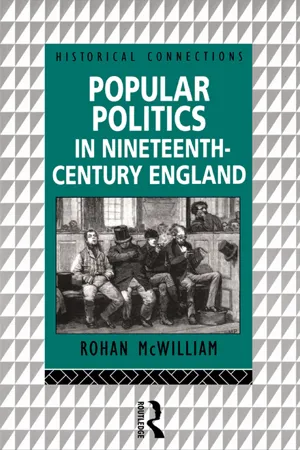
- 144 pages
- English
- ePUB (mobile friendly)
- Available on iOS & Android
eBook - ePub
Popular Politics in Nineteenth Century England
About this book
Part I
The Old Analysis
1 Reinterpreting the Queen Caroline Case
In 1820 Britain was rocked by one of the most bizarre episodes in its political history. This was the year that saw the death of George III. A far cry from the tyrannical despot that he had appeared in the early years of his reign, the king was considered by many to be the father of his people, a benevolent farmer who resembled the national emblem of John Bull. As the king withdrew from public life with old age and ‘madness’ (or rather, porphyria), his popularity had increased. By contrast, the new king was remarkably unpopular. The Prince Regent was reckoned by many to be a libertine whose lechery rendered him unfit to lead the nation. Exception was taken to his treatment of his wife, Caroline of Brunswick. The pair had married in 1795 mainly to persuade Parliament of the new-found respectability of the bankrupt Prince whose debts required payment. Their marriage was a disaster. Neither could abide the other and rumour had it that they spent only their wedding night together after which they went their separate ways. Caroline moved to the Continent in 1814 where it was believed she took an Italian lover, Bartolomeo Bergami, and, on one occasion, visited the brothel of the Dey of Tunis. In 1820, the new king, George IV, attempted to prevent her becoming queen.
Radical opinion was infuriated by his decision. Sympathy for Caroline had existed as early as 1796 when there were reports of their separation. In 1813, the agitator William Cobbett had taken up her cause when the Prince attempted to stop her seeing their daughter. With the coronation imminent, Caroline insisted on her right to be crowned queen. Alderman Matthew Wood, Whig MP for the City of London and a leading champion of Caroline, travelled to the Continent and persuaded her to return home. At Dover she received an enthusiastic reception from the crowd. Negotiations with Lord Liverpool’s government to arrange a settlement broke down and George then demanded that she be put on trial for adultery through a Bill of Pains and Penalties. Not only radicals but the public generally came to Caroline’s rescue. Pamphlets, petitions and demonstrations on her behalf spread through the country. In Parliament, the Whig MP, Henry Brougham, who was acting as Caroline’s attorney, flamboyantly contested the Government’s case against the queen. Caroline became Britannia—the embodiment of the nation. Her lost rights became the people’s lost rights. She replied to an address from supporters in St Pancras by saying that ‘…those who degrade the queen have never manifested any repugnance in abridging the liberties of the people’.1 This agitation was rooted in the concern that the monarchy apparently considered itself above the law, George IV having previously entered into an illegal marriage with Mrs Fitzherbert.2 Although the ideology of the cause never amounted to much more than the struggle of ‘Us’ against ‘Them’, the Caroline movement dramatised the reality of ‘Old Corruption’, government by clique and cabal. Furthermore, it provided the means by which radicals suffering from a deluge of repressive legislation could agitate whilst appearing loyal to the state through their support for the queen. Although the Bill passed through the Lords, the government decided not to continue with it, a move that signalled a triumph for Caroline. She attended a ceremony of thanksgiving at St Paul’s Cathedral and public meetings throughout Britain to celebrate her victory. The windows of unpopular government ministers were broken. Church bells were rung in support of the queen’s victory and there was fury when any member of the clergy refused supporters access to the belfry of the local church. Many authorities banned firework demonstrations and swore in additional constables to keep the peace.3 Given the government clampdown on popular political activity at that time, it was a spectacular mass mobilisation of opinion.
Having become a popular heroine, Caroline then lost favour by accepting a pension from the government. When the coronation took place, she attempted to gain admittance to Westminster Abbey in order to be crowned queen but was refused entry. She even had to endure the embarrassment of trying to enter by the back of the Abbey. Although crowds gathered to support her, there were no real disturbances. Nevertheless, when she died shortly afterwards, radicals frustrated government plans to quietly dispatch her body to Brunswick. A crowd intercepted the funeral procession and insisted that it should not exit through north London but instead pass through the city. The immense demonstration on her behalf led to violence and forced the resignation of the chief magistrate of Bow Street. It was the final moment of triumph both for Caroline and for Regency radicalism.
In his classic book, The Making of the English Working Class (1963), E.P.Thompson dismissed the Queen Caroline affair and devoted barely a page to it: ‘Into the humbug of the Queen’s case we need not inquire’.4 In his view, the agitation revealed the failure of the revolutionary tradition that he was tracing. With its middle-class leadership and sympathy for an aristocrat, the movement did not fit into any pre-existing model of class development. Lacking any real political content, it was an embarrassment in the history of radicalism. Yet in recent years the Caroline affair has been reassessed with a flood of articles and books that provide an indication of the way in which historical practice has changed. Whereas social historians were formerly mainly interested in class, the recent literature on Queen Caroline reveals a whole set of new categories through which to interpret popular movements: gender, patriotism, ethnicity, populism, respectability, the public sphere and melodrama. The historiography of the Queen Caroline case is typical of the new ways in which popular politics is being analysed. Indeed the affair has come into its own as a key moment in political development. Layer upon layer of new meanings have come to light. Recent historians have not been concerned with the problem of ‘authentic’ class responses (which made the Caroline affair difficult to understand) but have analysed instead the evidence that exists on its own terms.
How has the case been reinterpreted? It is now clear that the agitation was distinctive for its role in presenting a relatively new figure in politics: Public Opinion. The cause created communities of moral outrage although ‘public opinion’ was mostly used at that time to refer to middle-class males.5 In this new public sphere, the behaviour of the elite was open to criticism by all. Leonore Davidoff and Catherine Hall interpret the movement as a defining moment in the making of the English middle class. Rejecting the lax morality of the aristocracy, middle-class support for Caroline represented an assertion of its own values based on separate spheres (the division of civil society into public and private). The monarch’s contempt for domesticity (his duty towards his wife) contrasted with the earnest respectability invested by the bourgeoisie in the home.6 In retrospect, the Caroline case can be seen as part of a middle-class search for a monarchy that would deliver solid family values, a quest that concluded with the accession of Queen Victoria in 1837.
Nevertheless, the rhetoric of the movement appeared to be all inclusive, pitting the whole nation against the corrupt elite. The cause derived a great deal of support from artisan radicals such as the Thames shipwright John Gast. Whereas some radicals like Francis Place wished to simply discredit the monarchy, Gast admired the courage of the queen and agitated on her behalf. The movement served to re-establish political campaigning at a time when repressive government legislation(the Six Acts) threatened the possibility of any future radical action. I.J.Prothero argues that the simple existence of the agitation may have been more important than any political content it possessed.7 Beyond formal politics, the cause was notable for the way in which it was taken up in the rough culture of common labourers; hence the fears for public order registered by magistrates and church-wardens throughout the country and particularly in the countryside where authorities had to deal with the anger of the mob whose carnival-like spirit manifested the continuity of eighteenth-century patterns of protest. This was also true of the ideology of the movement which, although hardly sophisticated, was not devoid of content. Supporters claimed that they were defending the constitution as established by the signing of Magna Charta by King John. In William Hone’s pro-Caroline pamphlet entitled The Queen and Magna Charta; Or, the Thing that John signed, which went through at least five editions in 1820, Magna Charta was represented surrounded by the laws of England, the revolutionary Cap of Liberty, a lion with a crown and a dog with a collar labelled ‘John Bull’:
This is
THE STANDARD,
the
RALLYING SIGN,
RALLYING SIGN,
round which
every
every
BRITON of HONOR
will join
will join
To restore to their Country
their King and their Queen,
their King and their Queen,
The blessings that Faction
would dare contravene,
would dare contravene,
And with heart and with hand
in a moment expel,
in a moment expel,
THE TRAITORS TO ENGLAND,
the offspring of Hell.
the offspring of Hell.
THE HORRIBLE VERMIN
the RATS AND THE LEECHES
Whom the Blood and the Treasure
of Britain enriches.
of Britain enriches.
Whose pestilent breath
if prolong’d, would consume
The fruits of our country,
Its verdure, and bloom.
if prolong’d, would consume
The fruits of our country,
Its verdure, and bloom.
Destroy MAGNA CHARTA,
and then in its place
Allow us like slaves,
to exist in disgrace.8
Allow us like slaves,
to exist in disgrace.8
This squib captures the essence of popular political thought: its belief in a benevolent constitution under threat, its opposition to self-interest, its fear of despotism and love of liberty, its heroic cadences and abiding patriotism.
Supporters and opponents of Queen Caroline expressed their views in terms of the nation. The iconography of crown and constitution suffused the movement. The above pamphlet depicted an Englishman, an Irishman and a Scotsman under their common (and relatively new) identity as Britons supporting Caroline’s crown.9 National identity was a crucial component of the movement, with the queen representing the people. This was assisted by the role of foreigners in the case who unwittingly helped define the Britishness of the queen’s cause. Her former servant, Majocci, who testified against her, became a popular villain. His constant refrain during the trial, ‘non mi riccordo’ (I don’t remember), became the subject of popular derision and he was actually burnt in effigy and attacked by the crowd. Xenophobia ran deep within the common people, with the foreigner providing an example of ‘the other’ against which national identity could be constructed.
Caroline drew support not only because of her constitutional status as queen but also because of her gender. Her cause has enjoyed renewed attention on account of the unprecedented participation of women. As Thomas Laqueur reveals in what is probably the most influential recent assessment of the case, women predominated in the crowds. A female petition from Nottingham had 7,800 signatures, another from Bristol had 11,047, whilst London women produced petitions with 17,652 names.10 The Queen and Magna Charta was dedicated to ‘the Ladies of Great Britain’ and its cover featured Britannia with a parchment on which was written: ‘To assert the Rights of Man/To avenge the wrongs of woman’.11 Moreover, it was the first of several agitations during the century in which women were to represent themselves as defenders of communal morality. Such movements gave women a voice in a way that traditional radicalism based on artisan skill did not. The cause provided an opportunity to attack the double standard of sexual morality whereby men were allowed to exercise their sexuality outside marriage whilst women were expected to remain chaste. George IV, who had previously tried to prevent Caroline from seeing their daughter, was perceived as an enemy of the family and a debauched libertine. Anna Clark has drawn attention to the way in which plebeian women identified with Caroline as a victimised wife. The presence of a vigorous female lobby meant that male radicals were forced to incorporate women’s demands in their political agenda.12 The symbolism of the queen’s plight therefore expanded the range of popular politics beyond the question of the constitution. Similarly, male radicals supported Caroline because of their increasing opposition to libertinism and because of their desire to defend the family.13 Masculine support was usually enunciated in the language of chivalry. At a pro-Caroline demonstration in Alford, Lincolnshire, a man rode on horseback in front of a procession waving a sword as Caroline’s champion and challenging anyone who would dispute her succession. The procession of London brassfounders to celebrate the queen’s victory in January 1821 actually included eight knights on horseback in full armour.14 The women of Nottingham asked ‘all in whom the spirit of the days of chivalry are not utterly extinct’ to support the queen.15 Craig Calhoun argues that the Caroline agitation was a form of populism designed to preserve a traditional, community-based way of life.16
It should be clear by now that, as Laqueur suggests, the case was presented to the public through the lens of melodrama. Caroline was the wronged woman whilst George IV was an aristocratic seducer, both types familiar from the stage. For Laqueur, this ultimately trivialised the movement and rendered its political content redundant, explaining its failure. Anna Clark, by contrast, argues that it was melodrama that actually gave the movement its power and enabled it to reach a wider audience.17 The melodrama of the queen’s fate took no account of her actual behaviour with Bergami and others but this issue surfaced in the close cousin of melodrama, pornography. Anti-Caroline propagandists employed lewd images of the queen’s immoral life on the Continent, but the majority of pornographic material assaulted George IV whose libertinism made him the target of bawdy prints. Iain McCalman sees the Caroline case as a highpoint of obscene populism where the underground press employed pornography to satirise and deflate its government opponents. Radical publishers such as William Benbow produced ‘pro-Queen smut’.18 The Caroline case was therefore extremely complex. On the one hand, it embodied a deep respectability that was to be crucial not just to the middle class but also to many working-class politicians. On the other, it co-existed with what McCalman calls ‘unrespectable radicalism’. Political identities contain a great deal of ambiguity. They are expressed through performance and role play. Emotions and feelings about the social order are as important as well thought-out political programmes. What we learn from the Queen Caroline affair is that politics is frequently about states of mind.
At the end of the day, the Caroline agitation was stopped in its tracks by the strength of the conservative counterblast which attacked the queen’s morality and affirmed its loyalty to British institutions.19 Popular conservatism was therefore as significant as radicalism. At an elite level, the affair also had some importance. It brought the Liverpool government into further disrepute and enabled the Whig opposition to define itself as a grouping uniquely sympathetic to ‘public opinion’. Although not to enter government for another ten years, this sensitivity to public opinion was to prove a key to the Whig renaissance of the 1830s.
In the literature on the Queen Caroline case we can therefore find a range of readings that encapsulate the new agenda of historians of popular politics and which were not available in the 1960s. There is a new sensitivity to neglected groups such as women, to politics that were supposedly eccentric and non-class-specific. The new literature bears the imprint of developments in cultural history and current gender politics. The social and intellectual currents that enable historians to devise new explanations are the concern of this book.
2 From the Old Analysis to th...
Table of contents
- Cover Page
- Half Title page
- Series page
- Title Page
- Copyright Page
- Dedication
- Contents
- Series Editors' Preface
- Acknowledgements
- Introduction
- The Old Analysis
- 1 Reinterpreting the Queen Caroline Case
- 2 From the Old Analysis to the New
- New directions
- 3 The Peculiarities of Politics
- 4 A Polity-Centred History? Rethinking the State, the Franchise and Party Formation
- 5 The Culture of Popular Radicalism I Populism, Class and the Constitution
- 6 The Culture of Popular Radicalism II Gender and Socialism
- 7 The Nation and Politics I Patriotism
- 8 The Nation and Politics II Popular Conservatism
- Conclusion Towards Post-Revisionism
- Notes
- Bibliography
- Index
Trusted by 375,005 students
Access to over 1.5 million titles for a fair monthly price.
Study more efficiently using our study tools.
Frequently asked questions
Yes, you can cancel anytime from the Subscription tab in your account settings on the Perlego website. Your subscription will stay active until the end of your current billing period. Learn how to cancel your subscription
No, books cannot be downloaded as external files, such as PDFs, for use outside of Perlego. However, you can download books within the Perlego app for offline reading on mobile or tablet. Learn how to download books offline
Perlego offers two plans: Essential and Complete
- Essential is ideal for learners and professionals who enjoy exploring a wide range of subjects. Access the Essential Library with 800,000+ trusted titles and best-sellers across business, personal growth, and the humanities. Includes unlimited reading time and Standard Read Aloud voice.
- Complete: Perfect for advanced learners and researchers needing full, unrestricted access. Unlock 1.5M+ books across hundreds of subjects, including academic and specialized titles. The Complete Plan also includes advanced features like Premium Read Aloud and Research Assistant.
We are an online textbook subscription service, where you can get access to an entire online library for less than the price of a single book per month. With over 1.5 million books across 990+ topics, we’ve got you covered! Learn about our mission
Look out for the read-aloud symbol on your next book to see if you can listen to it. The read-aloud tool reads text aloud for you, highlighting the text as it is being read. You can pause it, speed it up and slow it down. Learn more about Read Aloud
Yes! You can use the Perlego app on both iOS and Android devices to read anytime, anywhere — even offline. Perfect for commutes or when you’re on the go.
Please note we cannot support devices running on iOS 13 and Android 7 or earlier. Learn more about using the app
Please note we cannot support devices running on iOS 13 and Android 7 or earlier. Learn more about using the app
Yes, you can access Popular Politics in Nineteenth Century England by Rohan McWilliam,Rohan Mcwilliam in PDF and/or ePUB format, as well as other popular books in History & Modern British History. We have over 1.5 million books available in our catalogue for you to explore.