- 242 pages
- English
- ePUB (mobile friendly)
- Available on iOS & Android
eBook - ePub
About this book
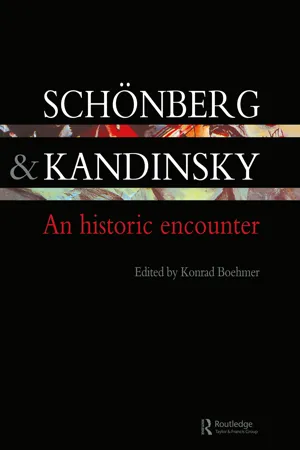
The historic encounter around 1911 between the composer Arnold Schönberg and the painter Wassily Kandinsky occurred at a moment when the first wild revolts against traditional art, Dada and Futurism, had just manifested themselves. Independently of those sometimes spectacular activities, both Schönberg and Kandinsky had already concluded that the material and the compositional methods they had relied on in the past were exhausted and did not satisfy the development of their artistic ideas. Both artists had already submitted their modes of production to a critical analysis which resulted in Schonberg's Theory of Harmony and Kandinsky's Concerning the Spiritual in Art , both of 1911 - indeed the two artists had already been putting their self-criticism into practice for some time. In Schönberg's case this led to breaking with tonality; Kandinsky effected the transition to abstract painting. This book is a collection of the papers presented at the conference on Schönberg and Kandin
Information
Latent Structural Power versus the Dissolution of Artistic Material in the Works of Kandinsky and Schönberg
KLAUS KROPFINGER
“Gegensätze und Widersprüche – das ist unsere Harmonie”1 (Kandinsky 1911)
I
On January 18, 1911 Kandinsky first wrote to Arnold Schönberg. The impulse for his letter came from a concert the painter had attended on January 2, 1911 accompanied by Franz Marc, Alexei Jawlensky, Marianne Werefkin, and others, in which the program included performances of Schönberg’s String Quartets in D (op. 7), in F-sharp (op. 10) (1907/08), five songs from op. 2 and op. 6, and the Piano Pieces op. 11 (1909).2 To the composer, Kandinsky wrote:
“In your works, you have realized what I, albeit in uncertain form, have so greatly longed for in music. The independent progress through their own destinies, the independent life of the individual voices in your compositions, is exactly what I am trying to find in my paintings. At the moment there is a great tendency in painting to discover the ‘new’ harmony by constructive means, whereby the rhythmic is built on an almost geometric form. My own instinct and striving can support these tendencies only half-way. Construction is what has been so woefully lacking in the painting of recent times, and it is good that it is now being sought. But I think differently about the type of construction. I am certain that our own modern harmony is not to be found in the ‘geometric’ way, but rather in the anti-geometric, anti-logical way. And this way is that of ‘dissonances in art[’], in painting, therefore, just as much as in music. And ‘today’s’ dissonance in painting and music is merely the consonance of ‘tomorrow’”3
Schönberg and Kandinsky apparently saw each other for the first time on September 14, 1911;4 in reality, however, they had already met mentally, that is, on artistic grounds, at the beginning of the year. It is highly significant that Kandinsky, after having heard Schönberg’s astounding new compositions, wrote a letter to the composer almost immediately in which he reflected on fundamental aspects of the artistic process, not in terms of music or painting, but of music and painting. His reaction indicates the degree to which artistic evocation and reflection among artists at the threshold of abstraction, were no more than two sides of the same coin. It also demonstrates in Kandinsky a readiness to grasp and perceive the pivotal importance of the music of Schönberg, who at this time and for decades to come would struggle for acceptance. Last but not least, the painter’s letter stands as an ‘essay’ in reception theory insofar as it points to the importance of an artist’s readiness for aesthetic and intellectual communication and exchange.5 Kandinsky’s own reflections are matched by those of friends such as Franz Marc, who – no less impressed by Schönberg than Kandinsky – wrote on January 14 of the same year to August Macke:
“Can you imagine a music in which tonality (that is, the adherence to any key) is completely suspended? I was constantly reminded of Kandinsky’s large composition, which also permits no trace of tonality … and also of Kandinsky’s ‘jumping spots’ in hearing this music, which allows each tone sounded to stand on its own (a kind of white canvas between the spots of color!) Schönberg proceeds from the principle that the concepts of consonance and dissonance do not exist at all. A so-called dissonance is only a more remote consonance – an idea which now occupies me constantly while painting .…”6
II
The idea of dissonance being nothing more than ‘remote consonance’ was prefigured by a poster for the January concert in which short excerpts from the chapter on ‘Parallel Octaves and Fifths’ in Schönberg’s Theory of Harmony were presented graphically.7 These theoretical excerpts, which were appropriated by the concert promoter to render something like a catchy headline, were soon taken up as watchwords for the avant-garde of painters in the ambit of Kandinsky. He immediately reacted by obtaining, translating, and publishing the text as part of the catalogue of an exhibition of Russian artists organized by Vladimir Aleksejeff Izdebskij at Odessa, Kiev, and St. Petersburg in 1910–1911.8 And, it is precisely this interpretation of dissonance that played an important role in Kandinsky’s own treatise On the Spititual in Art, which appeared in 1911. Here he refers explicitly to the excerpt from Schönberg’s Theory of Harmony.
“The Viennese composer Arnold Schönberg, with his total renunciation of accepted beauty, regarding as sacred every means that serves the purpose of self-expression, goes his lonely way unrecognized, even today, by all but a few enthusiasts. This ‘publicity seeker’, ‘charlatan’, and ‘bungler’ says in his Theory of Harmony. ‘Every chord, every progression is possible. And yet I feel already today that even here there are certain conditions that govern whether I choose this or that dissonance’.”9
Both artists confessed that their writings at this stage of development were merely first steps. As Kandinsky puts it:
“The characteristics of our harmony today make it self-evident that in our own time it is less possible than ever to establish a ready-made theory, to construct set procedures of pictorial harmonization.”10
Kandinsky’s remarks resonate in those of Schönberg, who emphasized at the end of his Theory of Harmony that:
“However much I may theorize in this book – for the most part, in order to refute false theory –, I am compelled to expand narrow and confining conceptions to include the facts … But not to set up new eternal laws.…”11
He goes on to write:
“Hence, I can just as well abstain from giving an aesthetic evaluation of these new harmonies …..”12
In concluding, Schönberg indicates ‘tone-color melodies’ as the ultimate achievement of this development:
“Tone-color melodies! How acute the senses that would be able to perceive them! How high the development of spirit that could find pleasure in such subtle things! In such a domain, who dares ask for theory!”13
III
The shared reluctance of the two artists to theorize definitively – a reluctance absolutely in keeping with artistic development in their milieu – corresponds with the particular way in which they dealt with the aesthetic problems of music and painting. They focused on investigations and reflections Kandinsky describes as the “weighing-up of the inner value of one’s material.”14
In musicology today, there seems to exist a certain – if not a strong – tendency to refrain from use of the term ‘material’ in the sense that it is introduced and elaborated by Theodor W. Adorno.15 Clearly we must be aware of the problems inherent in the stringency of historical tendencies according to Adorno’s conception, and in his understanding of ‘dialectics’ in material, which could be directed – as Ernst Krenek perceived – against aristic ‘freedom’. These problems would erupt into an epistolary dispute between Adorno and Krenek during the autumn of 1932.16 However, we should not forget the foreshadowing of a possible shift in Adorno’s position when, some three decades later, he wrote in Vers une musique informelle that “the material itself is changed by composition. From every coherent one it steps forth fresh and as if new.”17 Neither is it clear to what extent the next passage in Adorno’s text, where he writes that “The secret of composition is the strength which transforms the material in a process of proceeding adequacy.…”18 in fact refers to the question of the reduction of ‘free will’ that so preoccupied Krenek. In Adorno’s Philosophy of New Music itself, however, it is precisely the dialectics of ‘material’ that opens the way to a more adequate understanding of the relation between historicity and creative freedom. It seems that even in Adorno’s conception, the stringency of material was, finally, relative to the historical configuration.19 And, it is the example of Schönberg’s renunciation of material that eventually undermines the rigidity of the idea.20 Given its limitation, the essence of Adorno’s understanding of ‘material’ is nonetheless valid, for while
“musical material has usually been conceived as an inventory of physical resources …, Adorno, in contrast, conceived of musical material as sedimented history. Following a thought that he first presented in his early lecture ‘The Idea of Natural History’, he described this sedimentation as occurring in such a way that the more the material appears as nature, as second nature, the more intensively historical it is. As he wrote [in his Philosophy of New Music], the elements of music ‘bear historical necessity within themselves the more perfectly, the less they are immediately readable as historical characters …’.”21/22
Adorno’s stringent definition of artistic material has its roots in Schönberg’s free ‘atonality’; but Kandinsky’s aristic approach has its own affinity to Adorno’s notion of material in art.23 This may be valid above all because both artists’ consciousness of material is rooted in a kind of teleological thinking that heightened their sense of strictly progressive traits in artistic material. For both of them, this became the powerful impetus to ‘materialize’ the progression in the ‘new’ avant-garde work of art.
According to Kandinsky “… every art bears within it the seed of the future and awakens the strings of the soul … Art is the seer of the future and is a leader.… This embarkation on an almost forgotten path of prophetic revelations took place almost simultaneously in the various other arts.”24 Schönberg stresses that “the laws native to the genius … are the laws of future generations.”25 This methodical striving to apply to the artistic material a conception of progressive development, is of larger importance for the understanding and interpretation of their artistic theoretical texts. According to Panofsky, “what an artist has said about his own works must always be interpreted in the light of the works themselves;”26 reflections on material – when driven to the point of its practical applicati...
Table of contents
- Cover
- Halftitle
- Title
- Copyright
- Contents
- Introduction to the Series
- Preface
- Introduction: The Schönberg–Kandinsky Symposium by Frans Evers
- The Construction of Painting with White Form by Wassily Kandinsky
- Latent Structural Power versus the Dissolution of Artistic Material in the Works of Kandinsky and Schönberg
- Kandinsky, Schönberg and their Parallel Experiments
- Kandinsky and Schönberg: The Problem of Internal Counterpoint
- Where does “The Blue Rider” Gallop? Schönberg, Kandinsky and Scriabin on the Synthesis of Art
- Public Loneliness: Atonality and the Crisis of Subjectivity in Schönberg’s Opus 15
- The Fool as Paradigm: Schönberg’s Pierrot Lunaire and the Modern Artist
- Expressionism and Rationality
- Schönberg’s Pursuit of Musical Truth: Truth as a Central Category in Expressionism
- The Dialectics of Artistic Creativity: Some Aspects of Theoretic Reflection in Schönberg and Kandinsky
- Notes on Contributors
- Index
Trusted by 375,005 students
Access to over 1.5 million titles for a fair monthly price.
Study more efficiently using our study tools.
Frequently asked questions
Yes, you can cancel anytime from the Subscription tab in your account settings on the Perlego website. Your subscription will stay active until the end of your current billing period. Learn how to cancel your subscription
No, books cannot be downloaded as external files, such as PDFs, for use outside of Perlego. However, you can download books within the Perlego app for offline reading on mobile or tablet. Learn how to download books offline
Perlego offers two plans: Essential and Complete
- Essential is ideal for learners and professionals who enjoy exploring a wide range of subjects. Access the Essential Library with 800,000+ trusted titles and best-sellers across business, personal growth, and the humanities. Includes unlimited reading time and Standard Read Aloud voice.
- Complete: Perfect for advanced learners and researchers needing full, unrestricted access. Unlock 1.5M+ books across hundreds of subjects, including academic and specialized titles. The Complete Plan also includes advanced features like Premium Read Aloud and Research Assistant.
We are an online textbook subscription service, where you can get access to an entire online library for less than the price of a single book per month. With over 1.5 million books across 990+ topics, we’ve got you covered! Learn about our mission
Look out for the read-aloud symbol on your next book to see if you can listen to it. The read-aloud tool reads text aloud for you, highlighting the text as it is being read. You can pause it, speed it up and slow it down. Learn more about Read Aloud
Yes! You can use the Perlego app on both iOS and Android devices to read anytime, anywhere — even offline. Perfect for commutes or when you’re on the go.
Please note we cannot support devices running on iOS 13 and Android 7 or earlier. Learn more about using the app
Please note we cannot support devices running on iOS 13 and Android 7 or earlier. Learn more about using the app
Yes, you can access Schonberg and Kandinsky by Konrad Boehmer in PDF and/or ePUB format, as well as other popular books in Art & Music History & Criticism. We have over 1.5 million books available in our catalogue for you to explore.