Effective use of driving simulators requires considerable technical and methodological skill along with considerable background knowledge. Acquiring the requisite knowledge and skills can be extraordinarily time consuming, yet there has been no single convenient and comprehensive source of information on the driving simulation research being conduc
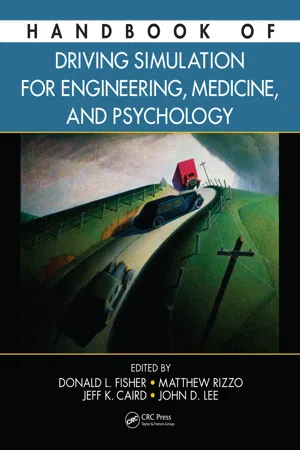
eBook - PDF
Handbook of Driving Simulation for Engineering, Medicine, and Psychology
- 728 pages
- English
- PDF
- Available on iOS & Android
eBook - PDF
Handbook of Driving Simulation for Engineering, Medicine, and Psychology
About this book
Information
Table of contents
- Front Cover
- Contents
- Acknowledgments
- Editors
- Contributors
- Chapter 1: Handbook of Driving Simulation for Engineering, Medicine, and Psychology: An Overview
- Chapter 2: A Short History of Driving Simulation
- Chapter 3: Using Driving Simulators Outside of North America
- Chapter 4: The Future of Driving Simulation
- Chapter 5: Twelve Practical and Useful Questions About Driving Simulation
- Chapter 6: Scenario Authoring
- Chapter 7: Physical Fidelity of Driving Simulators
- Chapter 8: Sensory and Perceptual Factors in the Design of Driving Simulation Displays
- Chapter 9: Psychological Fidelity: Perception of Risk
- Chapter 10: Surrogate Methods and Measures
- Chapter 11: Validating Vehicle Models
- Chapter 12: Cross-Platform Validation Issues
- Chapter 13: Simulator Validity: Behaviors Observed on the Simulator and on the Road
- Chapter 14: Simulator and Scenario Factors Influencing Simulator Sickness
- Chapter 15: Independent Variables: The Role of Confounding and Effect Modification
- Chapter 16: External Driver Distractions: The Effects of Video Billboards and Wind Farms on Driving Performance
- Chapter 17: Measuring Physiology in Simulators
- Chapter 18: Eye Behaviors: How Driving Simulators Can Expand Their Role in Science and Engineering
- Chapter 19: Situation Awareness in Driving
- Chapter 20: Simulator Data Reduction
- Chapter 21: Analytical Tools
- Chapter 22: Statistical Concepts
- Chapter 23: The Qualitative Interview
- Chapter 24: Understanding and Changing the Young Driver Problem: A Systematic Review of Randomized Controlled Trials Conducted With Driving Simulation
- Chapter 25: The Older Driver (Training and Assessment: Knowledge, Skills and Attitudes)
- Chapter 26: Methodological Issues When Conducting Research on Older Drivers
- Chapter 27: Profiles in Cell Phone-Induced Driver Distraction
- Chapter 28: Night Driving: How Low Illumination Affects Driving and the Challenges of Simulation
- Chapter 29: Driving in States of Fatigue or Stress
- Chapter 30: Driving Simulators as Training and Evaluation Tools: Novice Drivers
- Chapter 31: The Commercial Driver
- Chapter 32: Driving Rehabilitation as Delivered by Driving Simulation
- Chapter 33: The Importance of Proper Roadway Design in Virtual Environments
- Chapter 34: The Use of High-Fidelity Real-Time Driving Simulators for Geometric Design
- Chapter 35: Traffic Signals
- Chapter 36: Design and Evaluation of Signs and Pavement Markings Using Driving Simulators
- Chapter 37: Advanced Guide Signs and Behavioral Decision Theory
- Chapter 38: Driving Simulation Design and Evaluation of Highway–Railway Grade and Transit Crossings
- Chapter 39: Roadway Visualization
- Chapter 40: Advanced Warning Technologies: Collision, Intersection Incursion
- Chapter 41: Adaptive Behavior in the Simulator: Implications for Active Safety System Evaluation
- Chapter 42: Cognitive Architectures for Modeling Driver Behavior
- Chapter 43: Combining Perception, Action, Intention, and Value: A Control Theoretic Approach to Driving Performance
- Chapter 44: Acute Alcohol Impairment Research in Driving Simulators
- Chapter 45: Validity of Three Experimental Performance Tests for Predicting Risk of Cannabis-Induced Road Crashes
- Chapter 46: Medical Disorders
- Chapter 47: Psychiatric Disorders and Driving Performance
- Chapter 48: Driving in Alzheimer’s Disease, Parkinson’s Disease and Stroke
- Chapter 49: Driving Simulation in Epilepsy and Sleep Disorders
- Chapter 50: Traumatic Brain Injury: Tests in a Driving Simulator as Part of the Neuropsychological Assessment of Fitness to Drive
- Back Cover
Trusted by 375,005 students
Access to over 1.5 million titles for a fair monthly price.
Study more efficiently using our study tools.
Frequently asked questions
Yes, you can cancel anytime from the Subscription tab in your account settings on the Perlego website. Your subscription will stay active until the end of your current billing period. Learn how to cancel your subscription
No, books cannot be downloaded as external files, such as PDFs, for use outside of Perlego. However, you can download books within the Perlego app for offline reading on mobile or tablet. Learn how to download books offline
Perlego offers two plans: Essential and Complete
- Essential is ideal for learners and professionals who enjoy exploring a wide range of subjects. Access the Essential Library with 800,000+ trusted titles and best-sellers across business, personal growth, and the humanities. Includes unlimited reading time and Standard Read Aloud voice.
- Complete: Perfect for advanced learners and researchers needing full, unrestricted access. Unlock 1.5M+ books across hundreds of subjects, including academic and specialized titles. The Complete Plan also includes advanced features like Premium Read Aloud and Research Assistant.
We are an online textbook subscription service, where you can get access to an entire online library for less than the price of a single book per month. With over 1.5 million books across 990+ topics, we’ve got you covered! Learn about our mission
Look out for the read-aloud symbol on your next book to see if you can listen to it. The read-aloud tool reads text aloud for you, highlighting the text as it is being read. You can pause it, speed it up and slow it down. Learn more about Read Aloud
Yes! You can use the Perlego app on both iOS and Android devices to read anytime, anywhere — even offline. Perfect for commutes or when you’re on the go.
Please note we cannot support devices running on iOS 13 and Android 7 or earlier. Learn more about using the app
Please note we cannot support devices running on iOS 13 and Android 7 or earlier. Learn more about using the app
Yes, you can access Handbook of Driving Simulation for Engineering, Medicine, and Psychology by Donald L. Fisher, Matthew Rizzo, Jeffrey Caird, John D. Lee, Donald L. Fisher,Matthew Rizzo,Jeffrey Caird,John D. Lee in PDF and/or ePUB format, as well as other popular books in Technology & Engineering & Industrial Health & Safety. We have over 1.5 million books available in our catalogue for you to explore.