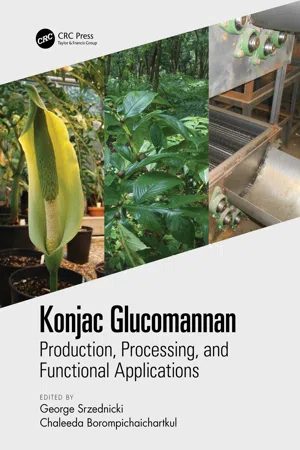
In recent years, konjac glucomannan (KGM) has attracted growing attention as a dietary fibre. It is a neutral hydrocolloid with significant health functions. Although relatively little known in the Western world, it has been part of the human diet in China and Japan for nearly two thousand years. Initially, the main source of KGM was Amorphophallus konjac from which the common English name 'konjac' is derived. Nowadays, the production of KGM is expanding into SE Asia and more tropical species of Amorphophallus are used as a raw material.
Konjac Glucomannan: Production, Processing, and Functional Applications deals with a wide range of aspects related with the production of KGM, including the taxonomy of the genus Amorphophallus with a focus on edible species, their physiology, ecology and field production. Other sections of the book discuss the postharvest processing and physico-chemical properties of KGM. A considerable portion is dedicated to the applications of KGM in functional foods, food additives and their derivatives and in medicine. In addition, Konjac Glucomannan describes the current status of the KGM industry and the research done by industrial and scientific institutions in the major producing countries.
Key Features
- Provides thorough information about taxonomy and ecology of KGM producing Amorphophallus species
- Describes commercial production of Amorphophallus sp. in the field and the forest
- Describes advanced industrial extraction techniques of KGM
- Reviews the major applications of KGM nutritional (anti-obesity, regulation in lipid metabolism, prebiotic) and biomedical fields
At present, KGM has wide applications in the food industry as a gelling agent, stabiliser and emulsifier and is used for edible coatings for preservation of fruit and vegetables. Other uses are in pharmaceutical industry for microencapsulation of active compounds that are to be released 'on demand' for treatment of various diseases. This book is aimed at researchers in academia and industry, and will appeal to professionals from a wide variety of industries including food scientists & engineers, botanists, agronomists, nutritionists, health care professionals, pharmaceutical industry professionals.