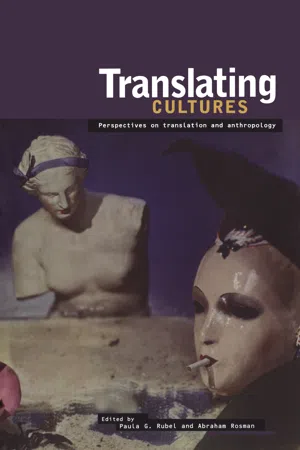
eBook - ePub
Translating Cultures
Perspectives on Translation and Anthropology
- 320 pages
- English
- ePUB (mobile friendly)
- Available on iOS & Android
eBook - ePub
Translating Cultures
Perspectives on Translation and Anthropology
About this book
The task of the anthropologist is to take ideas, concepts and beliefs from one culture and translate them into first another language, and then into the language of anthropology. This process is both fascinating and complex. Not only does it raise questions about the limitations of language, but it also challenges the ability of the anthropologist to communicate culture accurately. In recent years, postmodern theories have tended to call into question the legitimacy of translation altogether. This book acknowledges the problems involved, but shows definitively that 'translating cultures' can successfully be achieved. The way we talk, write, read and interpret are all part of a translation process. Many of us are not aware of translation in our everyday lives, but for those living outside their native culture, surrounded by cultural difference, the ability to translate experiences and thoughts becomes a major issue. Drawing on case studies and theories from a wide range of disciplines -including anthropology, philosophy, linguistics, art history, folk theory, and religious studies - this book systematically interrogates the meaning, complexities and importance of translation in anthropology and answers a wide range of provocative questions, such as: - Can we unravel the true meaning of the Christian doctrine of trinity when there have been so many translations? - What impact do colonial and postcolonial power structures have on our understanding of other cultures? - How can we use art as a means of transgressing the limitations of linguistic translation? Translating Cultures: Perspectives on Translation and Anthropology is the first book fully to address translation in anthropology. It combines textual and ethnographic analysis to produce a benchmark publication that will be of great importance to anthropologists, philosophers, linguists, historians, and cultural theorists alike.
Information
Part IGeneral Problems of Translation
—1— Lyotard and Wittgenstein and the Question of Translation
Aram A. Yengoyan
Translations and the tensions in translation have always plagued anthropology, be it in its scientific version or humanistic side, with the persistent question of how cultural translations can be made without destroying the very subjects which we are attempting to convey. From Boas onward, anthropological theory regarding translation has been caught up in various conceptual developments, in our attempts toward comparison and what that meant, as well as in our efforts to generalize or forge a systematic study of human societies as Radcliffe-Brown demanded.
Yet, cultural translation (even linguistic translation) has seldom been directly addressed as an issue. Aside from some similarities, cultural translations and linguistic translations differ in a number of ways. Usually cultural translations have been done through a frame which either stresses differences or serves as a means in which the "other" is portrayed in categories which are understandable to a Western audience. Although traditional anthropological categories (such as kinship, lineage, family, etc.) have been used as glosses, cultural translations are less exacting and also less scientific. On this matter, not only do linguistic translations bring forth the language of the investigator, but also linguistics - as a discipline which covers phonological, morphological, and grammatical categories and distinctions - is usually more exacting in terms of rigor. Furthermore, what linguists mean by semantics is hardly comparable to anthropological usage. The distinction between cultural and linguistic translation is blurred, but in general, a more dominating framework on how translations are done can be imposed by linguistic methods and means of inquiry which are absent in more vague cultural translation attempts.
I
The first part of this chapter attempts to demarcate some of the intellectual concerns which stimulated various types of translation but also may have neglected other potential expressions of translation. Under Boas and his students, American historical anthropology stressed particularism which was closely connected to theories of relativism. The Americanists insisted that comparison and generalization were the ultimate goals which could only be achieved after the particular and the local were analyzed and understood.
The Boasians, however, moved in many different directions regarding these matters. Boas, Lowie in Primitive Society (1920), Radin (1923, 1933) and even Kroeber in his own way, all accepted an anti-nominalistic position, basically arguing against categories of analysis. They also stressed that the laws, comparisons and generalizations of the evolutionists and the founders of British social anthropology (Malinowski and Radcliffe-Brown) were only "law-like" because of the way phenomena were defined apart from an empirical existence. For example, Lowie's Primitive Society (1920) reads from one chapter to another like an attack on the creation and use of categories such as economy, politics, kinship and social organization. Thus, Lowie leaves the reader with the impression that kinship or polity in various societies embrace a series of institutions and behaviors which are highly variable, with limited or no connection to anything else. The reason they are called 'kinship' is simply the result of our definition of kinship as a category but, in fact, the empirical content therein is so diverse as to make the label meaningless. However, Kroeber (1952: 175-81) also differed in part from the Boasian anti-nominalist position. As early as 1909 Kroeber proposed categories of kinship analysis which later became analytic categories for componential analysis in the 1960s and 1970s, In particular, Kroeber insisted that kinship terms were primarily linguistic rather than sociological.
Radin's (1923) ethnography of the Winnebago goes further in denying all categories and generalizations. If Radin is simply the passive scribe of the tribe, enumerating cultural things the way people gave them to him, then one is left to read 500 pages of text with virtually no conclusions. Radin, whose only theoretical position was historical, translated Winnebago ethnography by simply giving the "facts" to the reader in the way the Winnebago gave the "facts" to him. From my reading of this ethnography, I would conclude that Radin's account is the best and only example we have of a postmodern treatise which has eluded any contemporary notice of postmodern description.
Written in the early 1930s, Radin's Method and Theory in Ethnology (1933) is not only an attack on British anthropology but a devastating critique of Boas, Kroeber and Benedict in their insistence that generalizations, even weak comparisons, and cultural portraits (via Benedict) must be one of anthropology's aims, even one with minimal priority. Radin's heavy intellectual and moral commitment to localism, particularism and relativism might have been an embarrassment to Boas and some of the Boasians, but the ideas did resonate well with Lowie and with some of Sapir's non-linguistic writings.
Kroeber's position on particularism and relativism is somewhat more obtuse. In his historical writings on Western civilization as expressed in The Configurations of Cultural Growth (1944) and other works and essays from the 1930s on, Kroeber moves toward a form of generalization, comparison and interpretation which culminates in Anthropology (1948). Most of these developments were attacked by Boas in the 1930s, and they were heavily criticized by Radin throughout his writings. But Kroeber has another side in which the argument regarding generalization and facile theory is accepted with marked caution and even contempt. In Anthropology (1948), Kroeber discusses "odd customs," such as the couvade, and reviews theories which may explain the practice. His critique is a heavy attack on Malinowski's hypotheses which explain couvade and other "exotic" behaviors, Kroeber argues that these explanations are trite and even worthless; he also makes it clear that some customs/practices should only be described and that is the best we can do. In support of this position, Kroeber stresses that we should always be concerned with the potential violation of the nature of the object which may succumb to vapid and banal explanations; he further warns that analysis may cause the phenomena to dissolve into something else with no reality. There have been few, if any, past or contemporary writers who would argue such a position - only in the heyday of theoretical triteness.
Furthermore, textbooks noted that what anthropology conveyed was the range of socio-cultural differences and similarities expressed within the arc of human variation. While the Americans stressed differences over similarities, early British anthropology took the reverse position. For Malinowski, there were only surface differences in culture which were directed toward the universality of our biological constitution as well as what human nature meant. Radcliffe-Brown stressed that societal differences could be related to a finite number of social structural types and/or subtypes. Kroeber, however, was simply warning that the "heavy greasy hand" of the anthropologist in regard to explanation and interpretation must always be scrutinized, since it violates the very subject it treats.
II
The emphasis on the particular and the enhancing and deepening of the idea of difference, which has been part of our intellectual genealogy, has a critical and marked impact on our concerns for translation. While such is an issue (if not a problem) in anthropology, we might extend our inquiries to how problems of translation have been comprehended by Wittgenstein and Lyotard. Although their approaches differ somewhat, both writers have started their inquiries with marked particularism and relativism.
In Philosophical Investigations (1958), Wittgenstein makes it clear that "obeying a rule," which has been one of the markers of grammatical analysis, can only capture one facet of how the game of language is played. In this sense obeying a rule can only be done by one individual and only once, since the context in which rules are played changes and those changes have an impact on what the rule is and how it is expressed. Rules are caught up in customs, which for Wittgenstein means uses and institutions, and the context, which establishes how the performance of rules occur. As an avid chess player, Wittgenstein knows the rules of chess but also notes that the stamping of feet or yelling during the match might be part of the context of the game. Do the rules of chess exclude such behaviors or customs?
From this postulate Wittgenstein (1958: para. 199) states "To understand a sentence means to understand a language. To understand a language means to be master of a technique." The technique is far beyond the rules per se and would embrace the whole context of language, or what Becker (1995) has called "languaging." This type of specificity would never be limited to a rule which is privately conceived, since the private aspect of language would have to collapse and combine the act of thinking about a rule as isomorphic to obeying a rule. Although Wittgenstein has a relatively negative view of the privatization of language, his major challenge to the issue is how language is evoked by memory and memory-reaction. Some writers have wrongly concluded that many aspects of Wittgenstein's thoughts on language are a form of behaviorism, but it is fairly clear that when Wittgenstein enunciates the word "pain," and although "pain" is expressive of behavioral parameters, "pain" is still first and foremost a mental term which is not reducible.
Throughout his discussion of language and any possibility of translation, Wittgenstein's position is nearly always linked to the contrast between the argument and the counterargument or, in more recent contemporary thinking, as the contrast between the factual and the counterfactual. Both sets of contrasts I consider as parallel. The implications of these contrasts sharpen Wittgenstein's conception of language and language games, but of more importance to me is that the idea of difference becomes the barometer of accepting statements which we can call truth. As long as difference(s) become the bottom line, which one might never fully contemplate or even arrive at, it becomes virtually impossible to invoke any form of translation.
For Wittgenstein, the issue of difference and specificity is only one facet of particularism; it must be understood as the essence of language. From Wittgenstein to the recent work by Becker, language is a form of life or a frame which embeds all of what we consider as grammar. But grammar per se does not and will not capture the essence of language games. Language as image creates the varying propositions which we use and state and express to ourselves throughout our language experiences. Thus language is an organizer of experience as well as the framing of contexts which bear on the speaker and also evoke memories which speakers bring forth to explain experience. As Wittgenstein (1958, para. 114) states "One thinks that one is tracing the outline of the thing's nature over and over again, and one is merely tracing round the frame through which we look at it."
Following from Wittgenstein's approach, Becker (1995: 288) concludes that the specificity of language is primarily orientational (as opposed to denotational); consequently language, and what Becker calls languaging, shapes and attunes speakers to context and in turn defines how context bears on speakers. Yet in dealing with distantly related languages, these problems are not only difficult but virtually insurmountable. Contexts are radically and differently shaped, and they also require both memory retrieval and new memories combined with possibly radical prior texts which an outsider might be unable to master or even approximate. Becker's (1995) appeal for a return to philology, what he labels Modern Philology, is premised on the approach that the primary task of the modern version of philology is describing and interpreting these different frames. In Becker's analysis, frames involve a range of contexts which include the physical world, social factors, prior texts, the parts to the whole, and how silence is constituted.
In both Wittgenstein and Becker, the problem remains: namely, what are we translating, and, even if we know what that is, can any form of translation be adequately accomplished? The conclusion from my reading is that it cannot be done. I suspect that, for the anthropologist, translation is the writing of cultural portraits or language portraits as texts, prior texts and frames which embed and create action, either as cultural behavior or as speech. Each of these portraits, a tradition which goes from Benedict to Geertz in cultural anthropology, must be comprehended as portraits and readings which are basically non-comparable.
Lyotard's The Dijferend: Phrases in Dispute (1988) represents an even more acute and radical move in the direction of particularism and difference. Although Lyotard is concerned about the political aspects of differend, his conviction is that only a sense of difference and heterodoxy can minimize political domination based on global theory and homogeneity which sweeps away and obliterates all voices based on the local and (lie particular.
But the political agenda has far-reaching effects in regards to language and any possibility of translation. Lyotard's concern is to move toward the most minimal "thing" which creates and maintains difference, that being the phrase. The overall idea is that the differend cannot or should not be collapsed into another in which one phrase regimen is dissolved into the other, or both sides of the phrase regimen are dissolved into something else. In a series of examples, Lyotard develops the idea that the phrase is the most minimal unit of analysis which embeds and combines the context in which language occurs. Lyotard takes the phrase from Stendhal "Be a popular hero of virtu like Bonaparte" as an assignment of prescriptive value to the name/label Bonaparte. On this basis, Lyotard (1988: 48) states: "A phrase which attaches a life-ideal to a man's name and which turns that name into a watchword is a potentiality of instructions, an ethics and a strategy. This name is an Ideal of practical or political reason in the Kantian sense."
In this vein, Lyotard (1988: 48) emphatically argues that phrases are governed by different regimens which cannot be translated into each other. Any translation from one language to another assumes that the phrase of the departing language is recoverable in the phrase of the receiving language. Translations assume that the regimen and its corresponding genre are analogous to another language or one set of regimen/genre in language "A" has a counterpart in language "B." Furthermore, translations from one language to another are one type of translation; other forms are not directly translated from language A to B and back, but also in what Lyotard calls pertinences which are "transversal." Here Lyotard sees translation as a triangulation in which both languages resonate with one another through a third meta-structure which produces or generates similar analogies with each other. This is what linguists have done with the procedures of parsing and glossing which have been accepted as a normal methodology. Lyotard, who does not address the problems of parsing and glossing, still concludes "How then can phrases belonging to different regimes and/or genres (whether within the same language or between two languages) be translated from one into the other?" (Lyotard 1988: 49).
The process of glossing from one language to another is seldom if ever a neutral act. As Becker (1995) emphatically notes, the claims of universality through translation is a political expression in whi...
Table of contents
- Cover
- Half Title
- Title Page
- Copyright Page
- Contents
- Acknowledgments
- Notes on Contributors
- Introduction: Translation and Anthropology
- Part I: General Problems of Translation
- Part II Specific Applications
- Index
Trusted by 375,005 students
Access to over 1.5 million titles for a fair monthly price.
Study more efficiently using our study tools.
Frequently asked questions
Yes, you can cancel anytime from the Subscription tab in your account settings on the Perlego website. Your subscription will stay active until the end of your current billing period. Learn how to cancel your subscription
No, books cannot be downloaded as external files, such as PDFs, for use outside of Perlego. However, you can download books within the Perlego app for offline reading on mobile or tablet. Learn how to download books offline
Perlego offers two plans: Essential and Complete
- Essential is ideal for learners and professionals who enjoy exploring a wide range of subjects. Access the Essential Library with 800,000+ trusted titles and best-sellers across business, personal growth, and the humanities. Includes unlimited reading time and Standard Read Aloud voice.
- Complete: Perfect for advanced learners and researchers needing full, unrestricted access. Unlock 1.5M+ books across hundreds of subjects, including academic and specialized titles. The Complete Plan also includes advanced features like Premium Read Aloud and Research Assistant.
We are an online textbook subscription service, where you can get access to an entire online library for less than the price of a single book per month. With over 1.5 million books across 990+ topics, we’ve got you covered! Learn about our mission
Look out for the read-aloud symbol on your next book to see if you can listen to it. The read-aloud tool reads text aloud for you, highlighting the text as it is being read. You can pause it, speed it up and slow it down. Learn more about Read Aloud
Yes! You can use the Perlego app on both iOS and Android devices to read anytime, anywhere — even offline. Perfect for commutes or when you’re on the go.
Please note we cannot support devices running on iOS 13 and Android 7 or earlier. Learn more about using the app
Please note we cannot support devices running on iOS 13 and Android 7 or earlier. Learn more about using the app
Yes, you can access Translating Cultures by Abraham Rosman, Paula G. Rubel, Abraham Rosman,Paula G. Rubel in PDF and/or ePUB format, as well as other popular books in Social Sciences & Translating & Interpreting. We have over 1.5 million books available in our catalogue for you to explore.