Children's early experiences of literacy have a major influence on how they continue to learn as they grow older. Children enter early childhood programs and school with a wealth of knowledge and understandings of literacy. It is critical that early childhood professionals and teachers recognise and build on this learning.
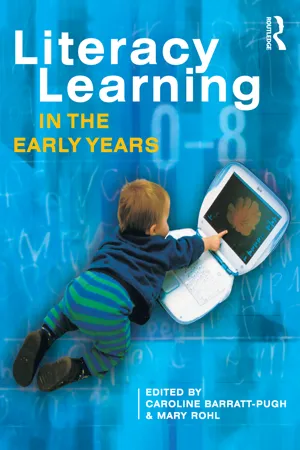
Literacy Learning in the Early Years offers a practical introduction to literacy issues for early childhood professionals and teachers working with children aged 0-8, in childcare, preschool and school contexts.
The authors take a socio-cultural approach to literacy learning, emphasising the importance of understanding the various contexts in which young children are involved in literacy practices. They explore a range of literacy issues that early childhood professionals and teachers are facing in the 21st century. These issues include the role of play in literacy learning, how to use information communication technologies with young children and ways of introducing critical literacy. Literacy is understood broadly and readers are encouraged to explore a range of print and other media with children.
With chapters from both Australian and UK authors Literacy Learning in the Early Years is an ideal professional reference and student text.
a very useful introductory text to literacy development in early childhood. It is clearly written and accessible to the wide range of professionals working with young children as well as to teachers and parents. It will be a valuable text in training at initial and in-service levels on a wide range of courses.
Lesley Abbott, Professor of Early Childhood Education, Manchester Metropolitan University
this well written, comprehensive book combines many practical examples of learning to do literacy and suggestions for action, and all the while engages the reader with questions and starting points for reflection.
Susan Hill, Associate professor, The Centre for Studies in Literacy, University of South Australia
- 272 pages
- English
- ePUB (mobile friendly)
- Available on iOS & Android
eBook - ePub
Literacy Learning in the Early Years
About this book
Information
1
The socio-cultural context of literacy learning
CAROLINE BARRATT-PUGH
Learning literacy?
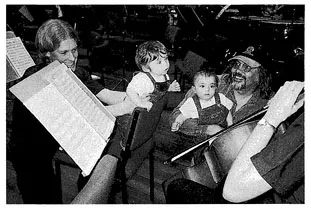
What do you think of when you hear or read the word 'literacy'? Reading, writing and numeracy, or more than this? For example, in this photograph are the twins learning about a form of literacy? During the last 100 years our understanding of what literacy encompasses and how it is learned and carried out has changed. Each view of literacy is embedded in the political, social and philosophical context of the time and has a profound influence on how children are taught literacy in the early years. The following four perspectives are an illustration of key changes in our understanding of literacy and their impact on practice. These theories are interrelated, building on past beliefs and adding to our knowledge of human learning. They all have something to contribute to our current understanding of literacy. The complexity of what it means to be literate and how literacy is learned is still debated and varies within and across cultures. The following brief taxonomy leads into the focus of this book: a socio-cultural view of literacy. A more elaborated and alternative description of some of these theories can be found in Crawford (1995) and Hill (1997).
Different perspectives on early literacy
Four perspectives on early literacy are shown in Table 1.1.
Maturational
During the early part of this century it was believed that children could only learn to read when they had reached a particular mental age, brought about through a process of biological maturation (Gesell 1954). A series of 'readiness' tests was used in schools to determine if a child was ready to begin formal instruction in reading. Parents were thought to have little influence on this process and young children were thought to have little knowledge or understanding about reading and writing before formal schooling.
Developmental
The maturational theory of learning was brought into question when it was suggested that although children had to be developmentally 'ready' to read, this process could be influenced by pre-reading experiences (Durkin 1966). As a result, in many early childhood care and education contexts, experience and instruction were emphasised as a means of hastening reading readiness. Several pre-primary 'readiness' programs were developed that involved highly structured, sequentially-organised, skills-based drills in the form of work books. Reading and writing were seen as separate skills taught in isolation through systematic direct instruction. The role of parents was seen as limited and often parents were asked not to teach their children to read or write before they came to school.
Emergent
During the 1970s research into how young children learn to read and write challenged the developmentalist view of literacy (Clay 1979; Goodman 1973; Smith 1971). They suggested that reading and writing are not a set of isolated skills that have to be taught, but are rather an ongoing process which starts at birth and in which the child is an active participant. They argued that reading, writing and oral language development are interrelated, emerging over time through participation
| Maturational | Developmental | Emergent | Socio-cultural | |
| Theorists | Gesell | Thorndike | Piaget | Bourdieu |
| Theory | Maturation depends on pre-programmed biological processes | Development is joint process of biological maturation and environmental influences | Learning emerges as children actively construct the world | Learning is embedded in the socio-cultural practices that children are involved in |
| Method of teaching | Skills based | Reading readiness | Whole language | Critical literacy |
| Implications for teaching literacy | Repetitive learning of a hierarchy of isolated skills | Pre-reading activities and direct instruction | Involvement in 'real' literacy activities | Use and critical analysis of a variety of literacy practices and texts |
| Role of family and community | Thought to have little influence on literacy | Involved in programs provided by teachers | Provide experiences that facilitate literacy | Socialise children through involvement in literacy practices |
in literacy events. The family, extended family and community were thought to be central to this process as they provided the experiences that facilitate emergent literacy.
A number of approaches to teaching literacy grew from this research. Early childhood professionals were encouraged to provide print-rich environments and a language-based curriculum, which emphasised the integration of reading, writing, speaking and listening. Children engaged in authentic reading and writing activities with 'real purposes'. Specific skills were taught as part of reading and writing activities rather than as isolated units. This was known as the 'whole language' approach to literacy (Goodman 1986). At the same time, changes in the way children learn to write emerged. Children were encouraged to take responsibility for their writing, making decisions about what to write and how to spell in conjunction with conferences with the teacher. This was known as 'process writing' in which children were thought to learn to write through writing (Graves 1983).
Socio-cultural
During the 1990s, following on from emergent views of literacy, sociocultural theories of literacy learning emerged. Socio-cultural theories are derived in part from theory developed by Bourdieu (1977). Bourdieu argues that literacy is a form of 'cultural capital'. Cultural capital is defined as knowledge and competence that can be converted into 'status, wealth and mobility' (Luke 1993, p. 7). For example, it is argued that literacy knowledge and competence differ according to the social and cultural context in which they are learned. Thus, there are not only different forms of literacy, but also different ways of doing particular literacy practices. Hence, children become familiar with a wide range of literacies undertaken in their family and community. When children take part in early childhood programs, they find that only some literacy practices are perceived as valid or legitimate. Those practices that are valued by the family and community may not be valued in formal learning contexts and, therefore, hold little cultural capital. The knowledge of literacy practices that some children have may be in competition to, or conflict with, those of more formal learning environments. This puts some children at a disadvantage as soon as they enter formal learning contexts, where their knowledge and experiences of literacy are not recognised or built on.
Luke (1993) argues that when the teaching methods, texts and assessment practices are inappropriate, because they do not take children's experiences into account, it is difficult for these children to make sense of the literacy demands of formal learning. Consequently, children have unequal access to literacy competence, which has a significant impact on their future. Hill et al. (1998, p. 26) argue that, 'Poor achievement for some groups and positive outcomes for others occur when those with the appropriate cultural capital are reinforced with success, whilst others are not'. The disparity of achievement among children from different socio-economic groups is widely recognised by early years professionals. It is argued that all children should have equal access to literacy, which will enable them to take part in the wider society as well as in their homes and communities. A socio-cultural perspective enables early childhood professionals to examine the way patterns of inequality are constructed and maintained, and explores ways of teaching literacy which expose and challenge this inequality, as part of children's developing literacy competence.
There are several perspectives on what constitutes a socio-cultural view of literacy. We have identified the following six elements of a socio-cultural view of literacy:
- Children learn about literacies and how to 'do' literacy through participating in a range of activities in their family and community.
- Literacy practices are carried out in culturally specific ways and contribute to children's developing sense of identity.
- Children have different understandings about what counts as literacy and how literacy is done.
- Literacy practices are carried out in specific ways for particular purposes.
- The pattern of literacy learning differs between children, as they become relative experts within different literacy events.
- Literacy practices are valued differently in different social and educational contexts.
Children learn about literacy through participating in a range of activities
Mrs Lingard is talking about some of the activities her family do that involve reading, writing and watching television:
Oliver is only seven months but he sits for ages with his little cloth book, pulls all the things out. Of course he likes to eat. them rather than read! I read it to him and Beth, but Beth likes a bedtime story by herself. We read it together. She can't, well she's only three, she can't read properly but she knows when Kate changes the words. I like Kate to write to her grandparents and she Lets Beth put kisses and her name at the end. Yesterday we made some little cakes for Beth's birthday party. Kate chose the recipe and made a birthday card from her and Oliver. Shopping is a nightmare. The girls have to make a list and find the things they want, Oliver starts crying, the girls have to check everything off their list, checkouts are always full. Anyway we've done invitations for all her friends at Sunday School. We go every week, Kate's got a Scripture book, but I have to help her with the answers. Just a minute, I'll go put the telly on . . . they all like telly ... it worries me. You wouldn't think a baby would watch telly. We all watch the kids programs together!'
Taking a telephone message
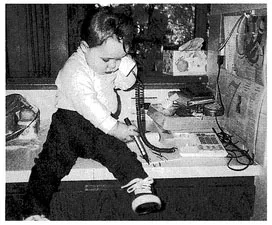
From this description it is clear that Oliver, Beth and Kate take part in many activities that involve literacy. How typical is this of other families? In two recent studies of preschool literacy, Weinberger (1996) and Hill et al. (1998) found that the children in their studies had access to a range of literacy practices, although the literacy resources varied considerably. They concluded that there was a great deal of rich and diverse literacy learning occurring at home. From these and other studies, we can see that from birth young children are involved in a variety of interactions with their carers, siblings and people in the communities in which they live. Many of these interactions include a variety of literacy activities. Many occur in everyday activities, such as writing telephone messages, shopping lists, names on drawings, labels in clothes and shoes, reading stories, recipes, instructions, and familiar signs in the community and shops. In addition, storytelling and music are significant literacy events in some families.
Other literacy practices are part of cultural activities such as religious events, birthday parties, festivals and rituals. Anstey and Bull (1996, p. 153) summarise this view by arguing that 'literacy is an everyday social practice in which individuals participate at home, in the community, workplace, and through mass media and religion'. Thus, for many children, literacy is an integral part of their everyday experiences.
How do children learn about literacy from their involvement in these events? Let us have another look at Beth and Kate, this time on their shopping trip. During their last shopping trip they were involved in making a list, finding the appropriate item in the shop, counting out specific numbers of tins, fruit, vegetables, ticking off items on the list and collecting the payment slip at the checkout. Through this involvement they are learning about specific literacy practices that occur in their family when they go shopping. They are beginning to learn that:
- a list can help you remember what you want
- you can cross thing...
Table of contents
- Cover
- Half Title
- Title Page
- Copyright Page
- Dedication
- Contents
- List of figures
- List of tables
- List of samples
- List of photographs
- Acknowledgments
- Contributors
- Introduction
- 1 The socio-cultural context of literacy learning
- 2 Linking literacy learning across different contexts
- 3 Learning about words, sounds and letters
- 4 Play and literacy learning
- 5 Children's literature and literacy learning
- 6 Information communication technologies and literacy learning
- 7 Negotiating critical literacies with young children
- 8 Literacies in more than one language
- 9 Monitoring young children's literacy learning
- References
- Index
Trusted by 375,005 students
Access to over 1.5 million titles for a fair monthly price.
Study more efficiently using our study tools.
Frequently asked questions
Yes, you can cancel anytime from the Subscription tab in your account settings on the Perlego website. Your subscription will stay active until the end of your current billing period. Learn how to cancel your subscription
No, books cannot be downloaded as external files, such as PDFs, for use outside of Perlego. However, you can download books within the Perlego app for offline reading on mobile or tablet. Learn how to download books offline
Perlego offers two plans: Essential and Complete
- Essential is ideal for learners and professionals who enjoy exploring a wide range of subjects. Access the Essential Library with 800,000+ trusted titles and best-sellers across business, personal growth, and the humanities. Includes unlimited reading time and Standard Read Aloud voice.
- Complete: Perfect for advanced learners and researchers needing full, unrestricted access. Unlock 1.5M+ books across hundreds of subjects, including academic and specialized titles. The Complete Plan also includes advanced features like Premium Read Aloud and Research Assistant.
We are an online textbook subscription service, where you can get access to an entire online library for less than the price of a single book per month. With over 1.5 million books across 990+ topics, we’ve got you covered! Learn about our mission
Look out for the read-aloud symbol on your next book to see if you can listen to it. The read-aloud tool reads text aloud for you, highlighting the text as it is being read. You can pause it, speed it up and slow it down. Learn more about Read Aloud
Yes! You can use the Perlego app on both iOS and Android devices to read anytime, anywhere — even offline. Perfect for commutes or when you’re on the go.
Please note we cannot support devices running on iOS 13 and Android 7 or earlier. Learn more about using the app
Please note we cannot support devices running on iOS 13 and Android 7 or earlier. Learn more about using the app
Yes, you can access Literacy Learning in the Early Years by Caroline Barratt-Pugh,Mary Rohl in PDF and/or ePUB format, as well as other popular books in Education & Early Childhood Education. We have over 1.5 million books available in our catalogue for you to explore.