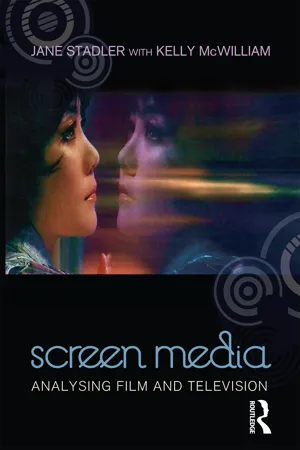
Screen Media offers screen enthusiasts the analytical and theoretical vocabulary required to articulate responses to film and television. The authors emphasise the importance of 'thinking on both sides of the screen'. They show how to develop the skills to understand and analyse how and why a screen text was shot, scored, and edited in a particular way, and then to consider what impact those production choices might have on the audience.
Stadler and McWilliam set production techniques and approaches to screen analysis in historical context. They demystify technological developments and explain the implications of increasing convergence of film and television technologies. They also discuss aesthetics, narrative, realism, genre, celebrity, cult media and global screen culture. Throughout they highlight the links between screen theory and creative practice.
With extensive international examples, Screen Media is an ideal introduction to critical engagement with film and television.
'Screen Media offers a systematic approach to film and television analysis. The examples chosen by the authors are both appropriate and timely, and are presented in a very lively and readable form that will appeal to an international readership.' - Rebecca L. Abbott, Professor of Film, Video + Interactive Media, Quinnipiac University, USA
- 416 pages
- English
- ePUB (mobile friendly)
- Available on iOS & Android
eBook - ePub
About this book
Information
1
by design
Art direction and mise en scéne construction
Most people who use screen media in their everyday lives for entertainment or information evaluate what they see largely in terms of the storyline and the personalities on screen. This indicates the central importance of narrative and characterisation, but it also raises the following question: if all we are interested in is story and information, why not just read a novel, a newspaper or a film script? If all the meaning and impact is encoded in the script, then why does anyone ever bother to shoot and screen the film or television program? Thinking critically about film and television entails considering what makes Screen media special, and what differentiates screen texts from literature, photography, theatre or opera, as well as examining the depth and significance added to a story when we see it staged, lit and performed.
Beginning by considering the relationship of screen media to theatre, and ending by pointing to the significance of photography and cinematography, this chapter aims to develop an understanding of the connection between a screen text's visual style and its meaning, mood and theme. Because style and content are intrinsically interconnected, we explore the relationships between subject matter and aesthetic components like composition, performance, costume, setting and lighting. In arguing that style can convey meaning, we suggest that the fictional world constructed on the screen can express, dramatise, add to or distract from a story's atmosphere and thematic content. Assessing the interplay between form, content, style and meaning also requires an appreciation of the roles and responsibilities of the cast and crew members responsible for crafting the visual style of a production and analysing their decisions about what to include in, or exclude from, the frame. Such decisions govern the design and placement of all the ingredients that create the fictional world inhabited by the protagonists, and the ingredients that lend the story world an aura of authenticity and vibrancy.
Mise En Scène
Mise en scène is a French theatrical term meaning to place on a stage, or to stage an action. In film and television, the stage-equates to the screen, and mise en scènerefers to the organisation of the elements that can be seen within the borders of the frame in any shot. Mise en scènecan be broken down into four key components:
- costume (wardrobe, accessories, prosthetics and makeup);
- setting (architecture, décor, scenery and props);
- action (figure movement, object movement, performance); and
- lighting (including coloured light and shadow).
Mise en scènerefers to everything that can be seen on the screen, including four key elements: costume, performance, setting and lighting.
Together, these four elements are central to constructing the story world and determining wherethe action takes place (on a set or location), whenthe action takes place (signalled by lighting that cues time of day, or sets and costumes that indicate period), and howand whytheaction takes place (as communicated via performance). These components of the fictional world express and dramatise the mood and thematic content of the storyline, conveying meaning through visual style.
In early films featuring only mise en scèneand static camera (without synchronised sound or editing), and in contemporary studio-based television shows, the close relationship between the art of mise en scèneconstruction and theatrical stage design is particularly evident: performers often face the camera and address the audience as though they are on a stage. As the following examples demonstrate, even screen texts that are not intended to look 'staged' often draw on traditions of symbolism, allusion and metaphor developed in theatre and literature. Consequently, the analysis of mise en scèneincorporates terminology and techniques developed in literary criticism and theatre and drama studies.
When an element of the mise en scènealludes to or acts as a visual metaphor for something else, it can be described as allusive or metaphoric mise en scène.For example, the images of the black widow spider and the moth in the room during Pete's whispered phone conversation with Alice in the David Lynch film Lost Highwayindicates Alice is a dangerous, man-eating femnie fa tale and Pete is irresistibly attracted to her like a moth to the light.
Metonymic mise en scèneis another way in which elements of visual design can be interpreted. A metonym is a relationship of symbolic substitution when one part represents or stands for something larger. For instance, one might say 'I'll take the wheel,' thereby using part of the: car—the steering wheel—as a metonymic representation of the whole car and the act of driving and taking charge (steering), The American flag is a metonymic signifier or symbol for patriotism and all that the nation represents. When the flag is turned upside down, this signifies subversion or disrespect for America itself. In Oliver Stone's Natural Bom Killers(1994) and the earlier road movie that influenced it, Dennis Hopper's 1969 classic Easy Rider,the American flag is hung upside down in certain scenes, as when the motorcyclists Wyatt and Billy ride through a small town during a Fourth of July parade, and when Mickey and Mallory kill the Indian in the desert. The inverted flag represents a challenge to authority and a rejection of the American dream by the films, the filmmakers and the characters.
The art department
The art departments role is best described as the art of forgery and illusion, since its purpose is to fake the existence of an entire narrative world. The art director, also known as the production designer, is in charge of the art department. This involves managing a team of set designers and decorators, illustrators and draftspersons, and liaising with wardrobe, makeup artists and researchers, as well as working closely with the director, producer and cinematographer. (We use the terms 'art director' and 'production designer" interchangeably, but where separate individuals are credited for each role, the production designer is largely responsible for envisioning the look and feel of the production, while the art director takes responsibility for executing the design.) Crew members working in wardrobe and the art department research the era and locale in which the story is set, sourcing, creating and constructing sets, props and costumes, prosthetics and makeup effects, as well as scouting locations and dressing sets for different scenes.
Wryly describing his experience upon entering the Hollywood film industry and beginning work in the art department, Ward Preston writes that the production designer is responsible for 'the enhancement of communication by visual means'—or, more frankly, 'for everything you see on the screen that doesn't move and is usually out of focus' (1994} x). Of course, some elements of the mise en scène domove, and frequently they arein focus—even if popular and critical acclaim is generally 'focused' on storylines, stars and directors. Sometimes the work of the art department steals the show, as in the lush costume and set design of Sophia Coppola's 2006 extravaganza Marie Antoinette.The range of skills a production designer requires in order to effectively manage the art department may include training in fine art, architectural drafting and interior design; the ability to undertake or oversee historical and cultural research; budgeting, business acumen and managerial expertise; inventiveness and a keen sense of style; insight into the practicalities of lighting, textiles, construction and cosmetics; and even legal expertise.
The production designer often commences work by doing preliminary sketches and working through a script breakdown, highlighting all references to the visual impact of the story and factoring in figures in the budget to achieve the required look, as discussed in a concept meeting with the director. Together, the production manager and the director brainstorm details like the colour palette,mapping out signature colours that might be associated with particular characters, locations or moods. Sometimes a visual timeline is created to chart the different scenes and plot points in the script, with fabric swatches and paint samples attached to signify shifts in the colour palettfe. The colour palette expresses the unique 'personality' of a production and the changing moods associated with different scenes and characters.
The colour paletteof a screen text is a colour scheme for lighting, décor and costume devised by the production manager to express and chart the shifting moods of characters and scenes over the course of the story.
The colour scheme of a film or television program has a significant impact on viewers and is closely linked to the expression of theme and characterisation. This is evident in a comparison of the grimy, earthy aesthetic that extends throughout the television series Deadwood's Wild West setting versus Ugly Betty's bright primary colours, and further variations between the warm tones of Betty's home versus the cold, stark whites of her work environment. Another revealing contrast is found between two contemporary Spanish films, Pan's Labyrinth,directed by Guillermo del Toro, and Pedro Almodóvar's Volver.The use of a verdant green aesthetic running throughout the lighting and setting in Pan's Labyrinthsignifies the ancient forces of nature that the faun Pan embodies, and the shadowy browns and greens of the woods and the costumes express the darkness of the protagonists' lives under Franco's fascist rule in 1944. Eugemio Caballero, the production designer for Pan's Labyrinth,won an Oscar in 2007 for best art direction based on the creation of intricate puppetry and prosthetics, and the moody, mystical visual style that brought the fairytale world to life. A superb gallery of conceptual sketches, models and images of the development of costumes and props are displayed on the official website, www.panslabyrinth.com. In comparison with the deep greens pervading Pan's Labyrinth, Volver's lush, bold colour palette, with its vivid reds, floral patterns and stark contrasts of light and dark, establishes an impassioned tone. Discussing the texture and atmosphere of Volver,Almodovar has pointed out in his online production diary that pastel colours couldn't possibly capture the vivacious characters, nor could a muted aesthetic do justice to the surreal quality and dramatic extremes of a film that swings from comedy through musical numbers and domestic melodrama to the kind of action usually found in a thriller (www.clubcultura.com).
Colour can also be used to express and create emotion. Director Todd Haynes recreated the visual style of 1950s melodrama in his film Far From Heaven(2002), paying homage to the influence of earlier films like All That Heaven Allows(1955), directed by Douglas Sirk. Sirk's films had very complex colour palettes. In an interview with Anthony Kaufman, Haynes observes contemporary films are comparatively dumbed down' in terms of colour:
A whole movie will be honeycomb gold colors if it's set in the past or all icy blue if it's a suspense thriller. But [Sirk's] films use complex interactions of warm and cool in every single scene. And emotions are multi-colored. Color, lighting, costume, all the visual elements are supplementing what can't be said in these films, (www.indiewire.com)
A range of different elements must work in concert to create a colour palette that supports both script and character. Members of the art department work closely with the director in designing the overall look and feel of a production. In addition, they liaise with the camera and lighting crew, and with actors regarding makeup and wardrobe. The art department also coordinates with the producer and production assistants regarding location permissions and copyright clearances. These last two tasks are little-known blights on the production process which are as important as they are onerous.
Permission must be sought to use any location outside the studio. The copyright clearance process is often difficult and costly and subject to restrictions imposed by local bureaucrats and residents. Other than agreed product placement, any signs, logos, brands, containers or products associated with a known trademark or business presence are subject to copyright law. They may not be used indiscriminately in screen productions for fear of compromising brand identity, thereby giving rise to lawsuits and damages. For example, a television broadcaster once refused to air a public service announcement produced by university students because the shape of a Ponds cold cream jar was visible in shot. Even though the logo and label were turned away from the camera, the distinctive shape of the jar was considered enough to create an unwanted association between Ponds and the social issue in the advertisement. Frequently, copyright permission will be refused because a corporation does not want to be associated with the storyline of a production, or with the politics of the director or stars involved, or even with the demographic to whom the production is marketed. As Preston points out, in the television industry the problem is more pronounced due to the economic importance of advertising revenue derived from product tie-ins, product placements, sponsorship and commercial breaks: the television production itself cannot feature goods and services that might be seen to compete with those its sponsors advertise (1994: 35), This means the art department must frequently Photoshop fake business signs, billboards and labels, and mock up bogus brands (like the fictitious Ka-Boom! breakfast cereal box used when Vernita Green shoots at Beatrix Kiddo in Kill Bill).
Costume
In Michel Gondry's film Eterna...
Table of contents
- Cover
- Half Title
- Title
- Copyright
- Contents
- Acknowledgments
- Introduction: Thinking on both sides of the screen
- 1 By design: Art direction and mise en scène construction
- 2 Cinematography: Writing in light and movement
- 3 Soundscapes: The invisible magic of sound
- 4 At the edge of the cut: Editing from continuity to montage
- 5 Plotting and planning: Storytelling and reviewing techniques
- 6 Screen narratives: Traditions and trends
- 7 Reality and realism: Seeing is believing
- 8 Genre: ‘Something new based on something familiar’
- 9 Star struck: Fandom and the discourse of celebrity
- 11 The crowded screen: Transcultural influences and new directions in visual culture
- Glossary
- Bibliography
- Index
Trusted by 375,005 students
Access to over 1.5 million titles for a fair monthly price.
Study more efficiently using our study tools.
Frequently asked questions
Yes, you can cancel anytime from the Subscription tab in your account settings on the Perlego website. Your subscription will stay active until the end of your current billing period. Learn how to cancel your subscription
No, books cannot be downloaded as external files, such as PDFs, for use outside of Perlego. However, you can download books within the Perlego app for offline reading on mobile or tablet. Learn how to download books offline
Perlego offers two plans: Essential and Complete
- Essential is ideal for learners and professionals who enjoy exploring a wide range of subjects. Access the Essential Library with 800,000+ trusted titles and best-sellers across business, personal growth, and the humanities. Includes unlimited reading time and Standard Read Aloud voice.
- Complete: Perfect for advanced learners and researchers needing full, unrestricted access. Unlock 1.5M+ books across hundreds of subjects, including academic and specialized titles. The Complete Plan also includes advanced features like Premium Read Aloud and Research Assistant.
We are an online textbook subscription service, where you can get access to an entire online library for less than the price of a single book per month. With over 1.5 million books across 990+ topics, we’ve got you covered! Learn about our mission
Look out for the read-aloud symbol on your next book to see if you can listen to it. The read-aloud tool reads text aloud for you, highlighting the text as it is being read. You can pause it, speed it up and slow it down. Learn more about Read Aloud
Yes! You can use the Perlego app on both iOS and Android devices to read anytime, anywhere — even offline. Perfect for commutes or when you’re on the go.
Please note we cannot support devices running on iOS 13 and Android 7 or earlier. Learn more about using the app
Please note we cannot support devices running on iOS 13 and Android 7 or earlier. Learn more about using the app
Yes, you can access Screen Media by Jane Stadler,Kelly McWilliam in PDF and/or ePUB format, as well as other popular books in Media & Performing Arts & Film & Video. We have over 1.5 million books available in our catalogue for you to explore.