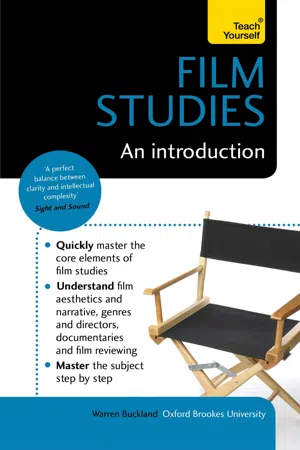
An unpretentious guide for all those who want to learn to analyse, understand and evaluate films. Film Studies: An Introduction provides an overview of the key areas in film studies, including aesthetics, narrative, genre, documentary films and the secrets of film reviewing. From Hitchcock and Tarantino to Spielberg and Bigelow, you will gain a critical understanding of legendary directors and the techniques and skills that are used to achieve cinematic effects. Whether you are a film studies student or just a film buff wanting to know more, this book will give you an invaluable insight into the exciting and incredibly fast-moving world of film.Understand Film Studies includes:
Chapter 1: Film aesthetics: formalism and realism
Chapter 2: Film structure: narrative and narration
Chapter 3: Film authorship: the director as auteur
Chapter 4: Film genres: defining the typical film
Chapter 5: The non-fiction film: five types of documentary
Chapter 6: The reception of film: the art and profession of film viewing
- 240 pages
- English
- ePUB (mobile friendly)
- Available on iOS & Android
eBook - ePub
Film Studies: An Introduction: Teach Yourself
About this book
Information
Subtopic
Film & Video1
Film aesthetics: formalism and realism

In this chapter you will learn about:
• ten different approaches to studying film
• an examination of one of those approaches – namely, a study of film techniques, divided into:
– elements of mise-en-scène (including set design)
– elements of mise-en-shot (including the long take, deep focus and colour)
– rules of continuity editing
– film sound
• a theoretical study of film aesthetics, divided into:
– the realists (e.g. André Bazin, Siegfried Kracauer)
– the formalists (e.g. Rudolf Arnheim, Sergei Eisenstein), including the theory of montage.


… film had to legitimize its place in our culture. And the way that it initially set about getting itself taken seriously was to prove that it was an art – an art on a par with its seven predecessors.
Noël Carroll, Philosophical Problems of Classical Film Theory, p. 4
Once we have accepted the notion that studying the cinema isn’t an absurd idea, the question arises: How do we study the cinema? The cinema has been studied from a multitude of approaches. Following, and modifying, a list put together by Charles Altman, we can identify ten approaches to the cinema (the list is not exhaustive):
1 A technological history which may emphasize pioneers, such as the Lumière brothers or Edison, and/or technological innovations such as the coming of sound, the development of colour, etc.
2 A study of techniques: either historically, which asks questions such as: When was the first close-up used? or – as in this book – critically and analytically: What technical choices are available to film-makers?
3 A study of personalities (studio moguls, stars, etc.).
4 A study of the relation between film and other arts, usually theatre or the novel; this type of approach was one way in which university departments of English justified their study of film in the 1960s and early 1970s.
5 A chronological history of classical or important films. Such histories canonized a small group of films (the most unusual, such as Citizen Kane, Orson Welles, 1941) and marginalized the majority of films from study (usually the typical or ordinary film).
6 Film in relation to society. Film can be studied in relation to important social events such as the Second World War.
7 A history of Hollywood studios (including economic histories).
8 A study of directors (see Chapter 3).
9 A study of genres – either formally or as a social ritual (see Chapter 4).
10 Regulation of the film industry by means of censorship and anti-trust (or monopoly) laws; censorship is briefly discussed in Chapter 4.
This chapter focuses on point 2, a critical and analytical discussion of the technical choices available to film-makers. In the first part of this chapter, I shall examine three technical choices film-makers have to make. The first concerns set design, or mise-en-scène. The second concerns mise-en-shot – the way the mise-en-scène is filmed. Here we shall look at the long take, which is sometimes combined with deep focus photography. Finally, we shall look at editing and montage. In the second half of this chapter, we shall see how realist and formalist film scholars concentrated on these, and other, filmic techniques in their attempts to defend film as an art.
As I pointed out in the introduction, my aim here is to enable you to go beyond the informal practice of merely verbalizing your personal impressions of a film. The starting point for rejecting this impressionistic talk about films is to study the basic components of the medium of film and the way these components are organized in a particular film. In Chapters 1, 2 and 3 we shall explore the stylistic and narrative dimensions of various cinemas – Hollywood studio films, independently produced American films and European cinema.
The critical and analytical study of films therefore begins with the way a film is constructed. This emphasis on a film’s construction combines film practice and film aesthetics because it analyses the choices that are made when a film is constructed, and the effects these choices have on film spectators. The aim of the first section of this book is therefore to enable you to study in an exact and orderly fashion the basic choices available to film-makers, and the effect making a choice has on a film’s meaning and effect.
Mise-en-scène
One of the most frequently used terms in film analysis is mise-en-scène, which literally translates as ‘putting on stage’, or ‘staging’. The term originates from the theatre, where it designates everything that appears on stage – set design, lighting and character movement. In film studies, mise-en-scène often has a vague meaning: it is either used in a very broad way to mean the filmed events together with the way those events are filmed, or it is used in a narrower sense (closer to its original theatrical meaning), to designate the filmed events. In this book the term mise-en-scène will be used in its narrower sense to mean what appears in front of the camera – set design, lighting and character movement. Another term will be used to name the way the filmed events, mise-en-scène, are filmed – namely, mise-en-shot, which literally means ‘putting into shots’, or simply ‘shooting (a film)’.
Set design
If you read film credits, you may notice the category ‘Art Director’. Art directors are people who design or select the sets and decor of a film. Initially, their job was simply to create a background in which the action of the film was to unfold. In the heyday of the Hollywood studios (from the 1920s to the end of the 1950s), art directors built entire worlds inside movie studios. More recently, some art directors have become production designers, whose job is to co-ordinate the look of an entire film. They develop a visual concept around which sets, props, lighting and costumes are designed to work together. This is particularly important in contemporary science fiction films, in which the production designer creates a total concept and image of the future. The director Ridley Scott takes set design so seriously that he almost takes over the job of art director on some of his films (he trained as an art director). On his film Blade Runner (1982), for instance, he worked closely with the art department in conceiving and designing sets. Michael Deeley, the film’s producer, goes so far as to argue that the futuristic ambience and look of the film was essentially designed by Scott.
The production designer begins by making sketches and by building miniature sets in order to determine the best way to construct and film the actual sets. This is particularly important from a financial point of view because a film may need several – even dozens of – sets, all of which require an army of carpenters, prop buyers and so on, to construct and take down again. This is in opposition to the theatre, where only a few sets are constructed. Because of the expense, many film sets are only partly constructed. In other words, only those parts of the set that appear in the film need to be constructed.
We shall now consider the stylistic options available to art directors/set designers and the choices that two Hollywood studios made in the 1930s. These choices strongly determined the look of the films; in fact, they determined the identity of the studio.
 | Spotlight |
1939 is usually considered to be the most significant year in the Hollywood studio era. In that year, Hollywood produced a whole raft of films that have stood the test of time: Gone With the Wind, The Wizard of Oz, Mr Smith Goes to Washington, Ninotchka, Only Angels Have Wings, Stagecoach, and many others.
SET DESIGN IN 1930S WARNER BROS. FILMS
In the 1930s, Warner Bros. produced low-budget films, many of which had a contemporary theme since their stories were in large part inspired by newspaper stories. One of the themes that dominated American society in the 1930s was gangsterism, so it was little wonder that Warner Bros. made a number of gangster films, the most notable being Little Caesar (Mervyn Le Roy, 1932) and The Public Enemy (William Wellman, 1931). Due to Warner Bros.’ policy of low-budget films, little was spent on set design. Many Warner Bros. films of the 1930s have simple, bare sets – shabby, dank rooms and bare streets. This economic factor largely determined the visual style of Warner Bros. films in the 1930s. But like all artists, Warner Bros. film-makers made the most of this limitation and even used it to their own advantage. Directors were frequently forced to use medium shots (shots of the actors from waist to the top of the head) or close-ups (a shot of an actor’s head and shoulders) so that the actors would take up most of the frame. Low-key lighting (in which only part of the set is lit) was also used in order to partly conceal the cheapness of the set and its small size. Much of the set was shrouded in darkness. Further, Warner Bros. was one of the first studios to use fog generating machines, which also served to hide the set.
Yet, these sets are consistent with the stories and the circumstances that the characters find themselves in. Many of the gangster films are about the impoverished backgrounds of the gangsters. The sets and lighting therefore add to the story’s meaning – they complement the story. Although the stylistic options available to Warner Bros. film-makers at this time were severely limited, they used this economic limitation to their own advantage.
MGM SET DESIGN
In complete contrast to Warner Bros., MGM spent a great deal of money on sets and lighting. In fact, MGM had the biggest costume, property and art departments in Hollywood. MGM art directors created large elaborate sets, which were lit using full, high-key lighting, creating a very bright image with little or no shadows. In MGM colour films, the colours are usually saturated. MGM’s philosophy was to create clear, clean images. One problem was that the set occasionally dominated the action and the stars – think of the sets of two very famous MGM films, The Wizard of Oz (Victor Fleming, 1939) and Gone With the Wind (Fleming, 1939). The director Vincente Minnelli made musicals for MGM, including Meet Me in St Louis, which opens with a long, elaborate shot of the set of St Louis built on the MGM backlot. It seems imperative that, if the studio was to spend a great deal of money on the sets, then they should be lit properly and should be ‘shown off’ on screen, which frequently meant that the director used long shots (showing the whole actor in his or her surroundings) or very long shots (in which the actor appears small within the frame).
Mise-en-shot
Above I made the distinction between mise-en-scène (staging) and mise-en-shot (shooting, or filming). Mise-en-scène (in the narrow definition adop...
Table of contents
- Cover
- Title
- Dedication
- Contents
- Acknowledgements
- Introduction
- 1 Film aesthetics: formalism and realism
- 2 Film structure: narrative and narration
- 3 Film authorship: the director as auteur
- 4 Film genres: defining the typical film
- 5 The non-fiction film: five types of documentary
- 6 The reception of film: the art and profession of film reviewing
- Taking it further
- Bibliography
- Copyright
Trusted by 375,005 students
Access to over 1.5 million titles for a fair monthly price.
Study more efficiently using our study tools.
Frequently asked questions
Yes, you can cancel anytime from the Subscription tab in your account settings on the Perlego website. Your subscription will stay active until the end of your current billing period. Learn how to cancel your subscription
No, books cannot be downloaded as external files, such as PDFs, for use outside of Perlego. However, you can download books within the Perlego app for offline reading on mobile or tablet. Learn how to download books offline
Perlego offers two plans: Essential and Complete
- Essential is ideal for learners and professionals who enjoy exploring a wide range of subjects. Access the Essential Library with 800,000+ trusted titles and best-sellers across business, personal growth, and the humanities. Includes unlimited reading time and Standard Read Aloud voice.
- Complete: Perfect for advanced learners and researchers needing full, unrestricted access. Unlock 1.5M+ books across hundreds of subjects, including academic and specialized titles. The Complete Plan also includes advanced features like Premium Read Aloud and Research Assistant.
We are an online textbook subscription service, where you can get access to an entire online library for less than the price of a single book per month. With over 1.5 million books across 990+ topics, we’ve got you covered! Learn about our mission
Look out for the read-aloud symbol on your next book to see if you can listen to it. The read-aloud tool reads text aloud for you, highlighting the text as it is being read. You can pause it, speed it up and slow it down. Learn more about Read Aloud
Yes! You can use the Perlego app on both iOS and Android devices to read anytime, anywhere — even offline. Perfect for commutes or when you’re on the go.
Please note we cannot support devices running on iOS 13 and Android 7 or earlier. Learn more about using the app
Please note we cannot support devices running on iOS 13 and Android 7 or earlier. Learn more about using the app
Yes, you can access Film Studies: An Introduction: Teach Yourself by Warren Buckland in PDF and/or ePUB format, as well as other popular books in Media & Performing Arts & Film & Video. We have over 1.5 million books available in our catalogue for you to explore.