Community Performance: A Reader is the first book to provide comprehensive teaching materials for this significant part of the theatre studies curriculum. It brings together core writings and critical approaches to community performance work, presenting practices in the UK, USA, Australia and beyond.
Offering a comprehensive anthology of key writings in the vibrant field of community performance, spanning dance, theatre and visual practices, this Reader uniquely combines classic writings from major theorists and practitioners such as Augusto Boal, Paolo Freire, Dwight Conquergood and Jan Cohen Cruz, with newly commissioned essays that bring the anthology right up to date with current practice.
This book can be used as a stand-alone text, or together with its companion volume, Community Performance: An Introduction, to offer an accessible and classroom-friendly introduction to the field of community performance.
TO OPEN THE COMMUNITY/PERFORMANCE discussion, we begin with the pedagogies of communities, the kind of engagement opportunities that reside in the concept of ‘community’, and the practices that can meld people together into political aesthetic action. Defining ‘community’ is hard, indeed, and it is even harder to escape an unreflective celebration of communality. Victor Turner identified ‘communitas’ as a limit experience: as a state of being with others that transcends differences. In this state, it is easy to feel warmth and love towards others. It is much harder to sustain this communality into political engagement, and into a serious reflection on the differences that need to stay visible and experiential if a community is to sustain itself and grow. Many of the writers in this section address these problems, and present processes and ways of thinking about ethics of engagement that try to remain open to difference.
The section presents core texts in which the specific nature and charge of community performance as an empowering tool for the oppressed emerges. Augusto Boal’s work in Brazil has created a foundation for many practitioners who want to foreground free and democratic expressive exchange, as well as reflect on the problems inherent in such terms. Paulo Freire’s pedagogy of the oppressed developed out of his work on literacy campaigns with landless peasants in Brazil, and speaks eloquently about the need to address the power structures inherent in teaching and transmission. Gerard Delanty, in contrast, looks at how modernist theorists Habermas, Touraine and Bauman distrust the equation of community with democracy and instead call for a stronger link between community and communication. Jessica Berson discusses the political charge of Rudolf von Laban’s work, which, in a different tradition, has created a touchstone for community dance practice that is not based on technique and exclusivity.
The Pedagogical communities section also reflects shifts in the theorization of performance, and a changing emphasis in the nature of ‘the political’ in performance. Building on the legacy of Bertolt Brecht and the epic theatre, many writings on the political nature of drama focus on didactic elements in the interplay of the performance and an audience. Baz Kershaw, writing on political theatre in Britain in the 1960s to early 1990s (including community theatre), addresses the potential ideological differences between target groups (audiences) and the presenters of material. His intricate discussion of stage aesthetics emerges from a belief in the ability of performance to manipulate and challenge its audience – so much so that audiences become co-creators of community performance in a shared world.
The personal ethics of the facilitator become central in Dwight Conquergood’s reflection on ethnography, performance and performing other people’s stories.
Anita Gonzalez writes on the multiple meanings of community in the Urban Bush Women’s work, a black US group that affirms black women’s aesthetics, and Petra Kuppers discusses Jean Luc Nancy’s politics of community in relation to a long-term Welsh community project with mental-health system survivors. In both of these essays, the group dynamics of creation take precedence over a calculated audience address in a performance age where shared communal politics and identifications are hard to come by. Forms of modeling and an invitation to sharing become the experiential dimension of these pedagogies of community.
All community performance practitioners have to find answers to questions about agency, impact, collaboration, access and engagement. The writings in this section show how searching for answers, not merely in the created art work, but in the processes that lead to the work, become the shared creative act.
CHAPTER 1 Augusto Boal Poetics of the oppressed
GEORGE IKISHAWA USED TO SAY that the bourgeois theater is the finished theater. The bourgeoisie already knows what the world is like, their world, and is able to present images of this complete, finished world. The bourgeoisie presents the spectacle. On the other hand, the proletariat and the oppressed classes do not know yet what their world will be like; consequently their theater will be the rehearsal, not the finished spectacle. This is quite true, though it is equally true that the theater can present images of transition.
I have been able to observe the truth of this view during all my activities in the people’s theater of so many and such different countries of Latin America. Popular audiences are interested in experimenting, in rehearsing, and they abhor the “closed” spectacles. In those cases they try to enter into a dialogue with the actors, to interrupt the action, to ask for explanations without waiting politely for the end of the play. Contrary to the bourgeois code of manners, the people’s code allows and encourages the spectator to ask questions, to dialogue, to participate.
All the methods that I have discussed are forms of a rehearsal theater, and not a spectacle theater. One knows how these experiments will begin but not how they will end, because the spectator is freed from his chains, finally acts, and becomes a protagonist. Because they respond to the real needs of a popular audience they are practiced with success and joy.
But nothing in this prohibits a popular audience from practicing also more “finished” forms of theater. In Peru many forms previously developed in other countries, especially Brazil and Argentina, were also utilized and with great success. Some of these forms were:
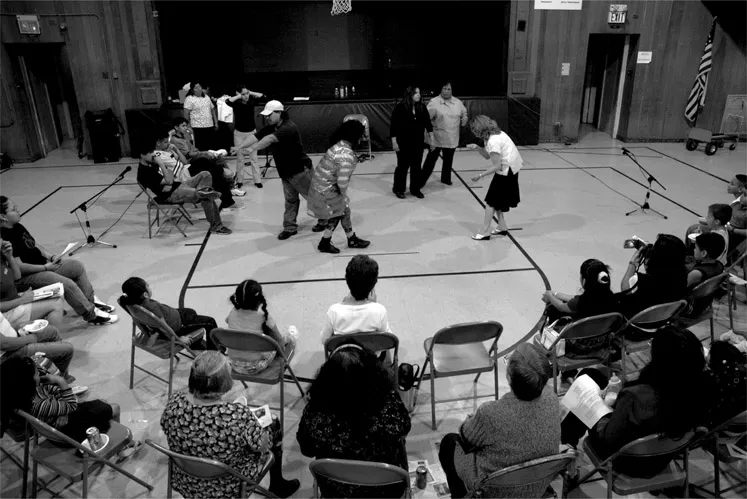
Figure 1 Boal workshop. Setting up changes in an opening fluid image to show how awareness of exposure pathways and environmental health risks can transform a neighborhood (Teatro Luca/de Madres a Madres at Holy Name parish, Houston, TX, 2005).
Photo: Karla Hold.
1) Newspaper theater: It was initially developed by the Nucleus Group of the Arena Theater of Sao Paulo, of which I was the artistic director until forced to leave Brazil.1 It consists of several simple techniques for transforming daily news items, or any other non-dramatic material, into theatrical performances.
a) Simple reading: the news item is read detaching it from the context of the newspaper, from the format which makes it false or tendentious.
b) Crossed reading: two news item are read in crossed (alternating) form, one throwing light on the other, explaining it, giving it a new dimension.
c) Complementary reading: data and information generally omitted by the newspapers of the ruling classes are added to the news.
d) Rhythmical reading: as a musical commentary, the news is read to the rhythm of the samba, tango, Gregorian chant, etc., so that the rhythm functions as a critical “filter” of the news, revealing its true content, which is obscured in the newspaper.
e) Parallel action: the actors mime parallel actions while the news is read, showing the context in which the reported event really occurred; one hears the news and sees something else that complements it visually.
f) Improvisation: the news is improvised on stage to exploit all its variants and possibilities.
g) Historical: data or scenes showing the same event in other historical moments, in other countries, or in other social systems, are added to the news.
h) Reinforcement: the news is read or sung with the aid or accompaniment of slides, jingles, songs, or publicity materials.
i) Concretion of the abstract: that which the news often hides in its purely abstract information is made concrete on the stage: torture, hunger, unemployment, etc., are shown concretely, using graphic images, real or symbolic.
j) Text out of context: the news is presented out of the context in which it was published; for example, an actor gives the speech about austerity previously delivered by the Minister of Economics while he devours an enormous dinner: the real truth behind the minister’s words becomes demystified — he wants austerity for the people but not for himself.
2) Invisible theater: It consists of the presentation of a scene in an environment other than the theater, before people who are not spectators. The place can be a restaurant, a sidewalk, a market, a train, a line of people, etc. The people who witness the scene are those who are there by chance. During the spectacle, these people must not have the slightest idea that it is a “spectacle,” for this would make them “spectators.”
The invisible theater calls for the detailed preparation of a skit with a complete text or a simple script; but it is necessary to rehearse the scene sufficiently so that the actors are able to incorporate into their acting and their actions the intervention of the spectators. During the rehearsal it is also necessary to include every imaginable intervention from the spectators; these possibilities will form a kind of optional text.
The invisible theater erupts in a location chosen as a place where the public congregates. All the people who are near become involved in the eruption and the effects of it last long alter the skit is ended.
A small example shows how the invisible theater works. In the enormous restaurant of a hotel in Chiclayo, where the literacy agents of ALFIN were staying, together with 400 other people, the “actors” sit at separate tables. The waiters start to serve. The “protagonist” in a more or less loud voice (to attract the attention of other diners, but not in a too obvious way) informs the waiter that he cannot go on eating the food served in that hotel, because in his opinion it is too bad. The waiter does not like the remark but tells the customer that he can choose something à la carte, which he may like better. The actor chooses a dish called “Barbecue a la pauper.” The waiter points out that it will cost him 70 soles, to which the actor answers, always in a reasonably loud voice, that there is no problem. Minutes later the waiter brings him the barbecue, the protagonist eats it rapidly and gets ready to get up and leave the restaurant, when the waiter brings the bill. The actor shows a worried expression and tells the people at the next table that his barbecue was much better than the food they are eating, but the pity is that one has to pay for it. …
“I’m going to pay for it; don’t have any doubts. I ate the ‘barbecue a la pauper’ and I’m going to pay for it. But there is a problem: I’m broke.”
“And how are you going to pay?” asks the indignant waiter. “You knew the price before ordering the barbecue. And now, how are you going to pay for it?”
The diners nearby are, of course, closely following the dialogue — much more attentively than they would if they were witnessing the scene on a stage. The actor continues:
“Don’t worry, because I am going to pay you. But since I’m broke I will pay you with labor-power.”
“With what?” asks the waiter, astonished. “What kind of power?”
“With labor-power, just as I said. I am broke but I can rent you my labor-power. So I’ll work doing something for as long as it’s necessary to pay for my ‘barbecue a la pauper,’ which, to tell the truth, was really delicious — much better than the food you serve to those poor souls. …”
By this time some of the customers intervene and make remarks among themselves at their tables, about the price of food, the quality of the service in the hotel, etc. The waiter calls the headwaiter to decide the matter. The actor explains again to the latter the business of renting his labor-power and adds:
“And besides, there is another problem: I’ll rent my labor-power but the truth is that I don’t know how to do anything, or very little. You will have to give me a very simple job to do. For example, I can take out the hotel’s garbage. What’s the salary of the garbage man who works for you?”
The headwaiter does not want to give any information about salaries, but a second actor at another table is already prepared and explains that he and the garbage man have gotten to be friends and that the latter has told him his salary: seven soles per hour. The two actors make some calculations and the “protagonist” exclaims:
“How is this possible! If I work as a garbage man I’ll have to work ten hours to pay for this barbecue that it took me ten minutes to eat? It can’t be! Either you increase the salary of the garbage man or reduce the price of the barbecue! … But I can do something more specialized; for example, I can take care of the hotel gardens, which are so beautiful, so well cared for. One can see that a very talented person is in charge of the gardens. How much does the gardener of this hotel make? I’ll work as a gardener! How many hours work in the garden are necessary to pay for the ‘barbecue a la pauper’?”
A third actor, at another table, explains his friendship with the gardener, who is an immigrant from the same village as him; for this reason he knows that the gardener makes ten soles per hour. Again the “protagonist” becomes indignant:
“How is this possible? So the man who takes care of these beautiful gardens, who spends his days out there exposed to the wind, the rain, and the sun, has to work seven long hours to be able to eat the barbecue in ten minutes? How can this be, Mr. Headwaiter? Explain it to me!”
The headwaiter is already in despair; he dashes back and forth, gives orders to the waiters in a loud voice to divert the attention of the other customers, alternately laughs and becomes serious, while the restaurant is transformed into a public forum. The “protagonist” asks the waiter how much he is paid to serve the barbecue and offers to replace him for the necessary number of hours. Another actor, originally from a small village in the interior, gets up and declares that nobody in his village makes 70 soles per day; therefore nobody in his village can eat the “barbecue a la pauper.” (The sincerity of this actor, who was, besides, telling the truth, moved those who were near his table.)
Finally, to conclude the scene, another actor intervenes with the following proposition:
“Friends, it looks as if we are against the waiter and the headwaiter and this does not make sense. They are our brothers. They work like us, and they are not to blame for the prices charged here. I suggest we take up a collection. We at this table are going to ask you to contribute whatever you can, one sol, two soles, five soles, whatever you can afford And with that money we are going to pay for the barbecue. And be generous, because what is left over will go as a tip for the waiter, who is our brother and a working man.”
Immediately th...
Table of contents
Cover
Half Title
Title Page
Copyright Page
Contents
List of illustrations
Contributors
Permissions
Acknowledgments
General Introduction
Part One Pedagogical communities
Part Two Relations
Part Three Environments
Part Four Rituals, embodiment, challenge
Part Five Practices
Index
Trusted by 375,005 students
Access to over 1.5 million titles for a fair monthly price.
Study more efficiently using our study tools.
Frequently asked questions
Yes, you can cancel anytime from the Subscription tab in your account settings on the Perlego website. Your subscription will stay active until the end of your current billing period. Learn how to cancel your subscription
No, books cannot be downloaded as external files, such as PDFs, for use outside of Perlego. However, you can download books within the Perlego app for offline reading on mobile or tablet. Learn how to download books offline
Perlego offers two plans: Essential and Complete
Essential is ideal for learners and professionals who enjoy exploring a wide range of subjects. Access the Essential Library with 800,000+ trusted titles and best-sellers across business, personal growth, and the humanities. Includes unlimited reading time and Standard Read Aloud voice.
Complete: Perfect for advanced learners and researchers needing full, unrestricted access. Unlock 1.5M+ books across hundreds of subjects, including academic and specialized titles. The Complete Plan also includes advanced features like Premium Read Aloud and Research Assistant.
Both plans are available with monthly, semester, or annual billing cycles.
We are an online textbook subscription service, where you can get access to an entire online library for less than the price of a single book per month. With over 1.5 million books across 990+ topics, we’ve got you covered! Learn about our mission
Look out for the read-aloud symbol on your next book to see if you can listen to it. The read-aloud tool reads text aloud for you, highlighting the text as it is being read. You can pause it, speed it up and slow it down. Learn more about Read Aloud
Yes! You can use the Perlego app on both iOS and Android devices to read anytime, anywhere — even offline. Perfect for commutes or when you’re on the go. Please note we cannot support devices running on iOS 13 and Android 7 or earlier. Learn more about using the app
Yes, you can access The Community Performance Reader by Petra Kuppers, Gwen Robertson, Petra Kuppers,Gwen Robertson in PDF and/or ePUB format, as well as other popular books in Media & Performing Arts & Education Theory & Practice. We have over 1.5 million books available in our catalogue for you to explore.